CoinW Research Institute
Abstract
Pearl Research (PRL) has surged more than 60% in the last 7 days, with an increase of over 250% in the last 30 days, and its circulating market value has risen to approximately $650 million, becoming a hot project in the recent AI cryptocurrency space. Pearl attempts to utilize the Proof of Useful Work (PoUW) mechanism to enable GPUs to participate in blockchain mining while executing AI computations, achieving dual benefits of AI service revenue and PRL rewards. The partnership with Together AI has preliminarily verified its commercial application potential, but the proportion of actual paid computation, business revenue, and token value capture mechanism still need validation. Moreover, the current circulation ratio of PRL is only about 16.4%, and the continuous issuance of mined coins may bring selling pressure. The short-term market reflects optimism for AI computing mining, while long-term value depends on whether genuine AI demand can continue to grow and support the current valuation.
1. PRL Surges Over 250% in the Last 30 Days; AI Computing Mining Becomes a New Market Hotspot
Recently, Pearl Research (PRL) has emerged as one of the standout projects in the AI cryptocurrency space. According to CoinGecko data, as of October 14, the price of PRL is approximately $1.95, rising about 64% in the last 7 days and nearly 261% cumulatively in the last 30 days, with a circulating market value of around $650 million. This rise cannot be fully explained by a single event; the key focus of the market is the new model of computational power utilization proposed by Pearl. Traditional cryptocurrency mining requires a large amount of computational resources to maintain the blockchain network, while Pearl hopes to allow GPUs to participate in mining while running AI models and earning PRL tokens as rewards. This mechanism is known as Proof of Useful Work (PoUW). Simply put, the same set of GPU devices has the opportunity to earn both AI computing service revenue and blockchain mining rewards. Pearl thus positions itself as "Bitcoin of the AI era."
The recent increase in PRL can be attributed not only to the rising narrative around AI computing mining but also to new technological and market catalysts. Since September, Pearl has launched Pearl Inference Service and is advancing floating-point computation upgrades, planning to adapt to a wider range of AI models and high-performance GPUs through computing formats like FP8, making the PoUW mechanism closer to actual AI inference needs. At the same time, Pearl is also beginning to extend towards verifiable AI inference, attempting to provide verifiable proof for the AI computation process. On October 7, Pearl held its first Pearl Connect event during TOKEN2049, supported by No Limit Holdings, further increasing the project's exposure among cryptocurrency investors. These advances, along with the previously launched low-cost inference service in collaboration with Together AI, have led the market to assess Pearl's potential in transitioning from GPU mining to AI computing infrastructure. However, technological upgrades are still ongoing, and genuine business demand has not been thoroughly validated. At the same time, PRL's low circulation ratio could amplify market volatility. Currently, about 344 million PRL are in circulation, accounting for only 16.4% of the maximum supply of 2.1 billion. With limited circulating chips, concentrated buying could quickly push the price up, but the future increase in mining supply might also bring potential selling pressure. PRL's strong recent performance reflects market optimism for AI computing mining; however, an FDV of nearly $4 billion also means a high valuation threshold. Whether Pearl can translate technical innovation into sustainable business growth will determine whether market expectations can be supported.
2. How Pearl Allows GPUs to Participate in Mining While Running AI
To understand Pearl, it's best to start with Bitcoin mining. Bitcoin miners need to invest heavily in computing equipment, continuously performing hash calculations to compete for the accounting rights of new blocks and earn rewards. This system is called Proof of Work (PoW), which ensures the security of the blockchain network, but the computation results are typically difficult to apply directly to other commercial scenarios. Mining machines consume a lot of electricity, with network security as the main output. Pearl hopes to change this. It is a Layer 1 public chain that uses the PoUW mechanism, replacing hashing calculations in traditional mining with matrix multiplications, which are closer to AI workloads. Matrix multiplication is one of the foundational operations for AI training and inference; whether allowing large models to answer questions or generating images, a great deal of similar computations need to be completed by GPUs in the background. Through a special algorithm, Pearl enables GPUs to generate verifiable proof of work for the blockchain while performing these calculations.
For GPU operators, equipment that originally could only charge for AI computing services now has the opportunity to add PRL mining income. If the additional income exceeds the extra computational costs, operators may achieve better profit margins or offer cheaper AI services to customers. From the project's background, Pearl is developed by Pearl Research Labs, with a core team including Omri Weinstein and Ilan Komargodski, who have backgrounds in algorithms, cryptography, and computer science research. The project chose to approach this from the underlying consensus mechanism, aiming to address the one-dimensional use of computational resources in traditional PoW. Pearl's technological innovation is making blockchain mining compatible with AI computing. This opens the possibility for dual income for GPUs, differentiating them from regular GPU leasing platforms.
FLOP Network is also aligned with Pearl's approach. Both hope to combine GPU computational power with blockchain rewards to generate additional economic value from AI computations, but the paths to achieve this differ. Pearl employs Proof of Useful Work (PoUW), introducing matrix multiplication into the underlying mining mechanism, so that even if the computational tasks do not involve real customer payments, miners may still receive PRL rewards by completing stipulated calculations; FLOP, on the other hand, uses Proof of Useful Inference (PoUI) to allocate computational power based on actual inference requests from an AI agent, whereby miners earn FLOP payments and block rewards by completing tasks and submitting verification proofs. Pearl emphasizes making AI computations compatible with blockchain mining, whereas FLOP aims to directly bind actual inference demand to token payments and miner rewards. Therefore, Pearl needs to prove that mining power can continuously serve real AI businesses, while FLOP needs to validate the paid demand of AI agents, the inference result verification mechanism, and whether the computational power market can operate effectively. Nevertheless, the mechanisms disclosed by FLOP are still largely in the white paper design and development phase, and cannot yet directly compare to the actual effectiveness of Pearl's already-launched network and commercial partnerships.
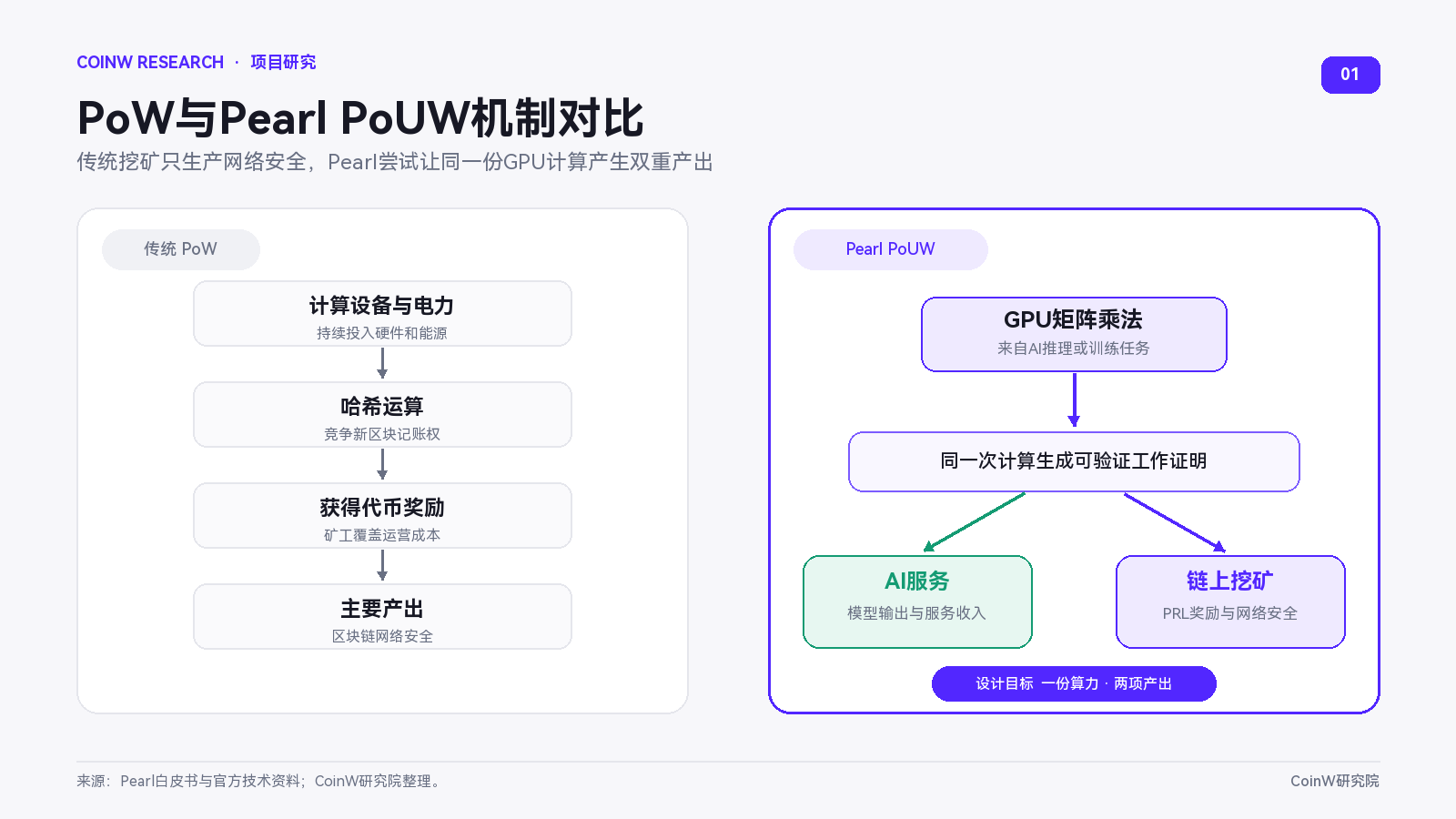
Figure 1. Comparison between PoW and Pearl PoUW mechanism. Source: CoinW Research Institute
3. Partnering with Together AI, Pearl Uses Mining Revenue to Reduce AI Inference Costs
The true value creation potential of a new mining mechanism ultimately depends on whether people are willing to pay for computing services. The partnership between Pearl and AI cloud service provider Together AI provides an early commercialization case. In May 2026, Together AI will launch the Gemma model service, which incorporates Pearl's mining mechanism. When users call for AI models, the backend GPUs participate in Pearl mining while processing inference requests and have the opportunity to earn PRL block rewards. Together AI stated that it can leverage anticipated mining revenue to subsidize computational costs, with price discounts for the related model interfaces exceeding 25%. The attraction of this model is straightforward. Traditional AI cloud platforms need to rely on fees charged by customers to cover GPU purchasing, electricity, and operational costs, while after integrating Pearl, the same set of GPUs stands to gain an additional source of token revenue. As long as the mining revenue exceeds the additional costs, service providers can lower inference prices to attract customers or increase their profits. It’s important to note that the 25% price discount comes from token revenue subsidies, which does not mean that the actual computational costs of GPUs have decreased by 25%.
Pearl hopes this will create a cycle of growth. Lower inference prices attract more customers, and real demand growth spurs more GPUs to integrate, thereby expanding network computational power and enhancing blockchain security. If ecosystem development further drives PRL demand, miner earnings could also increase, attracting more computational power to join. However, whether this cycle can be sustained still depends on the scale of real business and mining revenue. When PRL prices are high, service providers may gain greater subsidization; if the coin price drops and mining difficulty increases, the rewards obtainable for each unit of computational power may shrink, weakening price advantages. The collaboration with Together AI indicates that Pearl has found a way to embed mining rewards into real AI services, but there remains a gap before forming a mature commercial loop. Future growth will require more paying customers, stable inference requests, and sustainable service revenues to demonstrate that this model possesses long-term competitiveness.
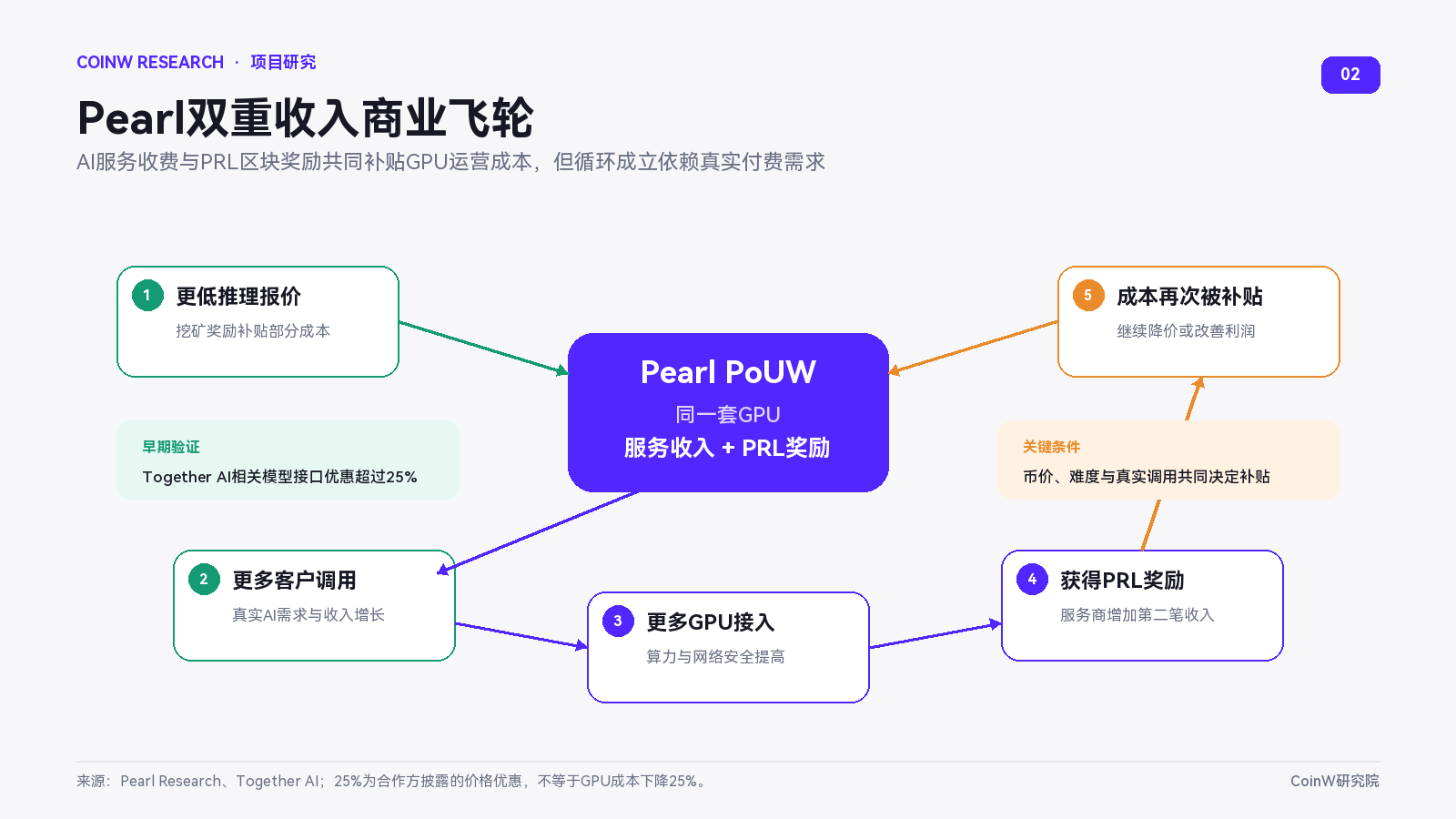
Figure 2. Pearl's dual income commercial flywheel. Source: CoinW Research Institute
4. Controversies Around PoUW Mechanism: AI Computing May Just Be Another Form of Mining
The most intriguing aspect of Pearl is its aspiration to make mining power genuinely serve the AI industry. However, this also raises the project's biggest controversy. Just because miners complete matrix calculations commonly used in AI does not mean these computations genuinely come from AI clients, nor does it imply that anyone is willing to pay for them. If the matrix computations performed by GPUs stem from genuine AI model requests, service revenue could arise; if they are merely tasks generated by miners to earn PRL rewards, it essentially remains mining for the sake of mining. An independent paper studying Pearl's cuPOW protocol highlighted this issue. Researchers found that miners could randomly generate matrices and submit valid proof of work without needing to run full AI models. Some mining software even lacked AI inference code yet could still participate in mining and earn rewards. This suggests that what Pearl is primarily verifying is whether miners have completed the specified calculations, not whether these calculations have been utilized by genuine customers.
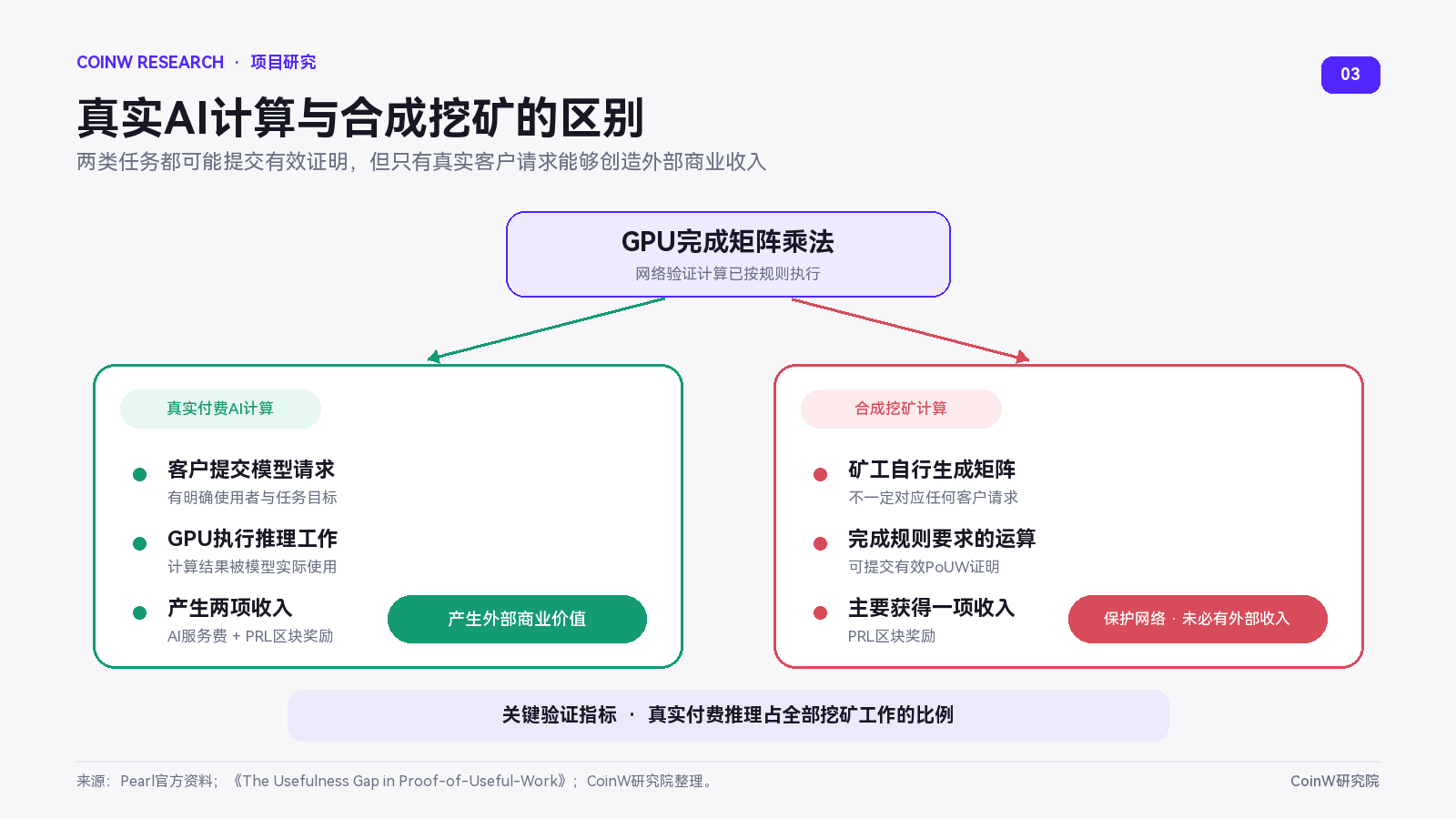
Figure 3. The distinction between genuine AI computations and synthetic mining. Source: CoinW Research Institute
Of course, this does not imply that Pearl's technological innovation lacks value. For PoW public chains, calculations that meet security requirements and can be efficiently verified are useful for maintaining network security. Pearl's breakthrough lies in making mining calculations compatible with AI workloads, providing a basis for integrating real inference tasks into mining. However, facilitating integration into real businesses and ensuring that the entire network's computing power is creating commercial value are still two different matters. If a large number of miners are merely generating matrix tasks to earn PRL, Pearl's economic model will still closely resemble traditional mining. The network incentivizes miners through token issuance, while miners may sell rewards to cover their equipment and electricity expenses. Only when more computing originates from the paying requests of businesses and developers will the dual income model truly realize its advantages. Therefore, evaluating Pearl cannot solely focus on coin prices, network computational power, and miner counts; it’s crucial to consider how much of the power genuinely generates revenue. The project needs to further disclose the proportion of real inference tasks to total mining work, as well as data on paying customers, model call volumes, and service revenues. Otherwise, it will be difficult for outsiders to determine whether network growth truly derives from AI demand or from the influx of mining power following a coin price increase.
Moreover, even if real business can grow, Pearl must still compete with traditional cloud platforms in inference speed, service stability, and long-term price advantages. If it loses competitiveness after reducing PRL subsidies, the sustainability of the business model will be challenged. Pearl has already demonstrated a technical path for involving AI computation in blockchain mining but still needs to prove that these computations can consistently meet real customer needs. Without stable paid business, even a large network could merely be a traditional mining field that has switched to a different computational method.
5. Approximately 1 Million New PRL Tokens Issued Daily, Continuous Mining Selling Pressure Tests $4 Billion Valuation
Pearl's business prospects must ultimately withstand the scrutiny of the token market. Even if real AI business can grow, investors still need to clarify how PRL is issued, how much new supply will be generated in the future, and whether the value of the business can be effectively transferred to the token. The maximum supply of PRL is 2.1 billion tokens, with no common pre-mining for teams or reserved shares for VCs, and the token is mainly issued gradually through mining. Unlike Bitcoin, which halves approximately every four years, PRL adopts a smooth declining issuance mechanism, with block rewards gradually decreasing over time. According to the official design, about half of the token supply will be released in four years. This arrangement mitigates the risk of concentrated unlocking by teams and institutions, but a lack of unlocking pressure does not mean there is no selling pressure. Miners need to pay for GPUs, electricity, and operational costs, and may continue to sell PRL to maintain operations. According to estimates from third-party platforms, approximately 1 million PRL are newly issued daily. At a calculation of $1.8, this corresponds to about $1.8 million in new token value daily. Although new issuances do not equate to all being sold immediately, if market buying pressure is insufficient, the ongoing release of supply may still suppress the coin price.
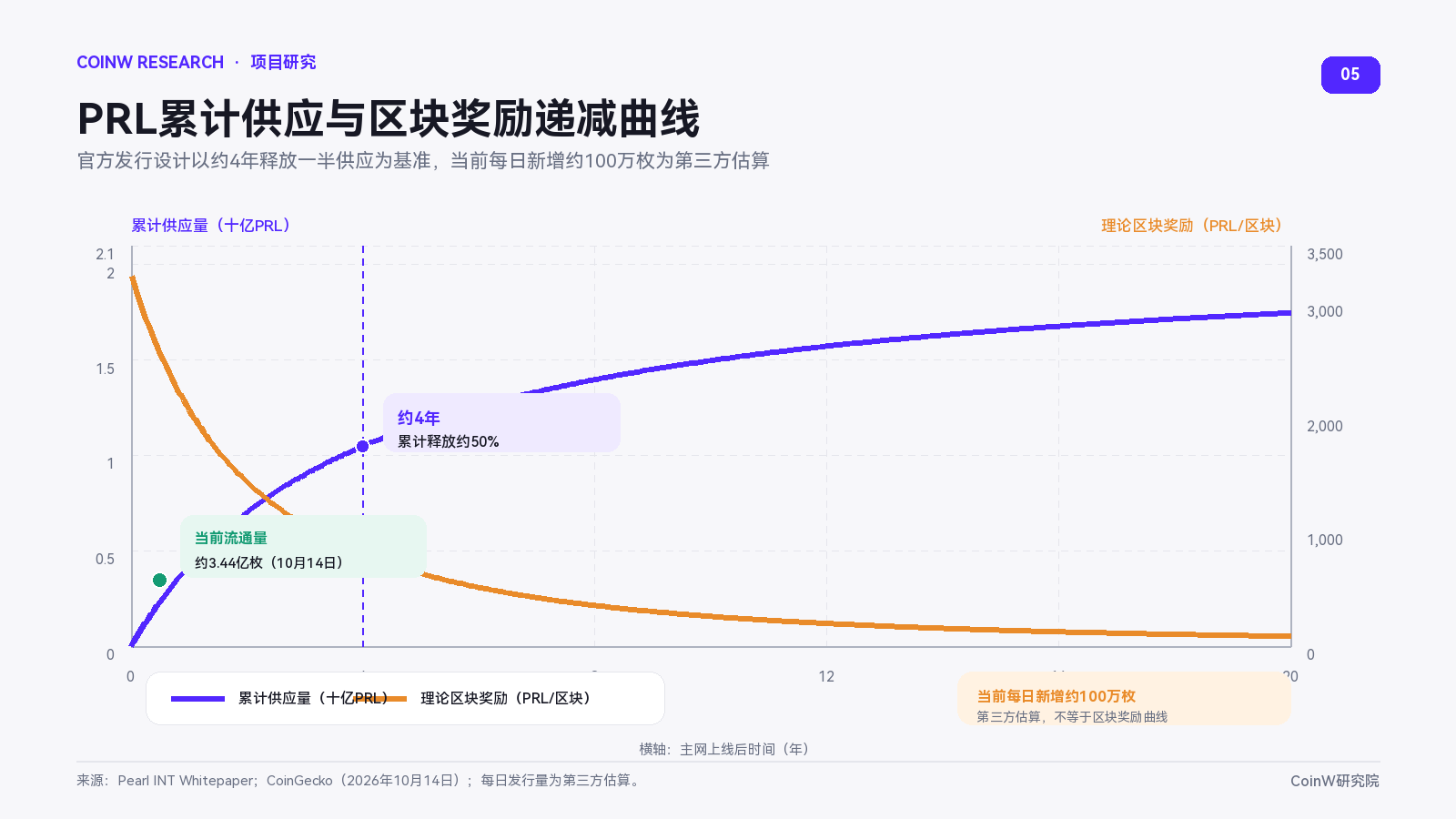
Figure 4. PRL supply growth versus decreasing block reward curve. Source: CoinW Research Institute
As of October 14, the circulating supply of PRL was approximately 344 million tokens, accounting for 16.4% of the maximum supply of 2.1 billion, with a circulating market value of approximately $650 million, and an FDV close to $4 billion. The gap between the two reflects the current circulating supply's difference from the future maximum supply scale. A lower circulation ratio may amplify short-term increases, but as more tokens enter the market, existing prices will face continued testing. Furthermore, a lack of pre-mining does not imply that chips are naturally dispersed. During the early stages of the Pearl mainnet launch, mining difficulty was relatively low, and some early miners may have accumulated significant amounts of PRL at lower costs. Therefore, early miner holdings, exchange inflow volumes, and mining pool power concentration are all important indicators to assess potential selling pressure.
It is even more crucial to focus on PRL's value capture mechanism. Currently, PRL primarily serves block rewards and network incentives and does not represent a computational credential that can be directly exchanged for GPU usage time. The inference fees paid by AI clients do not automatically convert into PRL buying pressure. Even if Pearl serves more AI clients in the future, the token must establish clearer demand sources to continuously share the economic value generated from ecosystem growth. Thus, the nearly $4 billion FDV actually contains two layers of expectations. On one hand, the market anticipates Pearl to expand its real AI computing business; on the other hand, it expects these businesses to ultimately support long-term demand for PRL. If business growth cannot translate into token value while mining supply continues to rise, the current valuation may face a repricing.
6. Pearl's Commercial Potential and Valuation Risks
Pearl has notable technological differentiation and preliminary commercialization cases, but current market pricing significantly exceeds verifiable business outcomes. PRL's short-term strong rise reflects investor optimism regarding AI computing mining, while an FDV close to $4 billion indicates that the project needs to realize growth more rapidly. Future focus should be on two directions. On the business side, validating the proportions of real paying inference, customer growth, and the sustainability of service revenues; on the token side, observing new mining supply, changes in miner holdings, and whether PRL can establish a more explicit value capture mechanism. If real business growth can gradually reduce dependence on token subsidies and form stable token demand, Pearl's long-term valuation might receive stronger support. From an investment perspective, PRL combines growth potential in an emerging sector with the volatility risks associated with low circulation and high valuation. Especially after recent significant price increases, overextending market expectations, continuous selling from miners, and insufficient liquidity could trigger price corrections. Pearl has proven that it can attract market attention; the next stage is to demonstrate whether commercial revenue and token value can truly keep pace with market expectations.
References
1. CoinGecko | Pearl Research (PRL) price, market value, and circulating supply data: https://www.coingecko.com/en/coins/pearl-research
2. Together AI | Together AI Partners with Pearl Research Labs: https://www.together.ai/blog/together-ai-partners-with-pearl-research-labs
3. Pearl Research Labs | Pearl INT Whitepaper: https://pearlresearch.ai/research/int-whitepaper
4. Pearl Research Labs Official website: https://pearlresearch.ai/
5. Pearl docs: https://platform.pearlresearch.ai/docs
免责声明:本文章仅代表作者个人观点,不代表本平台的立场和观点。本文章仅供信息分享,不构成对任何人的任何投资建议。用户与作者之间的任何争议,与本平台无关。如网页中刊载的文章或图片涉及侵权,请提供相关的权利证明和身份证明发送邮件到[email protected],本平台相关工作人员将会进行核查。