Author: Raoul Pal (Founder of Global Macro Investor, Co-founder of Real Vision)
Translation: Deep Tide TechFlow
Deep Tide Introduction: In 2014, Raoul Pal first heard the idea of using blockchain as an "ownership ledger" at a closed-door seminar in the Cayman Islands, asserting that this was the biggest technological revolution since the internet. Twelve years later, this prophecy has a shorter name: "everything will become a token." But in his view, the real story is much broader than "trading Apple stocks on Sundays, with 24/7 settlements": when the most active participants in the economy are no longer humans but machines, tokens become the information carriers that machines can read, verify, price, and trade. Identity, contracts, attention, computing power, energy... everything can be tokenized.
The concept is correct, but the chain was chosen incorrectly
In May 2014, I had just moved to the Cayman Islands and thought the best way to "bless" my new home was to invite over twenty GMI (Global Macro Investor) members to Grand Cayman for what later became our first "roundtable" event. It was two days of intense intellectual collisions, filled with grand ideas. We discussed China's currency devaluation, the impending El Niño, and even listened to a presentation from someone in the gold custodial business: he proudly claimed that this system was designed for "paranoid macro investors" by "paranoid macro investors." That weekend was quite remarkable.
Later, a few long-term members stepped forward; they had invested in a small Bitcoin exchange in Singapore. By the time they sat down, they had completely overturned everyone's understanding in the room, including mine. As I walked out of the venue, I was convinced that what I had just heard was the biggest technological revolution since the invention of the internet, and I publicly expressed my views.
I thought they would promote payments or "digital gold," but instead, they stripped away the currency shell and clarified the essence of blockchain: a ledger. A ledger you can write anything on, with no custodian and no one able to tamper with it. I remember sitting there calculating what this meant, and when I got back to my desk, I wrote the following to my subscribers:
"Once you realize that anything can be recorded on top of Bitcoin, you gain a timestamped, decentralized proof of ownership over everything. Imagine a world where every insurance contract, derivative contract, real estate transaction, property ownership contract, purchase certificate, etc., can be stored in a decentralized manner. Bitcoin can label, record, and verify the ownership of every stock, bond, and security, as well as every derivative contract."
I referred to it as "the world's ownership ledger" and claimed it would replace the dark, under-capitalized, and repeatedly re-mortgaged custodial system that was entrenched at the core of financial decay at the time (I have the right to say that, as I spent my entire career within that system and knew how broken it was). It felt grand and new, and at the end of the article, I wrote a line that I would quote repeatedly in the years to come: "Bitcoin. I get it. Do you?"
Fast forward twelve years, this argument has a shorter name: everything will become a token.
To be honest, we had the right idea but chose the wrong chain. This did not happen on Bitcoin: Bitcoin ultimately excels at just one thing (a currency that cannot be devalued by anyone and has stayed in its own lane since). The idea of "the ledger of everything" migrated to chains designed for programmable contracts, where a token can simultaneously carry logic and ownership, and that is where the entire story unfolds.
However, in the following years, virtually nothing happened.
The exciting items on my 2014 list made no progress, as no one tokenized the real estate market, insurance contracts still lay in file cabinets, and the few real estate tokens that were actually issued mostly just sat there silently.
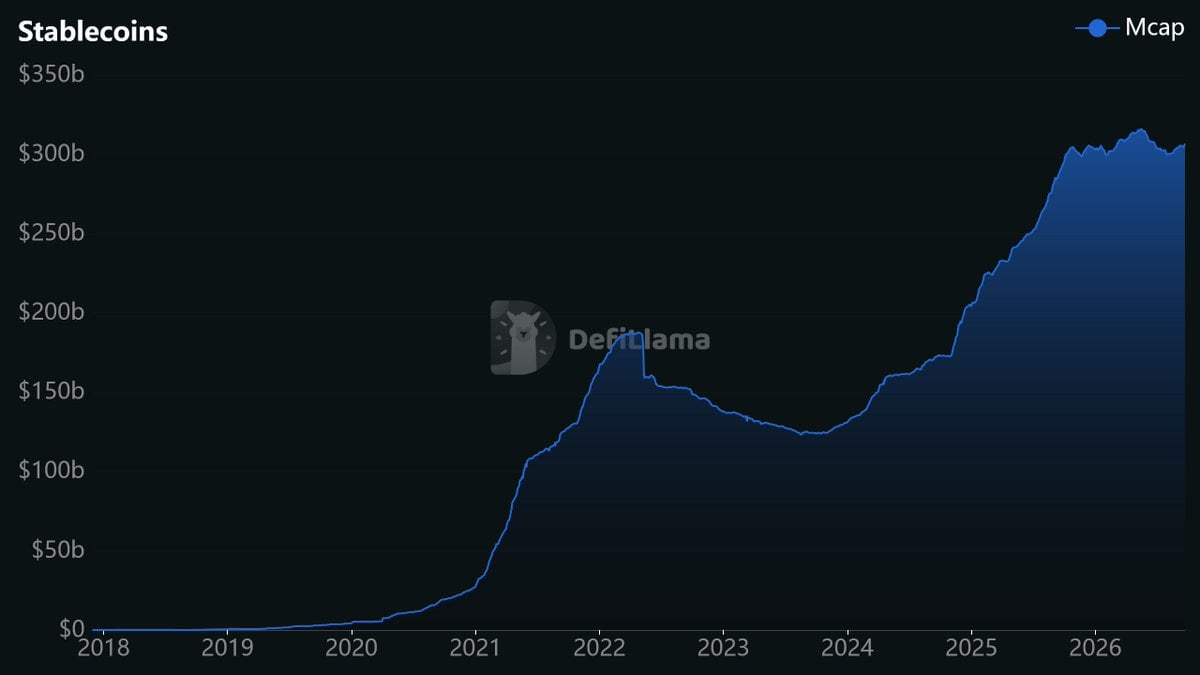
The first to move were the things no one was excited about: the dollar. A purely digital dollar on-chain, redeemable one-to-one, that anyone on earth can hold and transfer at a cost of less than a penny at any moment. As I write this, these types of assets on-chain total about $300 billion.
Where we stand today
Following the dollar, the next simplest thing is government bonds. And the story, from here on, is no longer just a crypto story.
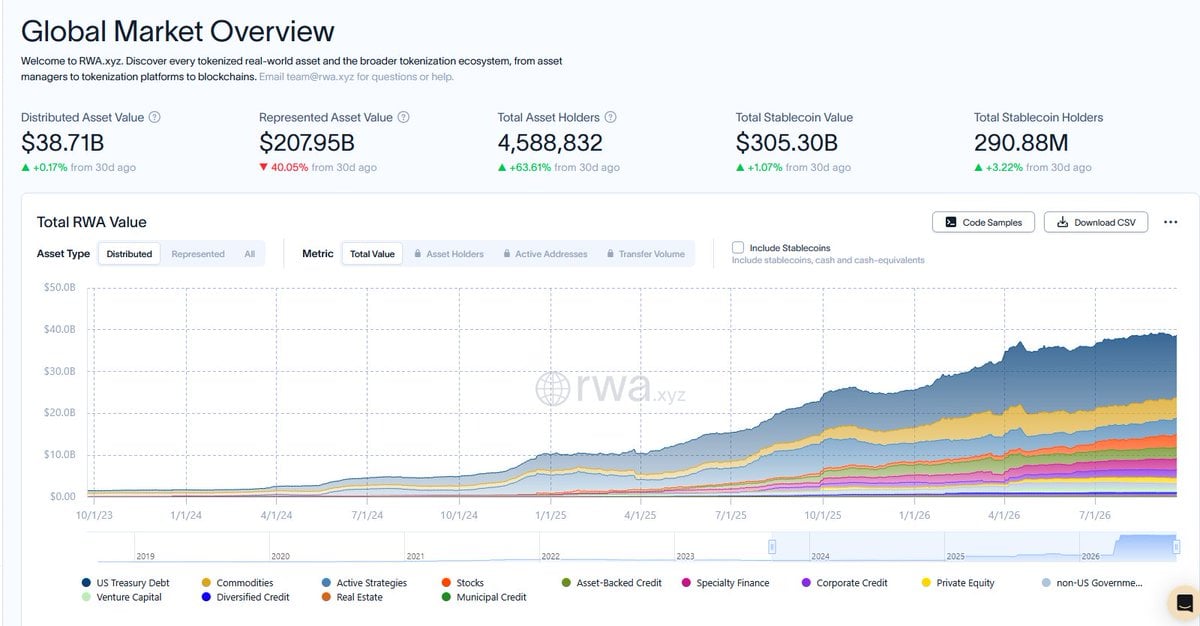
As of September 20, the tokenized U.S. Treasury funds are valued at about $14.8 billion; let’s look at who is issuing them: BlackRock, Franklin Templeton, JPMorgan, Fidelity, Invesco, WisdomTree, State Street, VanEck.
Stocks are next. By June 2025, both Robinhood and Kraken launched 24/7 tokenized trading of U.S. stocks; Robinhood also allowed European customers to hold tokens tracking private companies, including SpaceX and OpenAI. Nine months later, regulation caught up with the market. In March, the SEC approved Nasdaq's rules allowing securities to be traded in tokenized form, with the Depository Trust Company (DTC) minting the tokens; the New York Stock Exchange's own rules were approved a month later. Nasdaq plans to operate on a 23-hour trading day starting December 6. Stripe's own blockchain, Tempo, is built for stablecoin settlements, with Visa, Mastercard, Shopify, Klarna, and UBS among its partners.
This is the real "Real World Asset (RWA) wave," worthy of the hype. Think about what it means for finance: a market that never closes. Settlements changing from days to seconds. Assets carrying their own rules, so bonds can automatically pay interest and funds can self-rebalance. A twenty-year-old in India, who has never had a channel to buy Apple stocks, can now hold a small piece with just a smartphone. Every company can reach every saver on earth, while each saver can reach the best companies globally. For a country (most countries) burdened with substantial outstanding debt, this is strategic.
And everything is just beginning. That $14.8 billion in tokenized government bonds is facing a $31 trillion stock of outstanding debt, accounting for less than five-thousandths of it. The total of all non-stablecoin tokenized assets is slightly above $30 billion. The world's largest balance sheet has determined that the direction of the financial system is here, and it has only taken a step that is practically negligible.
Your imagination is too limited...
But most people's imagination stops at the market. Faster settlements, longer trading hours, lower thresholds. Treating tokenization as an upgrade of financial pipelines. The industry uses the term this way, and that’s why the whole thing has been categorized under "real-world assets," as if the interesting question is simply "what existing assets will be wrapped next."
This way of thinking is too small. Trading Apple stocks on Sundays is a nice thing, but it is not the meaning of the existence of "the ledger of everything."
What is a token exactly?
Back to what I saw in the Cayman Islands. Blockchain records everything, so the key question is what this "everything" really is, which means we should ask what exactly a token is.
A token is a piece of information that a machine can read, verify, price, and trade, without asking humans. It just happens to be a good container for dollars or stocks, so dollars and stocks went in first. But it's just a container; the container does not care what is inside.
In all of human history, we have only quantified value on a very narrow set of things: money, and our claim to future money: securities. Our systems were built to record and trade these because these are what humans value in measurable forms relative to others. So when a new ledger appears, we place money and securities onto it. Of course, we would do this.
We are now building an economy where the most active participants are not human. This is the core of my "index age" framework, which I have written about here before and has been included in my upcoming book (out on November 3, now available for pre-order). The world's financial system has a human interface, but these new participants are not human. I anticipate that within five years, agents will double the number of users in the internet, crypto, and AI themselves. Billions of new residents will arrive simultaneously, and they will not be able to use anything we have built.
An agent does not value money and securities the way you do. What agents need is information: who you are, if you are allowed to do this, what its cost is at this moment, who owns that thing, and whether it is true. In the machine economy, information is value, while money is just one of thousands of types of information.
Everything means everything
Starting with identity, because everything else depends on it. Every person and every agent in this economy needs a machine-verifiable credential. For humans, the first question is proving that you are human. AI can now browse, buy, swipe, sign; every business built on the assumption of "click to identify" is discovering that this assumption has failed. The answer is a "human identity proof" that you hold in token form, built on zero-knowledge proofs: allowing you to prove something about yourself without revealing the information itself. Thus you can prove you are over eighteen without revealing your birthday or prove you passed KYC without submitting your passport. It has entered mainstream products: World (whose team was on my podcast last summer) had verified about 18 million human users by this spring, integrating with Zoom, DocuSign, and Tinder.
Agents also need the same thing from the other side. Every agent must prove: who is executing this economic action, for whom it is executed, and by what authority. Multiply this scale of billions of agents, with thousands of calls every hour, and the identity layer alone represents an astounding magnitude. Identity is the key that unlocks everything that follows and is one of the least discussed markets I know.
Next are contracts: the very item on my 2014 list that has finally landed. A ticket is a contract between you and the venue. A booking is a contract with a hotel. An insurance policy, a warranty, a car maintenance record, permissions to enter a building or read a document, are all contracts. Each one is a commitment attached to a certain identity, and a token is a commitment that a machine can verify in milliseconds, attached to a certain identity. Real estate will eventually also land here, once every registry on Earth reaches an agreement on "what constitutes a deed."
Then there is attention, which is completely beyond finance at this point. In a world where machines can generate infinite content, human attention is the only thing that remains scarce, meaning it is the only thing that still holds value. Today, you "rent" your audience from platforms, which set the rules and take the profits. Tokens allow creators, musicians, and communities to own the networks they build, rather than renting from platforms. Moreover, it is not just about creators. What you watch, what you know, the data your body generates: every form of human attention can become a token that you own and profit from. People have calculated the "ad revenue sharing with users" and found the amounts very small. This severely underestimates it, as they are measuring human attention using units from the old economy. In the new economy, when machines have taken over the work, this is one of the answers to "how do people earn income."
Then there are the raw inputs of the machine economy itself. Every agent consumes energy, computing power, and data. Energy feeds computing power. Computing power produces information and attention. Information and attention are refined into intelligence. Every layer relies on the one below it, and the higher you go, the higher the unit value. As the number of agents multiplies, every layer will be tokenized so that machines can buy and sell from each other at machine speeds. A kilowatt-hour becomes a token. A second of GPU time becomes a token. A dataset becomes a token: this is the newest emerging market because, prior to this, there were no buyers.
And I want you to pay attention to one thing here: you are already living in a tokenized economy. It's just centralized. Salesforce is a token factory: it extracts vast amounts of proprietary data into information and sells it back to you. Alphabet and Meta are token factories and also markets for attention. The largest trading exchange group in the world, ICE, is both a token exchange and sells the data of the tokens it trades. These companies are worth trillions because they own both factories and markets, while you own neither. What is changing now is that factories and markets are moving toward openness, built on tracks owned by no one, and tokens can be held by anyone, including those who produce the data and attention.
This is the true meaning of the index age. Every bit of information about everything in the world, about every person, becomes a unit that can be owned, priced, and exchanged. The "ledger of everything" I saw in 2014 isn’t a ledger for humans to keep better accounts. It is an operating system designed for an economy that has yet to be born. If you want to dive deeper along any of these threads: identity, attention, computing power market: this is precisely the rationale behind my building raoulpal.ai. It is trained on everything I have written (including this book) and will challenge you, as well as help clarify these concepts.
The measuring stick is melting away
Putting all of this together, you will arrive at a place where financial narratives have never set foot.
We are about to have an economy like this: billions of non-human participants creating, trading, and consuming value at machine speeds, using units that were never designed to count for humans. Most of this activity will occur in a layer that we cannot see directly. When one agent buys a second of computing power from another agent to verify a credential, enabling a third agent to settle a contract, no human receives compensation, no products are shipped, and there are no traces on payroll or receipts. However, value is created, priced, exchanged, and the ledger records it all.
Soon, the entire apparatus we have spent thousands of years building to score the "scarcity-based human economy" will no longer be able to describe reality because the economy it points to has become an ever-shrinking part of the existing economy. This is what I call the "Economic Singularity": the moment when the economy accelerates to a point where human-centric measurement methods can no longer keep up. The instruments fail to function because machines are running faster than the dials.
This part sounds frightening, but the collapse of a system built for scarcity is precisely the prerequisite for the birth of a system to replace it. When information itself becomes the most valuable thing in the economy, and every bit of it turns into a token that can be owned, a new form of wealth is emerging from things that never were assets. Your attention. Your identity. Your data. The computing power you can spare, the energy you can generate. For the first time in history, the raw materials of the economy have become things that ordinary people can produce simply by existing, and now there is a way to own it and profit from it, rather than letting platforms harvest it. Those who understood this early on will hold positions in the new economy that have no equivalent in the old economy.
And we have only just begun to imagine it. In 2014, we sat in that room thinking that putting property deeds on the ledger was the most exciting part. The truly interesting companies of the next decade will be built on things that no one in the room then could name, in markets that do not yet exist, priced with units we have not yet invented. The whole economy will be rebuilt from the ledger, along with the ways we value, price, and keep accounts for life itself...
This is the endpoint pointed to by The Everything Code. This book outlines the entire journey: the "demographic trap" we are in, how debt and currency devaluation arise from it, why exponentially advancing technology is the only way out, and why the "economic singularity" at the end is worth being optimistic about rather than fearful of.
The Everything Code is set to be released on November 3, and pre-orders are now open (https://lnk.to/everythingcode).
免责声明:本文章仅代表作者个人观点,不代表本平台的立场和观点。本文章仅供信息分享,不构成对任何人的任何投资建议。用户与作者之间的任何争议,与本平台无关。如网页中刊载的文章或图片涉及侵权,请提供相关的权利证明和身份证明发送邮件到support@aicoin.com,本平台相关工作人员将会进行核查。


