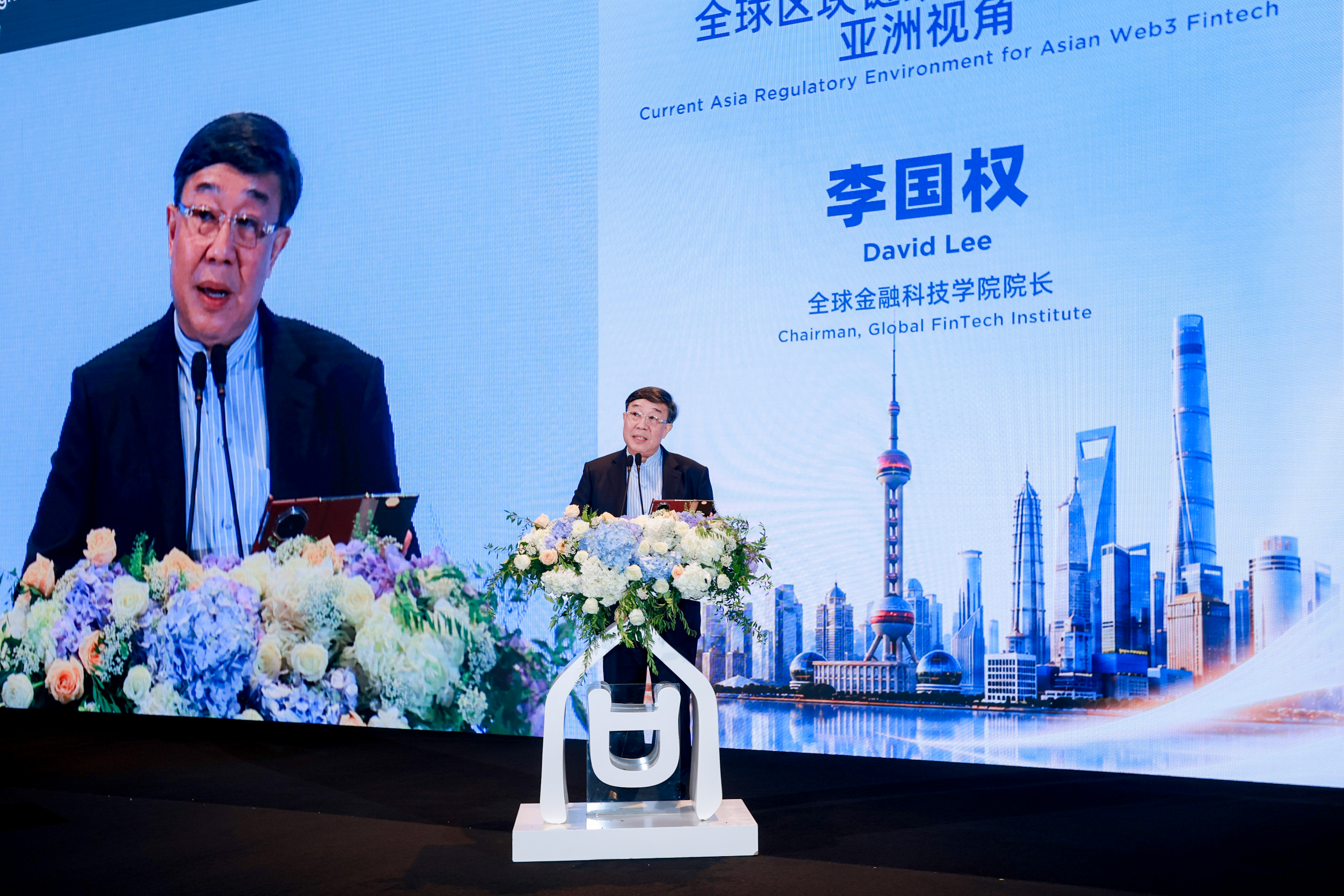
Good morning, distinguished guests and friends. Just now, John introduced the new changes in global blockchain policy from the perspective of the United States. I would like to shift the focus to Asia. Asia does not have a unified system, nor a common timetable. Mainland China, Hong Kong, Singapore, Japan, South Korea, and Southeast Asia each have different monetary systems, capital markets, and development goals. However, if we shift our attention away from token prices, we will see a clear common direction: discussions around regulation are shifting from "whether to allow cryptocurrencies" to "how to build trustworthy, settleable, and accountable digital financial infrastructure." This distinction is very important. Cryptocurrency regulation primarily deals with market boundaries and investor risks; digital financial infrastructure must also handle monetary policy, legal rights, liquidity, and cross-border connectivity. The former can limit operators through licensing, while the latter must enable multiple institutions and ledgers to work together. Today, I want to clarify that the real competition in Asia is not about who is the most permissive, but about who can integrate legal certainty, trusted currency, and final settlement into the same infrastructure.

Common Policy Shift in Asia
This shift manifests in four aspects. Market access is becoming increasingly permissive, with clear responsibilities assigned for issuance, trading, custodianship, and distribution. Stablecoin regulation places reserves, redemption, and asset segregation at its core. The institutional market brings funds, bonds, deposits, and real assets onto the blockchain. Cross-border connectivity requires payments, forex, and securities settlement to be coordinated. Why is connectivity particularly emphasized in Asia? Because the region's supply chains are long, there are many currencies, and there are significant payment needs from cross-border labor and small businesses. A token that operates only within a single institution may improve backend efficiency, but it is unlikely to generate societal value. Only with the capacity to connect bank accounts, securities registration, identity, and forex arrangements can technological advantages translate into lower costs and wider coverage. The systems in various places remain different, but the questions are converging: what can become an asset, what can become currency, and who is responsible for failures.
Complete Lifecycle and DvP PvP
In the past, when discussing blockchain regulation, we often only asked whether trading platforms have licenses. This is no longer sufficient. Regulation must cover issuance, trading, custodianship, settlement, and data. Particularly important are DvP, which refers to delivery-versus-payment, and PvP, referring to payment-versus-payment. DvP prevents one party from delivering an asset without receiving payment; PvP reduces principal risk in foreign exchange transactions. Suppose a fund purchases a digital bond on-chain. If the bond has been transferred but the cash does not arrive due to congestion in another chain, the parties involved are not facing a regular technical failure, but rather principal and legal risks. The same applies to foreign exchange transactions; if one currency is paid and the counterpart is delayed, the time difference creates credit exposure. Blockchain can enable synchronous execution of both actions, but regulators must still answer: do the assets on the chain represent legal ownership? Are payments made in stablecoins, tokenized deposits, or central bank currency? When is it considered final settlement? Can it roll back after a failure? Who bears the loss? Therefore, DvP and PvP are not deviations from the regulatory theme. They are precisely the reasons for the shift of regulation from license management to financial market infrastructure.
Singapore's Three-Layer System
What is most worth explaining about Singapore is not an individual project, but how the three layers combine. Project Guardian operates at the asset and product layer, promoting the tokenization of funds, fixed income, and foreign exchange, while exploring common standards. BLOOM operates at the settlement currency layer, testing how tokenized bank liabilities and well-regulated stablecoins support institutional trading. GL1 operates at the network and governance layer, researching shared ledgers, interoperability, policy autonomy, and enforceable compliance. It is important to clarify that BLOOM is not issuing a public stablecoin endorsed by the Monetary Authority of Singapore; GL1 is also not requesting countries to adopt the same chain.
Recently, Singapore took another step forward. On September 10, 2026, DBS, OCBC, and UOB completed the first real-time interbank transactions in Singapore dollars using tokenized deposits. The Swift blockchain ledger is responsible for coordinating payment information and matching and netting the tokenized deposit liabilities among the banks. However, final settlement is still completed through existing systems. Thus, this is not about blockchain replacing bank settlement, but rather a hybrid architecture: shared ledgers improve coordination and programmable processing, while existing systems continue to provide final settlement. Swift Ledger is not part of Guardian, BLOOM, or GL1, but it provides an interoperative example that has already entered real-time transactions. Regulation here is not just about approving projects, but also determining what constitutes regulated bank liabilities, when finality occurs, and who is responsible in the event of a failure.
Singapore Stablecoin Consultation
This also explains why Singapore is seeking public opinions on stablecoins again in September 2026. In 2023, the Monetary Authority of Singapore established the policy principles of a single currency stablecoin framework. This time it is not a complete overhaul, but rather writing the framework into the Payment Services Act. The consultation proposes a new stablecoin issuance license, where only licensed issuers and their products may use the term "MAS-regulated stablecoin." Issuance activities include not only minting but also circulation, reserve management, and redemption at face value. Reserves must cover at least the circulating face value and be isolated in a trust manner, subject to proof and audit. New recommendations also strengthen arrangements during times of stress, including testing reserves and redemption mechanisms at least quarterly, allowing the Monetary Authority to require additional capital or liquidity buffers, and requiring board approval for recovery and orderly exit plans. Why are these changes relevant to blockchain policy discussions? Because the credit of on-chain markets ultimately depends on the cash leg. If holders cannot redeem in a timely manner under market stress, so-called atomic settlement only completes bookkeeping on the chain, and the entire system may still face runs and liquidity breaks. The consultation ends on October 16, 2026. Since the consultation is ongoing, the current stage pertains to proposed amendments, and the relevant systems have yet to come into full effect. Its policy significance is very clear: stablecoins are transitioning from crypto products into prudentially regulated on-chain settlement liabilities.
Hong Kong
Hong Kong is taking a different path towards a complete market. In June 2025, the Digital Assets Policy Declaration 2.0 pushed the LEAP framework for legal, tokenized products, and applications. On August 1, 2025, the Stability Coin Ordinance came into effect, and the issuance of fiat stablecoins entered a licensing system. Meanwhile, Project Ensemble and the later EnsembleTX are testing the actual settlement of tokenized deposits and tokenized assets. The characteristic of Hong Kong is the gradual connection of licenses, assets, and currencies. If on-chain bonds ultimately have to revert to the segmented and slow traditional cash system, the efficiency of tokenization will be limited. Hong Kong is trying to bring assets and settlement currencies into a regulated environment simultaneously. This also transforms DvP from a technical demonstration into a legally enforceable market arrangement. The comparison between Hong Kong and Singapore is also quite interesting. Hong Kong establishes legal anchors with its codified stablecoin ordinance and market licenses, while Singapore creates a blend of technology and regulation through institutional projects, common standards, and proposed amendments. The paths are different, but both aim to answer the same question: what trustworthy currency completes the delivery of on-chain assets.
Japan and South Korea
Japan and South Korea represent a path where traditional financial laws gradually absorb crypto assets. Japan already has a system for stablecoin issuance and intermediation, with further policy discussions involving disclosure, market manipulation, insider trading, and tax systems. South Korea has established a foundational first phase with the "Virtual Asset User Protection Act," while the second phase continues discussions around issuance, disclosure, and stablecoins, progressively opening up to institutional participation according to a roadmap. Once corporations enter the market, custodianship, accounting, auditing, and board responsibilities will become increasingly important. Both countries are moving in a similar direction: regulation is increasingly focused on economic function rather than just technical nomenclature. This reflects the principle that "same activity, same risk, same regulation." Tokens that take on investment functions must face market manipulation and insider trading rules; those that assume payment functions must address reserves, redemption, and payment safety. However, some of these reforms are still under discussion or being advanced and represent policy direction rather than fully effective laws at this stage.
Mainland China and Hong Kong
Understanding Asia also requires recognizing the division of responsibilities between Mainland China and Hong Kong. The Mainland continues to restrict cryptocurrency trading and mining while developing the digital renminbi, supply chains, trade documents, and trustworthy data infrastructure. Hong Kong, on the other hand, is building a licensed virtual asset market, serving as an interface between international capital and Asian applications. A more accurate description is not one being open and the other prohibitive, but rather how the two regions handle technological applications, monetary sovereignty, and international market connections under different risk boundaries.
Cambodia, Thailand, and Indonesia
Within ASEAN, there are also three representative paths. Cambodia prioritizes the construction of public payment infrastructure. Bakong and KHQR services promote financial inclusion, domestic connectivity, and cross-border QR code payments; new crypto asset regulations are only limitedly open to some asset-backed services, maintaining strict restrictions on unsupported crypto assets. Thailand adopts a regulatory sandbox approach. TouristDigiPay allows tourists to convert digital assets into Thai baht through licensed institutions, but merchants still receive baht. Thus, it tests controlled conversion, not turning cryptocurrencies into legal payment tools. G-Token demonstrates that the government is also exploring digital capital formation, but it is different from general unsupported cryptocurrencies. Indonesia moved regulatory responsibilities from commodity regulatory authorities to OJK in 2025, bringing crypto assets under financial services regulation; however, it still insists on using the rupiah in the payment sector. The shift in regulatory authority appears to be an administrative arrangement, but it actually changes policy logic: crypto assets begin to be governed with consumer protection and market conduct regulations as financial assets. In short, Cambodia builds the track, Thailand tests its applications, and Indonesia redraws regulatory boundaries.
Other Markets and Regional Comparisons
Other Asian markets I will briefly touch upon. Vietnam has begun to legally recognize digital assets and pilot control market entry. The Philippines focuses on licensed service providers, travel rules, and consumer protection due to strong remittance and financial inclusion needs. Malaysia manages trading platforms and digital asset issuance through the Securities Commission and explores integration with local capital markets and Islamic finance. Türkiye has clearly incorporated trading and custodianship into capital market licensing and anti-money laundering systems. These cases collectively illustrate that growing markets is not simply about seeking openness, but rather adopting a combination of "access with usage restrictions." Regional convergence occurs in reserves, redemption, custodianship, anti-money laundering, governance, and final settlement, rather than forming the same law.
Four Infrastructure Interfaces
The next phase of competition focuses on four interfaces. The first is money: how do stablecoins, tokenized deposits, and wholesale CBDCs maintain equivalence, redeemability, and final settlement? The second is assets: how do on-chain records represent legal rights and achieve bankruptcy isolation and effective delivery? The third is identity: how do KYC and verifiable credentials satisfy regulation while avoiding unnecessary disclosure of all personal information? The fourth is rules: investor qualifications, holding limits, and geographic requirements can be written into smart contracts, but upgrades, disputes, and emergency pauses still require governance. All four must be established simultaneously. Only having identity without privacy will not inspire user trust; only having smart contracts without error correction and dispute mechanisms will deter institutions from taking on large risks; having tokenized assets without a secure cash leg will still fail to complete final delivery. True network effects come from the interoperability of these four layers. The task of regulation is to ensure they remain trustworthy in times of stress, rather than merely functioning in demonstration environments.
Conclusion
Finally, I present three assessments. First, stablecoins will become the intersection of monetary sovereignty and on-chain settlement. It relates to who can issue monetary liabilities, how currencies are valued, and who provides liquidity in times of stress. Second, the main bottleneck for tokenization is not the speed of the blockchain, but legal rights, trusted currencies, finality, and liquidity. Twenty-four hour trading will not automatically create buyers, nor will it automatically solve issues of bankruptcy isolation and cross-border legal conflicts. Third, Asia will not unify legislation, but will gradually form regional connectivity through common standards, payment networks, and institutional platforms. Legal unification may not be realistic, but interoperability is very necessary. For policymakers, the focus should be on holding innovation accountable; for market participants, the focus should be on confirming whether assets are real, whether settlements are final, and whether customers are protected. Asia's advantage lies in the ability of diverse systems to parallelly experiment, while the risk is network fragmentation. If we can establish common technology and risk standards while retaining policy autonomy, Asia may become an important experimental ground for the next generation of digital financial infrastructure. Let me conclude with a question: are we merely regulating a new class of assets today, or are we collectively designing a next-generation financial market that can stand in the realms of code, law, and currency? Thank you all.
Core Sources and Links
MAS P015-2026 stablecoin consultation:https://www.mas.gov.sg/publications/consultations/2026/consultation-paper-on-proposed-amendments-to-the-payment-services-act-for-stablecoins-regulation
MAS stablecoin regulatory framework (2023):https://www.mas.gov.sg/news/media-releases/2023/mas-finalises-stablecoin-regulatory-framework
Hong Kong digital assets policy statement 2.0:https://www.fstb.gov.hk/fsb/en/publication/consult/doc/Policy_Statement_2.0_on_Development_of_Digital_Assets_in_HK.pdf
HKMA Project Ensemble:https://www.hkma.gov.hk/eng/key-functions/international-financial-centre/fintech/project-ensemble/
Thai SEC TouristDigiPay:https://www.sec.or.th/EN/Pages/Shortcut/TouristDigiPay.aspx
National Bank of Cambodia cryptoassets Prakas:https://www.nbc.gov.kh/english/legislation/prakas_detail.php?id=183
OJK digital financial asset regulation:https://ojk.go.id/en/regulasi/Pages/Licensing-of-Financial-Sector-Technological-Innovation-Organizers-Digital-Financial-Assets-and-Crypto-Assets.aspx
FSB crypto-asset recommendations:https://www.fsb.org/2023/07/high-level-recommendations-for-the-regulation-supervision-and-oversight-of-crypto-asset-activities-and-markets-final-report/
免责声明:本文章仅代表作者个人观点,不代表本平台的立场和观点。本文章仅供信息分享,不构成对任何人的任何投资建议。用户与作者之间的任何争议,与本平台无关。如网页中刊载的文章或图片涉及侵权,请提供相关的权利证明和身份证明发送邮件到support@aicoin.com,本平台相关工作人员将会进行核查。


