Authors: Katherine Long, Caitlin Ostroff, Neil Mehta
Translation: Chopper, Foresight News
In February of this year, a warning message came from an organization that handles debit card transactions for Polymarket's U.S. betting platform: a large number of fraudsters were flooding the platform.
The criminals were linking stolen debit cards to Polymarket US accounts, using these accounts to place bets and then withdrawing the funds to clean bank cards or accounts under their control, attempting to abscond with at least $10 million.
During the incident, the payment institution determined that over 80% of the deposit transactions were fraudulent, a figure far above the industry standard of about 1%. Insiders reported that Polymarket employees promptly reported this risk to CEO Shayne Coplan. The compliance team recalled that Coplan's response shocked them: just continue to expand, if regulators find issues, they can just pay the fines.
Current and former employees of Polymarket indicated that this previously undisclosed statement reflected Coplan's business approach for Polymarket—seeking growth at any cost.
Current and former employees and investors interviewed by the Wall Street Journal stated that the flourishing company was fully committed to attracting new users and investors, during which compliance gaps, legal disputes, and software failures emerged consecutively. Insiders noted that after the attack in February, while the platform's fraud rate did not return to 80%, it remained high for several consecutive months. Numerous executives left after the incident, and the company initiated an internal investigation.
Former regulators from the Commodity Futures Trading Commission (CFTC), the Justice Department, and the IRS remarked that the breadth of the fraud attempt and Polymarket's response were rare in the commodities and gambling sectors. Unlike traditional commodity exchanges, Polymarket directly accepts retail funds, making it more vulnerable to fraud attacks. Former CFTC law enforcement attorney Joe Konizeski stated, "In regulated areas, such things don't happen. Professionals manage client funds to ensure compliance in both the source and the disposal of funds."
A Polymarket spokesperson stated that the company is committed to maintaining an accurate, fair, and transparent market and actively cooperating with regulators and law enforcement. "Our market integrity mechanism includes processes for detecting, verifying, and addressing suspicious activities."
Polymarket is facing an increasing number of legal lawsuits in various aspects. The Commodity Futures Trading Commission has filed a lawsuit against it, and insiders revealed that the company has informed employees to retain records related to this fraud attack and other matters. The New York City Council is conducting a broad investigation into Polymarket and other prediction market platforms, with nearly twenty traders filing lawsuits alleging deceptive business practices by Polymarket.
Meanwhile, more than a dozen state lawsuits are focused on a core issue: whether Polymarket and its competitors like Kalshi qualify as unlicensed gambling platforms. The ruling outcomes of these cases may reshape the entire industry landscape.

Polymarket CEO Shayne Coplan urged employees to maintain the company's rapid growth pace.
As legal risks continued to accumulate, Coplan was advancing a round of $1 billion financing, after which the company's valuation was about $21 billion. 1789 Capital, an investment fund under Donald Trump Jr., will participate in this round of investment; the fund had previously invested approximately $200 million in Polymarket.
Polymarket has a data partnership with Dow Jones, the parent company of the Wall Street Journal. Currently, the company is working to reshape its image to investors and the public as a mature enterprise pursuing balanced growth. Insiders revealed that since May, the company has gradually recruited experienced risk control personnel, including a former FBI agent, while improving compliance processes and optimizing product testing.
Insiders noted that by the end of June, Coplan visited the home of Omeed Malik, co-founder of 1789 Capital, in the Hamptons to discuss strategies for refining Polymarket's internal operational systems ahead of a potential IPO next year. Malik advised Coplan to hire more seasoned executives. Recently, Polymarket appointed its first Chief Financial Officer, Warren Jenson, who previously served as CFO at Amazon in the early 2000s.
Following a Wall Street Journal investigation into Polymarket's social media betting business, the company restructured its marketing team and hired the founder of electric scooter company Bird as its head of growth. Other marketing staff involved in social media marketing projects may have either left or had their responsibilities reduced.
A company spokesperson stated, "Polymarket is rapidly growing and making progress every day. We are proud of our newly appointed core management team and our continuously upgraded infrastructure, achieving business scalability at the forefront of finance, technology, and culture while maintaining responsible growth."
The 28-year-old Coplan is known for his frankness and assertiveness, having previously reprimanded employees in the office. Former employees reported that staff generally needed to work late hours, and the use of Adderall was quite common within the company. Multiple former employees indicated that Coplan consistently pressured engineers to iteratively add features to their list, with frequent changes in demands.
A recording reviewed by the Wall Street Journal revealed that last July, during a discussion about how to arbitrate betting result disputes, Coplan bluntly stated, "Come on, this is just stupid! You guys keep complaining about this little issue, it's utterly ridiculous."
Since reaching a settlement with federal regulators in 2022, Polymarket has been prohibited from opening its international platform to domestic U.S. users. In 2024, as Polymarket's visibility increased, two federal agencies began investigating to verify whether the company was violating the settlement agreement by allowing U.S. traders to access the platform.
Around the same time, an employee known for practical jokes set up a life-size cardboard cutout of the imprisoned crypto fraudster Sam Bankman-Fried, partially as a joke stemming from the resemblance between Coplan and Bankman-Fried, both billionaires in the crypto industry.

After being prohibited from opening the international platform to U.S. users, Coplan informed employees that they should prepare to re-enter the U.S. market.
Coplan urged the team to prepare for a return to the U.S. market. Polymarket is laying the groundwork for a domestic application and negotiating with regulators to resolve related investigations. Last summer, the company spent $112 million to acquire a licensed exchange, transforming it into Polymarket US.
Polymarket US opened to early users in December. Insiders revealed that a substantial number of traders flooded the platform, with total account deposits exceeding $500 million.
As one of the anti-money laundering safeguards, Polymarket US adopts standard financial exchange rules: funds must be deposited from a specific payment channel and withdrawals must return via the same channel. Without this rule, criminals could recharge using stolen debit cards and withdraw profits to clean bank cards after completing transactions.
Federal regulations do not mandate prediction markets to enforce this rule. Other brokerages and betting applications, including DraftKings and FanDuel, comply with this rule. Polymarket’s main competitor, Kalshi, does not enforce this rule, but insiders indicated that Kalshi checks cross-channel withdrawal activities and freezes suspicious payments.
Fraud Warning
In January this year, the trading volume of the Polymarket U.S. application accounted for only a small portion compared to the massive international platform: less than $300 million in betting volume, while the international platform exceeded $7.6 billion.
Despite the app still being in beta testing and available only to a limited number of users, Coplan hoped to minimize any friction in user experience. One of his primary demands: to ensure users could withdraw quickly. By February, Polymarket users’ Discord community was flooded with complaints about slow withdrawals. Staff explained to users that the funds were being processed, but compliance reviews could delay withdrawals for days or even weeks. The engineering failures of the U.S. application further exacerbated the withdrawal challenges.

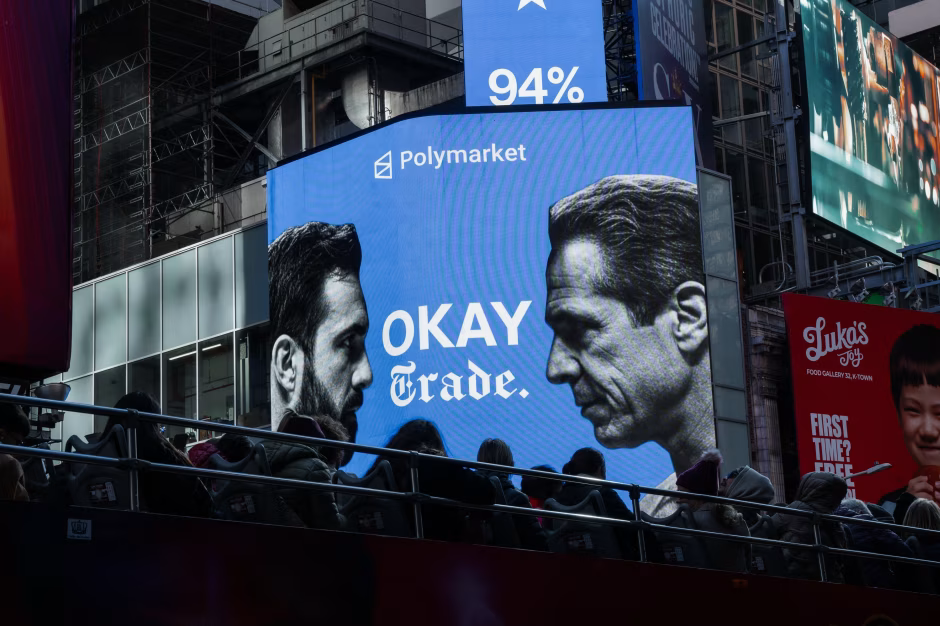
Before the November 2025 New York City mayoral election, Polymarket advertisements appeared on the streets of New York.
In February of this year, payment service provider Checkout.com informed Polymarket that fraudsters had launched an attack, linking stolen debit cards to thousands of new accounts. Insiders stated that most deposit attempts failed, and the attack primarily came from seven users, one of whom attempted to initiate about 4,000 deposit transactions. Checkout.com continues to collaborate with Polymarket but declined to comment on this incident or their partnership.
This attack overburdened the compliance team, and the backlog of withdrawal issues worsened. Insiders noted that in order to expedite user fund returns, company management decided to cancel the requirement for same-channel withdrawals, despite warnings from some employees that this move would open doors to money laundering activities. Executives believed existing protective mechanisms were sufficient to manage the risks.
A former federal prosecutor stated that failing to adequately control money laundering activities could violate federal anti-money laundering, illegal funds transfer, and even bank fraud laws. The CFTC and the Justice Department have initiated related lawsuits against various companies, including several crypto exchanges, with some fines reaching hundreds of millions of dollars. However, the anti-money laundering regulatory requirements applicable to Polymarket are relatively lenient.
Insiders disclosed that Polymarket US Chief Compliance Officer Andrew Clifford resigned after submitting a lengthy report detailing the fraud issues in April. Both Andrew Clifford and Polymarket declined to comment on his departure.
Around the same time, Polymarket completed a round of $1 billion financing, with the company’s valuation approaching $15 billion, including investment from Donald Trump Jr.'s fund.
Shortly thereafter, Polymarket fired CEO Justin Hertzberg for its U.S. division, followed by the departure of the head of U.S. regulation and the head of anti-money laundering. Justin Hertzberg did not respond to requests for comments. Insiders indicated that the investigation conducted by the law firm Sullivan & Cromwell concluded that the company's operations complied with regulatory requirements.
One insider stated that by May, through limiting the number of debit cards that could be linked to one account and introducing a new anti-fraud service provider, Riskified, the platform’s fraud rate had fallen back to normal industry levels.
Controversial New Market
Polymarket is also working to address various issues caused by hastily launching new features. Former employees revealed that the company often rolled out updates with insufficient testing to users. When engineers raised objections and suggested prioritizing existing platform bug fixes, Coplan sometimes had engineers directly use AI to develop new features.
A New York man stated that after the platform application crashed in July, his $950 disappeared from his account. A California woman claimed that $1,500 had been unable to be withdrawn from her account. A 22-year-old user from Massachusetts reported that his account was locked, and after dozens of attempts to reach customer service with no response, he waited weeks without hearing back from the company.
Insiders noted that Polymarket had compensated some customers who suffered losses; other customers had cooperated with banks to recover unauthorized funds. Additionally, the company has recently improved its code review process and hired more engineers.
Coplan has pushed the team to launch a significant number of controversial new prediction markets. Text messages reviewed by the Wall Street Journal indicated that he had suggested establishing such markets: "How many times will Kanye mention Jews on X platform this week?" and "Who will Elon insult next?". These markets ultimately did not go live. In June, the company filed a trademark application for "Create Your Own Market." Former employees stated that this is part of Coplan's long-term strategic growth plan aimed at allowing users to freely create prediction markets on various topics.
Rajiv Sethi, an economics professor at Barnard College who has long studied prediction markets, indicated that enabling users to create their own markets would pose new risks of market manipulation.

Polymarket has partnered with several top celebrities and sports stars, including NBA star LeBron James.
Coplan hopes to build Polymarket into a national brand, investing heavily in contracts with top celebrities and sports stars, including LeBron James, and reaching a $300 million partnership with Major League Baseball. Insiders stated that LeBron James' team had disclosed to a competing prediction market that Polymarket's offered terms included $20 million annually plus $50 million equity. The final terms of this partnership with Polymarket could not be verified, and insiders indicated that LeBron James currently does not hold any equity in Polymarket.
Last autumn, Polymarket had negotiated a multi-million dollar partnership with musician Drake. A Polymarket spokesperson and Drake's team indicated that the two parties ultimately did not sign a contract. However, Drake later mentioned Polymarket and Coplan in his album "Iceman." Coplan attended a private album release party hosted by Drake at a castle-like mansion in Toronto.
At the end of April, Polymarket launched a prediction market betting on whether Drake would mention "Polymarket" in his new album. An account created shortly before the album release, only betting on album-related markets, ultimately cashed out $7,800 in profit. Insiders and reviewed data indicated that hours before the album's release, Drake's team played the album for Polymarket employees; after hearing the company’s name mentioned in the album, staff, due to insider trading concerns, urgently pulled down that prediction market.
Someone involved in the collaboration negotiations indicated that the returns from brand partnerships are difficult to measure precisely, but Coplan seemed unconcerned about whether the partnerships would break even, solely focused on finalizing deals. When employees questioned the high partnership offers, Coplan responded: "I don't care at all."
Some executives at Intercontinental Exchange (ICE), Polymarket's largest investor, expressed worries in interviews that this prediction market company made multiple strategic errors. A report from the Wall Street Journal in June revealed that Polymarket had paid influencers to post fake trading videos and advertised its offshore platform to U.S. users, raising alarms among ICE and other investors, who feared that these actions violated federal advertising regulations and the settlement agreement that prohibited offering offshore platform services to U.S. traders.
At the end of July, ICE revealed in its quarterly report that its $1.6 billion stake in Polymarket accounted for 22% of the company's outstanding shares.
Another Attack Incident
In late July, nearly 500 Polymarket users fell victim to another fraudulent attack, stemming from engineering flaws. Insiders explained that attackers were able to register new accounts using others' personal information (such as stolen social security numbers) without needing passwords or usernames, directly taking over existing Polymarket accounts of those traders and the linked bank and debit cards. The total amount of stolen funds was not large.
A female Polymarket spokesperson stated that the company would compensate users for all lost funds.
Multiple users recounted losses of thousands of dollars in interviews and in Discord communities, sending numerous messages to customer service, with no response for weeks. However, a Polymarket employee stated in July on Discord that the engineering team was working on fixing the related user issues.
26-year-old Dane Collins reported that he began using Polymarket US to bet on the World Cup starting in May, after Kalshi was prevented by court order from providing sports betting services in his home state of Michigan. Upon logging into his account in July, he found all his bets had been closed, and his profit of $5,783.51 was withdrawn to a debit card that did not belong to him.
Polymarket credited his account with $25 without any explanation. Dane Collins has filed reports with local police, the FBI, and the CFTC. "Polymarket US has had no response for several weeks." After he submitted identity verification materials twice, the platform froze his account and did not address the issue of lost funds.
免责声明:本文章仅代表作者个人观点,不代表本平台的立场和观点。本文章仅供信息分享,不构成对任何人的任何投资建议。用户与作者之间的任何争议,与本平台无关。如网页中刊载的文章或图片涉及侵权,请提供相关的权利证明和身份证明发送邮件到support@aicoin.com,本平台相关工作人员将会进行核查。


