
Written by: DaiDai, MSX Maitong
Edited by: Frank, MSX Maitong
In the past two years, Silicon Valley and the tech community have been desperate to make large models "smarter."
But when the models step out of the dialogue box, put on their ID badges and become Agents, from Palantir's AIP field to the intranets of major companies, the CTOs of enterprises suddenly discover that IQ is no longer the primary concern; uncontrolled permissions are the root of disaster.
Assigning an account to an Agent allows it to quickly read SharePoint, run SQL, modify code, and even click payment approvals in ERP. It is not an employee, but it has system credentials; it is not traditional software, but it can proactively invoke tools, access data, and execute tasks.
For the past twenty years, the underlying logic of enterprise cybersecurity has been simply about "controlling people and devices, and guarding one’s own yard," but today, a legitimate Agent holding a legitimate Token, within a legitimate business flow, can perform unauthorized actions due to logical drift or a toxic Prompt that no one anticipated.
At this point, who is in charge?
This is also the biggest difference in this round of cybersecurity reassessment from the past, AI has lowered the threshold for attacks on one hand, while on the other, it has created new security targets: models, Agents, MCP, machine identities, enterprise data, and Runtime.
In other words, the control surface of cybersecurity is irrevocably shifting from peripheral networks and endpoints to identities, data, and Runtime.
1. "Cybersecurity," why has it suddenly become the main theme of AI
In the past decade, enterprise cybersecurity has roughly formed a stable division of labor.
Firewalls are responsible for network entry, EDR focuses on endpoints, IAM manages identities and logins, data security is responsible for sensitive information, and SOC handles alerts that have already occurred.
The underlying logic of this system is very simple, it has always revolved around people and devices—operators are either employees or intruders; as long as we can identify who this person is, whether the device is trustworthy, and whether the network connection is secure, most problems have relatively mature handling methods.
The Agent shatters this logic.
An Agent, even if it has a legitimate identity and normal login, can still perform unexpected behaviors due to excessive permissions, erroneous tool invocations, or being influenced by malicious Prompts and external content.
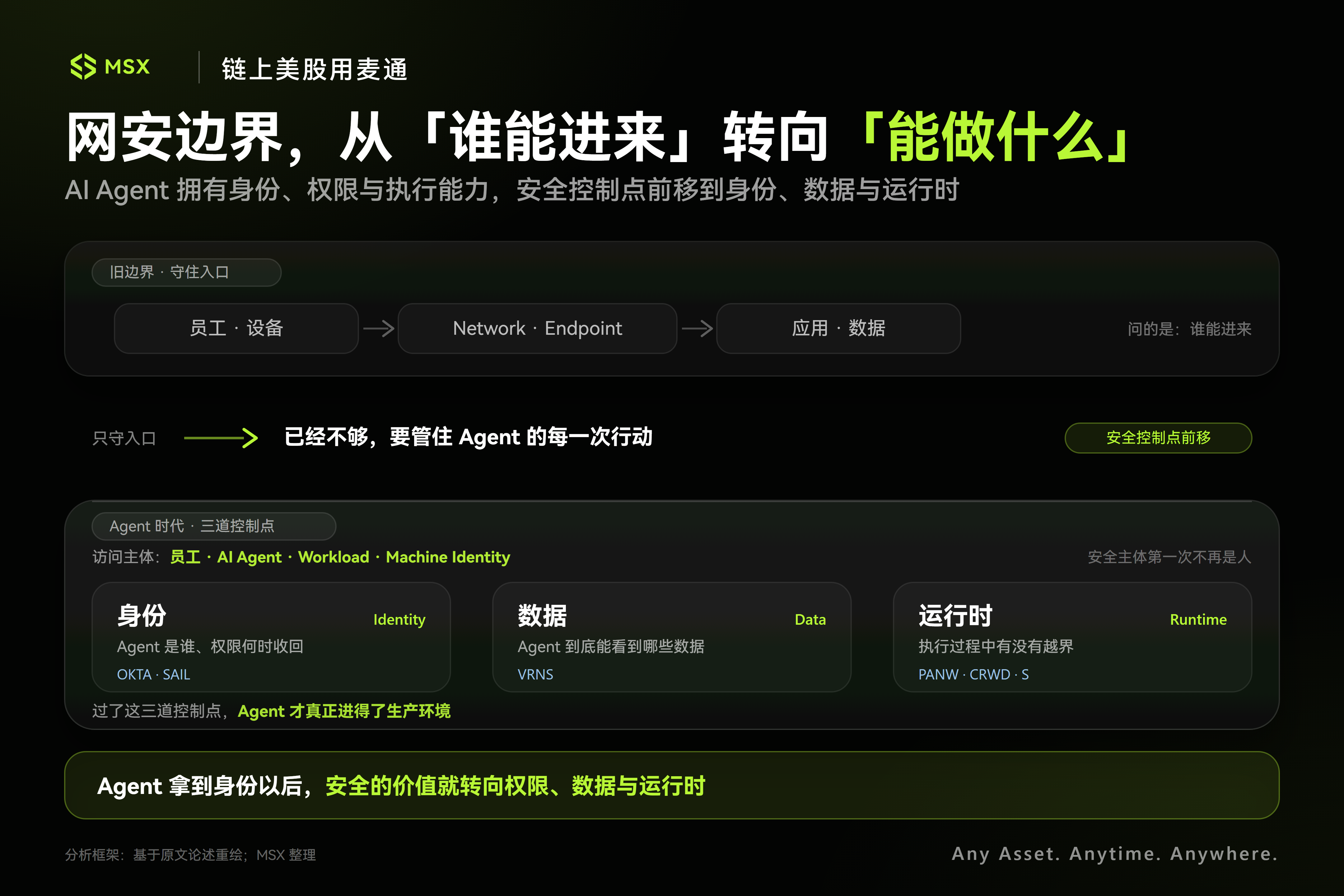
Thus, enterprise security must answer a new question it has never faced before: Does what it does now still conform to the original purpose it was authorized for?
If we look at the chain of events after the Agent truly enters the enterprise, we can actually divide the current cybersecurity companies into three factions: one focuses on platform development, one controls identities and data, and the other protects networks and access points.
2. From PANW, CRWD to SAIL, VRNS, who is truly at the throat of the matter?
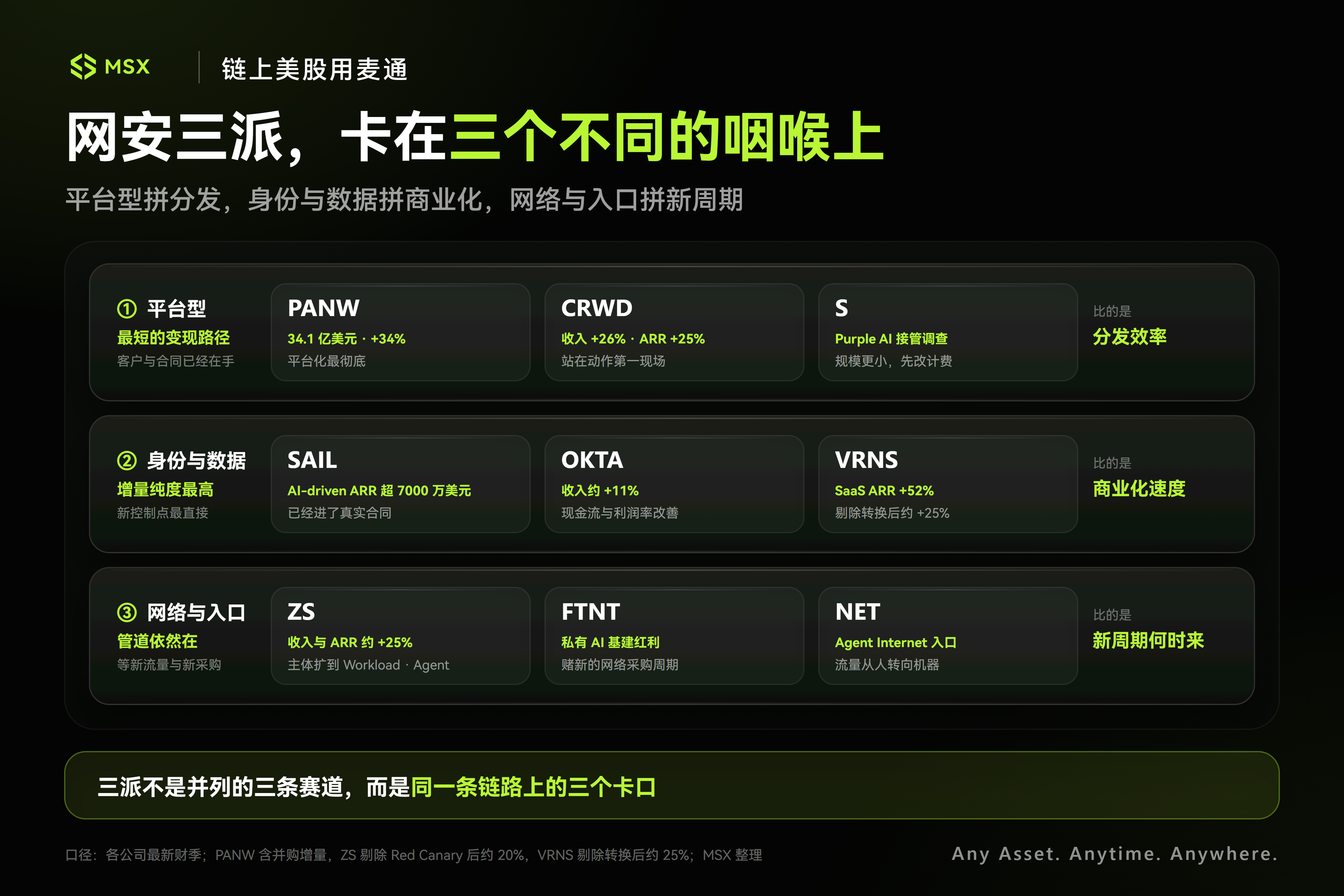
1.PANW, CRWD, S: Platform giants with the shortest path to commercialization
Palo Alto Networks (PANW) remains the most thoroughly platformized company.
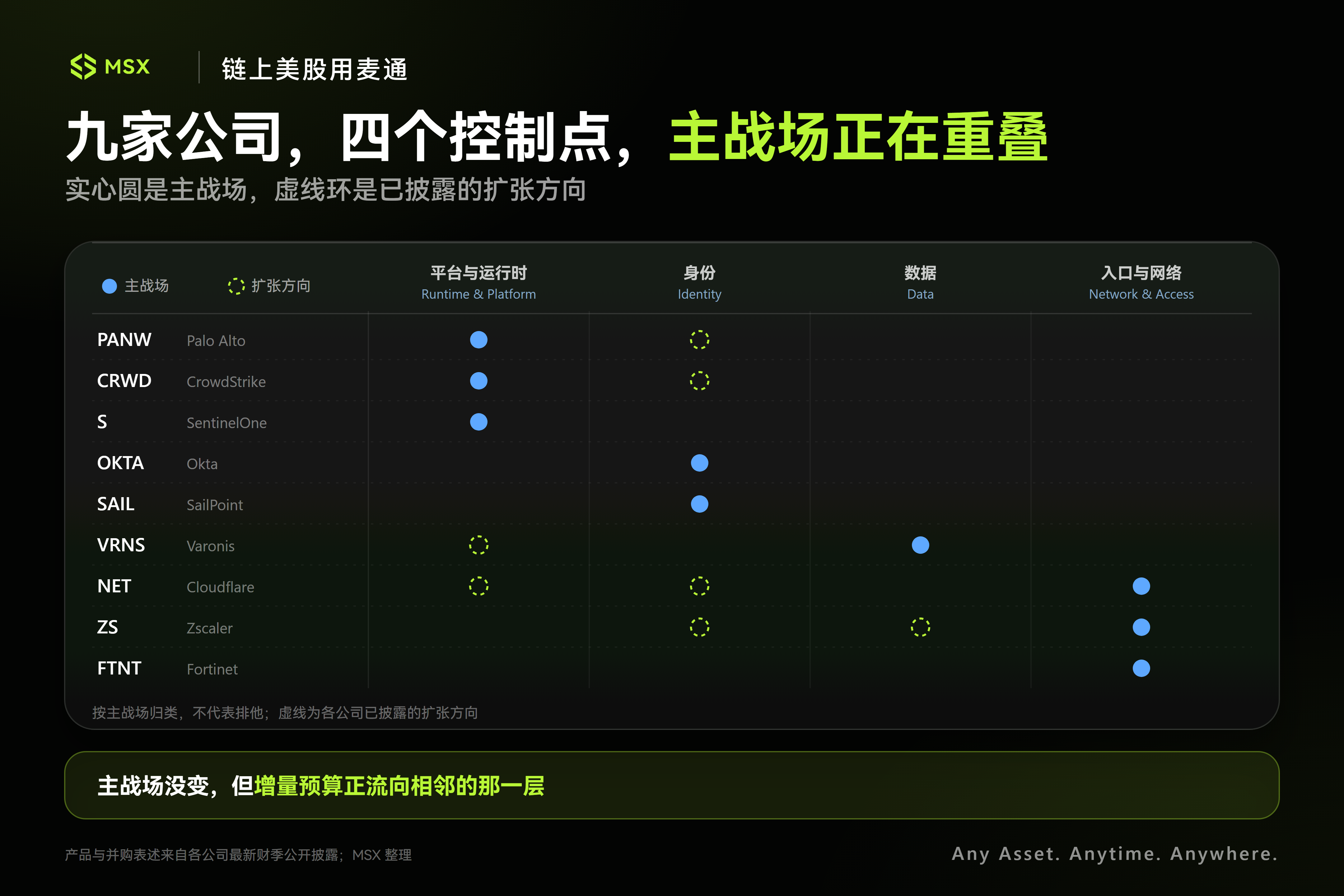
It no longer relies solely on traditional firewalls; instead, it continuously incorporates Network Security, Cloud Security, SOC, Identity, and AI Security into one platform. Prisma AIRS now covers models, data, AI Applications, and Agents, while also adding capabilities like AI Runtime Firewall and Red Teaming.
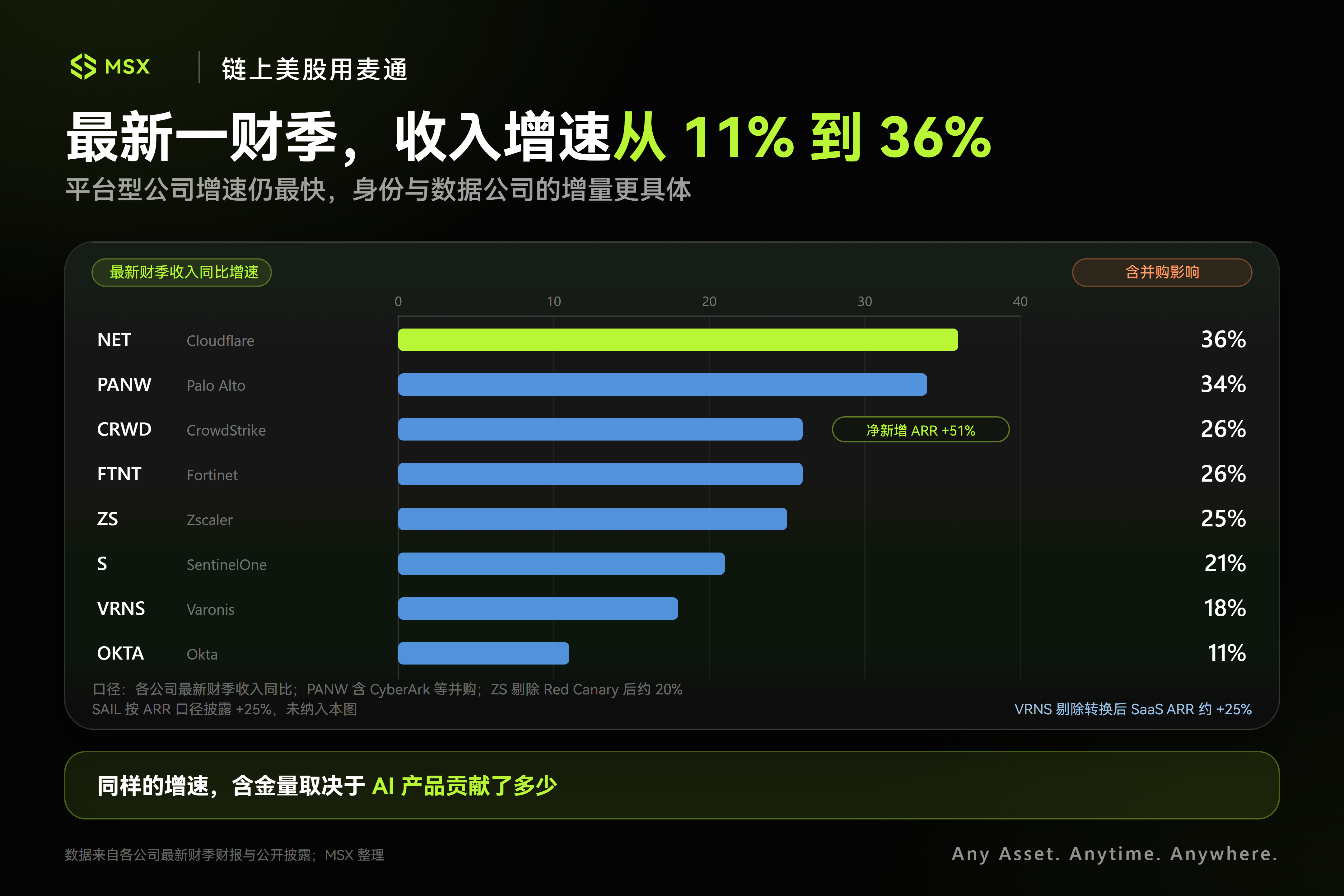
Thus, what PANW aims to resolve is actually the entire chain of events, including what models AI uses, what data it accesses, what tools it calls, and whether any unusual behavior occurs when it operates. The company’s latest quarterly revenue reached $3.41 billion, a year-on-year increase of 34%. Although this includes acquisition growth, it still shows that when new security budgets arise, large platforms typically have the shortest commercialization paths.
After all, customers are already there, contracts are already in place, and new products can be cross-sold into the existing system.
CrowdStrike (CRWD) has a different entry point, focusing more on the execution level.
The reasoning of the Agent may occur in the cloud, but the actual actions—running scripts, writing temporary files, adjusting system processes—still take place on servers, containers, or employee endpoints. This is precisely the comfort zone of the Falcon platform, neatly extending endpoint telemetry to Runtime, positioning CRWD at the frontline of action.
Therefore, CRWD's core asset has always been the Falcon platform and the telemetry accumulated from a large number of endpoints and cloud workloads. The latest quarterly revenue grew 26% year-on-year, ARR grew 25% year-on-year, and the strong performance of net new ARR also indicates that CRWD is expanding from Endpoints to Identity, Cloud, Runtime, and SOC.
SentinelOne (S) is following a similar direction, but its scale is significantly smaller.
Its ambition for Purple AI is more aggressive; rather than serving as an auxiliary tool, it lets Security Agents take over the workflow of junior analysts, further progressing toward automated investigations, event correlation, and triggered responses.
If this step truly takes off, the change brought by AI will not only be in the product features of cybersecurity companies but also in the way security software is used and billed.
2.OKTA, SAIL, VRNS: The new security locks with the highest incremental purity
If PANW and CRWD have the advantage of size, then the native increment brought by Agents primarily hits Identity and Data.
Okta (OKTA) and SailPoint (SAIL) are both expanding towards Agent Identity, but their traditional advantages are different.
Okta is closer to Authentication and Access Management, dealing with "who you are, whether you can log in, which applications you can access"; SailPoint, on the other hand, is more focused on Identity Governance, concerned with why a permission exists, who approved it, how long it should be retained, and whether it should be revoked after the task is completed.
Applying this governance to people is already complex; applied to Agents, the problem undoubtedly becomes more challenging. Because the Agent lifecycle may be short, may exist long-term, may invoke multiple tools, inherit user permissions, or even further create new Agents.
This is also a noteworthy part of SAIL's recent data; its latest quarterly ARR grew 25% year-on-year, SaaS ARR surged 36%, and more importantly, the company disclosed that AI-driven ARR has already surpassed $70 million, with AI products contributing over 30% of net new ARR, proving that Identity has transitioned from product stories to real contracts.
In contrast, OKTA's latest quarterly revenue grew by about 11%, with cash flow and profit margins improving continuously, but overall growth rate is significantly lower than leading cybersecurity platforms. Therefore, the next phase truly needs to prove when these new products can impact the overall growth curve again.
VRNS, on the other hand, stands on another very direct logic of Agents, which is data. Its long-term focus has been on sensitive data discovery, permission analysis, data classification, and threat detection, and now it has started incorporating AI Governance and AI Runtime into the same system.
After all, the stronger the Agent, the more enterprises need to first clarify one thing: what can this Agent see? The latest quarter saw VRNS total revenue grow about 18% year-on-year, with SaaS ARR growing 52%. Of course, this 52% includes a significant impact from traditional customers migrating to SaaS; if conversion is excluded, SaaS ARR growth rate is about 25%.
Thus, what is currently worth observing for VRNS is whether AI Data Security can take over growth after the SaaS transformation effect gradually diminishes.
If Agents truly enter the enterprise production environment, then data permissions are likely not to be an "optional security module," but rather a problem that must be resolved before deployment.
3.FTNT, ZS, NET: The network subject has changed, but the pipeline remains
The changes brought by Agents do not mean that traditional cybersecurity will lose its value; rather, the future access to enterprise applications and the internet will not be limited to employees and devices.
Zscaler (ZS)'s Zero Trust has mainly managed Employee → Application in the past, and it will gradually expand to Employee + Workload + Agent → Application. As the number of Agents increases, so will the machines that need to be authenticated, authorized, and isolated.
Therefore, as long as the machine access traffic skyrockets exponentially, the charging point for Zero Trust gateways is here.
The latest quarter saw ZS revenue and ARR both increase by about 25%; however, after excluding the impact of the Red Canary acquisition, both growth rates are closer to 20%. From this perspective, what ZS truly needs to validate is whether this new demand for Agent-to-App can drive new ARR growth again.
Fortinet (FTNT)'s AI logic is more focused on infrastructure, benefiting from the privatization deployment boom.
It is not a typical Agent Security company, but if more and more financial, medical, large enterprises, and government projects build their own GPU clusters, Private Clouds, and AI Factories, the demand for network isolation, east-west traffic, firewalls, SASE, and security operations will naturally increase.
These are precisely the capabilities that Fortinet has accumulated over the long term; in other words, it is betting on the essential needs of traditional infrastructure in the new computing power cycle, and whether Private AI will initiate a new cycle of enterprise network and security procurement.
Cloudflare, however, is even more unique; its appetite is the largest, and its valuation the highest.
NET cannot simply be categorized as a cybersecurity company. CDN, WAF, DDoS, Zero Trust, Workers, and the global Edge Network place it simultaneously within internet infrastructure, cloud, and security sectors. After the popularization of Agents, the traffic structure of the internet itself may also change.
In the past, it was more about Human-to-Web; in the future, there will be more Agent-to-API and Agent-to-Agent interactions. Agents will access websites, invoke models, execute code, and even complete machine payments. Ultimately, Cloudflare's true bet is not just on AI Security, but on a much larger change:
If more and more internet traffic is generated proactively by machines, can NET become a significant entry point for this layer of the Agent Internet? This is also what sets it apart from other cybersecurity companies—its greater imaginative space, but also the higher expectations already reflected in its valuation.
4. Valuation watershed: see who first accounts for Agent in ARR
Putting the industry logic back to fundamentals and valuations, the market has actually provided an honest vote with its feet:
- High premium camp (CRWD, NET): maintaining growth expectations of 20%+ or even higher, the market values their imagination of expanding TAM through AI, keeping EV/Sales at the highest level;
- Quality defense camp (PANW, FTNT): growth rate is not as explosive, but relies on platform depth, network infrastructure attributes, and extremely solid free cash flow for support;
- Elastic wait-and-see camp (SAIL, VRNS, ZS, OKTA): valuation centers are relatively restrained, but this also means opportunity; as long as one can prove that the Agent product is materially driving net new ARR, it will easily lead to a round of valuation recovery;
At this point, the AI narrative of cybersecurity has moved past the stage of "hackers are also using AI, benefiting the whole industry."
Because this logic is too broad, nearly every cybersecurity company can talk about it, can release Copilot, Agent, Runtime Security, or Agent Identity, and explain why AI will expand their TAM.
Now, the real differentiation is that companies are starting to use AI on a large scale, so the original security architecture must also be redesigned accordingly, and it comes down to who can clearly account for these new demands in their financial reports and further drive overall revenue to re-accelerate.
This is exactly why PANW, CRWD, SAIL, VRNS, ZS, FTNT, and NET can be discussed together; it can be anticipated that the differences between them will become increasingly significant.
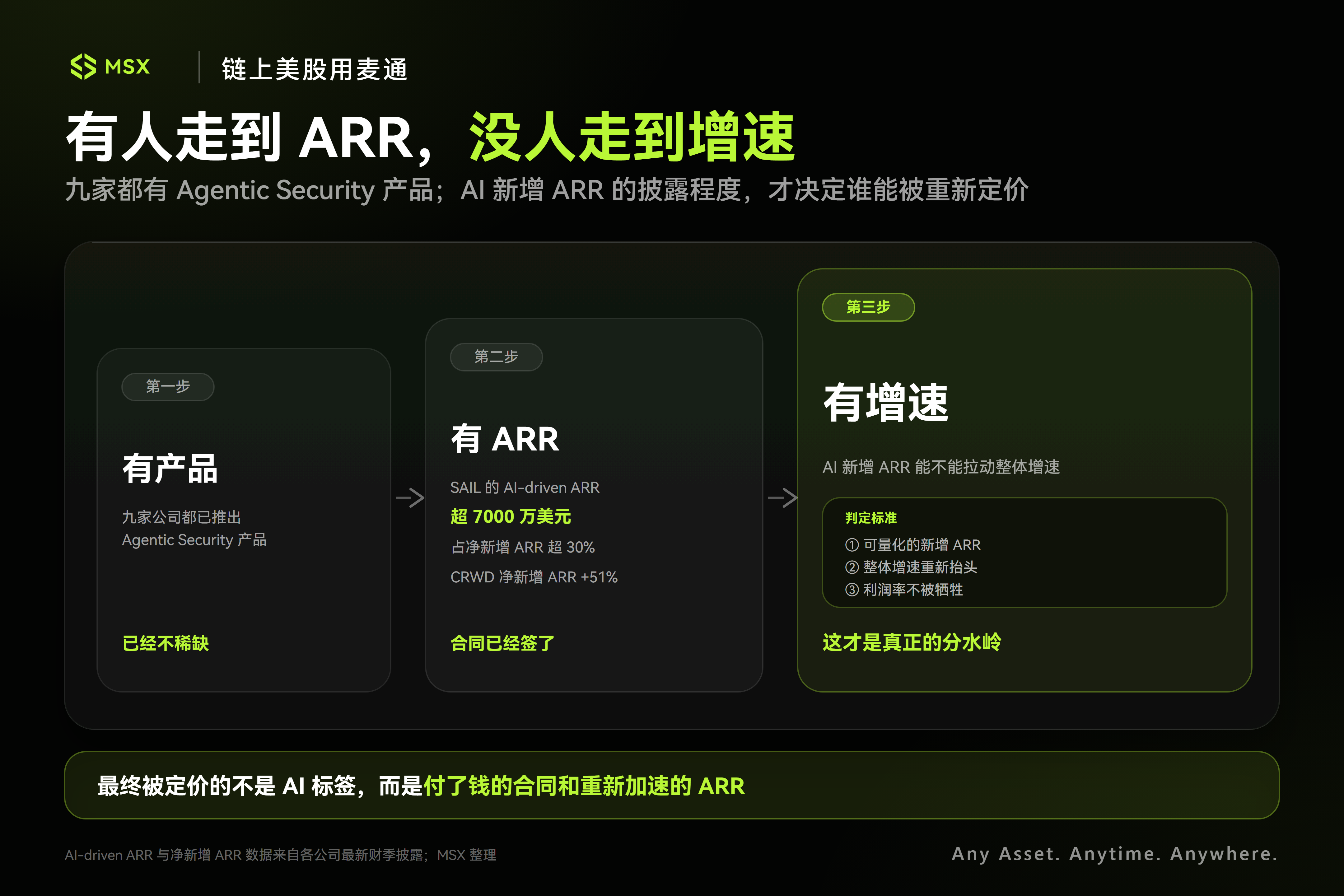
Platform companies compete on distribution efficiency, identity and data companies compete on whether new control points can be quickly commercialized, while network and infrastructure companies must prove that Agents and Private AI will ultimately bring in new traffic and procurement cycles.
Therefore, moving forward, the most noteworthy aspect is who can most quickly prove that Agents are changing their growth curves.
This is also why the AI-driven ARR recently disclosed by SAIL is worth more attention than simply launching an Agent product. As long as AI products truly find buyers, new ARR begins to appear, overall growth rebounds, and these revenues can ultimately convert into profits and cash flow, then the capital markets will naturally vote with their feet.
From this perspective, cybersecurity is not a new story that has suddenly emerged outside the main AI narrative.
The more capable AI becomes, the deeper the enterprise's fear of "losing control," and the winner of this round of cybersecurity market will be determined by who can quickly convert this fear into tangible cash flow in each quarter's financial report.
免责声明:本文章仅代表作者个人观点,不代表本平台的立场和观点。本文章仅供信息分享,不构成对任何人的任何投资建议。用户与作者之间的任何争议,与本平台无关。如网页中刊载的文章或图片涉及侵权,请提供相关的权利证明和身份证明发送邮件到support@aicoin.com,本平台相关工作人员将会进行核查。


