Author: Nancy, PANews
Linera was once a collective memory for the hair-pulling community. This star L1, which captivated the community with expectations of airdrops and delayed mainnet launch, ultimately exited quietly after a failed emergency financing.
As the trend of public chain shutdowns spreads, Linera's suspension serves as a warning, showing that elite teams, star capital, and grand narratives are no longer sufficient to sustain market confidence.
Lower fundraising thresholds still fail to gain traction, former star L1 heads toward shutdown
After a long time, Linera has come up again, not because of the mainnet launch or airdrop rules, but due to its shutdown.
At the end of last month, Linera boldly claimed it would create "the next Hyperliquid" and announced the impending launch of the LNRA token sale. On September 1, Linera officially kicked off the LNRA community round public offering, pricing the token at $0.16, corresponding to a $160 million FDV, while offering early participants discounted prices as low as $0.02.
However, the market response was far from expected. The subscription progress for the community round was slow, and overall enthusiasm was noticeably lacking. Ultimately, 617 participants from 69 countries and regions committed to subscribe approximately $848,000, well below the $8 million fundraising cap, and even failed to reach the $1.5 million minimum fundraising target. Despite this public offering being relatively modest compared to the tens of millions raised by previous crypto projects, Linera still could not meet the minimum fundraising requirement, indicating a lack of market interest.
On September 19, Linera founder Mathieu Baudet announced on Discord that due to the LNRA token sale failing to meet the minimum amount required for completion, all subscription funds had been refunded, and the project would cease operations immediately. The team had previously attempted to raise emergency funds to maintain operations until the mainnet launch but failed to secure the necessary funding, leading to the project's closure.
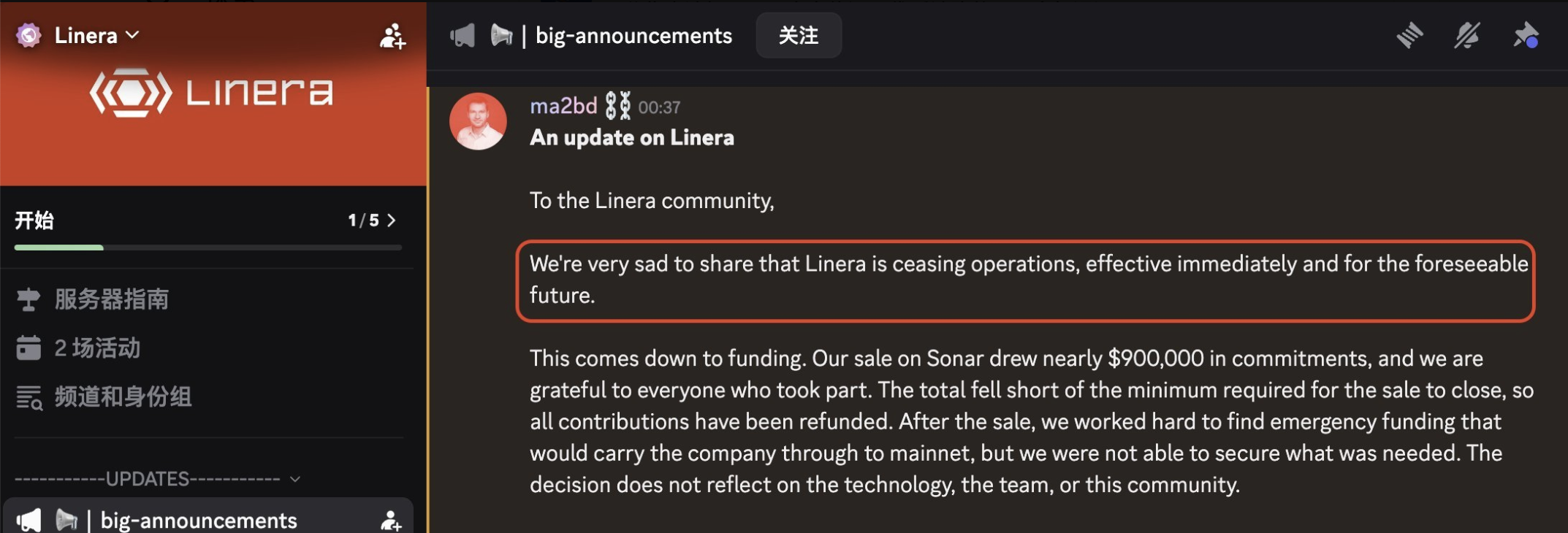
From the high-profile announcement of the token sale to the operational shutdown due to fundraising shortfalls, Linera's abrupt closure surprised the market, leaving many airdrop users’ years of waiting in vain. From testnet interactions, task completion, to badge collection, participating in weekly meetings, and accumulating Discord roles, the long-term engagement surrounding the Linera ecosystem had become the daily routine for many community users. Now, with the project abruptly halted, these investments have not yielded returns.
Some users posted on social media stating that they had continuously participated in Linera's ecosystem interactions for the past three years, accumulating an investment of approximately 40,000 to 80,000 MGS, publishing over 100 pieces of content, attending 69 community events, and earning 30 badges, yet their final “returns were zero,” not even having the opportunity to check for airdrop queries.
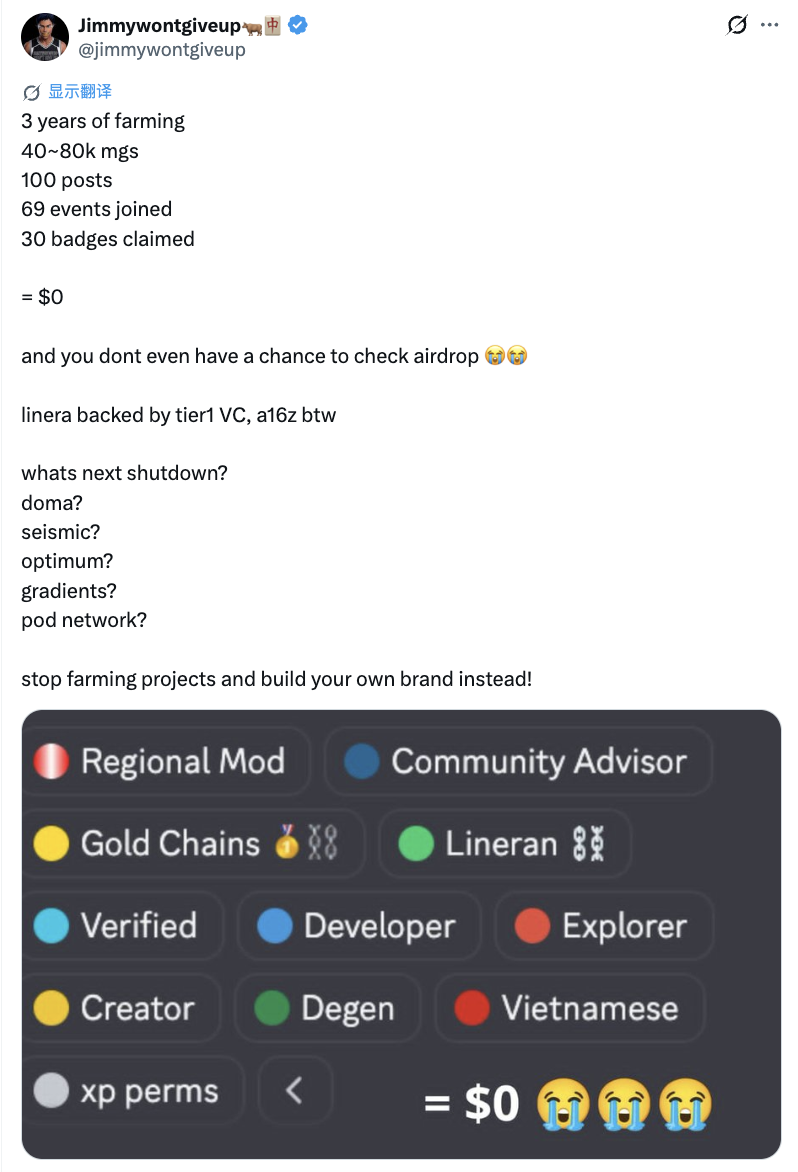
Others questioned that while Linera had received support from top venture capital firms like a16z, the project still hadn't officially launched its mainnet after several years and ultimately shut down due to financial issues. "Four years without a mainnet and funds exhausted, who will be next?" Such sentiments began to spread in the community. Some users directly stated, "VCs offload a ghost chain to retail investors and walk away," while others lamented, "We were grinding for points while Linera was taking our time."
Furthermore, some community users compared Hyperliquid and Linera, suggesting that the former allowed the product to run first with funding following, while Linera seemed more like “a story fully told” but ultimately depended on community fundraising to maintain operations.
Today’s Linera may find it difficult to be associated with star L1s. Since the project started in 2022, from team background to financing array, and the Move ecosystem narrative, Linera managed to gather many tags of popular public chains at the time. Even though it has not yet entered a large-scale application phase, Linera still gained sufficient market attention and community expectations.
Linera was founded by former Meta researcher Mathieu Baudet, and the founding team's background gave the project an early buzz, at one point being mentioned alongside Aptos and Sui as one of the “three Move pillars.” In 2022 and 2023, Linera completed two rounds of financing, with a total fundraising scale of about $12 million; a16z participated continuously, while other investors included Borderless Capital, GSR, Matrixport Ventures, and Flow Traders, creating a notable capital lineup. However, these glories did not form a protective moat for Linera through the cycles.
Currently, Linera is gradually shutting down applications and its Discord community. User point balances will still be kept on record, but the team cannot promise that these points will exchange for any rights in the future. As for protocol development and application launches, the team indicated that they still hope to move forward in the future, but a clear timetable cannot be provided for now.
Public chains launch survival battles, sustainable self-sufficiency becomes key
Linera's curtain call seems sudden but is not without warning.
As more public chains transition from highlights to silence, or are forced to shut down or transform, the industry may be experiencing not just a market adjustment, but a reassessment of liquidity, business models, and value capture.
In recent months, Layer 1 and Layer 2 projects such as Harmony, Scroll, Moonbeam, Secret Network, Saga, Vanar, and Zero have announced shutdowns or transformations, including some once highly regarded industry pioneers. They attracted market attention through technical narratives, financing arrays, and ecosystem incentives, and at one point accumulated considerable on-chain liquidity. However, as market enthusiasm faded and incentives gradually disappeared, their trading volumes and user activity began a steep decline, leading some to become genuine “ghost chains.”
Especially with the entry of new chains backed by traditional giants like Robinhood Chain, offering more choices for market funds and users, liquidity migration among different ecosystems has accelerated. For public chains lacking differentiated advantages, once users and funds leave, rebuilding an ecosystem often incurs higher costs.
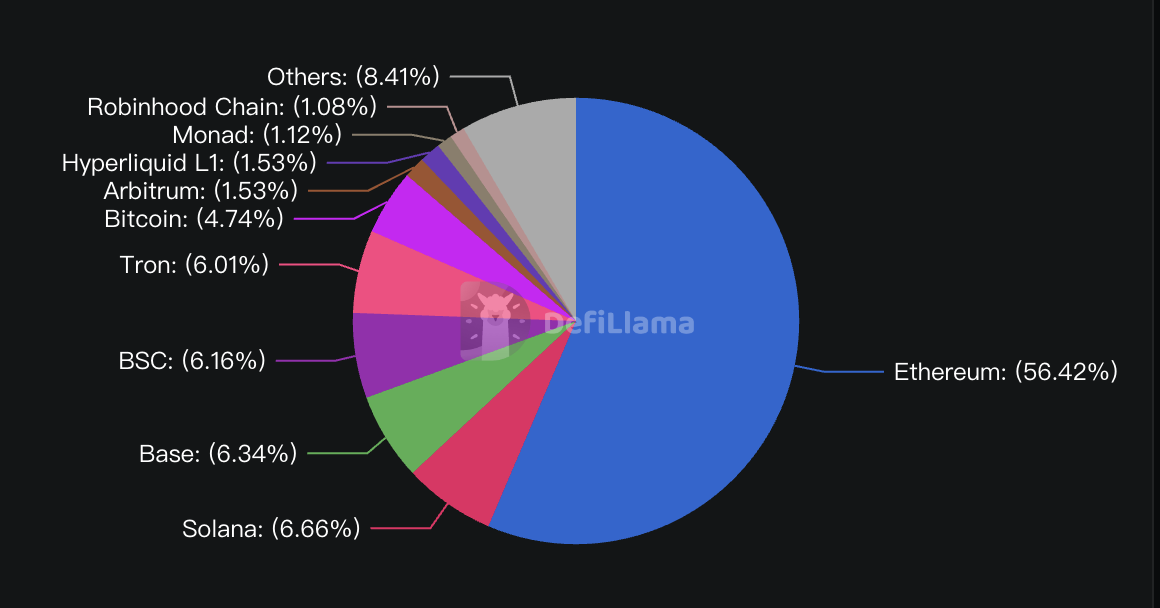
Under the head effect, the survival pressure faced by small and medium-sized public chains has increased further. Data from DeFiLlama shows that the top ten public chains, including Ethereum, Solana, Base, and BNB Chain, occupy about 90% of the public chain market share. In such a competitive landscape, simply relying on new chain narratives, short-term incentives, or token issuance to attract funds is increasingly difficult to establish a long-term advantage.
Faced with increasingly fierce competition, the development paths of public chains are also beginning to diverge. Compared to general-purpose public chains attempting to cover all application scenarios, vertically-oriented public chains driven by actual applications around specific needs are becoming the mainstream direction of industry exploration. Some established public chains are also shifting towards AI, payments, and other niche tracks, attempting to find new growth spaces through differentiated positioning.
However, regardless of which route is chosen, establishing a sustainable business model is essential. For crypto projects lacking sustained sources of revenue, financing reserves and proceeds from token sales may support team operations in the short term, but they cannot replace stable operating cash flow. Once financing encounters obstacles and reserves are consumed, projects may be forced to cut expenses, reduce development, or even shut down entirely. Linera's experience is a real case; financing can buy time for a project but cannot indefinitely replace its self-sufficiency capabilities.
What’s more noteworthy is that the market's evaluation logic for public chain value is also changing. Previously, technical narratives, financing profiles, ecosystem scales, and airdrop expectations were often enough to bring projects attention and valuation premiums. However, as more projects enter the actual operational phase, the market starts to reassess how much of this growth comes from true demand and how much relies on short-term incentives.
Although on-chain trading volumes and TVL still serve as important metrics for measuring ecosystem scale and user activity, they do not necessarily indicate that a project possesses sustainable profitability. For investors, whether a protocol can consistently generate income and whether that income can effectively reach token holders are gradually becoming important dimensions for assessing projects.
Recently, strong performances of tokens like Hyperliquid, Uniswap, NEAR, Venice, Arbitrum, and Aave further demonstrate the market's emphasis on aligning protocol revenues with token incentives.
Because of this, an increasing number of crypto projects are beginning to experiment with token buybacks and burns to link operational activities with token value. According to Unfolded data, crypto projects have spent $638 million on token buybacks so far this year, exceeding the $545 million spent in the same period last year, while only $36.6 million in 2024. Among these, Hyperliquid and Pump.fun together account for nearly 90%.
However, buybacks themselves are not equivalent to sustainable value capture. Their actual effectiveness still depends on the sources of funding, the scale of buybacks, changes in total token supply, and whether the project can continue to generate income in the future. Without stable operating cash flow, buybacks may only represent a temporary value expenditure, difficult to serve as long-term support.
Ultimately, when narratives and technical glories are no longer sufficient to attract liquidity, competition among public chains is shifting from vying for traffic and market attention to an examination of real demand, ongoing revenue generation, and value return capabilities.
免责声明:本文章仅代表作者个人观点,不代表本平台的立场和观点。本文章仅供信息分享,不构成对任何人的任何投资建议。用户与作者之间的任何争议,与本平台无关。如网页中刊载的文章或图片涉及侵权,请提供相关的权利证明和身份证明发送邮件到support@aicoin.com,本平台相关工作人员将会进行核查。


