Author: CoinDesk
Translation: ShenChao TechFlow
ShenChao Insight: The Meme coin craze that once made Robinhood Chain one of the most expensive networks is cooling down: network fee revenue has dropped by about 97%, but the number of transactions has only fallen by about 30%. The average fee over seven days has dropped by 82%, with a daily transaction volume still around $1.5 billion. The data does not support the simple narrative that "high Gas has driven people back to Solana"—traders are still present, but the amount they are willing to pay per transaction has decreased.
The Meme coin craze that once made Robinhood Chain one of the most expensive networks is cooling down, and network fee revenue has subsequently plummeted by about 97%, while the number of transactions remains close to its peak.
This contrasts sharply with August 30. At that time, this on-chain application, which had been launched for about two months, earned $2.7 million in fees in one day, twice that of Ethereum, second only to Solana. The token issuance platform Pons and the Meme trading application GMGN contributed about $2 million of that—users launched 22,600 tokens within 24 hours.
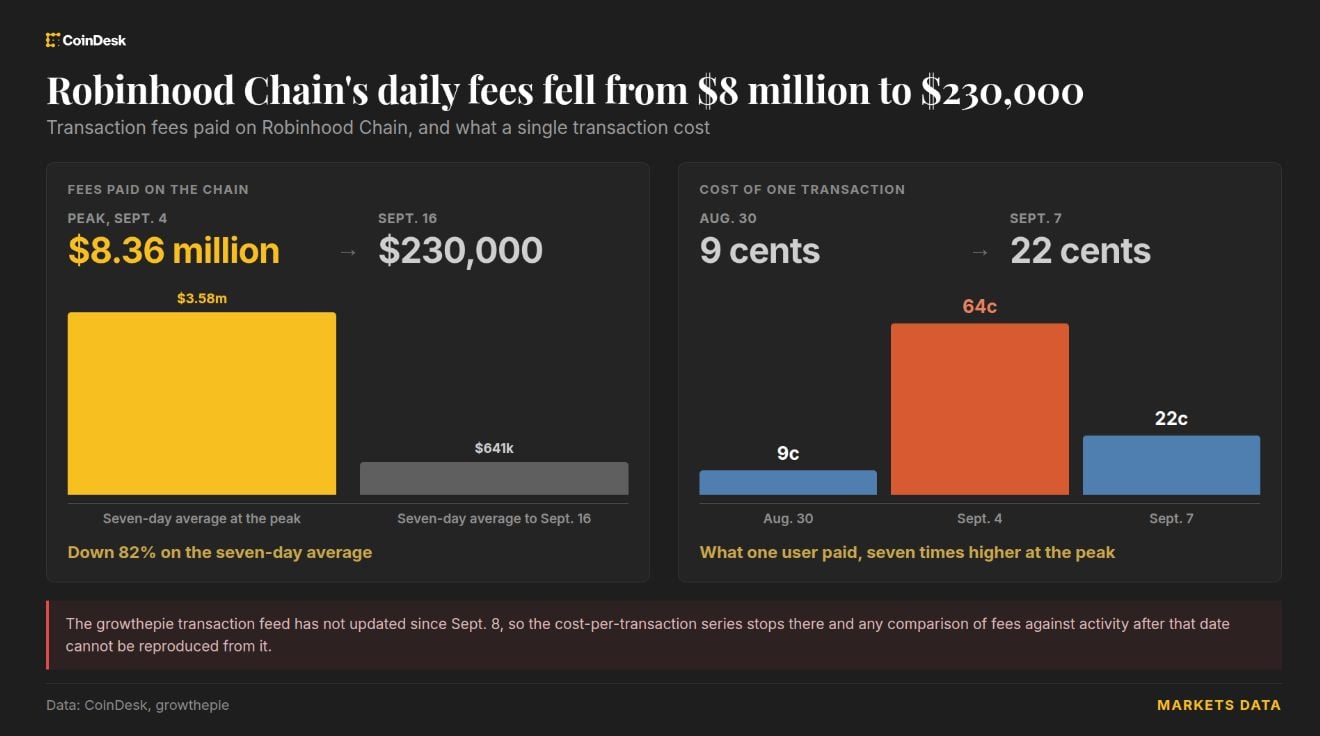
The peak occurred in early September: on-chain, around $8 million was collected in fees from 13.1 million transactions in a single day, averaging about 64 cents per transaction. By September 16, data from growthepie showed that daily fees had dropped to about $230,000, corresponding to about 8.9 million transactions, averaging only about 2.6 cents.
The amount spent on chain has fallen by 97%, and activity has only decreased by 32%—this gap will only appear when the network becomes cheaper, not emptier.
After the collapse of the fee chart, one explanation is that higher costs drove traders back to Solana, taking volumes away from Robinhood. However, weekly data points to a narrower withdrawal.
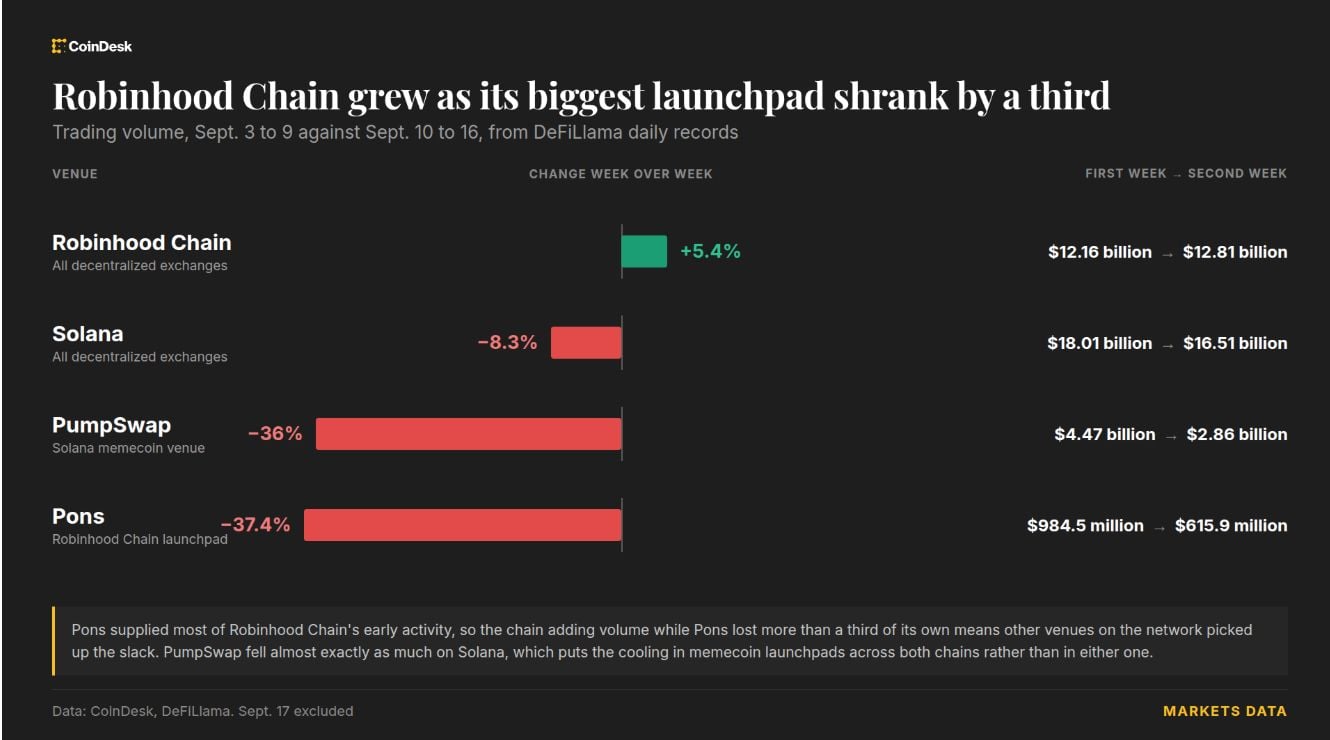
According to CoinDesk, using DeFiLlama's calculations, over the seven days ending September 16, decentralized exchanges on Robinhood saw approximately $13 billion in transactions, up 5% from the previous week; the supply of stablecoins only decreased by 1% to about $1 billion, of which about $930 million is parked in DeFi applications.
Businesses built on this chain are still earning more than the chain itself: in the last 24 hours, they collected about $8 million in fees, retaining about $1.5 million in revenue according to DeFiLlama data, compared to the network's own $230,000.
Unipcs, a pseudonymous trader ranked first by historical profits on FOMO (a platform tracking the performance of Meme traders), has not liquidated in this round of reversal. He told CoinDesk that the expensive phase never entered his consideration: "Earlier higher Gas fees did not affect me, nor did they affect any trencher I know. As long as I can still make money on this chain, no one cares about that." The term trencher refers to people trading newly launched tokens during the few hours after the new tokens go live—when price fluctuations are fastest.
The cooling is most evident on Pons. This is the launchpad for users to create and trade new Meme coins and was a major driver of Robinhood Chain's boom. Data shows that from September 10 to 16, its transaction volume was about $616 million, down 37% from the previous seven days; even so, the transaction volume across the entire chain is still increasing. During the same period, Pons protocol income dropped from $10.7 million to $5.8 million, still averaging about $830,000 per day.
In the same comparison period, on-chain Uniswap V3 transactions doubled from $2.5 billion to $5.3 billion, while Uniswap V4 dropped by 22% to $4.9 billion. Total transactions across all decentralized exchanges tracked by DeFiLlama saw Robinhood transactions increase by 5% to $12.8 billion.
Unipcs remains bullish on Robinhood Chain, expecting that by the end of the year, users, transaction volume, and fees will all reach new highs, stating that speculative Meme activity is still mainly concentrated on Robinhood Chain, BNB Chain, and Solana.
Earlier this month, Pons creator Ozzy told CoinDesk that the protocol uses 80% of its income to buy and burn PONS, permanently removing it from circulation. According to last week's income pace and the launchpad's own numbers, about $4.6 million would flow into this plan.
Solana remains the first choice for existing traders considering migration—it is still the busiest place for Meme trading and speculative bets.
However, the numbers do not indicate that they are arriving. From September 10 to 16, decentralized exchanges on Solana recorded transactions of about $17 billion, down 8% from the previous week; PumpSwap, tied to the Meme launchpad Pump.fun, recorded $2.9 billion, down 36%, compared to Pons at 37%.
Individual tokens may attract traders across networks, but overall chain data does not show a significant migration from Robinhood to Solana.
However, direct cross-chain bridge traffic does indicate that some money has flowed to Solana. deBridge processed $8.2 million from Robinhood to Solana from September 10 to 16, with slightly over $6 million flowing in the opposite direction, a net outflow of about $2 million.
The previous week was almost perfectly balanced: $13.4 million left Robinhood, while $13.3 million entered. The latest week's transfer numbers skew towards Robinhood: around 5,000 transactions from Solana to Robinhood, compared to about 3,800 on the opposite side.
Excluding the wildest days, the picture remains the same. For the seven days ending September 4, Robinhood Chain had an average of about 11.5 million transactions per day and about $4 million in fees; for the seven days ending September 16, about 10.8 million transactions and $641,000 in fees.
The casino floor is still lively; it’s just that the table that is crowded may have changed.
免责声明:本文章仅代表作者个人观点,不代表本平台的立场和观点。本文章仅供信息分享,不构成对任何人的任何投资建议。用户与作者之间的任何争议,与本平台无关。如网页中刊载的文章或图片涉及侵权,请提供相关的权利证明和身份证明发送邮件到support@aicoin.com,本平台相关工作人员将会进行核查。


