
Author: Dong Jing
Despite the Federal Reserve just announcing an interest rate hike, and Goldman Sachs economists expecting another rate increase in October, the Goldman Sachs global commodities research team remains firmly committed to maintaining a gold target price of $5,400 by the end of 2027.
According to the Pursuing Wind Trading Desk, Goldman Sachs conveyed a clear message to the market in its latest precious metals report on September 18: tightening policies will only slow down the short-term upward pace of gold, but will not end its long-term bull trend. The interest rate hike pressure has largely been digested by the market, and gold still has upward space.
The report states that currently, the structural gold buying frenzy by global central banks and the demand for bullish options triggered by concerns over the fiscal sustainability of G10 countries are building an extremely solid bottom for gold prices.
Goldman Sachs expects that the fair value of gold will reach $4,650 per ounce by the end of this year (significantly higher than the current spot price of about $4,350). In addition, investors need to be highly vigilant about the mechanical surge (short squeeze) risk that may arise from option market traders' hedging actions, as well as the speculative volatility around the U.S. midterm elections.
Limited Impact of Rate Hikes: Recent Path Slows, Terminal Target Unchanged
Goldman Sachs clearly pointed out in the report that although the Federal Reserve announced its first rate hike in three years, and Goldman Sachs economists expect another hike in October, the terminal target price of gold remains unchanged at $5,400 per ounce by the end of 2027.
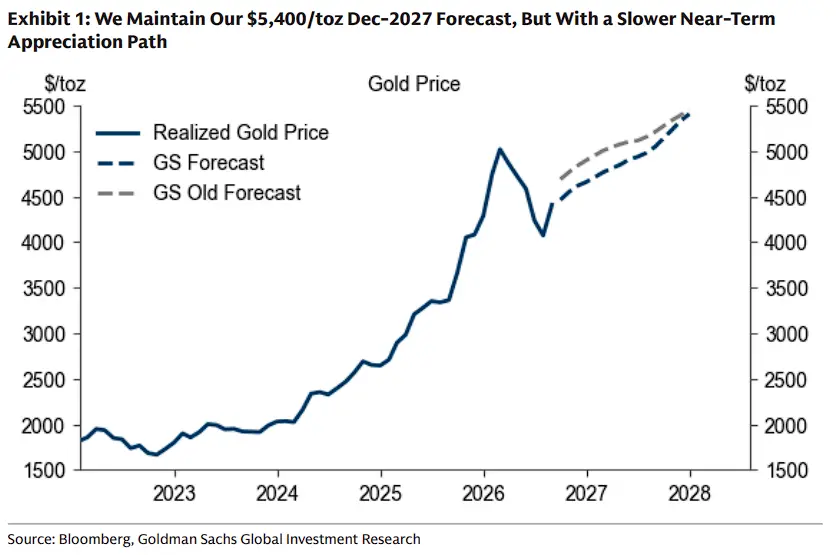
The logic behind Goldman Sachs' judgment is that the impact of tightening monetary policy will mainly manifest as a slowdown in the recent appreciation path of gold, rather than a decline in terminal prices. Goldman Sachs economists expect the Federal Reserve to implement three rate cuts between September 2027 and March 2028, with the terminal rate forecast remaining at 3.25%-3.5%.
For this reason, Goldman Sachs has reduced its fair value forecast for gold at the end of 2026 from $4,900 per ounce to $4,650 per ounce, but this figure still significantly exceeds the current spot price of about $4,350 per ounce. The report also points out that the anticipated tightening of monetary policy has largely been digested by ETF demand, indicating that the marginal suppressive effect of rising interest rates on gold prices is weakening.
Central Bank Gold Purchases: The Core Structural Driving Force Behind the Gold Bull Market
Goldman Sachs characterizes ongoing central bank gold purchases as the primary structural driving factor behind the bullish logic for gold, contributing to the expected approximately 23% increase by the end of 2027.
Goldman Sachs' real-time tracking model (Nowcast) for central bank gold purchases shows that the current rate of central bank gold buying is approximately 91 tons per month (seasonally adjusted three-month average), far exceeding the historical average level of 17 tons per month prior to 2022, an increase of over five times.
Based on this acceleration trend, Goldman Sachs has raised its central bank demand assumptions:
- Previous forecast: 50 tons per month in 2026, 40 tons per month in 2027
- Latest forecast: an average of 60 tons per month from 2026 to 2027
Goldman Sachs believes that the diversification demand for global central bank reserves triggered by the freezing of the Russian central bank's assets in 2022 is a structural rather than cyclical shift, and recent communications with multiple central banks have confirmed their strong ongoing demand for gold.
Bullish Options Demand is Resilient, Providing Additional Support for Gold Prices
The report pays special attention to the dynamics in the gold bullish options market. Currently, the open interest in gold bullish options is about three times the historical average, and after the Federal Reserve's rate hikes and relatively hawkish press conference, this level of open interest has shown extraordinary resilience.
Goldman Sachs interprets this phenomenon as market concerns about the fiscal sustainability of G10 countries, continuously supporting the demand for gold as a macro policy hedge.
It is noteworthy that Goldman Sachs' target price of $5,400 assumes that the current open interest level in bullish options remains roughly stable (with about 2.3 million outstanding GLD net bullish options contracts), and does not include the additional price amplification effect that could arise from further increasing bullish options positions.
Goldman Sachs estimates that at the current level of about 2.3 million contracts, every additional 100 tons of reliable demand would lead to an increase in gold prices of about 6.8%, while under normal holding conditions this figure is only about 2%—this means that market makers' hedging actions could mechanically amplify the upward trend in gold prices, pushing prices significantly beyond Goldman Sachs' baseline forecast.
Tail Risk Warning: Extreme Hawkish Path and the “Waiting Room” Effect Before Elections
Goldman Sachs clearly warns of two potential scenarios that could trigger a pullback:
1. Downside Risk (Extreme Hawkish Scenario): If the Federal Reserve unexpectedly raises interest rates three more times before the end of the year and signals a higher terminal rate, questions about the independence of developed country central banks may dissipate, leading to partial liquidation of macro hedging demand.
Combined with net selling by interest rate-sensitive ETF holders, gold prices may temporarily fall to about $4,070 per ounce. However, thanks to persistent central bank buying continuously raising the price floor, gold prices are expected to gradually recover to around $4,200 per ounce by the end of 2026.
2. Event-driven Volatility (the “Waiting Room” Effect Before the U.S. Midterm Elections): Speculative funds often treat gold as a “waiting room” asset for hedging ahead of significant events with uncertain outcomes.
Goldman Sachs points out that before the U.S. midterm elections, speculative positioning could temporarily drive gold prices up by about 5% (assuming net managed fund holdings increase by about 250 tons from the current level, reaching the 90th percentile since 2014, which is 685 tons). However, once the election results are finalized and funds are redeployed, there may be a sharp sell-off in gold prices, a phenomenon that has occurred in both the aftermath of the 2016 Brexit vote and the 2024 U.S. presidential election.
免责声明:本文章仅代表作者个人观点,不代表本平台的立场和观点。本文章仅供信息分享,不构成对任何人的任何投资建议。用户与作者之间的任何争议,与本平台无关。如网页中刊载的文章或图片涉及侵权,请提供相关的权利证明和身份证明发送邮件到support@aicoin.com,本平台相关工作人员将会进行核查。


