Author: Alea Research
Translation: Baihua Blockchain

Coinbase, Robinhood, and Circle recently launched significant releases that have far-reaching impacts on the crypto industry. The core commonality among the projects is: asset issuance. From tokenized US stocks to stablecoins, this year's betting from all parties ultimately hinges on one premise—whether users can truly access and purchase these issued assets. Distribution capability is the core competitiveness. As of September 10, Jumper's routing trading volume reached $934.6 million, with a month-on-month increase of 40.3%; its fastest growing target chain has only been live for 74 days.
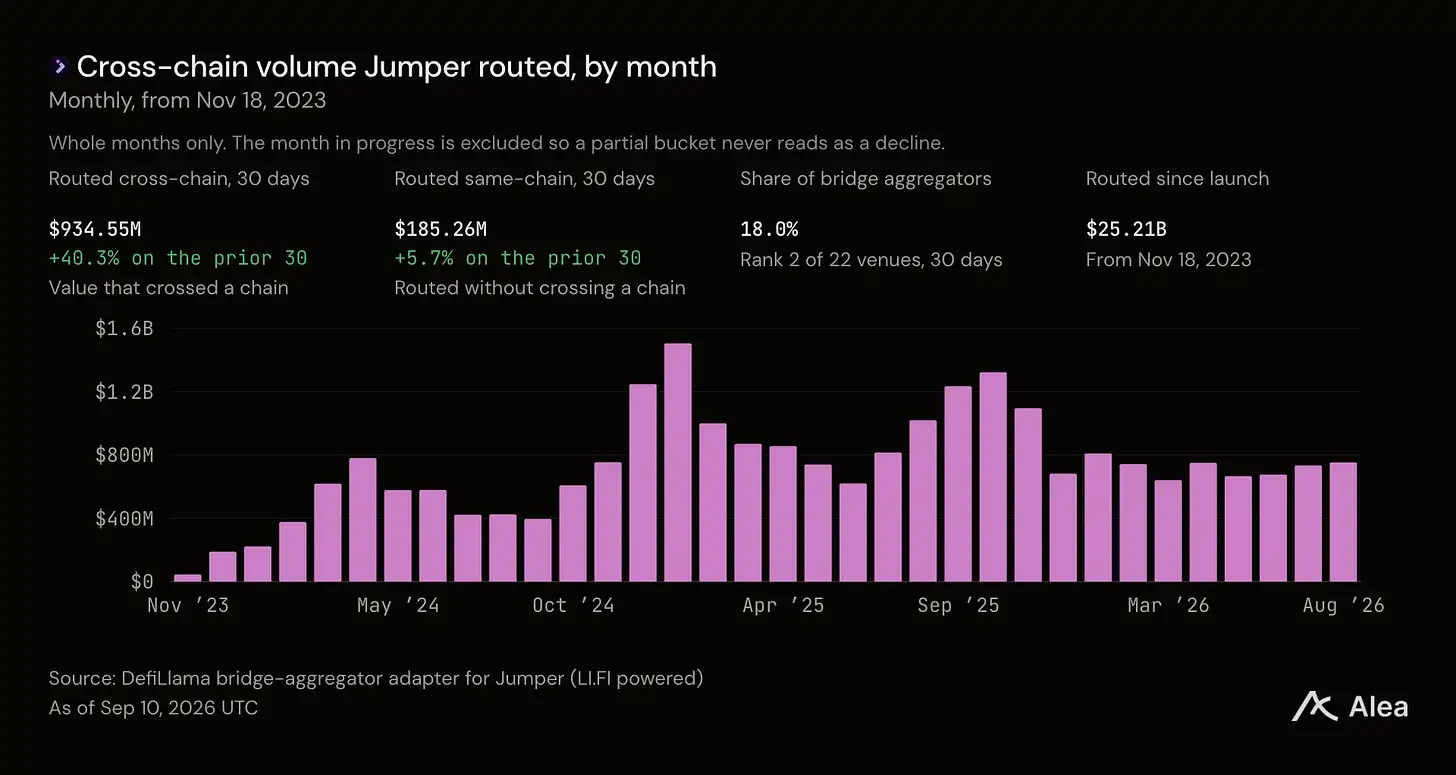 Monthly routing trading volume since November 2023. The recovery trend for 2026 is still below the peak of 2025, but the gap is narrowing.
Key Points
LI.FI aggregates and distributes tokenized stocks from xStocks, Ondo, Backpack, Robinhood, and Coinbase. With just one integration, access to all the aforementioned issuers can be achieved, reaching over 1,000 applications and wallets.
Robinhood Chain has accounted for 7.9% of Jumper's total trading volume over 30 days since its first routing transaction on June 28, reflecting a month-on-month increase of 2.9 percentage points, the highest growth among all target chains.
The Intents mechanism allows users to use USDG on one chain to directly acquire tokenized US stocks on another chain, completely eliminating manual cross-chain and exchange operations.
The Advance feature launched in its first month, driving the median transfer amount up 39.1% to $89.42.
Circle's Arc mainnet will launch on September 16, and LI.FI will provide routing support on the first day, replicating the strategy used for integrating Robinhood Chain in June.
Five Issuers, One Integration
Tokenized stocks are experiencing explosive issuance in 2026. Coinbase launched native US stocks on Base in August, and LI.FI is one of the first networks to support its routing; Robinhood built a public chain around tokenized assets; Ondo, xStocks, and Backpack are already live; Centrifuge signed on August 31; Circle's Arc will open on September 16.
However, each issuer will hit the same wall on their launch day: if users cannot smoothly purchase through existing wallets, blockchains, or assets in hand, then the value of on-chain stocks becomes meaningless. In contrast, asset issuance is the relatively easier part.
This is exactly the market demand that LI.FI addresses, with Jumper built as the user front-end on its foundation. In the cross-chain aggregator track valued at $5.14 billion, Jumper occupies 18.0% of the market share, ranking second among 22 protocols; the first place is taken by its dependent LI.FI Routing API (23.2%). According to DefiLlama's statistics, the two are calculated separately as independent protocols, hence the overall tech stack of LI.FI occupies 41.2% of the market share in this category.
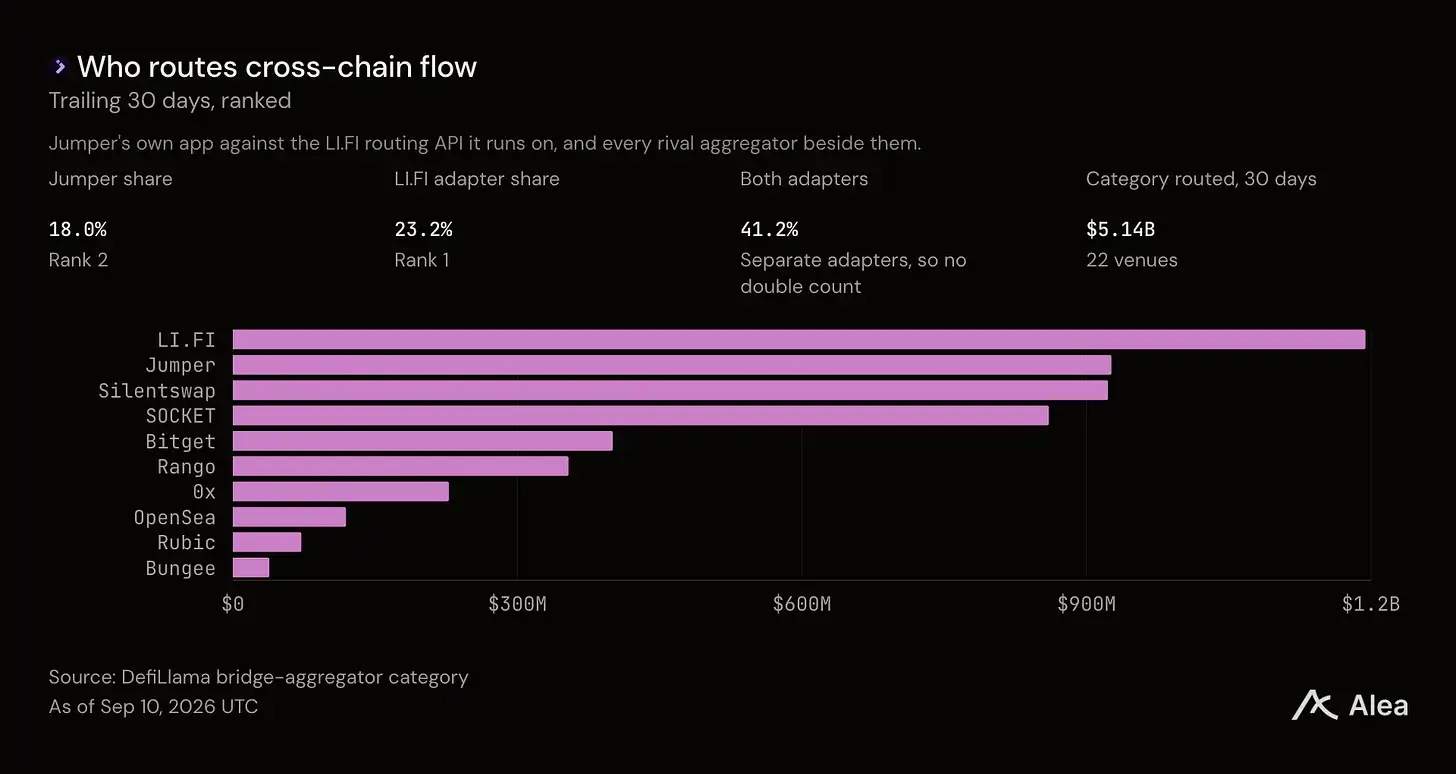 DefiLlama separately counts two sets of adapters, totaling 41.2% of the market share in this category.
The median transfer amount on the platform is $91, of which stablecoins account for about half of the receiving routes.
On a daily average basis, the combined daily processing volume of the two routing legs is $39.5 million, with the highest single day this quarter occurring on September 4, reaching $59.9 million. Overall growth has been steadily increasing since mid-August.
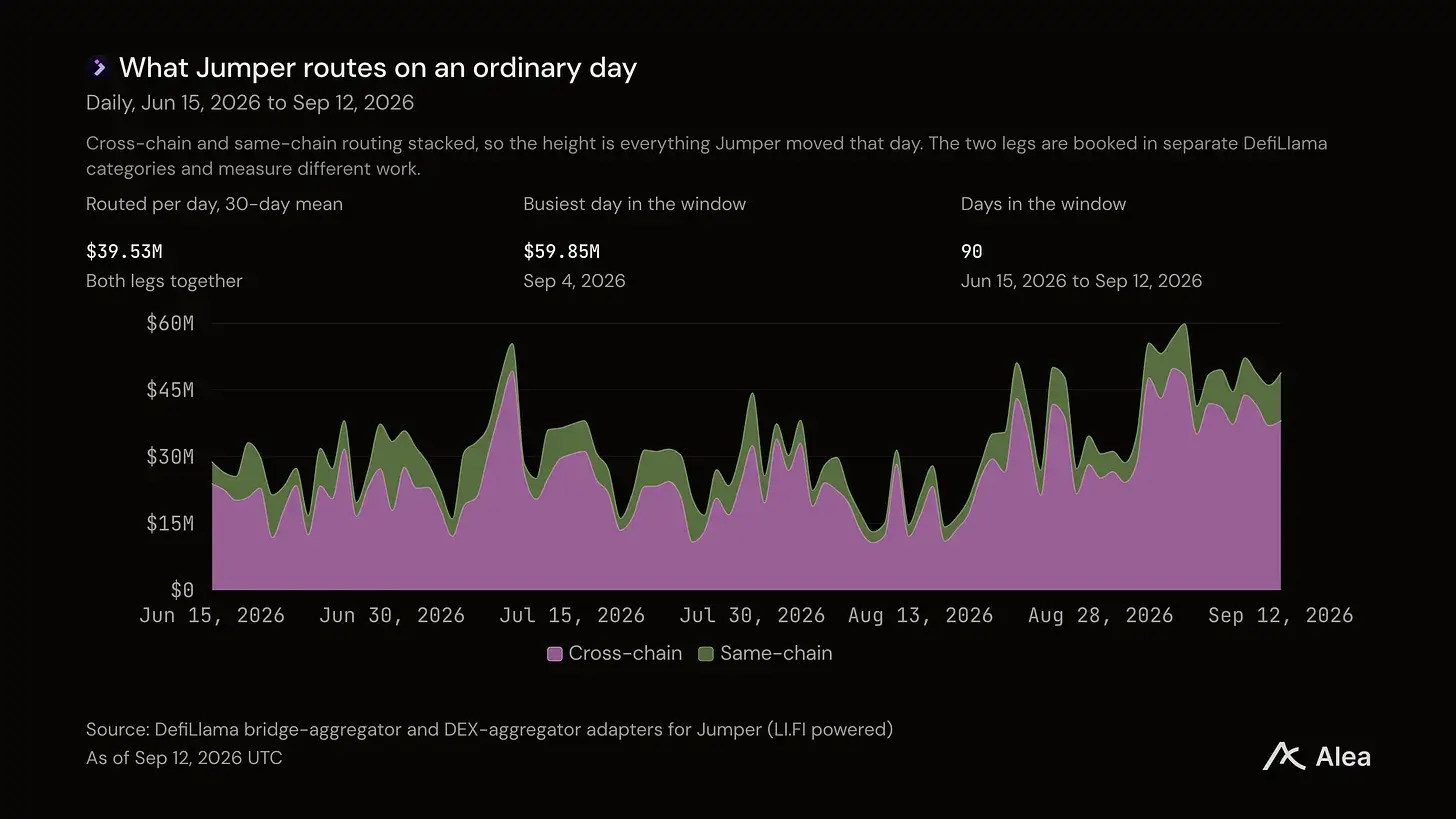 Cross-chain and same-chain stacking data. 30-day daily average reached $39.5 million, with significant growth since mid-August.
Robinhood Chain: From Zero to 7.9% in 74 Days
Robinhood Chain completed its first routing on Jumper on June 28, 2026. Just 74 days later, it contributed 7.9% of Jumper's total volume over 30 days, becoming the fifth largest target network after Ethereum, Arbitrum, Base, and Solana. This corresponds to $73.4 million in transaction volume within 30 days, accumulating to $119.6 million since launch.
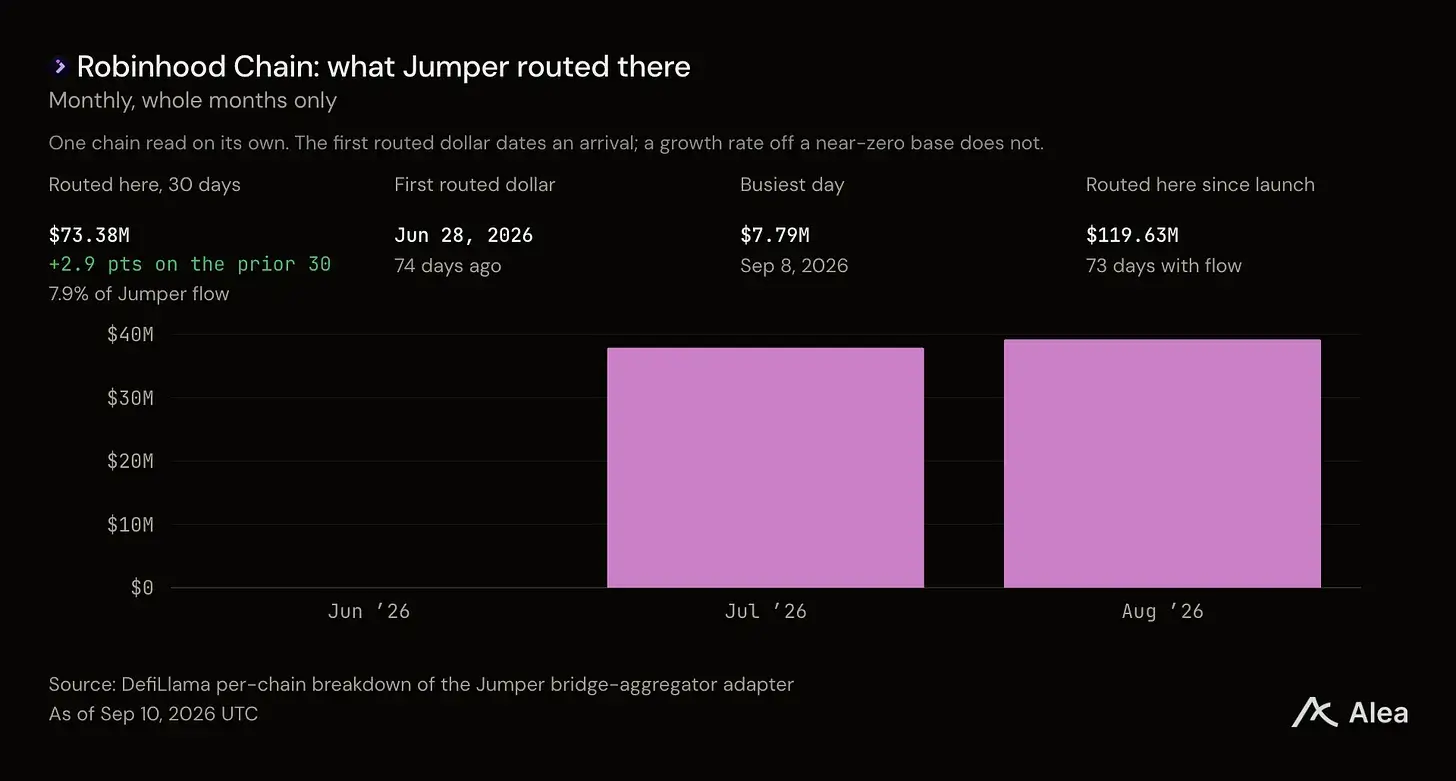 Two complete months of capital flow, with the busiest trading day on September 8 carrying $7.79 million.
Among the target chains, Robinhood Chain's market share growth is the largest, with a month-on-month rise of 2.9 percentage points. Ethereum grew by 1.3 percentage points, Ink increased by 1.2 percentage points from a lower base, and Solana added 1.1 percentage points. No chain's decline exceeded 1 percentage point. Overall capital flow is moving towards the newly launched networks, rather than concentrating highly on a single leader.
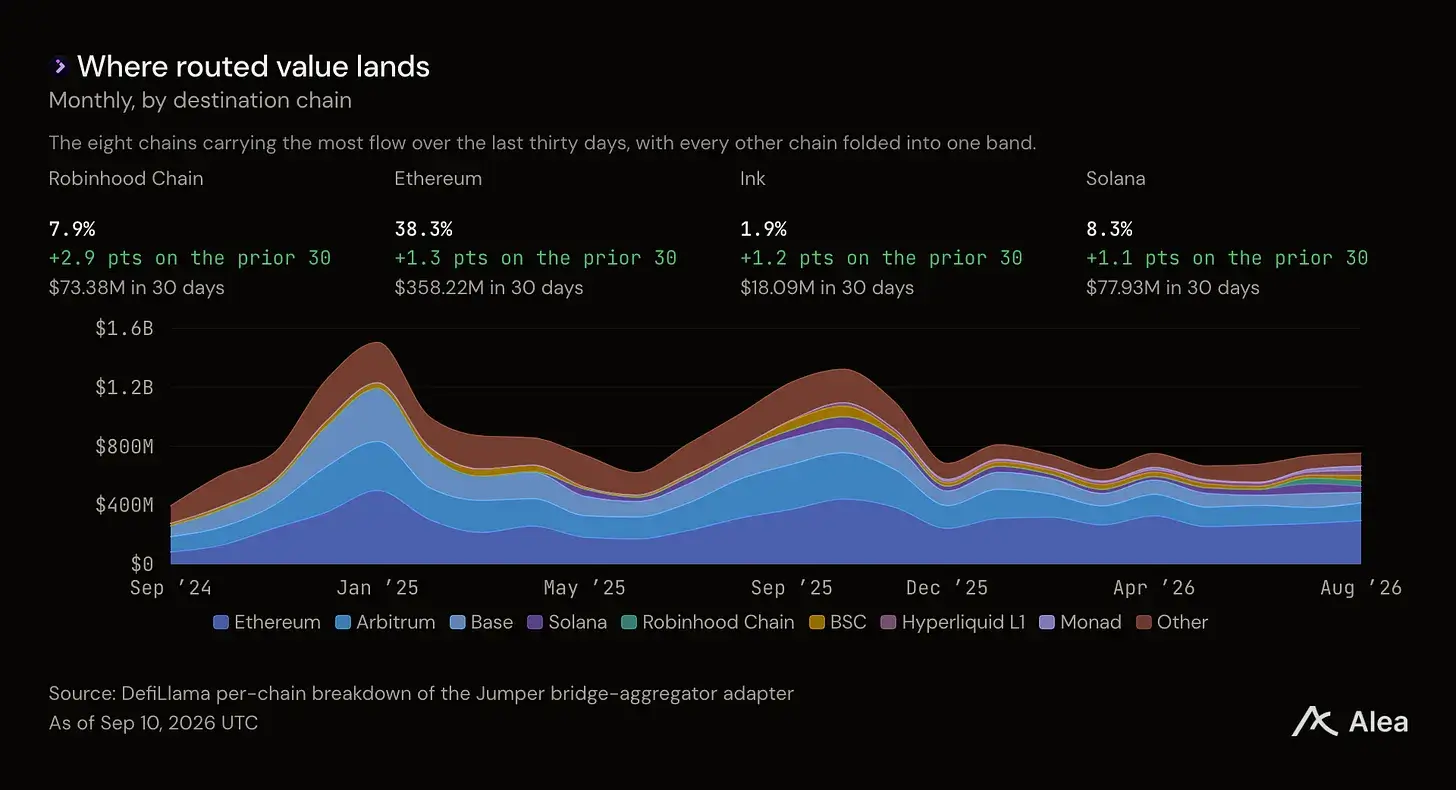 Robinhood Chain, Monad, and Hyperliquid occupy market share segments that did not exist a year ago.
From the perspective of capital volume and transaction counts, distinctly different pictures emerge: Robinhood Chain accounts for nearly 26% of Jumper's daily monitored routing counts, but only 7.9% of capital volume. This indicates that the chain is absorbing a large amount of high-frequency, small-value transfers, which is a typical characteristic of a healthy retail ecosystem.
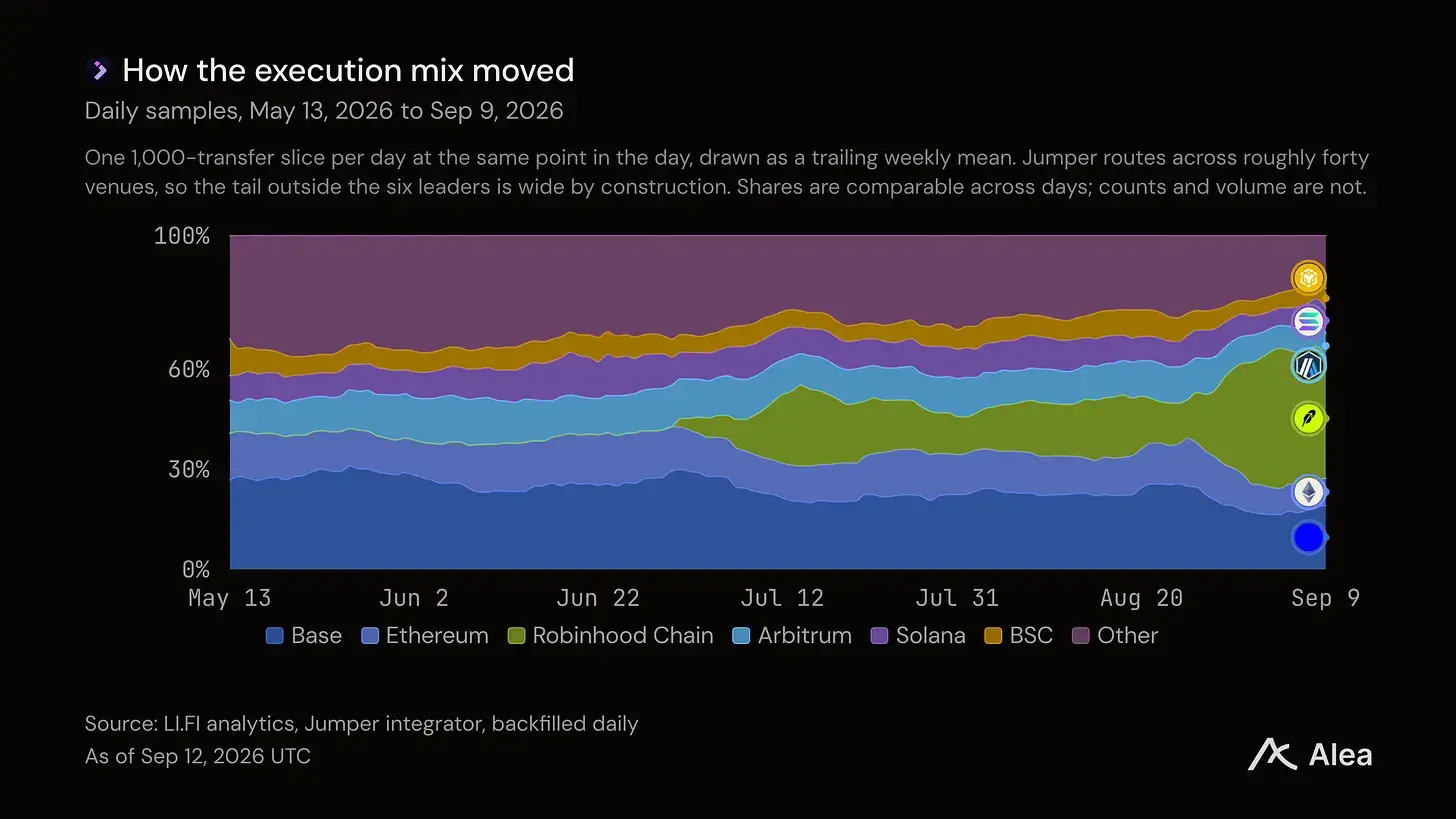 Statistics by routing counts rather than transaction value. The green Robinhood Chain surged to a quarter of the market share from a zero starting point in June.
Forty Types of Tokenized Assets and the Connected Liquidity Paths
The core of Robinhood Chain is tokenized US stocks, and Jumper serves as its important recharge channel. Among the 280 transfer samples that flowed into this chain, 52.9% arrived in ETH, and 36.1% arrived in USDG.
Every type of asset listed on Robinhood requires capital inflow before trading, and Jumper is the key path for delivering this capital.
The Intents mechanism enables one-click direct purchase of tokenized stocks. Users can input USDG on one chain and directly receive SPCX on Robinhood Chain, with matchmaking settlements completed by backend solvers bidding.
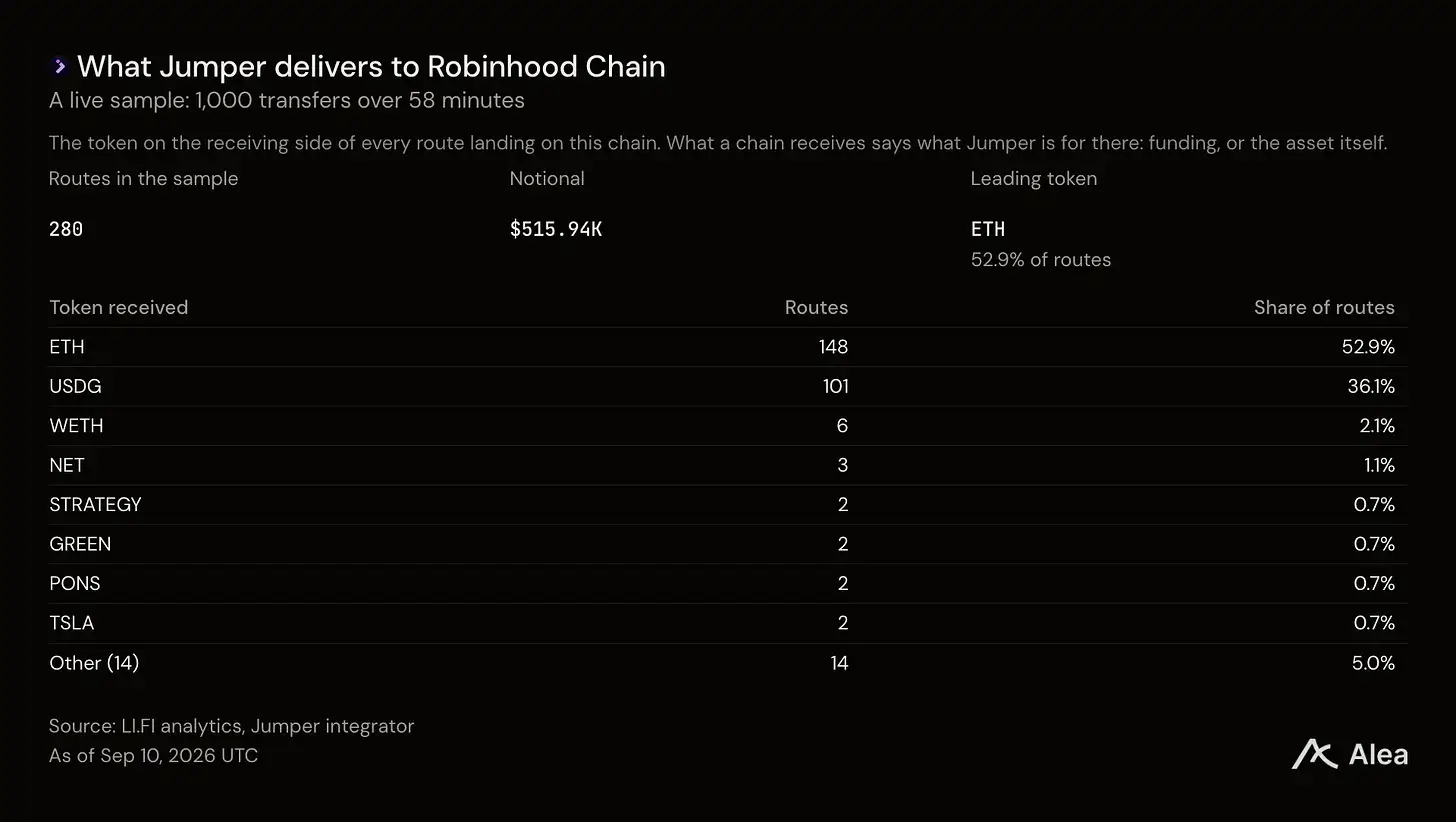 Ethereum and USDG carry the funds in, with stock trading completed after the funds arrive.
Application parties can access this link without building a complex underlying solver network; LI.FI has pushed this to over 1,000 integrators, including Robinhood Wallet, MetaMask, and Phantom. Jumper also independently operates a proprietary website (rwa.jumper.xyz), listing approximately 40 types of tokenized real-world assets (RWA), covering NVDA, SPY, gold, and short-term US Treasury bonds.
In the past four months, out of the 120,000 routes processed by Jumper, tokenized stocks only accounted for 34 cases. Jumper's self-operated front end is just one of many entry and exit points, and it is typically the least likely front end to handle final stock trades. The core strategy is to establish distribution pipelines in advance before real demand fully erupts. Capturing default channels for asset classes incurs the lowest costs when the scale of the category is still small.
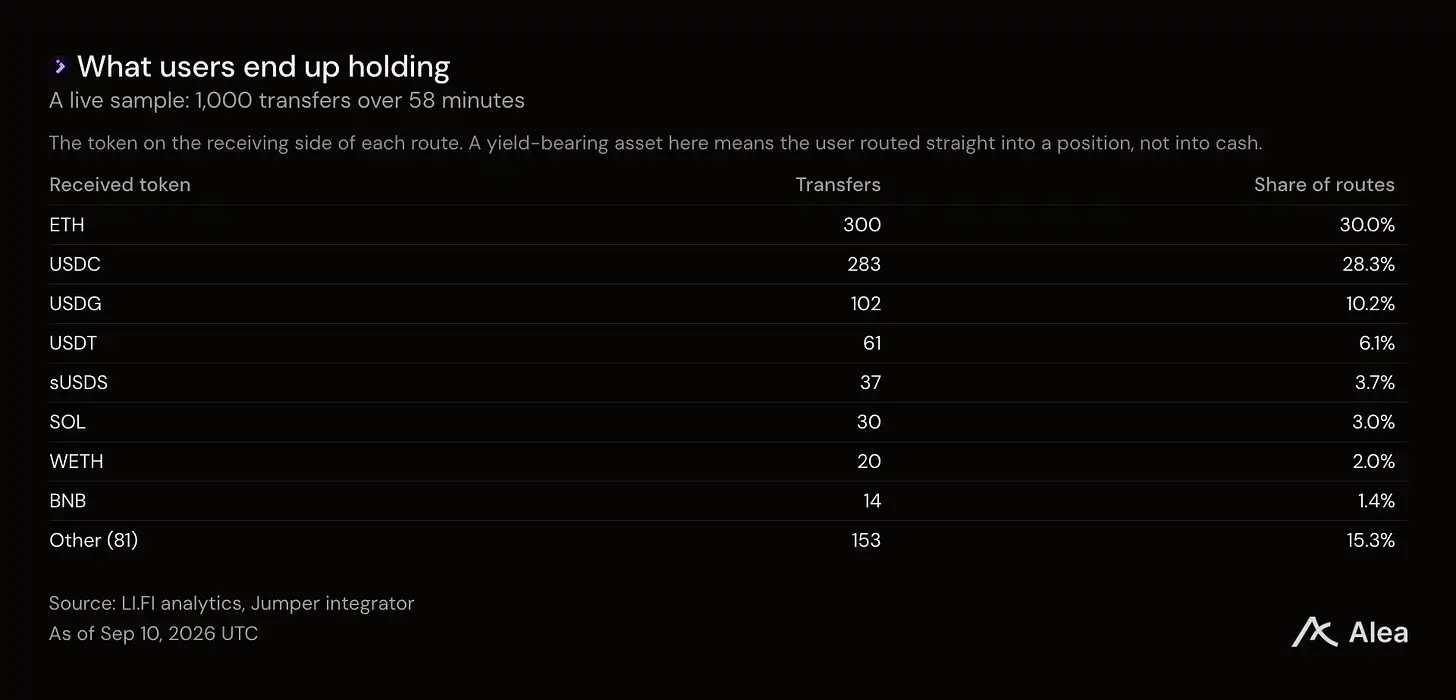 ETH and stablecoins currently account for four-fifths of the assets delivered by Jumper. sUSDS has now risen to third place, accounting for 7.5%.
The fragmentation of asset liquidity is far more severe than what the demand numbers reflect, which is also why the middle infrastructure layer can gain pricing power. For example, one share of Tesla corresponds to 11 different tokens on LI.FI's registry, scattered across 8 blockchains, minted by several institutions including Coinbase, Backed, Ondo, xStocks, and Robinhood; NVIDIA likewise has 11 different tokens. Users holding a token from one issuer cannot directly use it at another issuer's supported venue; an intermediary protocol must provide unified interchangeability.
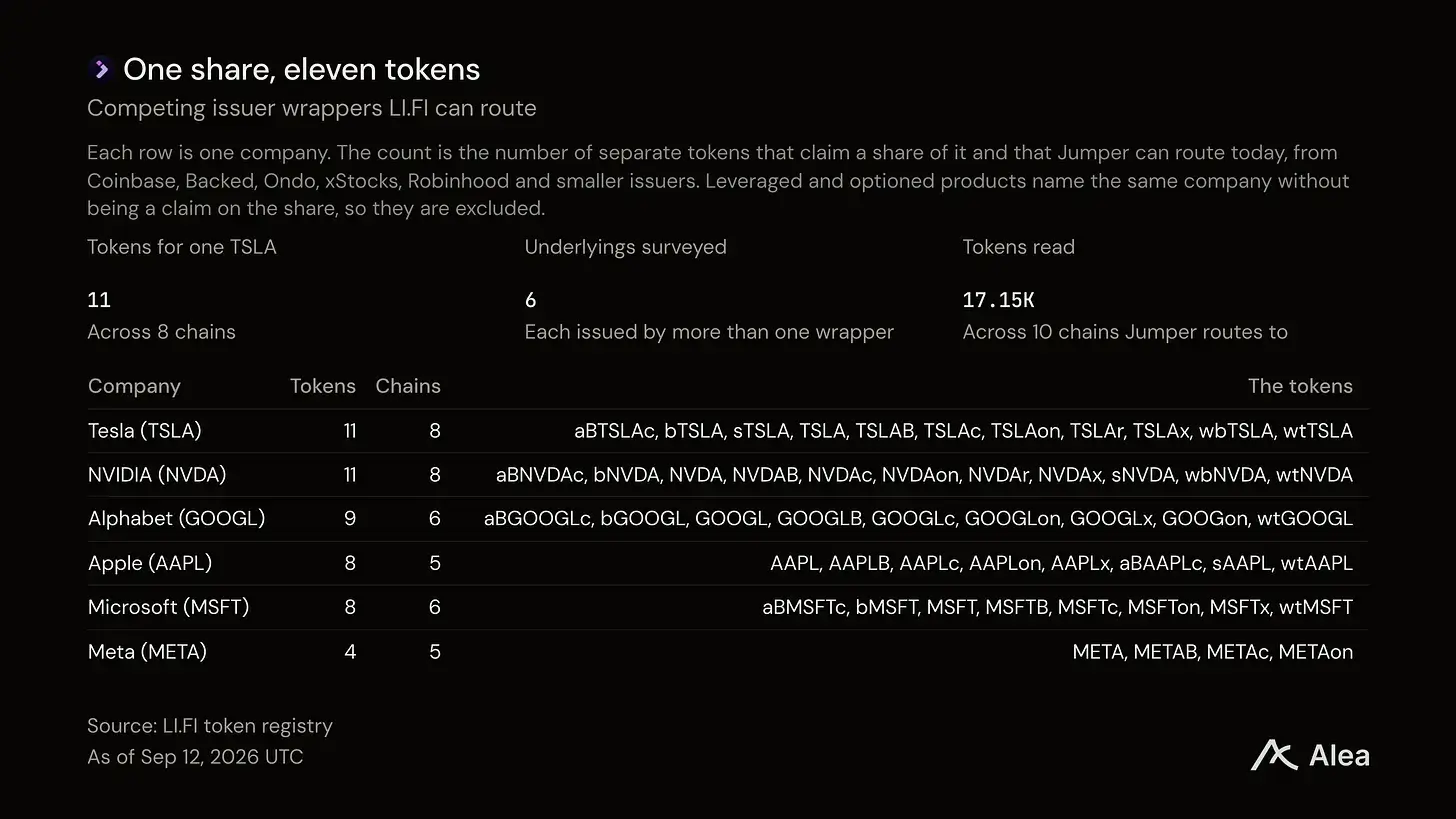 Just one share of Tesla has derived 11 independent tokens across 8 chains, and the same goes for NVIDIA.
Cost Structure of Fund Flows
In the first week of August, Jumper launched the Advance feature, supporting simulated exchanges, intelligent slippage, large order splitting, and offering limit order functionalities through CoW Swap and 1inch. Additionally, perpetual contracts and Solana quote simulation were added in August.
After the feature launch, the median transfer amount increased from $64.30 to $89.42. Conversely, the performance in the high amount range saw the 90th percentile amount drop by 10.8% to $2,116.34, with the proportion of transfers over $10,000 falling from 4.2% to 3.7%.
This change is mainly due to the increase in underlying transfer density. The time window to process 1,000 transfers has decreased from 2.65 hours to 1.97 hours. The absolute number of large transfers is actually increasing (from an average of about 380 per day to 445), but their proportion in the overall landscape is diluted because the overall small transfers are growing faster.
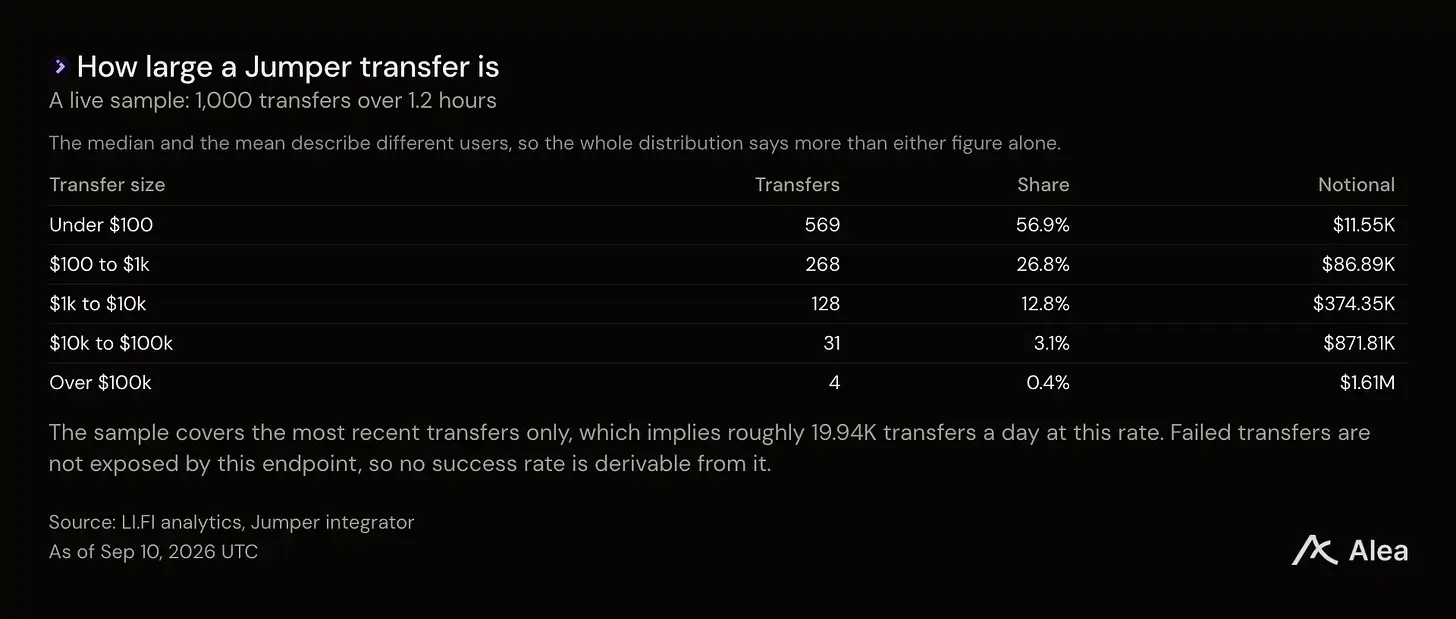 Four transactions over $100,000 accounted for $1.61 million; while 569 transactions under $100 collectively generated only $11,550.
The gas costs per transaction have remained stable, but the relative proportion varies greatly by amount: for transfers below $100, gas fees accounted for 0.077% of the total amount; while for transfers over $10,000, this proportion is less than 0.001%. Transactions under $100 dominate Jumper's overall counts (accounting for 589 out of every 1,000), while Advance is designed as a trading suite for large amounts.
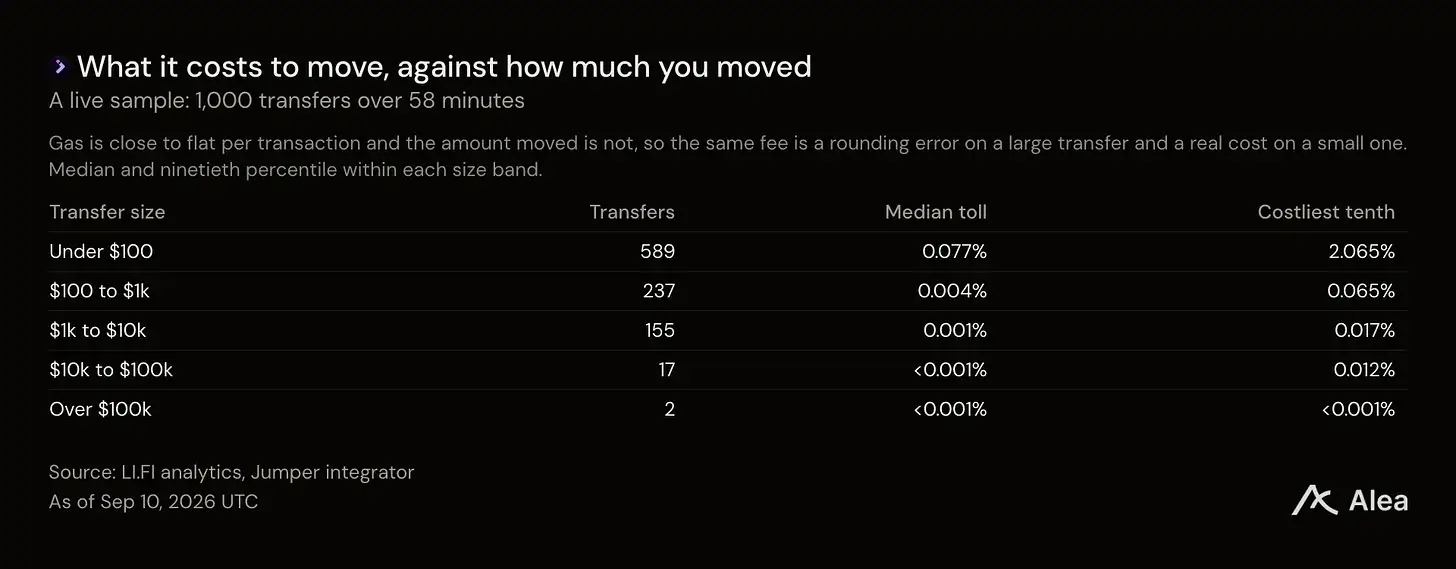 The same gas expenditure is nearly negligible for amounts over $10,000 but constitutes a significant actual cost for amounts under $100.
The choice of routing channels has shown a high degree of centralization during the same period. Relay's share in Jumper routing surged from 13.9% in mid-May to 34.0% on September 9 (calculated using a moving weekly average). The top six routing channels now account for approximately two-thirds of the routing share, while this proportion was only half in May.
LI.FI's own Intents channel currently runs at a share of 6.2%, owned entirely by LI.FI.
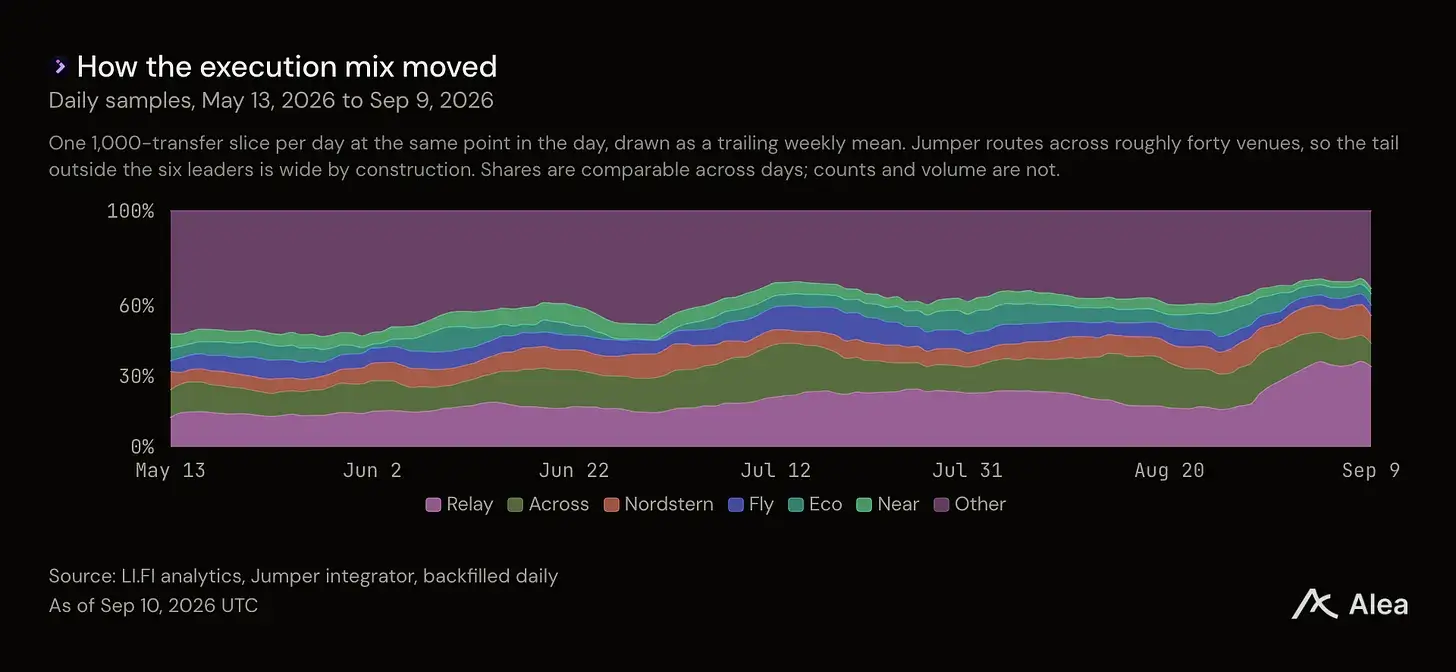 Relay absorbed most of the centralized shares from May to September; Intents remains a business line entirely controlled by LI.FI.
Arc will officially open on September 16
The launch of Circle's Arc mainnet will take place on September 16, and LI.FI will also launch simultaneous support from day one. This integration will bring on-chain currency exchange functionalities to Arc and connect all other supported ecosystems, while supporting one-click deposits. This mirrors the strategies employed by Jumper in June for Robinhood Chain and in August for Coinbase Base.
The underlying infrastructure has been running steadily throughout this quarter. Intents has been redeployed to the same address on all EVM chains and has been launched on Solana via sponsored transactions. The smart deposit address went live on August 19, converting on-chain operations into regular token transfers that do not require signature approvals.
Earn serves as the allocation layer. It currently indexes 250 vaults across 26 protocols. Aave holds $16.8 billion of this, accounting for 45.7%. Composer can access 95.2% of these vaults in a single transaction. In June, Earn added Compound, infiniFi, and Apyx vaults, in July, it added Plume's Nest vault, and in August, it introduced a 7-day and 30-day yield view labeled with insurance risk tags. It has now been integrated into MetaMask's Agent Wallet.
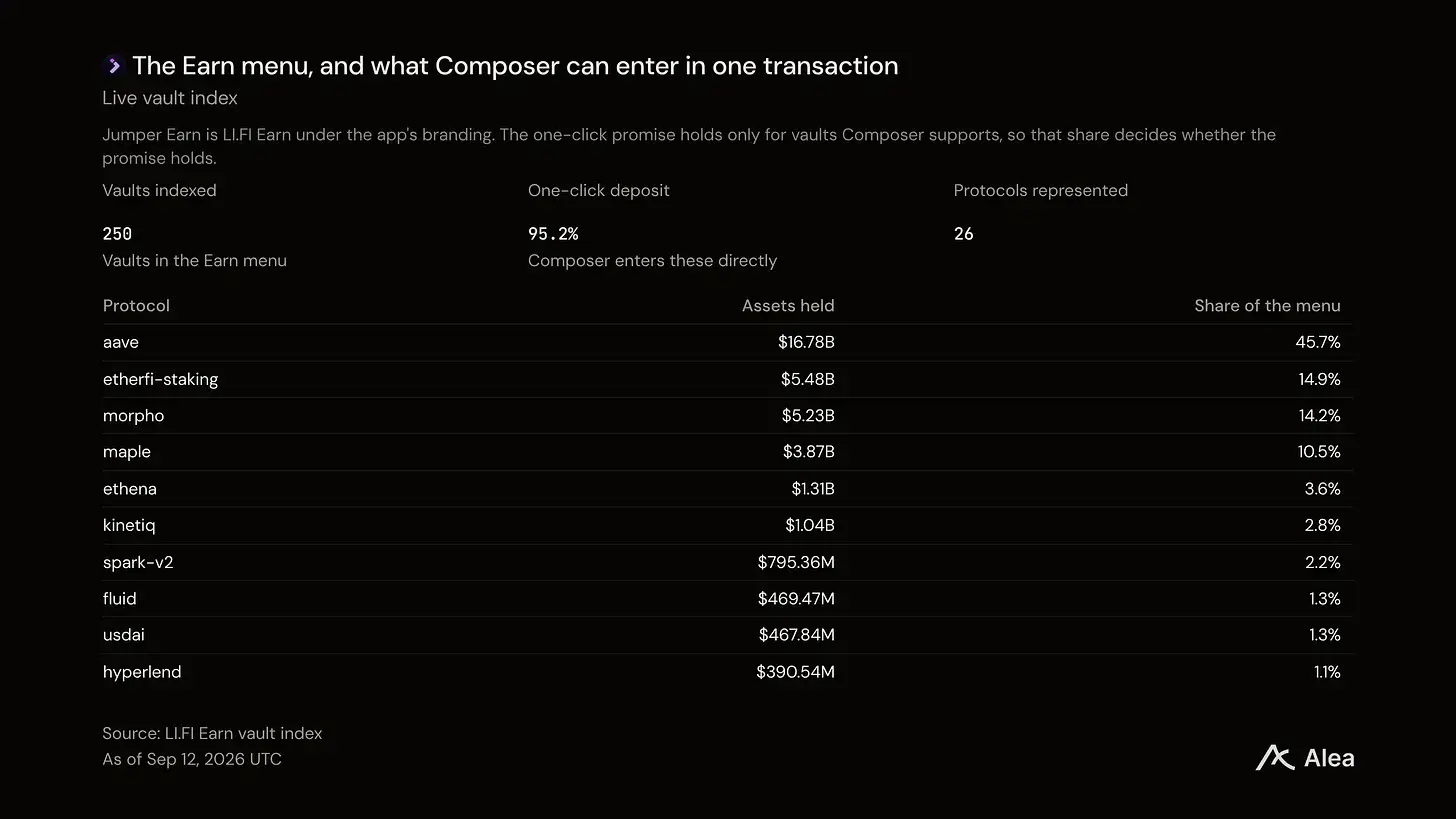 Composer can input 250 vaults covering 26 protocols in a single transaction menu, with 95.2% of the content being accessible.
Users can currently earn from 7.9% for a regular USDC vault to 24.4% for the highest on the list.
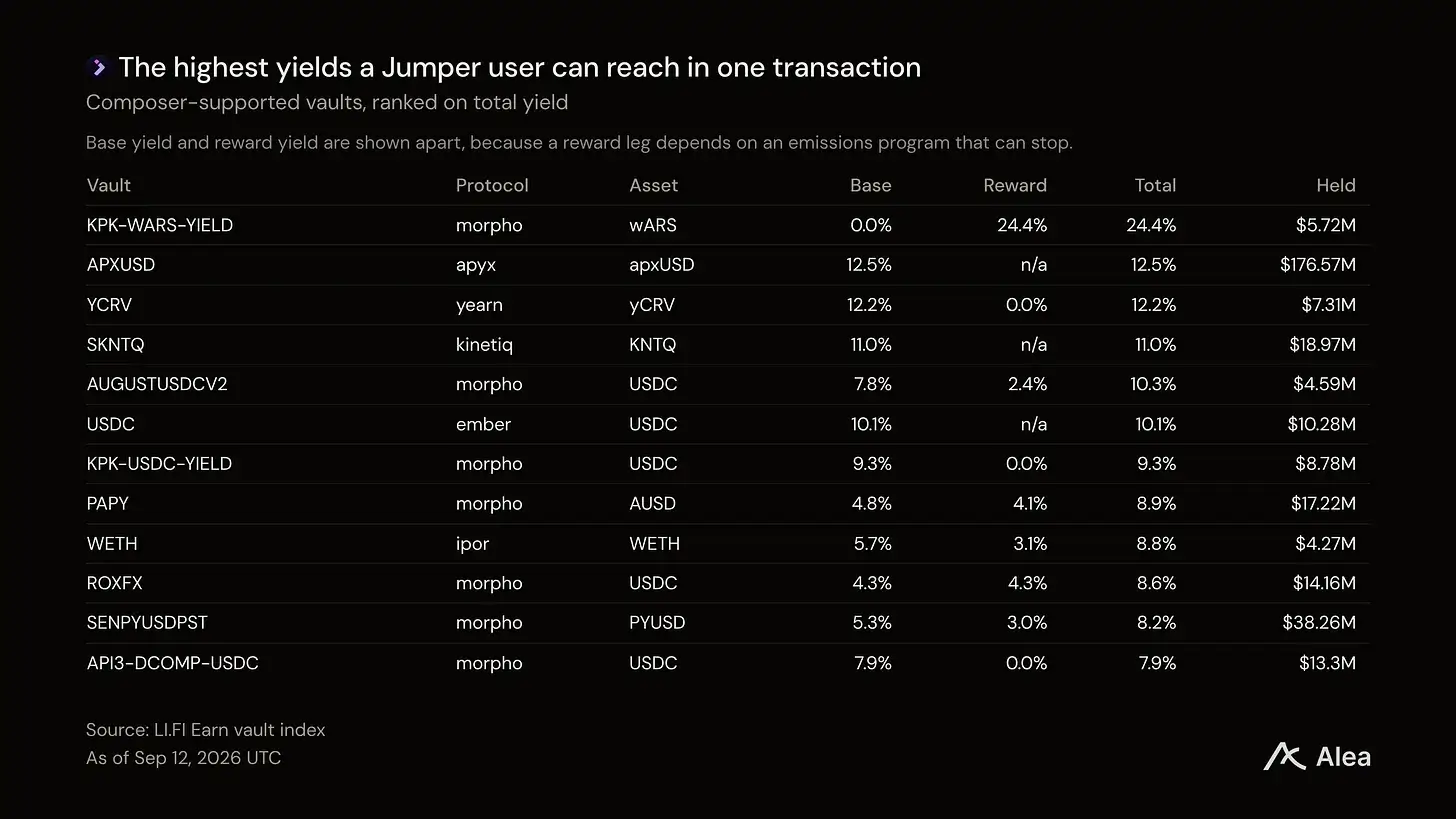 Basic earnings are marked separately from reward earnings, as reward earnings often depend on token incentive programs that may be terminated at any time.
Robinhood Chain surged to 7.9% of Jumper's trading volume in just 74 days. Arc will open on September 16 and has completed the exact same routing deployment. As new chains and application scenarios continue to emerge, the barriers of this distribution infrastructure are accumulating in a snowball effect—while in 2026, new networks are never absent.
This article link: https://www.hellobtc.com/kp/du/09/6446.html
Source: https://alearesearch.substack.com/p/three-huge-issuers-still-one-distribution?triedRedirect=true
免责声明:本文章仅代表作者个人观点,不代表本平台的立场和观点。本文章仅供信息分享,不构成对任何人的任何投资建议。用户与作者之间的任何争议,与本平台无关。如网页中刊载的文章或图片涉及侵权,请提供相关的权利证明和身份证明发送邮件到support@aicoin.com,本平台相关工作人员将会进行核查。


