Author: Juxtaposed Ideas
Translator: Deep Tide TechFlow
Deep Tide Guide: Infleqtion's neutral atom approach and modular laser systems support a compact, low-power quantum machine, and deployments in the government sector combined with collaborations with Eaton, Nvidia, etc., paint a comprehensive commercialization story; however, the expected revenue for FY2026 is only about $43 million, while the forward EV/Sales reaches as high as 53 times, with cash consumption, equity incentive dilution, and customer concentration compressing the safety margin. Analysts thus give a hold recommendation and suggest being more patient until entering around the $8 range.

I once wrote about IonQ (IONQ) in December 2025, discussing its huge TAM corresponding to future monetization.
This article turns to Infleqtion (INFQ), continuing around the mainline of quantum computing stocks.
INFQ's Quantum Narrative
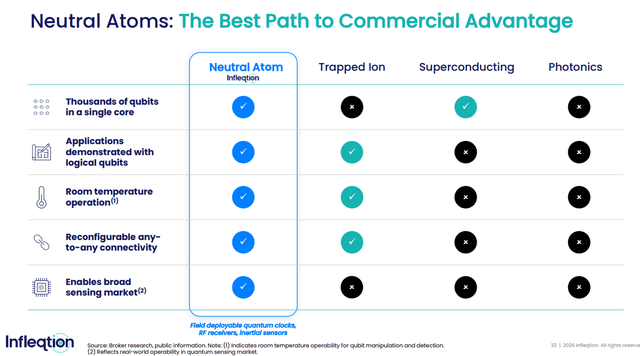
For those who are not yet familiar, INFQ is a vertically integrated "neutral atom quantum company," engaged in quantum computers, sensing systems, and software; management describes the neutral atom approach as the "best path to commercial advantage" compared to ion trapping, superconducting, and photonic routes.
The specific method is to build an "optical system that uses light to trap, move, and control atoms. This allows for large-scale atomic arrays that can change geometric structures according to different calculations and connect qubits without locking the machine into a permanent layout."
With the added modular laser systems/technologies that can rearrange atoms during program execution, INFQ repeatedly emphasizes its ability to minimize the cabinet’s volume, which is unsurprising.
Power consumption is also extremely low, "comparable to several household hair dryers, completely different from machines that require building power plants to run them."
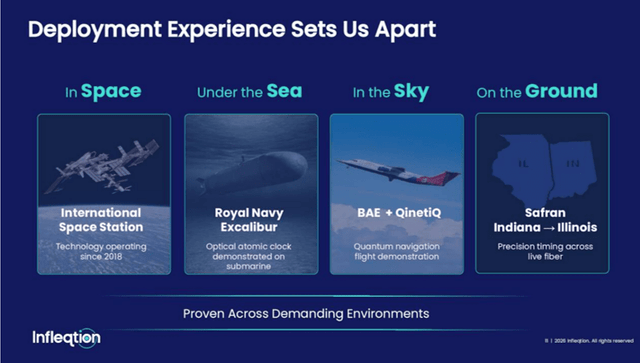
These characteristics may explain why INFQ has had multiple deployments in the government sector since 2018—while quantum computing is still in its early stages, it can deliver concept validation and push commercialization.
Looking ahead, management is clearly aimed at driving demand for quantum computing power and announced multiple collaborations with Eaton (ETN), Nvidia (NVDA), and others to jointly develop customer applications in energy, AI, and other end markets.
The collaboration with ETN allows INFQ to secure three new projects in the U.S. Department of Energy's Genesis mission that span AI, nuclear applications, and quantum sensing, further validating its quantum computing/sensing capabilities.
Additionally, its quantum sensing solution will be deployed to NASA's quantum gravity gradient sensor Pathfinder project, which is expected to become "the world's first space-based quantum gravity sensor."
With the rising interest in quantum products in the commercial sector, it’s understandable that INFQ's stock price could find support around $12 after receiving positive feedback during the FQ2'26 earnings call.
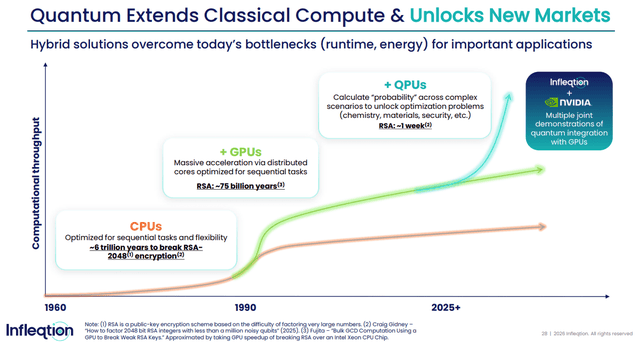
In addition to collaboration with NVDA, INFQ also maintains close cooperation with a leading AI foundry lab; a recent "OpenAI-supported company-wide hackathon" allowed this quantum company to "complete projects that previously would have taken months in just 24 hours."
These developments support management's statement that the CPU+GPU+QPU is a complementary platform used to "overcome the runtime and energy consumption bottlenecks faced by important applications today."
AI is also accelerating the pace of data/theorem exploration by about 2 times and may push the path to 1 million logical qubits forward—INFQ's current roadmap is 2 logical qubits in 2024, 12 in 2025, and management guides for 30 in 2026.
Thirty qubits are expected to improve reliability to a level "close to your laptop, server, or phone;" the next goal of 100 is viewed as a watershed for "beginning to solve important problems in material science, chemistry, and possibly AI that classical computers cannot tackle."
These dynamics indicate that INFQ is making solid progress on its technology roadmap—once quantum sensing/computing capabilities reach a real inflection point (that pun is intentional), it could contribute to both revenue and profit as broader quantum adoption accelerates.
Increased R&D Raises Cash Consumption and Balance Sheet Risks
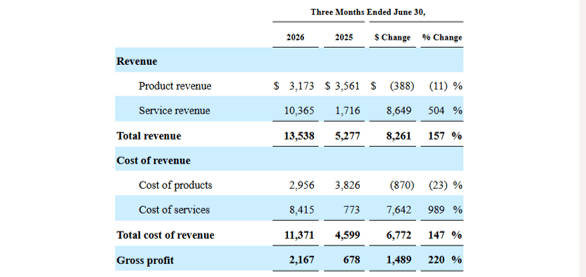
Due to the timing shift of recognizing revenue from two government contracts, INFQ's FQ2'26 revenue grew by 157% year-on-year, manufacturing leverage improved, and gross margin rose to 15.9% (up 3.2 percentage points year-on-year).
However, the number of technical positions increased by 25% year-on-year, and R&D expenses surged by 138% year-on-year, which also led to adjusted operating losses in FQ2'26 more than doubling.
This means that, before real improvements in manufacturing and operating leverage, INFQ's performance metrics may still be quite "bumpy."
Of course, increasing R&D might also accelerate the commercialization window for the mass market, corresponding to the accelerated technology roadmap discussed earlier.
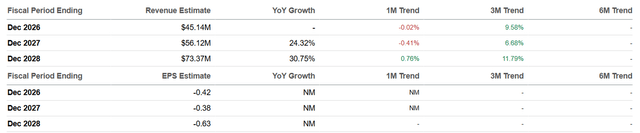
Thanks to the FY2026 revenue guidance being raised to $43 million (up 32.3% year-on-year), consensus expectations have also been revised upwards: INFQ is expected to maintain strong revenue growth of about +31.1% CAGR before FY2028.
Apart from the product/service monetization pace, management has also hinted that ultra-large-scale cloud vendors connecting to their quantum computers in the future could contribute more sustainable and repeatable revenue—this is based on the fact that they have already provided "private cloud access" to some clients.
However, INFQ seems to need to linger in the startup phase a bit longer: FQ2'26 cash consumption continued to expand, and management guided that "annual cash consumption will have another cautious adjustment" in 2027, thus bottom expectations are quite varied.
Based on adjusted operating losses of $30.2 million for H1'26 and net cash outflows from operating activities of $5.97 million, this quantum sensing/computing company may continue to consume its $582 million in net cash on the balance sheet (up 2.2% quarter-on-quarter).
More striking is the H1'26 equity incentive (SBC) expense amounting to $20.35 million (up 982% year-on-year), with SBC/revenue ratio reaching 92.1% (up 78.9 percentage points year-on-year), which poses considerable mid-term dilution risk.
In FQ2'26, customer A accounted for 82% of revenue, and for H1'26 it was 74%; if their procurement strategy changes, concentration risk will immediately become evident.
At this point, a hold rating is assigned to INFQ
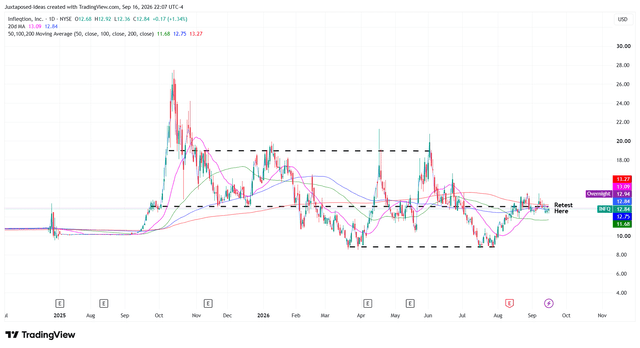
Currently, bulls have managed to hold INFQ's trading floor around $8 twice; however, after rebounding double digits from the low in July 2026, momentum has shown fatigue, with the stock price consolidating near $12 since mid-August 2026.

INFQ's forward EV/Sales ratio remains as high as 53.01 times, compared to a recent low of 32.46 times and a sector median of only 3.43 times, obviously overpriced.
Placing INFQ's expensive 53.01 times forward EV/Sales alongside consensus expectations of approximately +31.1% three-year revenue CAGR against quantum peers:
- IBM (International Business Machines) about 4.14 times / +4.4%
- D-Wave Quantum (QBTS) about 132.18 times / +81.8%
- IONQ about 27.83 times / +101.3%
- Rigetti Computing (RGTI) about 199.94 times / +126.7%
- Quantum Computing (QUBT) about 29.94 times / +443.6%
It can be seen that INFQ's startup type and high growth pace have already been overpriced in the valuation.
Additionally, about 10.78% of the relatively high short interest may bring volatility, and the stock price's failure to break through the $14 resistance makes it prudent to assign a hold rating to INFQ at this moment.
INFQ’s structure on quantum sensing monetization pace is not weak, but I believe quantum investments are still in the early stage, and the high growth already priced in leaves almost no safety margin.
Interested investors might better wait for another round of pullback, back to the already validated $8 trading floor, to discuss a better entry point.
For now, I suggest a bit more patience.
Analyst Disclosure: The author/its team holds beneficial long positions in NVDA through stock holdings, options, or other derivatives. This article is independently written by the author, expressing personal views; no other compensation has been received aside from Seeking Alpha, and there is no commercial relationship with the companies mentioned in the text. The analysis is for informational reference only and does not constitute professional investment advice; please conduct your own thorough research and due diligence before investing, as trading involves various risks including loss of principal.
免责声明:本文章仅代表作者个人观点,不代表本平台的立场和观点。本文章仅供信息分享,不构成对任何人的任何投资建议。用户与作者之间的任何争议,与本平台无关。如网页中刊载的文章或图片涉及侵权,请提供相关的权利证明和身份证明发送邮件到support@aicoin.com,本平台相关工作人员将会进行核查。


