Author: Gary Alexander
Translation: Shenchao TechFlow
Shenchao Introduction: In the context of a potential market correction and the high valuations of AI infrastructure facing pressure, Seeking Alpha analyst Gary Alexander reiterates a buy recommendation for MongoDB (MDB). The company's annualized revenue is nearing $3 billion, with a year-over-year growth rate accelerating to approximately 30%, driven by AI native customers and a pay-as-you-go billing model; the author believes that relative to its growth potential, the current valuation remains reasonable.
If the market enters a correction, year-end investments need to be more cautious. The author is particularly wary of those "meme stocks" that have risen primarily due to AI infrastructure themes this year—valuations are high, and once investors shift their focus to higher yields, these stocks will come under pressure. However, within the software sector, there are still several targets for "growth at a reasonable price."
MongoDB (MDB) is one such example. This unstructured database company continues to accelerate growth and demonstrates that AI is a genuine tailwind for its business, rather than just a narrative many software companies verbally espouse. Meanwhile, the author notes that since January of this year, MongoDB's stock price has remained roughly flat—unlike many other tech stocks, there has not yet been an uncontrolled surge here.
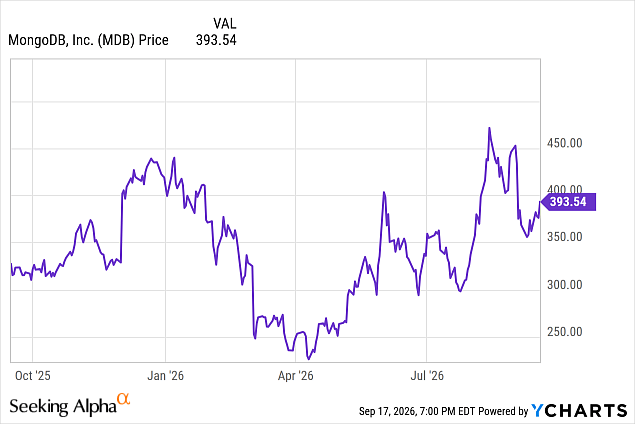
The author's last buy recommendation for MongoDB was in June, when the stock price was about $330. Since then, the price has risen about 20%, but the author believes this rebound is fully supported by fundamentals. The acceleration in revenue comes from new product traction and a sustained increase in new customer numbers; he confidently reaffirms the buy rating.
For investors who are not yet familiar with MongoDB, the author summarizes the key bullish reasons as follows.
First, it continues to accelerate growth on a large scale. MongoDB is currently achieving about 30% year-over-year revenue growth, further accelerating from the earlier low twenties growth rate. The company’s annualized revenue has essentially reached around $3 billion, yet it can still expand at this rate—few companies can maintain high growth at this scale, which indirectly indicates that its market opportunity is sufficiently unique. The company is also increasing its quota-carrying sales force to meet strong demand.
Second, it has a pay-as-you-go billing model and long-term tailwinds. The so-called "SaaS apocalypse" has been exaggerated, but one point remains valid: software companies that charge based on seats will face pressure from companies resizing their workforce due to AI replacing jobs. MongoDB does not have this risk—its pricing is based on data consumption, and as AI usage increases, data consumption only grows.
Third, new products are directly targeting AI demand. MongoDB's Voyage AI product is gaining strong traction, specifically helping with document retrieval, allowing AI models to query relevant data from the underlying database more swiftly.
Fourth, the business is highly scalable and well above the "Rule of 40." The company’s expected gross margin is in the high seventies; combined with an efficient sales model, overall performance far exceeds the Rule of 40 threshold and continues to generate healthy cash flow.
The author also acknowledges that MongoDB is certainly not a value stock, but relative to its growth potential, he believes the pricing is reasonable. The current stock price is slightly below $400, with a market capitalization of approximately $31.69 billion; subtracting the latest balance sheet's $2.41 billion cash and having no debt, the enterprise value is about $29.28 billion.

For FY27 (the fiscal year ending January 2027), the company has raised its full-year revenue outlook to $2.99 billion–$3.03 billion, corresponding to a full-year growth rate of approximately 22%–23% (previously projected at 19%–20%, a significant upward revision). Looking at FY28, Wall Street expects revenue of about $3.57 billion, representing approximately 18% growth. Based on this, MongoDB's valuation multiples are approximately:
Enterprise value multiple of about 9.7 times FY27 revenue; about 8.2 times FY28.
For a company growing at about 30%, this cannot be considered cheap, but it is also not expensive. The author compares it to similar back-end infrastructure software stocks like JFrog (FROG) and Snowflake (SNOW)—which often trade at higher multiples.
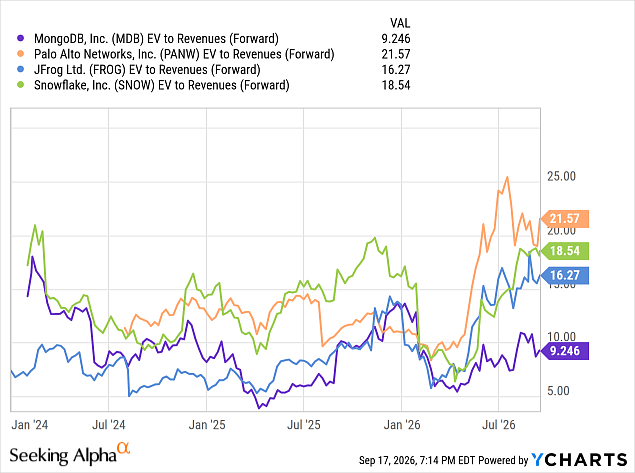
In the author's view, there is still room for MongoDB's recent rise. Continue to hold.
Second Quarter Breakdown
Let’s take a closer look at the latest quarterly report. The summary of second-quarter performance is as follows:
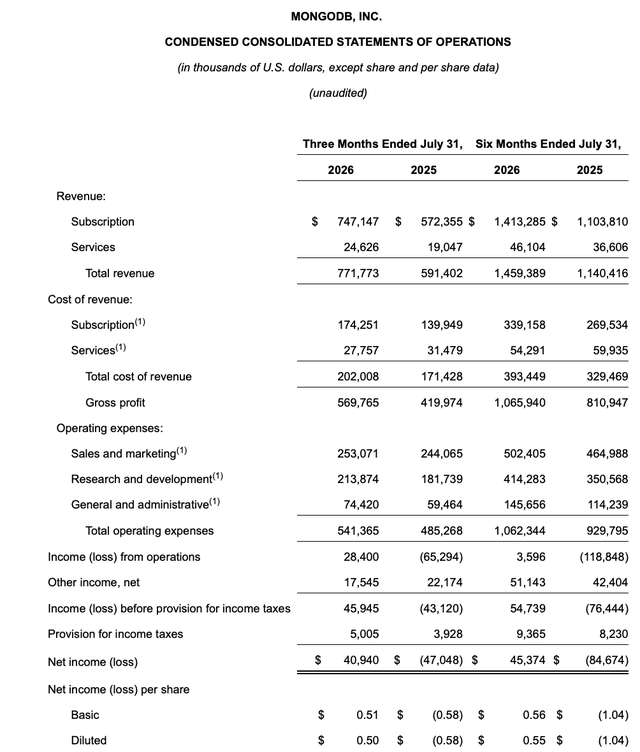
MongoDB's revenue grew by 31% year-over-year to $771.8 million, significantly exceeding Wall Street's expectation of $734.4 million (year-over-year +24%), surpassing by about seven percentage points. More notably, the street initially expected the company to decelerate from a 25% growth rate in the first quarter, but MongoDB instead accelerated by six percentage points.
The introduction of new products and the increase in new customers are the sources of this significant revenue outperformance. As shown in the figure below, the total number of customers for the quarter reached 70,600, an 18% year-over-year increase, with a net addition of 2,900 new customers for the quarter.
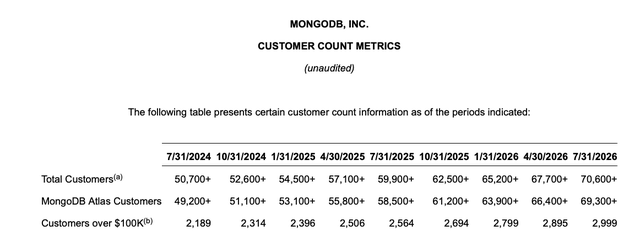
The company stated that most of the new customers are AI native customers. It is worth noting that approximately three-quarters of MongoDB's revenue comes from the fully managed Atlas product, which saw a year-over-year revenue growth of 29% to $565.9 million; the Enterprise Advanced (EA) product targeted at larger clients wishing to self-host MongoDB infrastructure grew even faster, with a year-over-year increase of 35% to $181.2 million.
The adoption of new products, increased data usage, and rising consumption all contributed to heightened revenue growth and improved net retention. CFO Michael Berry mentioned in the second-quarter conference call:
This marks the sixth consecutive quarter of year-over-year dollar incremental growth for Atlas, with a record addition of $127 million this quarter. The main growth drivers this quarter remain the strong performance in North America and among the largest customer base, especially for customers with annual recurring revenue (ARR) over $100,000, consistent with the upmarket momentum discussed in recent quarters. This momentum is also reflected in the company's net ARR expansion rate, which rose to 122% for the quarter compared to 119% a year ago and 121% last quarter. The quarter-over-quarter improvement was driven by both Atlas and EA sides. The company continues to see momentum from the AI native customer group and various AI signals, including the adoption of vector search, new Voyage customers, and a continued increase in clusters connected via MCP.
In terms of profitability, the adjusted operating margin increased by 9 percentage points year-over-year to 24%, bringing MongoDB's Rule of 40 score to an impressive 54. The company plans to allocate incremental resources towards quota-carrying sales personnel and marketing initiatives, but the author believes that with strong revenue growth, this will not dilute the profit margin.
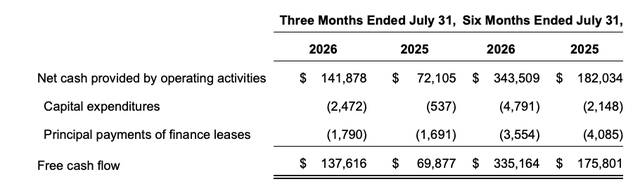
For the first half of FY26, free cash flow increased by 91% year-over-year to $335.2 million, as shown in the figure below:
Risks and Key Points
Of course, there are also risks to be aware of. One of the macro risks that the entire market is closely monitoring is the government's increased regulation on the AI industry or the potential for planned slowdowns in development. MongoDB's growth is entirely based on usage, and past consumption trends have also fluctuated; if a planned slowdown occurs, it would suppress its growth rate.
Even so, in the context of recent acceleration in growth and revenue being more evenly distributed among more customers and products, the author believes that there are far more tailwinds than headwinds ahead. Continue to hold.
Disclosure: The author/ their team holds beneficial long positions in MDB through stocks, options, or other derivatives; this article is written by the author and expresses their personal views; no compensation is received for this article outside of Seeking Alpha; there is no commercial relationship with the company mentioned in this article. Seeking Alpha disclaims: past performance does not guarantee future results; the opinions in this article do not constitute investment advice and do not necessarily reflect the overall stance of Seeking Alpha.
免责声明:本文章仅代表作者个人观点,不代表本平台的立场和观点。本文章仅供信息分享,不构成对任何人的任何投资建议。用户与作者之间的任何争议,与本平台无关。如网页中刊载的文章或图片涉及侵权,请提供相关的权利证明和身份证明发送邮件到support@aicoin.com,本平台相关工作人员将会进行核查。


