Author: Claude, Deep Tide TechFlow
In this round of old coin rebounds, ZEC, NEAR, and UNI have taken most of the discussions, while the voice of Pendle in the DeFi sector is much quieter.
However, a closer look reveals that PENDLE's price has also kept up. As of September 18, PENDLE has risen by 91.8% in the last month.
What is easier to overlook is that Pendle is still repeating what it has always done best in past market cycles: as long as new narratives generate profit, it can turn those profits into markets, allowing transaction fees to flow back to PENDLE.
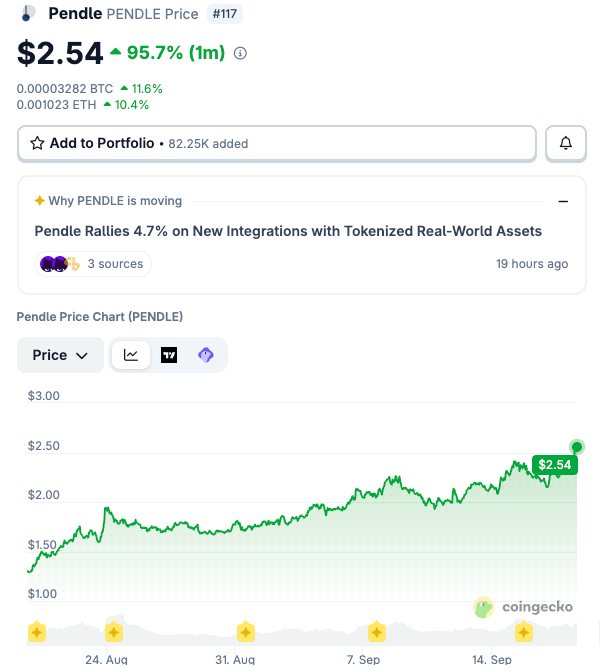
Recently, many have referred to this market cycle as "old coin rebound," but Pendle is actually a rare outlier among these older projects. While many old coins are waiting for funds to rediscover or upgrade past stories, Pendle has been continuously providing trading tools for new stories.
Its product model treats future earnings as a product, with the underlying assets that carry the earnings being replaceable at any time. The previous cycle involved LSD staking tokens and airdrop points, while this cycle has shifted to money market funds, private equity infrastructure, and on-chain stock dividends.
During the peak of liquidity staking, it split staking rewards; when points became a mainstream gameplay, YT became a tool to amplify point exposure; as high-yield stablecoins emerged, users returned to Pendle to lock in interest rates.
As a result, the crypto community has started to refer to a way of observation: looking at what earnings markets Pendle has launched can almost reveal which types of new assets and narratives funds are pursuing.
This observation is actually a great way to grasp crypto hotspots, as it allows one to reverse engineer popularity from fund movements. The author feels this is closer to real money than various marketing pitches.
For an asset to form a market on Pendle, it needs a clear source of earnings and maturity date, as well as liquidity and users willing to trade PT and YT.
The appearance of a new narrative in Pendle's market list indicates that it has transitioned from social media topics into fund pricing. Trading volumes and implied yields will also inform users how much funds are willing to pay for this narrative.
What Pendle has listed reveals what funds are chasing
Pendle can move with the narratives because the objects it trades have remained unchanged.
Once an income-generating asset enters Pendle, it will be split into PT and YT. PT can be understood as a fixed-income certificate, which users buy at a discount and redeem at face value upon maturity; YT contains interest, points, or dividends generated before maturity.
If earnings exceed market expectations, YT buyers earn even more. The narrative, issuer, and chain may change, and sources of earnings may shift, but this splitting method can continue to be reused.
The current hot narrative is clearly RWA and on-chain stocks. Pendle's shelves have closely followed current events, recently expanding the RWA earnings market in partnership with the tokenization infrastructure platform Asseto.
Asseto is responsible for tokenizing fund assets on-chain, managing asset correspondences, legal structures, and redemption processes; Pendle then separates the principal of these tokens from future earnings, allowing users to trade fixed income and earnings volatility. Traditional funds thus transition from tokens that can only be held and redeemed to PT and YT with market quotes.
An already listed product on Pendle is AMCASH+. This token is supported 1:1 by the U.S. dollar digital currency market fund under Huaxia Fund, the underlying fund primarily invests in short-term deposits and high-quality money market instruments. Hong Kong Stock Exchange data shows that this fund managed about $603 million by the end of July. AMCASH+ brings money fund shares onto the chain, while Pendle allows users to lock in the fund's yield in advance or buy YT to bet on subsequent interest changes.
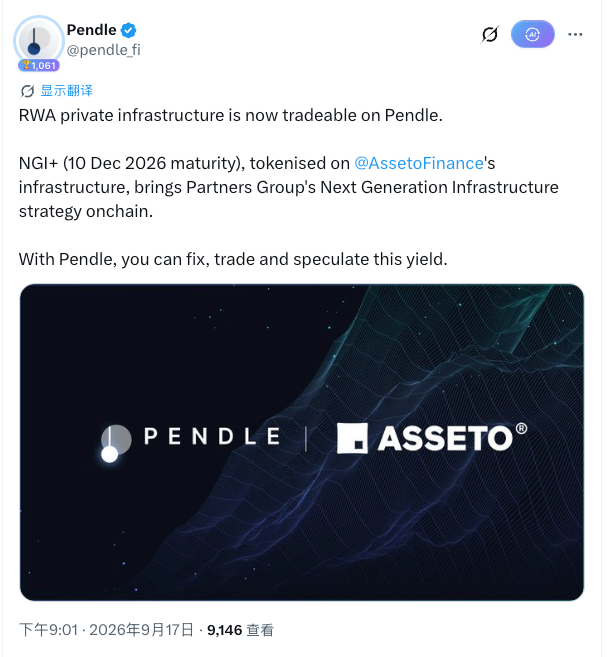
On September 16, Asseto announced that its latest product NGI+ has officially launched on the Pendle Ethereum market. NGI+ provides on-chain exposure linked to the net asset performance of Partners Group's next-generation infrastructure strategy, with underlying funds directed towards private market assets such as data centers, power grids, energy, and transportation.
After completing tokenization, Pendle established PT, YT, and liquidity markets for NGI+. The private equity infrastructure exposure originally held according to the fund's net value now has a new trading method: locking in returns for a certain period or directly trading the fluctuations of these returns.
Additionally, Pendle has opened up dividend markets for tokenized stocks of NVIDIA and Pfizer on the Robinhood Chain. Robinhood has already issued over 190 stock tokens, with stock price increases benefiting shareholders while dividends can continue to be split into PT and YT. The competition for tokenized U.S. stocks has extended from issuance and custody to who sets the prices, trades, and charges for dividends.
Moreover, the interests of money funds, investment returns from private infrastructure, and dividends from listed companies originally belonged to three sets of very distant financial products; at Pendle, they can all be viewed as future cash flows.
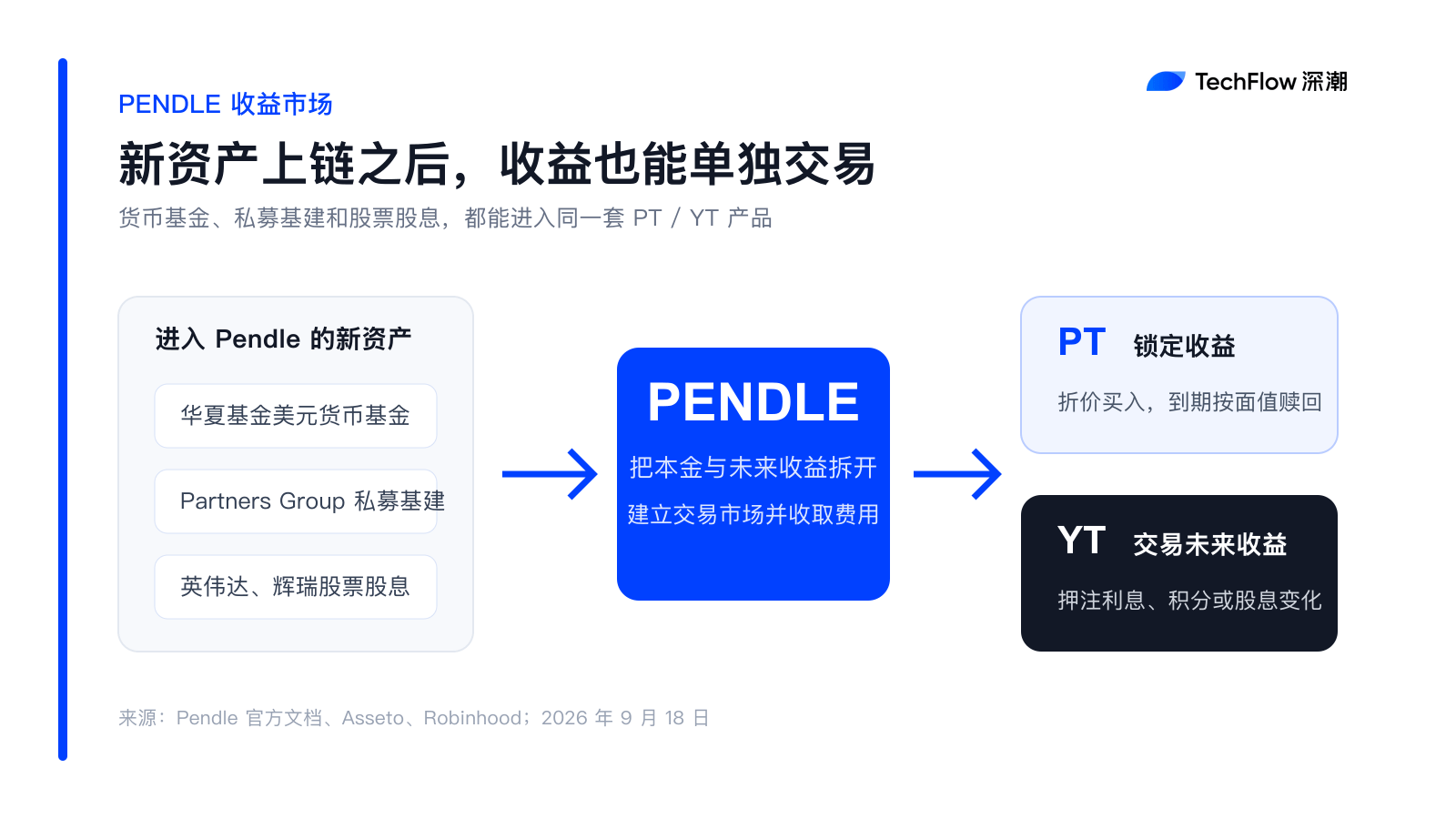
This also explains why Pendle frequently appears alongside new narratives. The protocol does not need to predict which asset will become a hotspot in advance; when funds begin to chase new earnings, Pendle has the opportunity to open another market.
Furthermore, RWA has also changed the nature of earnings on Pendle's shelves. Staking rewards and airdrop points typically fluctuate with project incentives; once enthusiasm wanes, trading cools down quickly; however, interests from money funds, infrastructure returns, and corporate dividends come from off-chain asset operations, which can continue to generate earnings monthly or quarterly.
Pendle simultaneously has active trading in crypto yields, as well as longer-duration traditional cash flows. Therefore, the narrative implicit in the PENDLE token, to some extent, reflects the exchange's increasing ability to generate commodities.
New earnings begin to enter PENDLE token buyback
Many old DeFi projects struggle with the disconnect between product growth and token performance.
Users engage with the protocol, fees stay in the treasury, and token holders can only wait for the market to view the so-called protocol growth as a sign for rising token prices. However, without direct measures like revenue buybacks that empower the token, many things are castles in the air.
After Pendle replaced vePENDLE with sPENDLE this year, this link has been shortened.
According to current protocol rules, Pendle collects a 5% fee from the earnings and points accumulated from YT, and trading between PT and YT will also generate trading fees. After deducting the portion allocated to liquidity providers, the remaining trading fees and all YT earnings fees will have 80% used for publicly buying back PENDLE, while the treasury and operations each receive 10%.
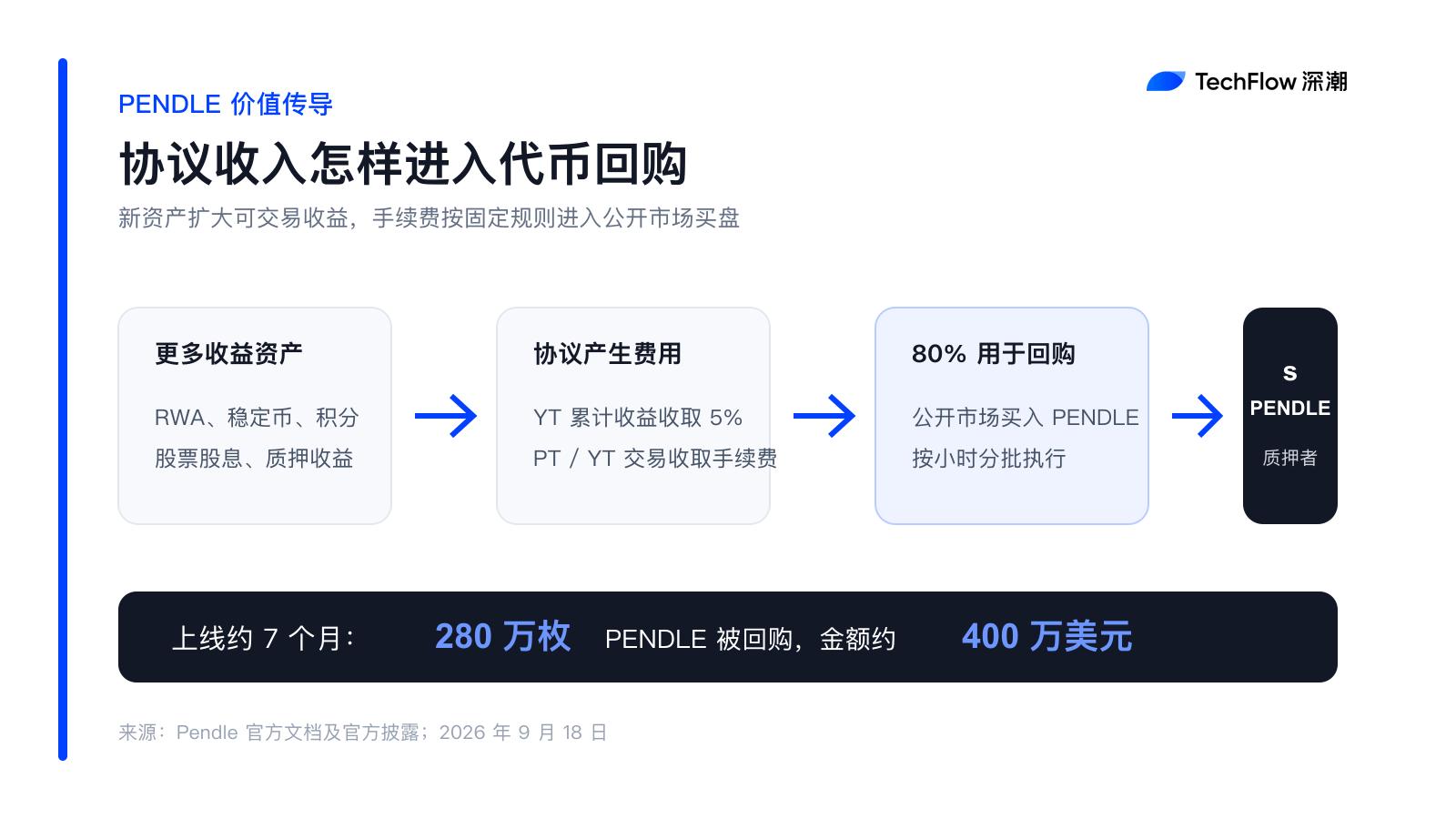
Fees are collected bi-weekly, and the buyback contract buys PENDLE hourly during the following week. Tokens purchased will be distributed entirely to active sPENDLE stakers. Spot holders receive buying pressure from the public market, while stakers directly obtain tokens bought back with protocol revenue.
The buyback has presented verifiable data. Pendle officially disclosed that approximately 7 months after the launch of sPENDLE, the protocol has bought back over 2.8 million PENDLE from the public market, spending approximately $4 million, with all acquired tokens being distributed to sPENDLE stakers. Based on the current circulating supply of about 173.6 million tokens, the buyback amount represents 1.6% of the circulating supply.
Another set of data highlights the change in supply. The PENDLE emission has decreased by 78% since the beginning of the year, with current annual inflation around 0.5%; the proportion of tokens bought back this year has already exceeded 1.5%. According to the ratios published by the official sources, the buyback scale has surpassed three times the current annual new supply.
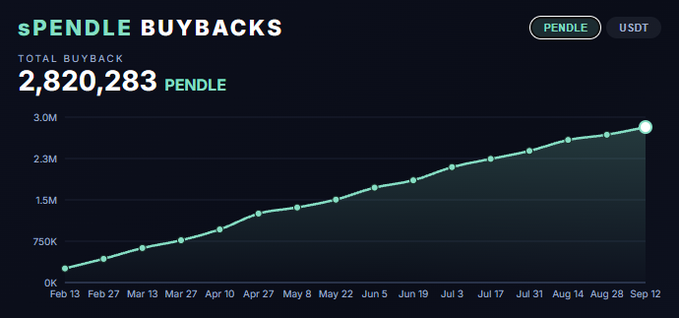
Players interested can find more real-time data on the Pendle official sPENDLE interface. As of September 18, at the time of writing, the latest cycle of the last 12 cycles has not yet settled, while the other 11 cycles have collectively bought back approximately 1.857 million PENDLE. Actual transactions are executed by the on-chain contract published in the official documentation.
Overall, the ongoing listing of RWA products has added a new batch of longer-term charge markets.
Dividend assets on the Robinhood Chain can also directly use the ready-made PT and YT structures. Pendle retains the trading brought by the hot topics within the protocol revenue, subsequently converting it into public market buy pressure through buybacks.
This is where PENDLE benefits within the new narrative.
As the market rushes to find the next new coin for RWA, don't forget about Pendle, this older project. It has already connected new assets, new earnings, and token buybacks into a business capable of recurring charges.
免责声明:本文章仅代表作者个人观点,不代表本平台的立场和观点。本文章仅供信息分享,不构成对任何人的任何投资建议。用户与作者之间的任何争议,与本平台无关。如网页中刊载的文章或图片涉及侵权,请提供相关的权利证明和身份证明发送邮件到support@aicoin.com,本平台相关工作人员将会进行核查。


