Written by: Rita
The travel and shared economy sectors dropped last week, while digital advertising rose, showing significant divergence within internet stocks. Morgan Stanley's report released on September 16, 2026, indicated that AI uncertainty has resurfaced, but the valuation of internet leaders is still discounted compared to historical levels. The expected P/E ratios for Amazon, Google, and META in 2026 are 19 times, 17 times, and 20 times, respectively, which are discounts of 34%, 35%, and 9% compared to their respective averages over the past 12 months.
Analyst Brian Nowak from Morgan Stanley noted in the report that the market is reassessing the sustainability of AI, with the travel and shared economy sectors performing the worst last week; ABNB dropped 6.5% and BKNG fell 10%. The digital advertising sector remained relatively resilient, led by META. The firm believes that the valuation discount and profit growth will support internet leaders, but AI uncertainty may suppress short-term sentiment.
Leader valuations still below historical levels
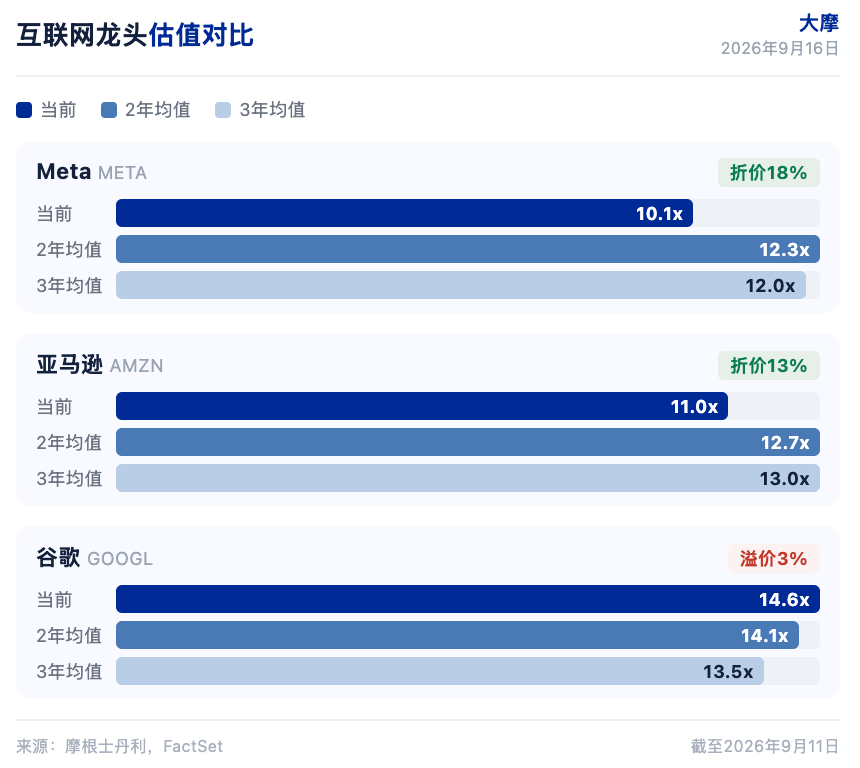
The NTM EV/EBITDA multiples (forward value multiples) for Amazon, Google, and META are 11.0 times, 14.6 times, and 10.1 times, respectively, reflecting discounts of 13%, premiums of 3%, and discounts of 18% compared to two-year averages, and discounts of 15%, premiums of 8%, and discounts of 16% compared to three-year averages. Morgan Stanley pointed out that META and Amazon exhibit the most obvious valuation discounts, reflecting market concerns about AI investment returns and regulatory risks.
In the internet sector covered by Morgan Stanley, the digital advertising market weighted average rose 1.4% last week, e-commerce dropped 0.6%, travel fell 8.1%, and the shared economy decreased 5.2%. The travel sector experienced the largest decline, mainly affected by concerns that AI search alters user booking habits. Morgan Stanley believes that the AI uncertainty for travel platforms is the highest, as AI agents may directly complete bookings, bypassing traditional platforms.
SBC adjustments widen the gap
Morgan Stanley specifically noted in the report that if stock compensation is considered as a cash expense, the EV/EBITDA multiples of internet companies would average 36% higher. In the digital media sector, the adjusted multiple for PINS rose from 9.0 times to 27.5 times, DUOL from 18.5 times to 38.7 times, and RDDT from 19.6 times to 29.0 times. In the e-commerce sector, EBAY rose from 24.6 times to 29.7 times, and FIGS from 23.8 times to 33.0 times.
Morgan Stanley believes that the adjusted valuations after SBC better reflect the actual cash expenses of the companies. For companies with a high proportion of SBC, the adjusted valuation multiples are significantly higher than the reported values. Investors need to consider the impact of SBC when comparing the valuations of internet companies. The adjustments for META and GOOGL are relatively small, at 13% and 19%, respectively, while PINS and DUOL have adjustments exceeding 100%. This difference indicates that the distortion caused by SBC varies greatly among different companies and cannot be generalized.
Travel sector has the highest AI risk
The travel sector dropped 8.1% last week, with ABNB and BKNG leading the decline. The market worries that AI agents may change the travel booking process, with users completing bookings directly through AI, bypassing traditional platforms. Morgan Stanley believes that the AI risk is highest for travel platforms because the standardization of the booking process is high, making it easier for AI agents to intervene.
The shared economy sector fell 5.2% last week, with UBER, DASH, and LYFT all declining. Morgan Stanley believes that the AI risk in the shared economy is relatively low, as it involves offline services and real-time scheduling, making it difficult for AI agents to completely replace them. However, market sentiment is cautious, leading to a drop in the sector following travel. The difference in the declines of travel and the shared economy reflects varying market assessments of AI replacement risks for different business models.
Digital advertising is relatively resilient
The digital advertising sector rose 1.4% last week, with META increasing by 5.1%, SNAP by 3.8%, and RDDT by 2.1%. Morgan Stanley believes the AI risk in digital advertising is the lowest, as ad placement and performance measurement have become highly automated. AI serves more as an efficiency tool, posing little threat of replacement. META's continued improvement in AI recommendations and ad targeting capabilities is the main reason for the sector's leadership.
Within the internet sector covered by Morgan Stanley, META's expected P/E ratio for 2026 is 20 times, reflecting a 9% discount to the 12-month average. GOOGL's expected P/E ratio for 2026 is 17 times, reflecting a 35% discount to the average. AMZN's expected P/E ratio for 2026 is 19 times, reflecting a 34% discount to the average. Morgan Stanley believes the valuation discounts for Google and Amazon reflect market concerns about AI capital expenditures and margin pressures, while META's smaller discount indicates stronger market confidence in its AI monetization capabilities.
Valuation signals mixed
Morgan Stanley pointed out that the internet sector's NTM EV/EBITDA multiple is 12.4 times, reflecting a 9% discount to the 5-year average and a 17% discount to the 10-year average. The NTM EV/Sales multiple is 4.9 times, reflecting a 17% premium to the 5-year average and an 18% premium to the 10-year average. The combination of EV/EBITDA discounts and EV/Sales premiums reflects a shift in the profitability structure of internet companies, with revenue growth outpacing profit releases.
Looking at individual stocks, META has the largest EV/EBITDA discount, reaching 18%, while GOOGL still has a 3% premium. This divergence shows that market expectations for AI investment returns differ across companies. Morgan Stanley believes that META's path for AI monetization in its advertising business is clearer, while Google and Amazon have larger scales of AI capital expenditures and more evident margin pressures.
Morgan Stanley lists downside risks including sustained AI uncertainty suppressing valuations, accelerated AI replacement in the travel sector, inflated valuations post-SBC adjustment, and macroeconomic weakness impacting ad spending. Upside risks include AI agents improving ad efficiency, travel platforms successfully integrating AI, and valuation discounts attracting capital inflows.
If AI agents indeed change the travel booking process, will the valuation discount for travel platforms continue to widen, or could this present a new buying opportunity?

Disclaimer
This article is a summary and interpretation of a third-party brokerage research report (Morgan Stanley, September 16, 2026) by Chao Xiang Research, combining publicly available market information. The ratings, target prices, profit forecasts, and related judgments cited in the text represent the views of the brokerage analysts and only reflect their institution's position, not the views of Chao Xiang Research, and do not constitute any investment advice.
The market has risks, and decisions should be made independently. This article should not be used as the basis for buying or selling any securities.
免责声明:本文章仅代表作者个人观点,不代表本平台的立场和观点。本文章仅供信息分享,不构成对任何人的任何投资建议。用户与作者之间的任何争议,与本平台无关。如网页中刊载的文章或图片涉及侵权,请提供相关的权利证明和身份证明发送邮件到support@aicoin.com,本平台相关工作人员将会进行核查。


