Written by: Rita
The S&P 500's earnings per share (EPS) grew by 51% year-on-year in the second quarter, and grew by 26% over the past four quarters, far exceeding the historical relationship between long-term trends and economic growth. Goldman Sachs pointed out in its U.S. equity outlook report published on September 17, 2026, that the market's concern over an "earnings bubble" is unfounded. The bank's baseline scenario is a deceleration of profit growth without collapse, predicting EPS growth of 11% in both 2027 and 2028, reaching $415 and $460, respectively.
Goldman Sachs analyst Ben Snider noted in the report that the current extraordinary profits have three temporary drivers. Capital expenditure on AI has contributed nearly half of this year's profit growth. Semiconductor profit margins are at multi-decade highs. The equity investment returns of big tech companies have boosted reported profits. These three factors will weaken next year, and profit growth will return to normal levels.
Extraordinary Profits but Not a Bubble
Valuation signals indicate that the market is skeptical about the sustainability of current profitability. The forward P/E ratio of the S&P 500 is 19 times, in line with the 10-year average. However, the market P/E calculated based on trend earnings has only been surpassed during the peak of the Internet bubble in the past few decades.
Goldman Sachs forecasts that EPS will be $415 in 2027 and $460 in 2028. This forecast is close to the bottom-up market consensus of $419 and higher than the median top-down strategist forecast of $403. The bank predicts a 14% return for the S&P 500 over the next 12 months, with a target of 8,700 points. Profit growth is the main driver of bull markets, not valuation expansion.
AI Capital Expenditure Contributes Nearly Half
AI capital expenditure is the biggest driver of profit growth this year. The largest firms are expected to spend $800 billion on capital expenditures this year, a year-over-year increase of 94%. These expenditures are directed to semiconductor, technology hardware, industrial, and utility companies, collectively contributing about half of the S&P 500's profit growth. Goldman Sachs anticipates that capital expenditures will increase to $1.2 trillion in 2027 and $1.4 trillion in 2028.
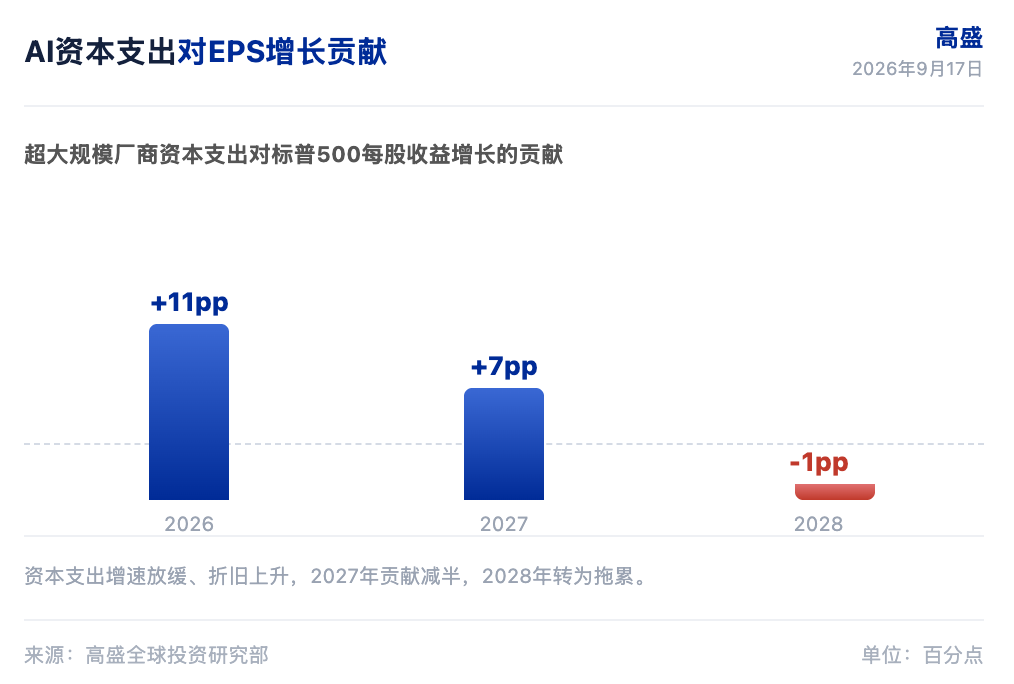
As capital expenditure growth slows, depreciation expenses will rise. Goldman Sachs estimates that depreciation from large firms will drag down profit growth by about 5 percentage points in 2027, offsetting nearly half of the 11 percentage points contributed by capital expenditure. By 2028, the drag from depreciation will completely offset the profit boost brought by capital expenditure. The tailwind from AI investments on profits is turning neutral or even dragging down.
Goldman Sachs pointed out that if capital expenditure in 2027 is $250 billion higher than the baseline, profit growth for the S&P 500 will increase by about 6 percentage points. If capital expenditure drops by about 30% to $570 billion, AI infrastructure-related profits will decrease by about 40%, but will still be about 25% higher than the 2025 level.
Sustaining Semiconductor Profit Margin Expansion is Challenging
Semiconductor gross margins are at a multi-decade high. The gross margin of S&P 500 semiconductor companies is around 70%, more than double historical levels. Goldman Sachs estimates that about a quarter of the 2026 semiconductor profit growth will come from gross margin expansion. Analysts at the bank expect supply-demand tightness to continue until 2027, but the pace of margin expansion will noticeably slow down next year.
If semiconductor gross margins fall from 70% to the 15-year average of 55%, the S&P 500 profits will decrease by about 10%. Every 1 percentage point change in gross margin corresponds to about a 1 percentage point change in S&P 500 EPS growth. Goldman Sachs noted that current profits are extremely sensitive to semiconductor prices, and a slowdown in AI infrastructure investment or an increase in supply could trigger a retreat in margins.
Equity Investment Returns to Diminish Next Year
The equity investment returns of big tech companies have boosted reported profits. In the second quarter of 2026, approximately $150 billion of equity investment income was recorded, raising the S&P 500 EPS by 12%. Goldman Sachs expects additional income in the second half of 2026, but at a smaller scale compared to the second quarter. In 2027, this portion of the income will decrease significantly.
If this income is completely excluded, profit growth in 2027 will rise from 11% to 18%. Goldman Sachs emphasized that this income is part of reported profits and does not reflect core business profitability. The market has already anticipated this; semiconductor stocks have recently lagged behind profit forecasts, showing that investors are wary of profit quality.
Valuation Does Not Reflect Bubble Burst
The current return on equity for the S&P 500 is 24%, the highest in history. According to historical relationships, this level corresponds to a forward P/E ratio exceeding 21 times. The current P/E ratio of 19 implies a return on equity of about 22%, 200 basis points lower than the current level, tied for the highest in history with 2021.
Upside risks include AI capital expenditure exceeding expectations; if large firms increase their capital expenditure by $250 billion in 2027, profit growth will rise by about 6 percentage points. Downside risks include a slowdown in AI investments, a retreat in semiconductor profit margins, and the disappearance of equity investment returns. Goldman Sachs believes that the market pricing has reflected expectations for profit deceleration but has yet to reflect the scenario of a bubble burst.
Profit slowdown has become a consensus, with the core divergence being whether AI productivity can take over capital expenditure and become a new profit driver.
Disclaimer
This article is a整理与解读 of third-party brokerage research reports (Goldman Sachs, September 17, 2026) by潮向研究, combined with整理 of publicly available market information. The ratings, target prices, earnings forecasts, and relevant judgments quoted in this article are solely the views of the analysts at that brokerage, representing their institution's position and not the views of潮向研究, nor do they constitute any investment advice.
The market carries risks, and decisions should be made independently. This article should not be taken as a basis for buying or selling any securities.
免责声明:本文章仅代表作者个人观点,不代表本平台的立场和观点。本文章仅供信息分享,不构成对任何人的任何投资建议。用户与作者之间的任何争议,与本平台无关。如网页中刊载的文章或图片涉及侵权,请提供相关的权利证明和身份证明发送邮件到support@aicoin.com,本平台相关工作人员将会进行核查。


