Author: Jae, PANews
On September 17, a notice from the U.S. Securities and Exchange Commission (SEC) drove the crypto market "from red to green."
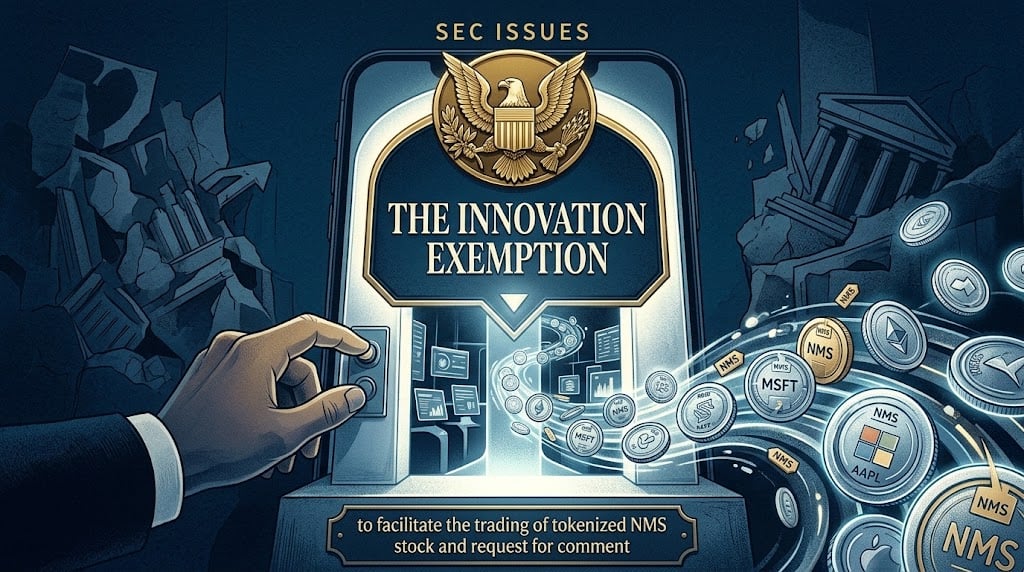
Just two days after the setback of the "Clarity Act," the SEC quickly introduced the highly anticipated "Innovation Exemption" framework: within a five-year temporary exemption period, eligible Tokenized Securities Venues (TSV) can trade certain National Market System (NMS) stocks through on-chain Automated Market Makers (AMM) and liquidity pools.
In the longer-term regulatory landscape, the endgame points towards a next-generation on-chain U.S. stock market for round-the-clock trading.
Pilot Implementation Grants Temporary Exemption for On-Chain Securities
This Innovation Exemption is essentially a five-year sandbox experiment initiated between the traditional securities regulatory framework and on-chain trading markets.
The exemption loosens restrictions for two types of entities:
Tokenized Securities Venues (TSV): Temporarily exempts the definition of "exchange" under the Securities Exchange Act, allowing them to operate on-chain tokenized stock trading under specific models. However, TSVs are not completely open, unlicensed markets but rather use licensed AMM liquidity pools to facilitate trading and set participant admission standards.
Liquidity Providers: Market makers providing their own funds to TSV AMM pools can obtain a temporary exemption for the definition of "dealer" after meeting the conditions.
The SEC has not definitively categorized TSVs and liquidity providers but indicated that it “does not preset conclusions.” During the five-year exemption period, it will observe market data to understand the operational patterns of tokenized securities before deciding whether to formulate systematic long-term regulatory rules. In simple terms, it opens the door for the market to start moving, and the data that emerges will serve as a draft for future regulations.
For the industry, the benefit of this model is that it reduces regulatory uncertainty, providing a clear experimental path for innovative projects; however, the cost is also clear: the regulatory arrangements after five years still hold many variables.
Four Regulatory Red Lines: True Rights, Reject "Price Tracking"
The SEC has set four constraints for the "Innovation Exemption," each responding to market controversies regarding tokenized securities and delineating the bottom line for investor protection and market integrity.
1. Regulatory Target: Controlled Entities
TSVs must be U.S. entities and comply with the economic and trade sanctions regulations of the U.S. Office of Foreign Assets Control (OFAC).
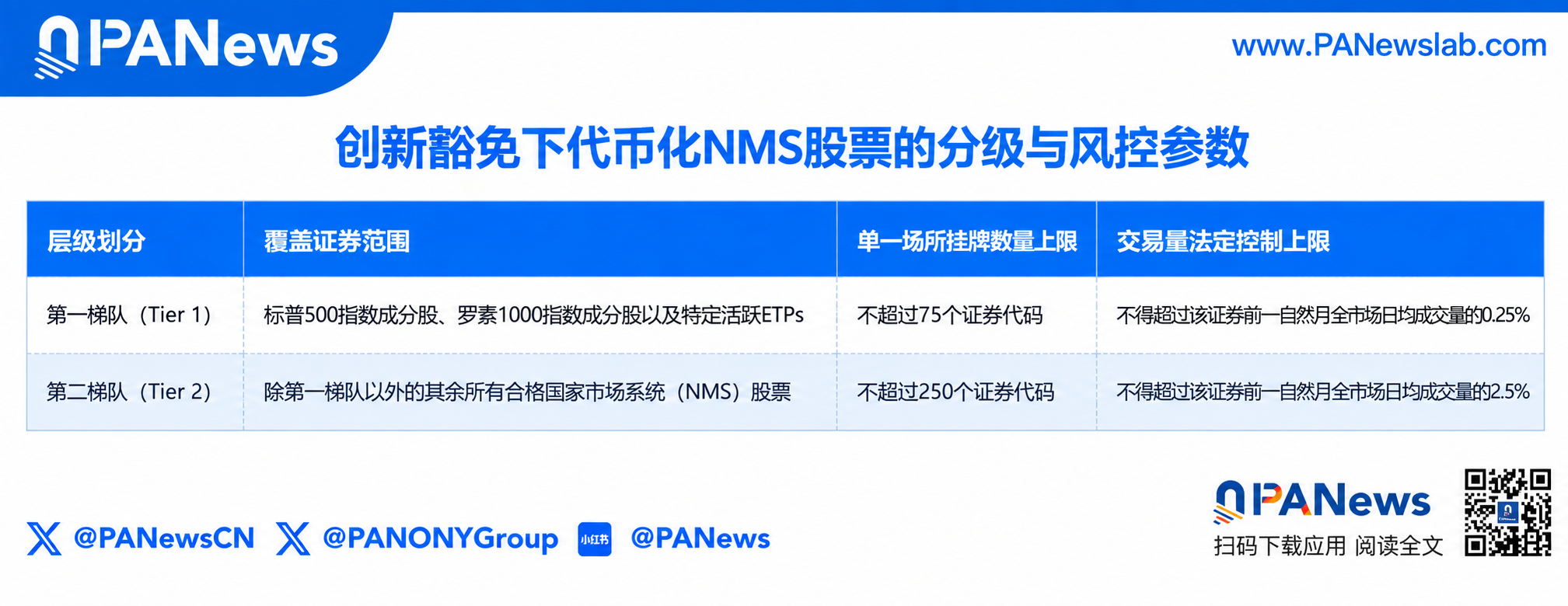
2. Scale Regulation: Limited Deregulation
Eligible tokenized NMS stocks are subject to limits on the number of shares and trading volume. This fundamentally determines that the "Innovation Exemption" is merely a regulatory experiment, not a full deregulation of stock on-chain.
3. Same Stock, Same Rights: No Discount on Shareholder Rights
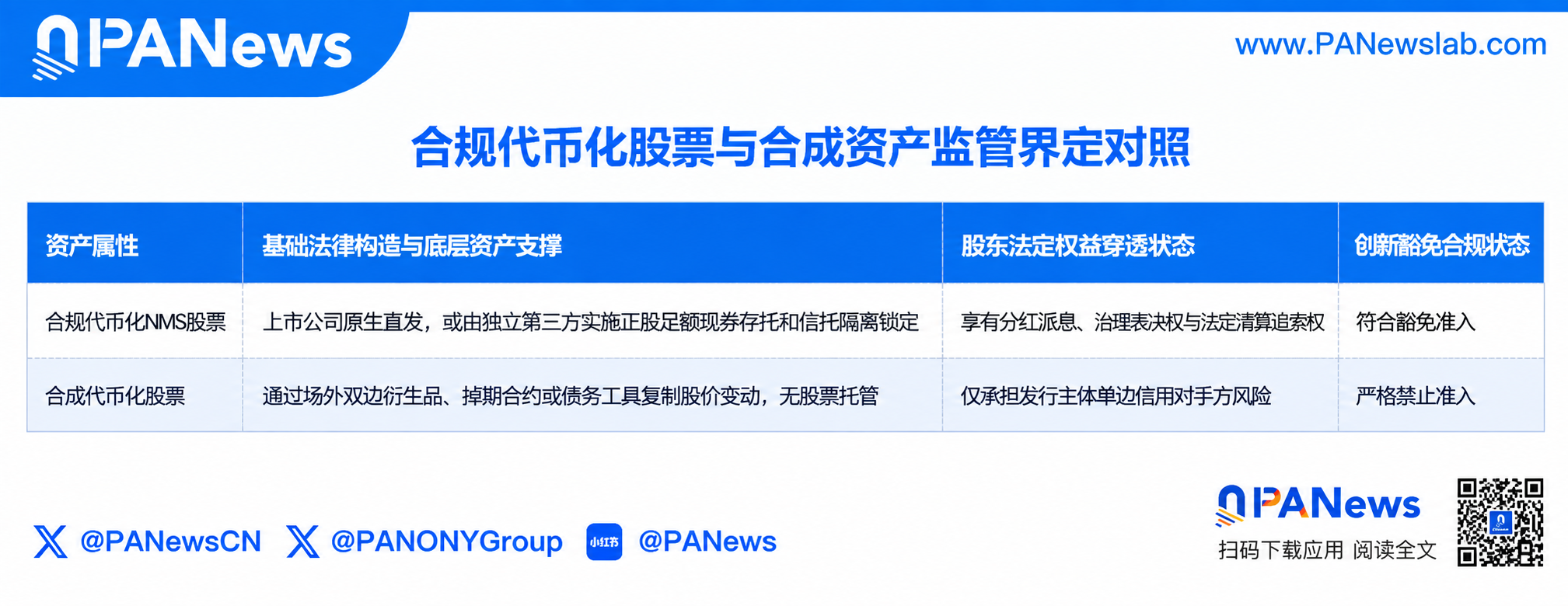
TSVs must ensure that holders of tokenized stocks will receive exactly the same rights as traditional stockholders, including dividends, voting rights, and other primary shareholder rights.
This regulation delineates the boundary between compliant and non-compliant entities, with the SEC explicitly ruling out synthetic products that merely replicate stock price performance. SEC Chairman Paul Atkins emphasized that tokenized stocks meeting the "Innovation Exemption" must represent true securities rights, not price exposures created through derivative structures. This means that a large number of "stock tokens" on the market that only track U.S. stock prices without providing shareholder rights are not covered by this "Innovation Exemption."
4. Issuer Objection Rights: Respect for Entity Rights
For third parties issuing tokenized stocks, TSVs must provide written notice to the stock issuer in advance and allow the issuer an opportunity to object. This design balances institutional innovation with the intentions of listed companies, but may also restrict the coverage of certain popular targets.
This month, AMC CEO Adam Aron and Robinhood CEO Vlad Tenev engaged in a heated debate on X regarding "Robinhood Chain's unauthorized launch of AMC synthetic stocks." Now, the latter two rules provide a preliminary conclusion.
Moreover, if the underlying stock is suspended from trading on its primary listing exchange, the corresponding tokenized stock must also stop trading. The on-chain market cannot operate outside the rules of the traditional market; the standards of market integrity apply equally.
Setting Rules for On-Chain Securities Intermediaries
On a technical level, the SEC's requirements remain consistent: the trading infrastructure can change technology, but the transparency standards cannot be lowered.
According to the exemption conditions, the smart contracts used by TSVs must meet three requirements: public, auditable, and deployed on a permissionless distributed ledger. Meanwhile, TSVs must publicly disclose operational conditions, trading activities, and transactions involving related parties within their venue.
SEC Commissioner Mark Uyeda further stated that information required for public disclosure includes dollar-denominated transaction prices, transaction scales, times, liquidity pool addresses, pool end-of-period sizes, daily trading volumes, and other data, aimed at reducing information asymmetry and facilitating regulatory agency research on the operational patterns of on-chain securities.
This points the way for future market competition: the competitiveness of compliant tokenized stocks lies not only in "putting stocks on the chain," but more in the security of smart contracts, the transparency of on-chain data, and the integration capabilities with traditional securities registration and corporate actions.
It is worth noting that the market may easily interpret this "Innovation Exemption" as "the SEC opening a regulatory door for DeFi," when in fact, the opposite is true.
SEC Commissioner Hester Peirce stated: the Innovation Exemption was not designed for DeFi. She pointed out that truly decentralized systems driven by automated software and using permissionless smart contracts do not pose the intermediary risks that the SEC focuses on. If trading can be completed directly point-to-point through permissionless smart contracts, relevant projects do not need to rely on the "Innovation Exemption."
In other words, this channel is actually for "on-chain securities intermediaries." What the SEC intends to regulate is who is allowed to enter the market, who organizes transactions, who provides liquidity, and what legal responsibilities each party bears. Access control, intermediated roles, and accountability are the core of this regulatory framework.
Uniswap Labs founder Hayden Adams believes that the "Innovation Exemption" is expected to drive the large-scale adoption of AMM. Driven by this news, the price of the UNI token rose more than 15% in the past 24 hours.
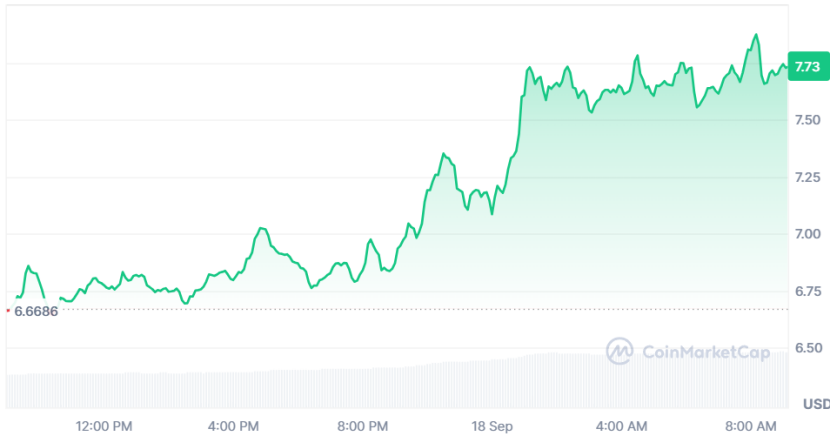
Taking Uniswap as an example, the regular protocols of Uniswap do not need to apply to this exemption arrangement; the SEC's exemption provisions mainly target the permissioned pools on Uniswap V4 that provide compliant AMM trading paths for specific assets and users in the U.S. Uniswap will also submit a position paper with improvement suggestions.
A Bigger Game: Aiming for 24/7 Trading
On the same day the "Innovation Exemption" was implemented, the SEC also held a roundtable discussion on 24/7 trading in the U.S. stock market, discussing topics such as exchanges, brokerages, clearing and settlement, market data, cybersecurity, and overnight liquidity. The simultaneous holding of the two meetings is not a coincidence.
Paul Atkins pointed out at the roundtable that the U.S. securities market is moving towards round-the-clock trading, and tokenization technology can help the industry achieve real-time inventory management, improve market efficiency, reduce settlement failure rates, and alleviate naked shorting risks.
This is the more long-term regulatory layout: the ultimate goal of tokenization is to reconstruct the underlying infrastructure for trade settlement. If securities ownership, transaction records, and available inventory can be recorded on-chain in near real-time, market participants can more promptly verify the status of securities and quantities available for trading, which will become the technical foundation for extending overnight or even 24/7 trading. Things that traditional clearing and settlement systems cannot achieve may be possible through tokenization technology.
Of course, this is just a direction; it is still far from implementation. The SEC itself also acknowledges that 24/7 trading involves a series of unresolved issues, including liquidity, market monitoring, system resilience, cybersecurity, and operational costs.
The implementation of the "Innovation Exemption" framework is an important step in the process of migrating the traditional securities market to on-chain, but it is still just a prologue.
Before systematic regulatory rules are established, all tokenized securities remain in the "innovation experiment" stage. The SEC is gradually pushing traditional finance step by step into the on-chain world using a small and steady approach.
免责声明:本文章仅代表作者个人观点,不代表本平台的立场和观点。本文章仅供信息分享,不构成对任何人的任何投资建议。用户与作者之间的任何争议,与本平台无关。如网页中刊载的文章或图片涉及侵权,请提供相关的权利证明和身份证明发送邮件到support@aicoin.com,本平台相关工作人员将会进行核查。


