Author: Claude, Deep Tide TechFlow
In the past few years, tokenized funds have solved how to issue and how to go on-chain, but they have not yet resolved how to enter the U.S. wealth management system.
On September 16, Oasis Pro Markets, a subsidiary of Ondo, became the first tokenized institution to connect to DTCC Fund/SERV. This connection has sent Ondo into a traditional fund pipeline that connects fund companies, wealth platforms, and service providers.
DTCC announcement shows that Oasis Pro Markets has become a Fund/SERV member. This system handles over 85% of mutual fund transaction activities in the U.S., and after connecting, Oasis can interact with fund companies, wealth management platforms, and fund service providers through the same standard connection, eliminating the need to build backend interfaces for each institution separately.
This situation is most easily understood as "RWA getting Wall Street certification," but what Fund/SERV actually does is more specific. It is not responsible for turning assets into tokens, nor does it facilitate transactions for investors; it processes fund order transmission, transaction confirmation, position reconciliation, income distribution, tax, and regulatory reporting. For tokenized products seeking to enter traditional account systems, these invisible backend links are harder to bypass than issuing a chain-based token.
Fund/SERV addresses how funds are sold
The mutual fund industry once faced a connection issue referred to by DTCC as "spaghetti." Fund companies, brokers, pension platforms, and wealth management institutions each had their own connections, and each additional product or distributor could create a new set of interfaces, document formats, and reconciliation processes. Fund/SERV replaced these bilateral connections with a unified system, and now more than 1,300 institutions use it.
For tokenized funds, the change occurs in distribution costs. In the past, even if an on-chain asset issuer completed custody, transfer, and compliance design, they still had to persuade traditional platforms to develop interfaces one by one. After Oasis connected to Fund/SERV, the technical integration changed from "redoing it for each" to using the existing standards in the fund industry. Wealth platforms no longer need to learn to handle a completely different backend system just to accept a tokenized fund.
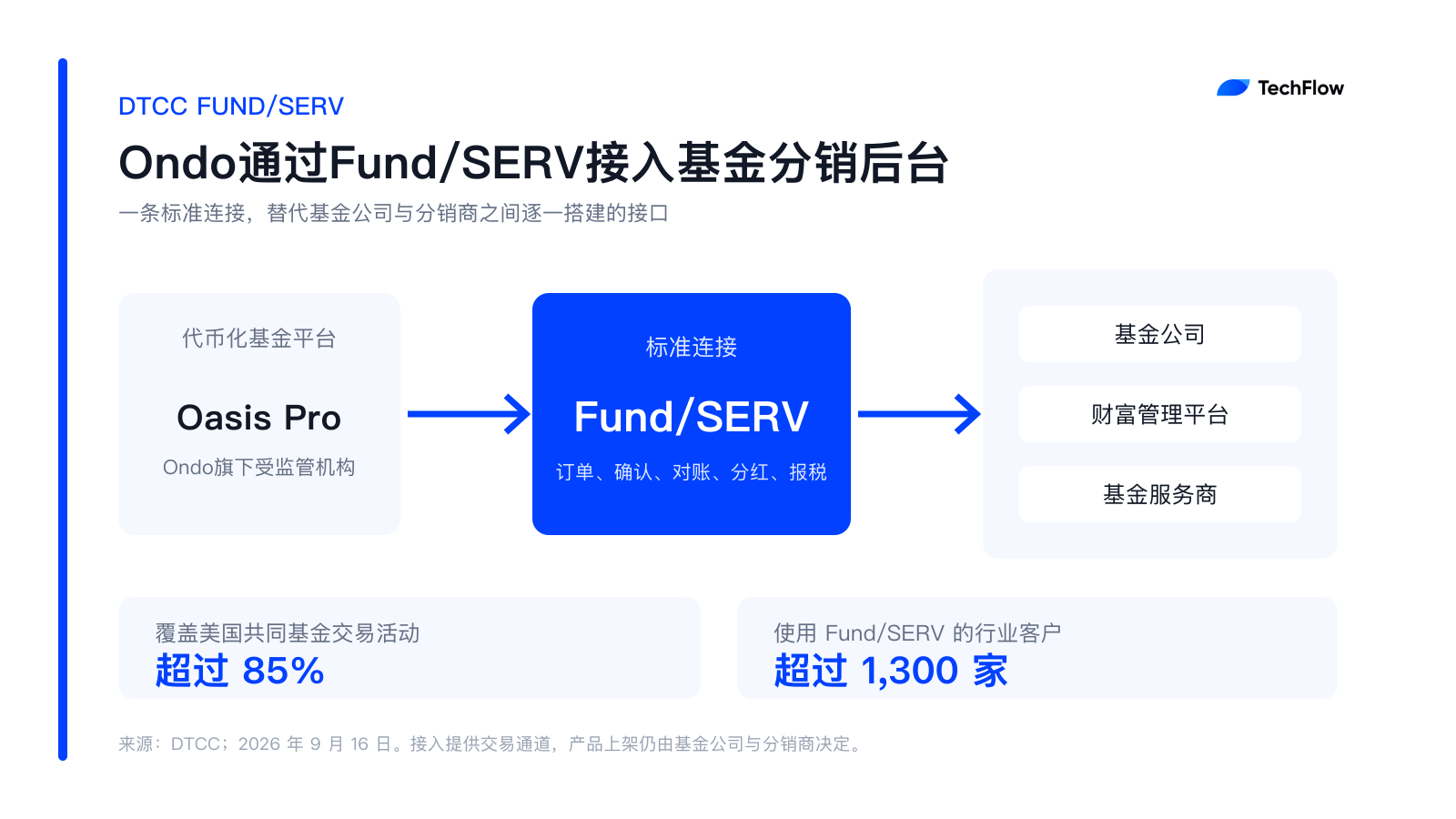
Figure: Oasis Pro connects fund companies, wealth platforms, and service providers through Fund/SERV. Data source:DTCC official announcement、Fund/SERV 40-Year Review。
On-chain is only half of fund operations. After investors submit purchase requests on wealth platforms, distributors must pass the orders to fund managers, subsequently receiving transaction confirmations, updating client positions, and continuing to verify records during dividend and tax periods. If any of these links rely on emails, forms, or separate interfaces, they will become an operational burden as product scale expands. Fund/SERV has turned these steps into standard processes familiar to the U.S. fund industry, and once Oasis enters this process, traditional institutions do not need to change their entire backend to accept a tokenized product.
There is an overlooked misalignment here. The crypto industry often understands “tokenization” to mean asset registration on-chain, while the traditional fund industry is concerned with whether orders can be accepted, net value can be verified, and dividends and tax forms delivered according to existing processes. Both sides are discussing the same product but using two different sets of infrastructures. What Oasis has just connected is exactly that latter set.
Ondo completes a U.S. compliant distribution chain
This is not a membership Ondo added temporarily. In October 2025, Ondo completed the acquisition of Oasis Pro, incorporating capabilities such as registered broker-dealer, alternative trading system, and transfer agentinto the company. In July 2026, Oasis obtained relevant regulatory licenses to provide tokenized stocks and funds to U.S. institutional and individual clients. Two months later, their connection to Fund/SERV filled in the backend channel for products to reach traditional distribution institutions.
Licenses determine who can sell, regulatory approvals establish what can be sold, and Fund/SERV manages how transaction data circulates between institutions. When these three steps are connected, Ondo is building not just a chain-based product page in the U.S., but a distribution path that can collaborate with existing fund businesses.
This path also explains why Ondo acquired Oasis first instead of merely signing cooperation agreements with licensed institutions. Broker operations, trading venues, transfer records, and fund distribution are each bound by different systems; outsourcing any one link would require re-coordination for each product change. By incorporating these capabilities into the same company and then connecting to DTCC’s industry network, Ondo reduces the number of repeated handovers from design to listing for products. For traditional distributors, identifying trade counterparts and where data goes becomes easier.
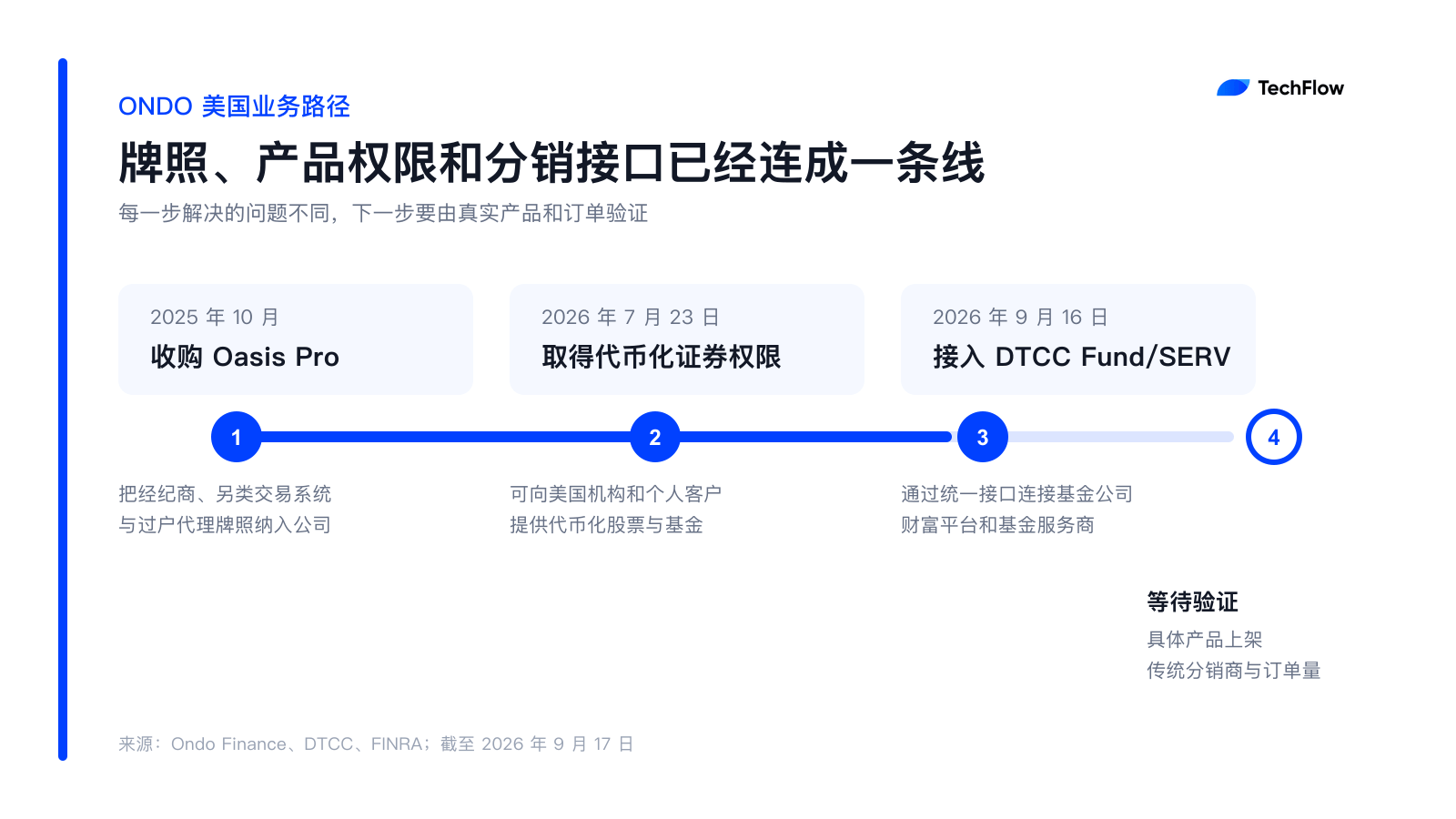
Figure: Ondo's three-step path from acquiring a licensed institution to connecting to the traditional fund backend. Data sources:Ondo acquisition announcement、Regulatory license announcement、DTCC official announcement。
In the same week, Nasdaq announced a $100 million investment in Kraken's parent company, Payward, and the two sides will continue to advance tokenized stocks and trading infrastructure. The two developments occur in different segments: Nasdaq and Kraken focus on stock trading and market regulation, while Oasis connects to fund order and distribution backends. When looked at together, traditional institutions' investments in tokenization have shifted from "issuing a chain version" to market facilities where trading, distribution, reconciliation, and regulation can continue to function.
This round of competition does not even require traditional systems to be completely replaced. Nasdaq hopes that tokenized stocks continue to adhere to existing market rules, while DTCC facilitates the entry of tokenized funds into the existing fund processing network. Assets can be registered and circulated on-chain, while institutional accounts, reports, and distributions continue to use mature interfaces. What RWA projects are genuinely competing over has begun to shift from which chain is faster to who can enable traditional money to enter with minimal change to their systems.
Real orders are more important than "first," $ONDO token still waits for empowerment
The DTCC announcement did not disclose the first batch of Ondo funds, cooperating distributors, launch dates, or transaction scales. What can currently be confirmed is that the channel has been properly connected, but whether products will enter the shelves of a particular wealth platform still needs to be determined by fund companies and distributors.
The next most informative development will be which traditional institution lists first, whether customers can purchase through existing accounts, and whether sustained purchase and redemption orders appear in Fund/SERV.
The asset management scale will also need to be observed after the product launch. The growth of the size of tokenized funds may come from new purchases, changes in the price of underlying assets, or migration of existing assets; focusing solely on a total amount may easily misinterpret an existing stock relocation as new demand. The list of distributors, net purchases, and recurring buys will show whether this channel has brought in new funds.
This also clarifies the relationship between the company’s progress and the token price. The announcement discusses Oasis Pro's fund distribution ability but does not add any fee-sharing, revenue rights, or other value assumption arrangements for the ONDO token.
The market may trade ONDO based on the expectations of its leading position in the RWA track, but to determine whether this lead can translate into value for the token, other value flows beyond governance rights need to be sought.
免责声明:本文章仅代表作者个人观点,不代表本平台的立场和观点。本文章仅供信息分享,不构成对任何人的任何投资建议。用户与作者之间的任何争议,与本平台无关。如网页中刊载的文章或图片涉及侵权,请提供相关的权利证明和身份证明发送邮件到support@aicoin.com,本平台相关工作人员将会进行核查。


