Author: The Interfold
Editor: Deep Tide TechFlow
Deep Tide Guide: The core challenge of sealed auctions is not confidentiality, but how to calculate results without relinquishing power. The Interfold dismantles the "host" of the auction using distributed keys and fully homomorphic encryption, and this architecture directly affects the design of token distribution, block space allocation, and settlement markets.

Auction results determine much more than just who won and at what price. They also determine what information participants are allowed to know about each other during the market formation process.
In the field of cryptography, auctions and auction-like mechanisms have been doing important work. They distribute tokens, coordinate competing solvers, allocate block space, and help discover prices. Outside of cryptocurrency, similar structures appear in procurement and allocation, where competing businesses have every reason not to disclose their prices, capacities, or constraints to one another.
Some of these markets rely on visible, ever-changing demand. Others perform better when participants first submit bids independently and then see competitive bids.
Sealed auctions take the latter approach. Bids are kept confidential from competitors until the bidding ends, after which they are evaluated collectively to determine the winner, clearing price, allocation plan, or other outcomes. Maintaining this independence is part of auction design: what information is visible to whom and when can change participant behavior and the outcomes generated by the market.
Therefore, confidentiality is not just about restricting who can see the data. It can expand the types of markets we can design.
Protecting bids is only half the problem
Sealed bidding is not new. Auctions have long used confidentiality measures to prevent competitors from seeing each other's bids before market settlement.
This is important because a bid can reveal much more than just a number: valuation, urgency, budget constraints, strategy. Hiding these bids before the bidding ends preserves their independence, rather than turning one party's bid into information that the other can immediately react to.
But auctions still need to derive results from information that participants should not see.
Traditionally, this means trusting an auctioneer who has access to the underlying bids. The auctioneer compares these bids according to the rules and determines the winner, clearing price, allocation plan, or other outcomes. Privacy between competitors is maintained, but access to the bids is centralized in one place.
To avoid this centralization, another set of questions arises:
- Who performs the computation?
- Who controls the keys?
- Who decides when to release the results?
- What information is allowed to become visible?
- After the auction ends, who retains these permissions?
Thus, the coordination issue starts where ordinary sealed bidding stops: how can private bids become a result that participants can verify and act upon while not concentrating access and permissions in a single operator?
This is where sealed auctions turn into confidential coordination issues.
How sealed auctions fit into Interfold
Modern cryptography and confidential computing technologies provide several ways to protect sensitive information during computation. Trusted Execution Environments (TEE), Secure Multi-Party Computation (MPC), and Fully Homomorphic Encryption (FHE) take different paths, each with different trade-offs in trust, performance, and deployment.
However, choosing a privacy technology does not intrinsically answer the above coordination questions. The architecture still needs to decide how computation, keys, verification, decryption, and publishing are divided among the relevant parties.
This is precisely the issue that Interfold aims to solve.
Interfold is a distributed network for confidential coordination. It uses an encryption execution environment (E3) as a temporary environment tailored for specific multi-party computation instances.
A sealed auction can be carried out using one E3 which encompasses the entire process from private submission to computation, verification, and threshold decryption:
- Initialization: A committee chosen from the ciphernode network that is specific to this computation participates in distributed key generation to produce a shared public key for the auction.
- Private bidding: Participants encrypt their bids using this public key.
- Computation: An independent compute provider utilizes FHE to execute auction rules on the encrypted bids.
- Verification and threshold decryption: The entire process and encrypted results are verified using zero-knowledge proofs. Once preset publishing conditions are met, the ciphernode committee participates in threshold decryption of permissible outputs.
- Closure: The E3 shuts down once computation is complete and does not persist as a permanent authority to handle unrelated activities.
No single ciphernode can unilaterally decrypt the results or control the outcome.
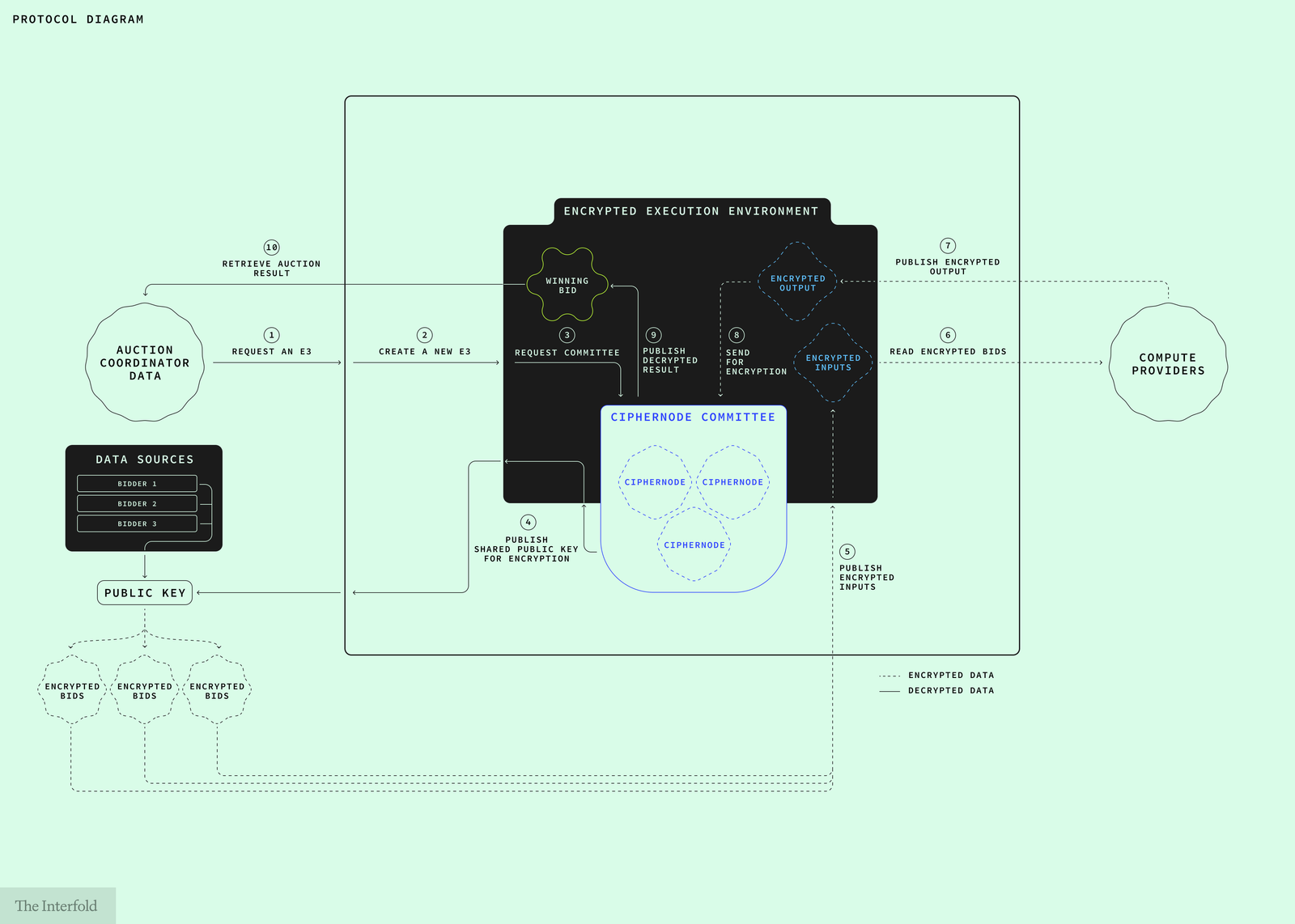
Role separation is intentional. The compute provider performs the computation but does not obtain unilateral decryption authority. The ciphernode committee participates in initialization, execution, and threshold decryption but does not become a single trusted executor.
E3 provides another layer of boundaries. It is instantiated for specific computations, and the associated permissions do not persist indefinitely after its work is complete.
FHE or threshold cryptography are not unique to Interfold. The architectural choice is about how these capabilities are assembled: computational permissions and decryption permissions are not consolidated in one operator, but instead, permissions are distributed among a computation-specific committee, and the environment is constrained to the computation it is meant to support.
Interfold does not eliminate permissions from confidential computing. It makes these permissions decentralized, bounded, and temporary.
A larger auction design space
Once bids can remain private and generate verifiable market results, markets can utilize information that previously had to be exposed or entrusted to intermediaries.
This is crucial in many scenarios:
- Token distribution: Bidders can contribute valuations without turning them into real-time signals visible to all subsequent participants.
- Solvers and execution markets: Sensitive pricing or strategies can influence choices without disclosing to competing solvers.
- Procurement and allocation: Companies can compete on price, capacity, or other constraints without requiring a certain operator to check every underlying bid.
- Block space and protocol markets: Private bids or strategies can influence allocation while limiting what competitors can learn before market settlement.
These have always been important forms of economic coordination. Uniswap has used auctions to distribute tokens, CoW Protocol coordinates competing solvers, competitive builder markets allocate block space, and similar information issues appear in procurement, settlement, and resource allocation.
Confidentiality does not automatically improve any of the above markets. It changes the options: participants are no longer required to expose sensitive information or entrust it to a privileged intermediary simply to allow that information to affect results.
What sealed auctions reveal
Privacy is not the final product of sealed auctions. The final product is a useful outcome: price, winner, allocation, or settlement.
In a sealed auction based on Interfold, private bids can contribute to this outcome without being exposed to anyone, while results that are allowed to be made public can still be revealed and verified.
The same pattern applies outside of markets. Anonymous voting, shared analysis across sensitive datasets, and coordination between autonomous systems all rely on private information contributing to collective outcomes without full disclosure.
This is the broader promise of confidential coordination: to produce useful collective results without requiring participants to relinquish the information they must keep confidential.
For sealed bid auctions, this means not just hiding bids. It means stronger independent competition, verifiable results, and less reliance on any single party to hold everyone’s private positions or control how the auction settles.
Retain inputs. Share results.
Build applications for confidential coordination based on Interfold.
Follow Interfold and join discussions on emerging use cases, updates, and early applications.
免责声明:本文章仅代表作者个人观点,不代表本平台的立场和观点。本文章仅供信息分享,不构成对任何人的任何投资建议。用户与作者之间的任何争议,与本平台无关。如网页中刊载的文章或图片涉及侵权,请提供相关的权利证明和身份证明发送邮件到support@aicoin.com,本平台相关工作人员将会进行核查。


