Written by: Rita
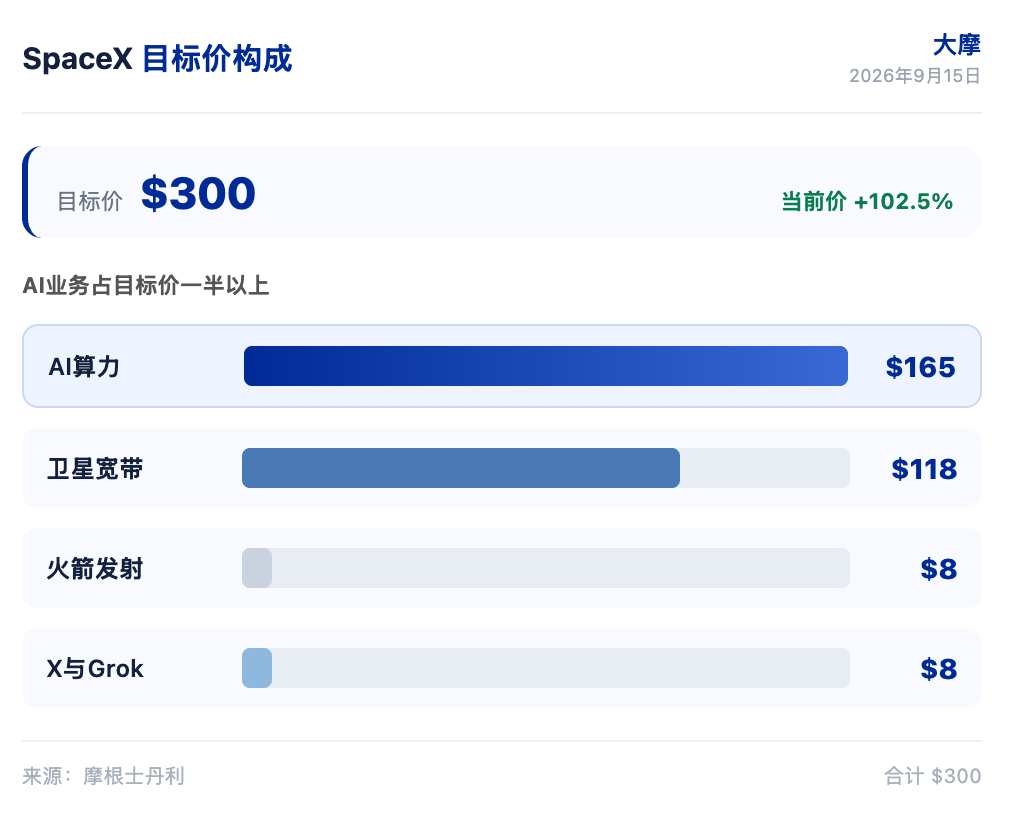
The market sees SpaceX as a rocket launch and satellite broadband company, but Morgan Stanley has allocated more than half of the target price to AI computing power. In the risk-reward update report released on September 15, 2026, Morgan Stanley maintains an overweight rating on SpaceX with a target price of $300. The current price is $148.15, representing an upside potential of about 102.5%. Morgan Stanley breaks down SpaceX's valuation into four segments: Space $8, Connectivity $118, X and Grok $8, Enterprise AI $165.
Morgan Stanley analyst Adam Jonas pointed out in the report that SpaceX's vertical integration capability is opening up the AI computing power market. Through end-to-end infrastructure, SpaceX is expected to deploy AI computing power at a lower cost per watt and with faster power supply times. The execution risk is high, but the potential market space is huge.
This report updates the earnings per share forecasts for 2026 and 2027, mainly reflecting the company's newly disclosed $1.1 billion neocloud transaction starting in December. Some of this was offset by the decline in Starlink pricing and delays in Starship launch schedules. The 2026 earnings per share was raised by 1%, and 2027 was raised by 3.8%. The target price remains unchanged.
Enterprise AI Valuation $165
The Space business is valued at $8, the Connectivity business at $118, X and Grok at $8, and Enterprise AI at $165. Enterprise AI accounts for about 55% of the total valuation and is the largest source of valuation. Morgan Stanley assigns a 50% execution risk discount to Enterprise AI, still arriving at a valuation of $165.
Morgan Stanley assumes that SpaceX's computing power deployment will grow at a 45% compound annual growth rate to 2040, with orbital computing power becoming the main capacity by 2032. This assumption is based on Starship becoming operational in the fourth quarter of 2026. If Starship is delayed, the entire AI computing story will be pushed back.
Starship Q4 Operation is Key
Delays in Starship testing have slowed the launch cadence. Morgan Stanley lowers the number of launches in 2027 from the original assumption to 81, while restoring it to 126 in 2028. It maintains 170 launches in 2026. Regarding launch costs, variable launch costs per kilogram are projected to decrease from $1,080 in 2026 to $836 in 2028.
Morgan Stanley points out that the delays in Starship compress the time window for AI computing power deployment. However, the firm still assumes that Starship will be operational in the fourth quarter of 2026. If it is delayed until 2029, under a bear market scenario, SpaceX's valuation will mainly depend on its space and connectivity businesses, while the value of Enterprise AI would significantly diminish.
Starlink subscriber growth is also slowing. Morgan Stanley projects that consumer and commercial broadband subscribers will reach 16.73 million in 2026, 27.82 million in 2027, and 41.24 million in 2028. Subscriber growth is the foundation of the valuation for the Connectivity business and the source of cash flow supporting AI computing power investments. Whether subscriber growth can keep pace directly determines whether the $118 valuation for the Connectivity business can be realized.
Vertical Integration Reduces Computing Power Costs
Morgan Stanley believes that SpaceX's vertical integration can reduce AI computing power costs. Traditional AI infrastructure relies on external power sources and cooling, often with power supply times measured in years. SpaceX aims to shorten power supply times and reduce cost per watt by launching orbital computing power with Starship, utilizing solar energy from space and vacuum cooling.
Morgan Stanley notes in the report that SpaceX's cost per watt and revenue per watt are key investment drivers. If orbital computing power becomes the main capacity, SpaceX can establish a cost advantage in the AI infrastructure market. This logic requires high-frequency reuse of Starship and scaling of orbital computing.
Morgan Stanley assumes that Starship reuse progresses smoothly, accelerating computing power deployment. In a bull market scenario, AI accounts for over 60% of the valuation, Starship is operational in Q4 2026, and the compound annual growth rate for computing power deployment is 50%. In a bear market scenario, Starship will not operate until 2029, significantly reducing the assumptions for orbital computing power. The gap between the two scenarios mainly comes from the pace of Starship reuse and the speed of orbital computing scaling.
Risk-Reward Bias Towards Bull Market
Morgan Stanley presents three scenarios. Bull market target price $600, base case $300, bear market $75. The current price is $148.15, with a 102.5% upside in the base case, 304.9% upside in the bull case, and a 49.4% downside in the bear case. Morgan Stanley estimates probabilities using implied volatility from the options market, but the exact probabilities for the bull market are not disclosed.
Upside risks listed by Morgan Stanley include faster progress in Starship reuse, stronger capacity growth of Starlink, better DTC and enterprise adoption, more neocloud orders, acceleration in Cursor ARR, and lower power supply time and costs for AI infrastructure. Downside risks include slower Starship reuse pace, slower growth in Starlink subscribers, weakness in Enterprise AI monetization, higher capital expenditures and costs per watt, longer power supply times, financing needs and dilution, and regulatory delays.
Morgan Stanley points out that the proportion of active institutional holdings is 96.2%, with a hedge fund long-short ratio of 2.4 times and a net exposure of 11.4%. The AI computing power narrative of SpaceX has not yet been fully priced by the market, with the current valuation mainly reflecting its space and connectivity businesses.
Morgan Stanley maintains an overweight rating with a target price of $300. SpaceX's AI computing power business contributes over half of its valuation, and the progress of Starship is a core catalyst. If Starship operates as scheduled in Q4 2026, AI computing power deployment will enter the validation phase.

Disclaimer
This article is a整理与解读 by潮向研究 of a third-party brokerage report (Morgan Stanley, September 15, 2026), combined with整理 of public market information. The ratings, target prices, earnings forecasts, and related judgments quoted in the text are the opinions of the brokerage analysts and represent their respective institution's position, not the views of潮向研究, nor does it constitute any investment advice.
The market has risks, and decisions should be made independently. This article should not be used as a basis for buying or selling any securities.
免责声明:本文章仅代表作者个人观点,不代表本平台的立场和观点。本文章仅供信息分享,不构成对任何人的任何投资建议。用户与作者之间的任何争议,与本平台无关。如网页中刊载的文章或图片涉及侵权,请提供相关的权利证明和身份证明发送邮件到support@aicoin.com,本平台相关工作人员将会进行核查。


