Author:Matt Hougan, Chief Investment Officer of Bitwise
Translation: Shaw, Golden Finance
The cryptocurrency bull market does not require Washington's approval. The following data supports this.
The Clarity Act failed to pass yesterday. The bill needed 60 votes to advance in the Senate but ultimately received only 49 votes. All Democratic senators voted against it, and several Republican senators also cast votes in opposition.
It's truly regrettable. The Clarity Act was a high-quality bill. It could have strengthened investor protection and established a set of regulatory rules for the crypto industry that would remain effective beyond this administration's term.
The most immediate question is: Will the setback of the Clarity Act interrupt the crypto bull market that started in early July?
As early as January this year, I referred to the Clarity Act as the "Groundhog Day" of the crypto space, predicting that once the bill failed, the market would have to endure six more weeks of winter. This means that the market would be in a state of high volatility until the midterm elections.
But I now believe that this is no longer the most likely scenario. On the contrary, I suspect that the impact of the setback of the Clarity Act is far less serious than current news headlines portray.
Clarity of Belief
The core basis for my changed judgment comes from the chart below.
Probability of the Clarity Act passing vs Bitcoin price
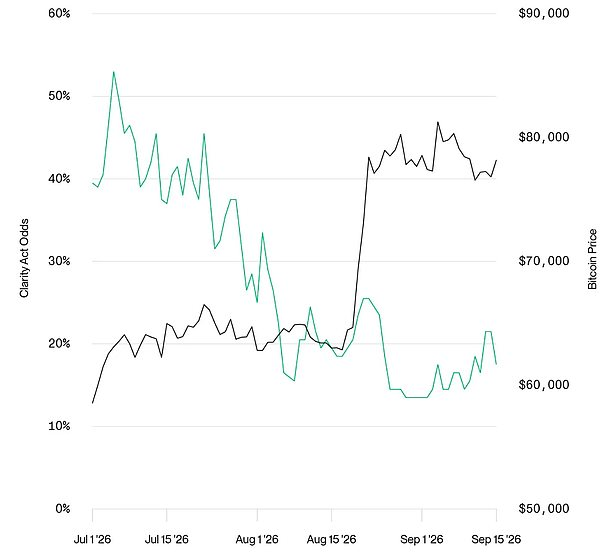
Source: Bitwise Asset Management, data from Polymarket and CoinGecko. Timeframe from July 1 to September 15, 2026.
The crypto bull market we are discussing began on July 1, when Bitcoin dipped to a low of $57,950 and then surged, reaching above $80,000 on September 4. During the same period, the probability of the Clarity Act being passed this year on the prediction market Polymarket plunged from 39% to 18%. If the bull market depended on the passage of the bill, then the drop in probability should have correlated with a decline in coin prices, but the actual trend was the opposite.
One reason behind this: Wall Street did not wait for the Clarity Act to take action on crypto assets. In the past quarter, Robinhood launched its own blockchain, Morgan Stanley listed a Solana ETF, and the DTCC completed its first tokenized stock trade settlement. These institutions (and others) dared to act because the current SEC and CFTC regulatory teams have been quite friendly toward crypto assets, a situation that could persist until 2029. They do not need the Clarity Act because they already possess firm convictions.
In the coming days, investors will gradually understand this reality: The crypto industry is in a "win big on the positive side, do not lose on the negative side" regulatory landscape. Before the new government in Washington takes office, the SEC and CFTC can autonomously lead the regulatory agenda in the crypto space. SEC Chairman Paul Atkins stated during a CNBC interview in July that the SEC "is ready, willing, and able to introduce regulatory rules that cover the same issues that the Clarity Act aims to address." This statement is not just bravado: the SEC proposed the Crypto Asset Regulatory Regulation in August. CFTC Chairman Mike Selig stated that the CFTC's regulatory rules are ready, and if the Clarity Act fails, the regulatory agencies will "act swiftly." Just this morning, he further stated that the agency is "fully committed and prepared to release regulatory rules for the new financial frontiers."
However, regulatory rules can be overturned by the next government; only Congress has the authority to grant CFTC substantive jurisdiction over the spot market. Other than that, the regulatory provisions drafted by Paul Atkins and Mike Selig are likely to be more favorable to the crypto industry than the Clarity Act itself. I predict that the current market downturn will persist until Paul Atkins and Mike Selig announce the next regulatory proposal for the industry.
Conclusion
I do not want to be blindly optimistic. If the Clarity Act could pass, it would certainly lead to better outcomes. Crypto assets would become a consensus trading target for investors in the fourth quarter, and prices would almost certainly soar.
The reality is that Bitcoin fell about 4% yesterday, which is a reasonable fluctuation (some of the drop also stems from market concerns about interest rates and oil prices). Along the way to the next bull market, we will encounter more speed bumps.
But in my view, the ultimate direction will not change. The reason lies in the resilience of top builders.
In the first 17 years after the inception of the crypto industry, there has never been accompanying core market legislation. Even without the Clarity Act, it has still grown from a fringe concept to a $25 trillion asset class, reshaping every aspect from global payments to capital markets, attracting hundreds of millions of investors, and gaining adoption from major global financial institutions.
I suspect that not long from now, when we look back at the failure of the Clarity Act, we will arrive at a clear conclusion: The crypto industry will always find a way to continue building.
免责声明:本文章仅代表作者个人观点,不代表本平台的立场和观点。本文章仅供信息分享,不构成对任何人的任何投资建议。用户与作者之间的任何争议,与本平台无关。如网页中刊载的文章或图片涉及侵权,请提供相关的权利证明和身份证明发送邮件到support@aicoin.com,本平台相关工作人员将会进行核查。


