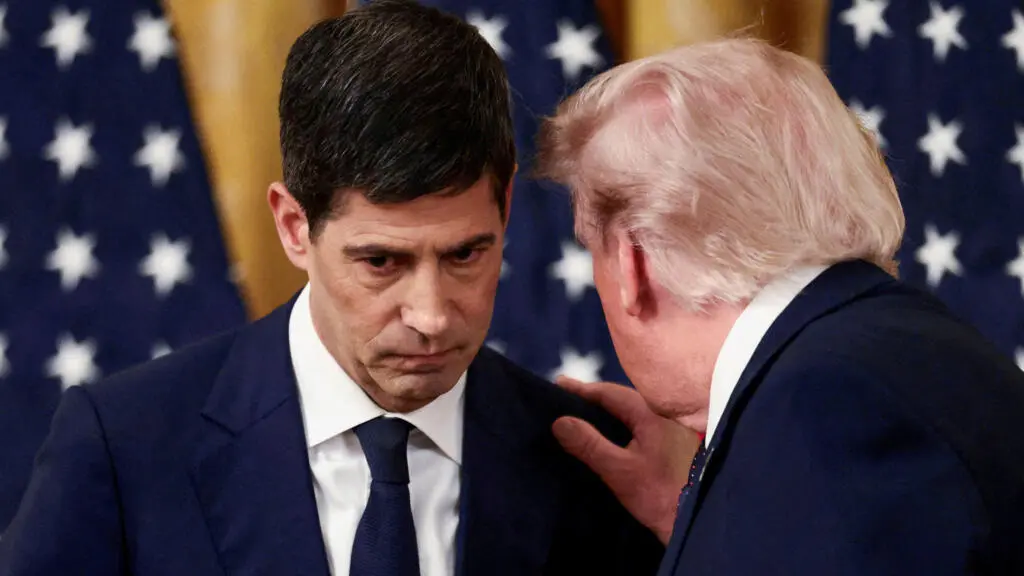
The insistence by President Trump of the United States on requiring interest rate cuts appears to be shattered: to control high inflation and defend its own credibility, the Federal Reserve raised interest rates for the first time in three years, as expected by the market, and most Federal Reserve officials anticipate another rate hike within this year.
On Wednesday, September 16, Eastern Time, after the Federal Open Market Committee (FOMC) meeting, the Federal Reserve announced that it would raise the target range for the federal funds rate from 3.50% to 3.75% to 3.75% to 4.00%, increasing by 25 basis points. This is the first adjustment to the policy rate since entering 2026 and the first rate hike by the Fed since July 2023. Prior to this, the Fed had decided to keep interest rates unchanged for five consecutive monetary policy meetings.
This rate decision was completely within the expectations of investors. By the close of trading on Tuesday this week, CME tools indicated that the futures market expected a better than 92% chance of a 25 basis point Fed rate hike this week, a 44% chance of another hike of the same magnitude at the October meeting, and nearly an 80% chance of two 25 basis point rate hikes total by the end of this year. This indicates that most market participants are betting that September is not a one-time rate adjustment and that the Fed will take action again within the year.
The updated expectations for the Federal Reserve's own rate path are also in line with the aforementioned market predictions. The dot plot released after the meeting showed that nearly 90% of the Federal Reserve officials providing rate expectations anticipate that there will be at least one more 25 basis point rate hike within 2026.
Journalist Nick Timiraos, known as the "new Fed correspondents," stated that the Federal Reserve officials unanimously approved the first rate hike in three years at this meeting, which indirectly undermines the White House's rhetoric that "there is no need to worry about inflation." This time, most officials expect another rate hike this year, as energy price shocks and surging investment in artificial intelligence (AI) are reshaping the inflation outlook.
Timiraos mentioned that analysts previously pointed out that while the market paid significant attention to the August inflation data recently, the biggest changes in the economic outlook actually stem from rising energy and commodity prices. Former "number three" at the Federal Reserve and President of the New York Fed, Dudley, stated, "The key is that the situation in Iran is tense again, and the magnitude of the energy price shock is expanding once more."
Among 18 people, 12 expect one more rate hike this year, and four expect two more hikes
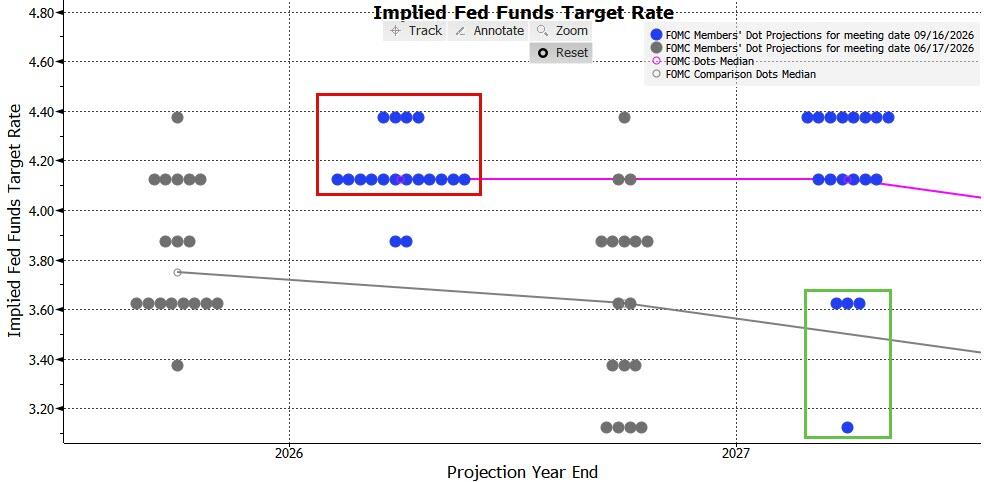
Compared to the last dot plot released in June, the current dot plot reveals a clearly stronger tendency among Federal Reserve policymakers towards rate hikes.
The dot plot shows that among the 18 Federal Reserve officials providing rate expectations, 12 expect that following the rate hike in September, there will be another 25 basis point hike within 2026; four expect two such hikes this year; two expect that rates will remain unchanged this year, meaning no further hikes other than September; and no one expects a rate cut this year.
In other words, among the 18 Federal Reserve decision-makers, 16 expect at least one more rate hike this year, accounting for nearly 89%.
In the last dot plot, among the 18, eight officials, accounting for over 40%, expected that rates would remain unchanged for the entire year, while nine expected at least one rate hike this year; among them, five predicted two hikes, three predicted one hike, and one predicted three hikes this year. Also, in the last plot, one person expected one rate cut this year.
The current dot plot also indicates that by next year, namely 2027, eight Federal Reserve officials expect one rate hike; six expect rates to remain unchanged for the year; three expect two rate cuts; and one expects four rate cuts.
The blue dots in the image below represent the September dot plot expectations, while the gray dots represent the June dot plot expectations.
Like the last time the dot plot was updated, among the 19 Federal Reserve officials, one did not submit rate expectations; the outside world generally believes that this person is the newly appointed Federal Reserve Chair Powell, who took office in May.
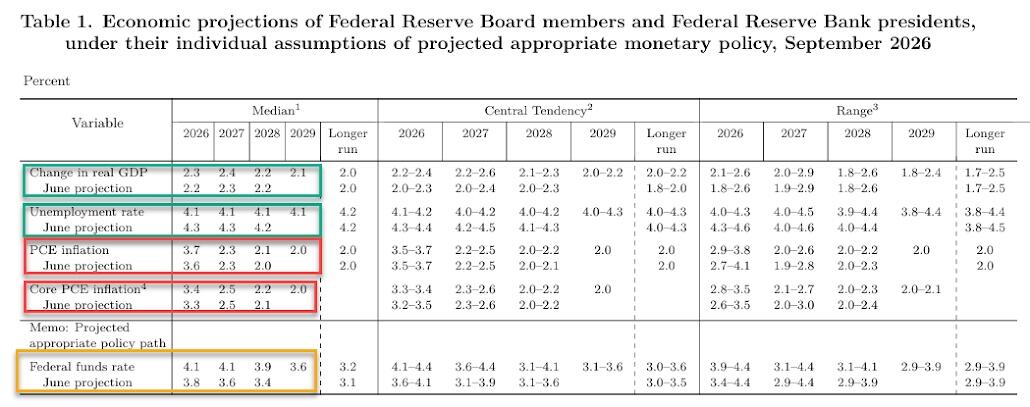
The median value of the Federal Reserve officials' rate forecasts released after Wednesday's meeting shows that as the expectations for rate hikes this year have intensified, the Federal Reserve officials have raised their rate expectations for the next three years:
The median federal funds rate at the end of 2026 is projected to be 4.1%, up from the June expectation of 3.8%; the federal funds rate at the end of 2027 is projected to be 4.1%, up from the June expectation of 3.6%; the federal funds rate at the end of 2028 is projected to be 3.9%, up from the June expectation of 3.4%; and the federal funds rate at the end of 2029 is projected to be 3.6%, with a longer-term federal funds rate of 3.2%, up from the June expectation of 3.1%.
The Federal Reserve believes that rate hikes will help inflation return to target “more timely”
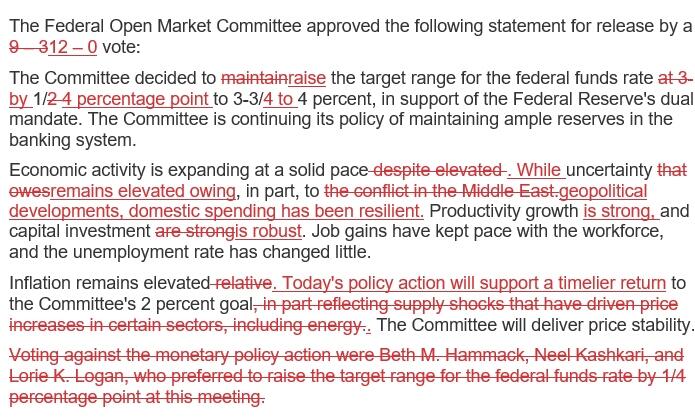
In addition to deciding to raise rates, this meeting's statement also specifically mentioned that the "policy action taken this time will help to bring inflation back down to the 2% target set by the FOMC more timely."
Compared to the last meeting's statement at the end of July, another major difference in this statement is that all 12 voting members of the FOMC unanimously supported the rate hike, while in the last meeting, three voting members opposed keeping rates unchanged. This clearly diverges from President Trump's repeated statements favoring rate cuts, highlighting the inflationary pressures faced by the Federal Reserve against the backdrop of Middle Eastern conflicts pushing up oil prices.
Earlier this week, Timiraos pointed out that after the U.S. August CPI was released last week higher than expected, the probability of a Federal Reserve rate hike this week skyrocketed, and Chair Powell's tough stance on inflation left him with almost "no retreat" from the rate hike decision. If the Federal Reserve indeed raises rates seven weeks before the U.S. midterm elections, it will directly test how long Trump’s "trust" in Powell can last.
At the same time as announcing the rate hike, this statement removed the previous remark made when maintaining rates unchanged, which stated that this action "partially reflects supply shocks driving up prices in specific areas such as energy."
In commenting on the economic situation, this meeting's statement basically remained unchanged from the last one, continuing to emphasize that the Federal Reserve is committed to achieving price stability and reaffirming: the U.S. economy is steadily expanding, with employment growth in sync with labor force growth, and the unemployment rate remaining essentially unchanged.
The previous two statements indicated that the Middle Eastern conflicts have led to high uncertainty in the economy, with inflation still high, partly stemming from rising energy prices; this statement then changed the phrasing of "Middle Eastern conflicts" to geopolitical situations and added an assessment that domestic spending is resilient. The statement read: "Although uncertainty remains high due to developments in geopolitical situations, domestic spending shows resilience."
Additionally, this statement slightly lowered its assessment of capital investment conditions; the last one stated that capital investment and productivity growth were both strong, while this one immediately followed the previous remark about high uncertainty by stating: "Productivity growth is strong, and momentum in capital investment is steady."
The following red text highlights the deletions and additions in this decision statement compared to the previous one.
Raised GDP growth and inflation expectations, lowered unemployment rate expectations
The economic outlook released after the meeting shows that Federal Reserve officials have slightly raised their GDP growth expectations for this year and next year, slightly lowered their unemployment rate expectations for this year and the next three years, and simultaneously slightly raised their PCE inflation and core PCE inflation expectations for this year and the following years. The specific predictions are as follows:
- The expected GDP growth rate for 2026 is 2.3%, up from the June estimate of 2.2%; the growth rate for 2027 is expected to be 2.4%, up from the June estimate of 2.3%; the expected growth rate for 2028 is 2.2%, unchanged from the June estimate; the expected growth rate for 2029 is 2.1%, with a longer-term growth expectation of 2.0%, unchanged from the June estimate.
- The expected unemployment rate for 2026 is 4.1%, down from the June estimate of 4.3%; the expected rate for 2027 is 4.1%, down from the June estimate of 4.3%; the expected rate for 2028 is 4.1%, down from the June estimate of 4.2%; the expected rate for 2029 is 4.1%, with a longer-term unemployment rate expectation of 4.2%, unchanged from June.
- The expected PCE inflation rate for 2026 is 3.7%, up from the June estimate of 3.6%; the expected growth rate for 2027 is 2.3%, unchanged from the June estimate; the expected rate for 2028 is 2.1%, up from the June estimate of 2.0%; the expected rate for 2029 is 2.0%, with a longer-term expectation of 2.0%, unchanged from June.
- The expected core PCE for 2026 is 3.4%, up from the June estimate of 3.3%; the expected rate for 2027 is 2.5%, unchanged from the June estimate; the expected rate for 2028 is 2.2%, up from the June estimate of 2.1%; the expected rate for 2029 is 2.0%.
免责声明:本文章仅代表作者个人观点,不代表本平台的立场和观点。本文章仅供信息分享,不构成对任何人的任何投资建议。用户与作者之间的任何争议,与本平台无关。如网页中刊载的文章或图片涉及侵权,请提供相关的权利证明和身份证明发送邮件到support@aicoin.com,本平台相关工作人员将会进行核查。


