
Following the previous article "Stablecoins: When the US Dollar, US Treasury Bonds, and Digital Finance Begin to Connect," let's return to discussing the digital renminbi in detail.
By the end of September 2025, the total transaction amount of the digital renminbi pilot regions reached 14.2 trillion yuan, with a total of 3.32 billion transactions, and approximately 225 million personal wallets on the digital renminbi app. By the end of 2025, the total transaction amount further increased to 19.5 trillion yuan, with 3.57 billion transactions and around 230 million personal wallets opened on the digital renminbi app, including about 19.08 million corporate wallets. (Data source: Xinhua News Agency)
In 2026, a systemic change occurred for the digital renminbi.
Starting January 1, 2026, a new generation of digital renminbi system was launched, and the balance in real-name digital renminbi wallets began earning interest according to deposit rules; the official statement indicates that the digital renminbi has transitioned from the "digital cash era" to the "digital deposit currency era."
But why is its public attention noticeably lower compared to when it was just launched?
The urgent problem to be solved may not be "development is slow," but rather "why must consumers switch." This is precisely a unique problem faced by the digital renminbi.
When the US dollar stablecoins entered many countries, they addressed a very obvious pain point: local currency instability, difficulty opening US dollar bank accounts, expensive cross-border transfers, and low efficiency of traditional banking systems. Therefore, USDT provided users with something that was not easily accessible before: dollarization.
However, the domestic environment faced by the digital renminbi is entirely different; China's existing digital payment infrastructure is highly mature. Ordinary consumers using Alipay or WeChat Pay can already complete payments within seconds.
Thus, the question for the digital renminbi is not: "cash or digital payments?" but more like: "with digital payments already functioning well, why switch to another form of digital payment?" This leads to the necessity for the digital renminbi to create additional value to drive users to voluntarily migrate, even if the technology is advanced.
Additionally, many of the statistics on the digital renminbi are heavily focused on cumulative transaction amount, cumulative number of transactions, and cumulative number of wallets. These metrics demonstrate that the infrastructure and transaction scale of the digital renminbi continue to expand, but they do not individually answer several other more important questions:
How many times do users actually use it per month?
What percentage of wallets are active?
How many consumers actively use it as their primary payment tool?
If government subsidies and promotions decrease, will the usage rate still be sustainable?
These aspects may be more worthy of observation than merely accumulating wallet numbers. The digital renminbi has not stopped its expansion but has transitioned from the early technological imagination phase into a phase where it must prove real user value.
The international demand for renminbi itself cannot be resolved through technology
The internationalization of the renminbi has not seen a lack of progress; on the contrary, its advancement is very notable. According to data from the Bank for International Settlements, the share of renminbi in global foreign exchange transactions increased from about 7% in 2022 to 8.5% in 2025, making it the fifth-largest trading currency globally.
The proportion of Chinese trade settled in renminbi has also significantly increased. Research from the Reserve Bank of Australia in 2026 shows that since 2021, the proportion of Chinese trade settled in renminbi has risen from less than 20% to approximately 35% in the past two years.
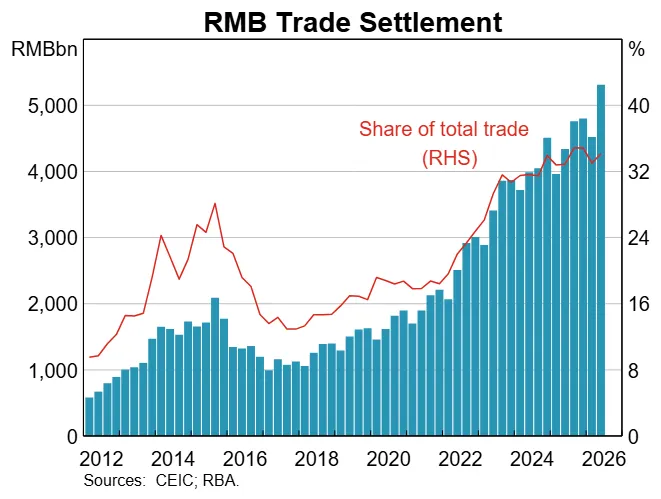
However, the share of renminbi as an official reserve asset was only 1.99% in the first quarter of 2026. This reveals a particularly interesting discrepancy: the renminbi is increasingly becoming a "currency for transactions," but it is still a long way from being an "asset currency" that global investors hold on a large scale for the long term.
Research from the Responsible Business Alliance points to several very traditional issues that limit the further internationalization of the renminbi:
- Restrictions still exist on the capital account;
- The Chinese financial market lacks sufficient depth compared to major reserve currency markets;
- Overseas investors still have room for improvement regarding exchange rate and interest rate risk management tools;
- Offshore liquidity of the renminbi still needs further development.
None of these issues can be addressed solely by launching the digital renminbi.
Thus, the real question is not "Is the digital renminbi advanced enough?" but rather "Why would others be willing to hold renminbi long-term?"
What can a foreign exporter do after receiving renminbi?
What assets can be purchased?
Is the renminbi bond market deep enough?
Can large amounts of funds enter and exit freely?
Are there enough safe assets available?
Can risks be easily hedged?
When a financial crisis occurs, will market liquidity still exist?
Are overseas banks willing to establish renminbi balance sheets for the long term?
Ultimately, these factors determine a currency's "holdability." The strength of the dollar is not due to any unreplicable technology behind a $100 bill. What is truly hard to replicate is the entire asset system behind $100: US Treasury bonds, money market funds, repurchase markets, corporate bonds, stocks, bank deposits, dollar loans, foreign exchange markets, and the global derivatives market. The dollar has a vast financial asset universe behind it.
Thus, when a business receives dollars, it rarely needs to ask, "What can these dollars do next?"
It can almost always find assets.
This is one of the deepest moats of the dollar.
The network of a currency can itself create value
From January to August 2026, the Cross-Border Interbank Payment System (CIPS) processed about 6.023 million transactions, with a total amount reaching 139.7 trillion yuan. At the same time, research from RBA points out that the transaction scale of CIPS (Cross-Border Interbank Payment Clearing Co., Ltd.) has increased over 400% since 2020; however, its processing scale in 2025 remains significantly smaller than that of the US CHIPS (Clearing House Interbank Payments System).
Cross-border experiments with the digital renminbi are also ongoing. By the end of 2025, mBridge had processed approximately 4,868 cross-border payments, with a transaction amount equivalent to about 477.8 billion yuan, of which digital renminbi accounted for about 96% of the transaction amounts across all currencies.
If future renminbi payments can become: cheaper, faster, easier to cross-border, easier to connect with renminbi financial assets, and easier for automated settlements, then the usage cost of renminbi as an international currency will decrease. And a reduction in usage cost may increase the demand for renminbi. In other words:
Technology cannot create currency credit, but technology can create network effects.
After re-examining digital renminbi and US dollar stablecoins, I realize that what we really need to focus on is not the superiority of digital renminbi or US dollar stablecoins. What is truly happening is that the two systems are advancing towards the digital financial era along completely different paths.
China is starting from central bank digital currency, payment infrastructure, and national financial system.
The US relies more on US dollar stablecoins, commercial banks, US Treasury bonds, capital markets, and private technology companies to promote tokenization.
Who will ultimately succeed is still far from conclusive. But one thing is becoming increasingly clear:
Future currency competition will not only occur on the currency level, nor only on the technical level.
The real competition is about who can combine their currency, assets, banking system, capital markets, and digital networks into a complete ecosystem.
免责声明:本文章仅代表作者个人观点,不代表本平台的立场和观点。本文章仅供信息分享,不构成对任何人的任何投资建议。用户与作者之间的任何争议,与本平台无关。如网页中刊载的文章或图片涉及侵权,请提供相关的权利证明和身份证明发送邮件到support@aicoin.com,本平台相关工作人员将会进行核查。


