The real trading opportunity from the Federal Reserve meeting is not the nearly fully priced 25 basis point rate hike, but whether Warsh can regain control of the policy narrative, which is key to unlocking the pricing logic of U.S. stocks, bonds, currencies, and gold.
Written by: Wu Yu, Jin Shi Data
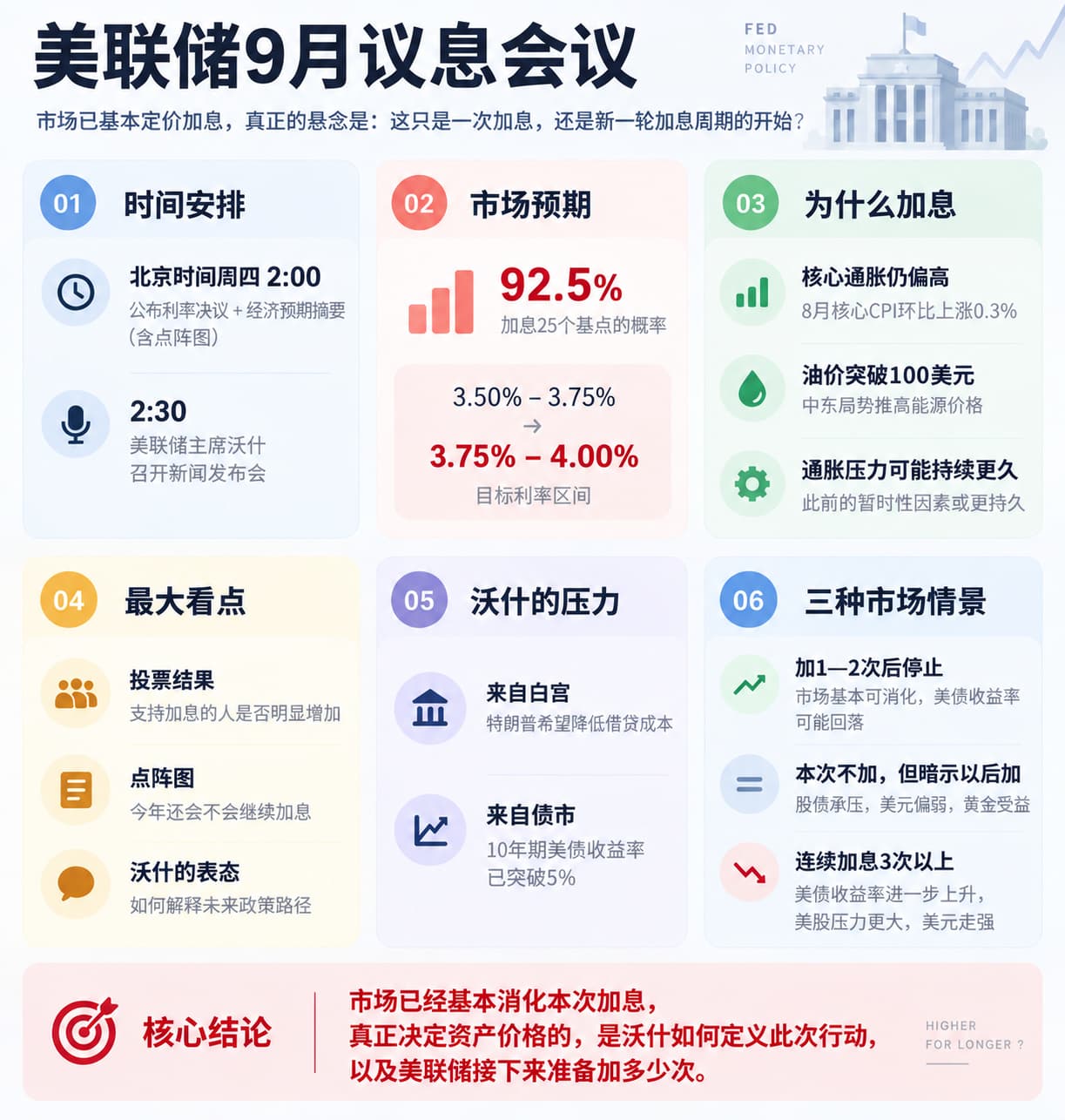
At 2:00 AM Beijing time on Thursday, the Federal Reserve FOMC will announce its interest rate decision and economic forecast summary. A half hour later, Federal Reserve Chairman Kevin Warsh will hold a monetary policy press conference.
This week’s rate hike from the Federal Reserve does not seem to be a suspense; this will be Warsh's first rate hike since he took charge of the Fed in May this year. In the previous July meeting, the Fed maintained interest rates with a vote of 9 to 3; more than a month later, markets have almost confirmed that the central bank will re-enter the rate hike path.
This meeting is of extraordinary significance for Warsh, as it may test whether he can turn a rate hike that has been "priced in" by the market back into a policy action defined by the Federal Reserve itself.
As of Tuesday, federal funds futures showed that traders expected a 92.5% probability that the Federal Reserve would raise rates by 25 basis points, with the target rate range increasing from the current 3.50% to 3.75% to 3.75% to 4.00%. A recent Reuters survey also showed that most economists expect the Fed to raise rates this week.
But the question is that the market has already made the first choice for the Federal Reserve, and Warsh must now answer: why must a rate hike happen now, and what will happen after the hike.
From "can wait" to "must act," the policy logic of the Federal Reserve is changing
For most of this year, the Federal Reserve's internal judgment on inflation has been that there is still room for observation. Tariffs and energy supply shocks caused by the war in Iran have been viewed by many policymakers as temporary factors pushing prices higher, so even if inflation exceeds 2%, there hasn't been sufficient reason to raise rates immediately.
The statement by Fed Governor Christopher Waller is the most representative. At the beginning of September, he stated, "Give inflation some time to cool down," believing that the relatively mild inflation data from June and July still indicated that price pressures might continue to fall back toward the 2% target. He also mentioned that the cost of waiting for a meeting is limited, as a 25 basis point hike won’t immediately bring the CPI back to 2%.
New York Fed President John Williams had also considered that "waiting and observing" was a reasonable choice.
But the current environment has changed.
The U.S. core CPI rose by 0.3% month-on-month in August, higher than the rate aligned with the 2% inflation target. Meanwhile, oil prices have surpassed $100 per barrel due to the situation in the Middle East. Warsh himself warned at the Jackson Hole annual meeting at the end of August that if policymakers cannot obtain more certainty about inflation falling positively toward the 2% target, the Federal Reserve "has work to do."
This poses an increasingly difficult question for the Federal Reserve: is the inflationary pressure that was previously considered temporary now lasting longer than expected?
Sebnem Kalemli-Ozcan, an economics professor at Brown University, believes that the Federal Reserve will have to raise rates sooner or later, and the longer it waits, the more persistent inflation might become, at which point the problems will be more severe.
JPMorgan economist Michael Feroli expects that the Federal Reserve will raise rates this week but believes that the rate decision is actually more ambivalent than the current market pricing of over 90% for a hike.
Scotiabank economist Derek Holt even thinks that a rate hike may not necessarily be the right choice now, but Warsh’s previous statements have made it difficult for him not to raise rates. "If the market has already priced in so much and he doesn't raise, then when will he?"
In other words, Warsh is not just facing a simple change in inflation data, but the previous policy statements, the latest inflation data, and market pricing have gradually pushed him toward the rate hike side.
Once a rate hike occurs, the real question becomes "how many times"
So, this 25 basis point hike may only be the beginning.
The 9 to 3 vote at the Fed's July meeting serves as an important starting point for understanding the current policy divergence. Harker, Logan, and Kashkari had already advocated for a rate hike at that time; while Waller, Williams, and others believed that observation should continue.
Meanwhile, Lisa Cook previously stated that she was "ready to take action" against inflation; Michael Barr was also concerned about the further entrenchment of temporary price pressures.
This means the final vote outcome of this meeting will tell the market whether the "three-vote hike" in July was merely a minority opinion or is turning into a broader policy shift.
David Kelly, Chief Global Strategist at JPMorgan Asset Management, believes that if a majority of members ultimately support a rate hike, some originally hesitant officials may join the majority camp to present a more unified stance, and ultimately only two, one, or even no opposing votes might remain.
What is more important than the voting results is the new interest rate dot plot.
Investors will observe how many officials still believe that a rate hike is necessary by the end of the year, and how the rate expectations for 2027 will change.
David Mericle, Chief U.S. Economist at Goldman Sachs, previously believed that the inflation exceeding 2% mostly comes from one-off factors, and the economic fundamentals are not strong enough to support a rate hike. Therefore, Goldman Sachs initially expected the Federal Reserve to remain steady this week, but then changed its forecast to lean toward a rate hike, mainly because market expectations have clearly shifted.
Therefore, the interest rate path announced by the Federal Reserve this week is likely to be more important than the 25 basis points itself.
If the dot plot indicates only limited further rate hikes, the market may interpret the September action as an adjustment to current inflation risks; if more officials begin to support continuous tightening, the September rate hike may be defined as the starting point of a new rate hiking cycle.
It is the latter scenario that the market has not fully digested.
Warsh's biggest challenge is not Trump, but the 5% U.S. Treasury yield
Warsh also faces a unique dual pressure. On one side is the White House, and on the other side is the bond market.
Trump again demanded last Sunday that the U.S. should have the lowest borrowing costs in the world. Although he has significantly reduced direct attacks on the Federal Reserve recently, he still implied that Warsh is influenced by other "very politicized" Fed officials.
If Warsh raises rates this week, it would directly conflict with Trump's wish to lower rates and is very close to the midterm elections in November. Higher borrowing costs may further increase the housing and consumption burdens of U.S. residents and also place greater cost-of-living pressure on the White House.
In addition, the yield on the U.S. 10-year Treasury bond broke 5% on Monday, with high oil prices, inflation pressures, and market expectations for a Fed rate hike collectively driving long-term yields higher. Analysts at Bank of America even believe that the Fed faces a choice: "raise rates, or risk further volatility in the bond market."
This has introduced a very delicate change to Warsh's task: if he does not raise rates, he needs to explain why his previous strong stance on inflation has not translated into policy action; if he raises rates, he must explain why this would not evolve into a longer cycle of tightening, further pushing up already pressured long-term yields.
This is also why his press conference may be more important than the interest rate decision itself.
At the post-meeting press conference on July 29, Warsh did not clearly explain the reasoning for keeping rates unchanged, nor did he sufficiently elaborate on his judgment of the economy, subsequently leading to a rise in long-term U.S. Treasury yields and market criticism. By the time of Jackson Hole, his speech clearly leaned more towards inflation risks.
Now, the market will again ask the same question: if the Federal Reserve really raises rates again, will Warsh be willing to tell the market this is just one action, or the start of a series of actions?
Yet, this precisely touches on Warsh's most explicit policy style—he does not like to provide forward guidance.
Oscar Munoz, an economist at TD Securities, said, "If Warsh still hopes to not provide forward guidance, he must be careful with his wording during the speech... If the Federal Reserve decides to tighten policy, he will surely be asked about future rate hikes. We are quite clear that if the Fed chooses to raise rates in September, then further tightening measures will be inevitable. How Warsh balances this will be very closely watched."
Under the dual pressure from the Treasury bond market and Trump, Warsh needs to strike a balance between two objectives: to prove that the Federal Reserve is willing to take action against inflation, but not easily allow the market to interpret this decision as an endless series of consecutive rate hikes.
Wall Street institutions predict three scenarios
Because of this precarious "tightrope" dilemma, Wall Street's focus on this meeting has shifted from the interest rate level to the reaction of asset prices.
Michael Rosen, Chief Investment Officer at Angeles Investment Advisors, believes that U.S. stocks can digest a rate hike.
Tom Essaye, founder of Sevens Report Research, also stated that the market can withstand this rate hike and even another one in 2026. If a path of "one to two times, then ending" ultimately forms, the market may not react sharply since it helps to curb inflation and refutes the claim of "the Federal Reserve lacks independence," especially in the context of concerns about it potentially being pressured by the White House to cut rates.
Essaye noted that in recent months, the market has generally believed that the independence of the Federal Reserve is threatened, which has pushed bond market yields higher. This month, the stock market declined due to soaring bond yields, with the yield on the U.S. 10-year Treasury bond rising to about 5% during Tuesday's trading. If the Federal Reserve can take slight actions "to prove its commitment to inflation issues," the 10-year Treasury yield may slightly retreat, "dropping a few basis points."
In Essaye's view, even if the Federal Reserve decides to keep rates unchanged, but indicates that a rate hike may occur later this year, the stock and bond markets may still face some impact this week. He pointed out that this may occur after an initial "rebound" driven by trading algorithms, whose underlying logic is that less frequent rate hikes are preferable, "but given concerns about inflation and credibility, I find it hard to believe that these early increases can be sustained."
In this scenario, he expects long-term Treasury yields to rise, putting pressure on the stock market, while "currency devaluation trades" may heat up again. Currency devaluation trades could lead to a weaker dollar and strong performance of dollar-denominated commodities like gold and real assets.
However, if the Federal Reserve signals that there will be consecutive rate hikes three times or even more in the future, the situation could be completely different. Essaye expects that at that point, the yield on the 10-year Treasury bond may clearly break above 5%, and the U.S. stock market will face greater pressure (possibly dropping more than 1%), affecting cyclical stocks, value stocks, and high-growth tech stocks. The dollar will significantly strengthen against other major currencies.
免责声明:本文章仅代表作者个人观点,不代表本平台的立场和观点。本文章仅供信息分享,不构成对任何人的任何投资建议。用户与作者之间的任何争议,与本平台无关。如网页中刊载的文章或图片涉及侵权,请提供相关的权利证明和身份证明发送邮件到support@aicoin.com,本平台相关工作人员将会进行核查。


