Author: Cooper Duschang
Translation: Deep Tide TechFlow
Deep Tide Introduction: Anthropic's IPO has become one of the most anticipated capital market events of 2026, but what is truly interesting is that the on-chain perpetual contract market has already begun pricing it in advance. This article dissects how Entropy has established a synthetic trading market for Anthropic without a spot market and has rapidly risen within the Hyperliquid ecosystem as a result. For practitioners focused on perpetual contract innovations and asset pricing before listing, this is a case that cannot be ignored.
Core Points
The long-anticipated Anthropic IPO has prompted traders to begin betting on its valuation through the pre-listing perpetual contract market. By aggregating data from multiple exchanges, traders estimate the company's post-listing valuation to be around $2.1 trillion.
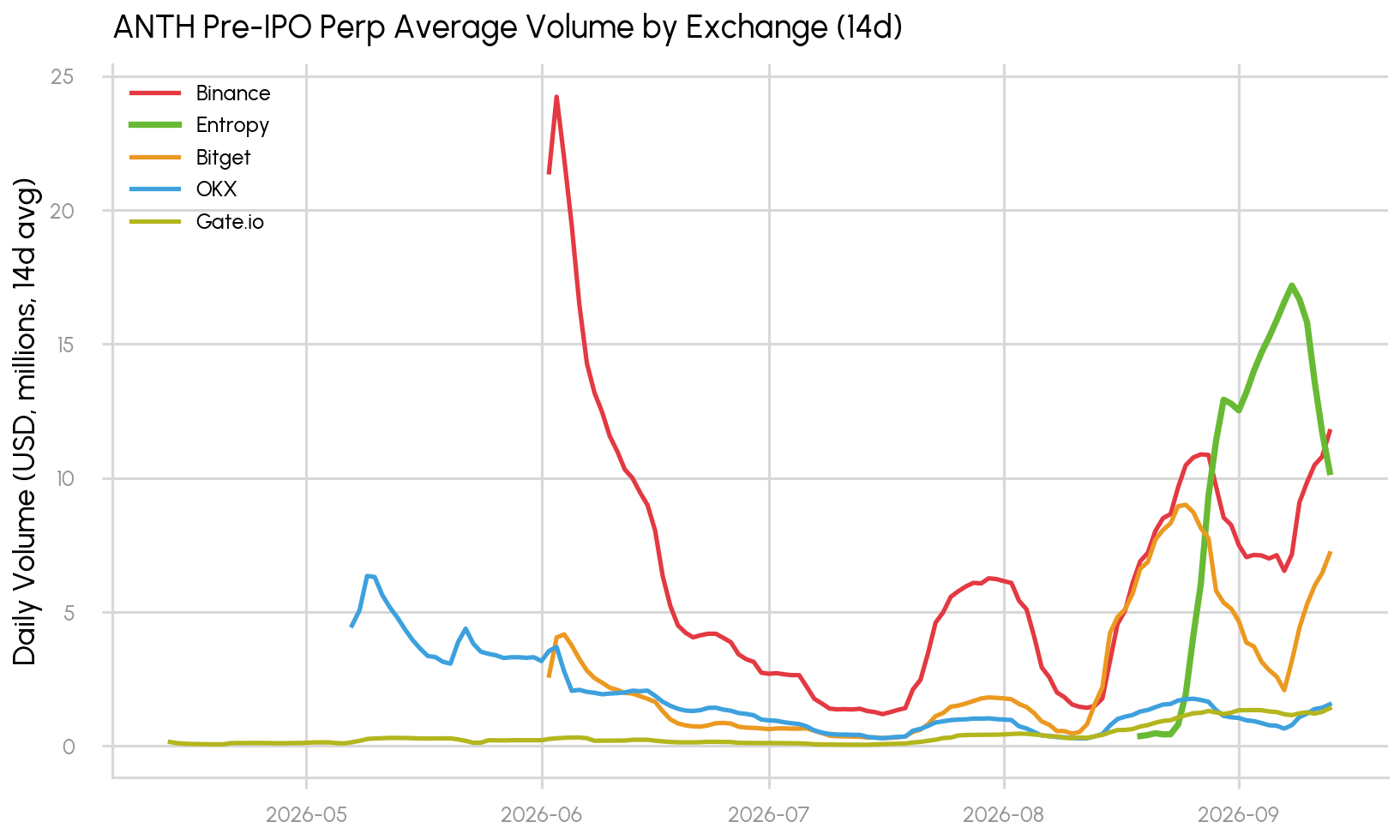
Entropy is a HIP-3 builder and, over the past two weeks, its pre-listing perpetual contract market for Anthropic has seen an average daily trading volume of over $10 million, with open contracts reaching $30 million. This is the largest open contract size among all exchanges offering exposure to Anthropic's pre-listing valuation.
With no spot market for Anthropic, a unique phenomenon has emerged: some exchanges do not charge funding rates, while others do so based on deviations from oracle prices. This leads to completely different trading motivations for Anthropic perpetual contracts across different exchanges.
Introduction
Anthropic is one of the most anticipated IPOs of 2026, and traders are betting its valuation will exceed $2.1 trillion. Historically, exposure to the performance and valuation of private companies has been limited to accredited investors and institutional capital. Most investors can only trade a company's shares after it is listed.
Perpetual futures settle without an underlying asset, allowing exchanges to create markets without needing Anthropic stock. The absence of settlement, delivery, or contract expiration has prompted exchanges to launch a pre-listing perpetual contract market for Anthropic, providing traders with synthetic exposure to Anthropic's valuation. Currently, 12 exchanges offer pre-listing futures markets for Anthropic, with 6 of them having open contracts exceeding $1 million. This issue of the network status report highlights the top five exchanges ranked by open contracts.
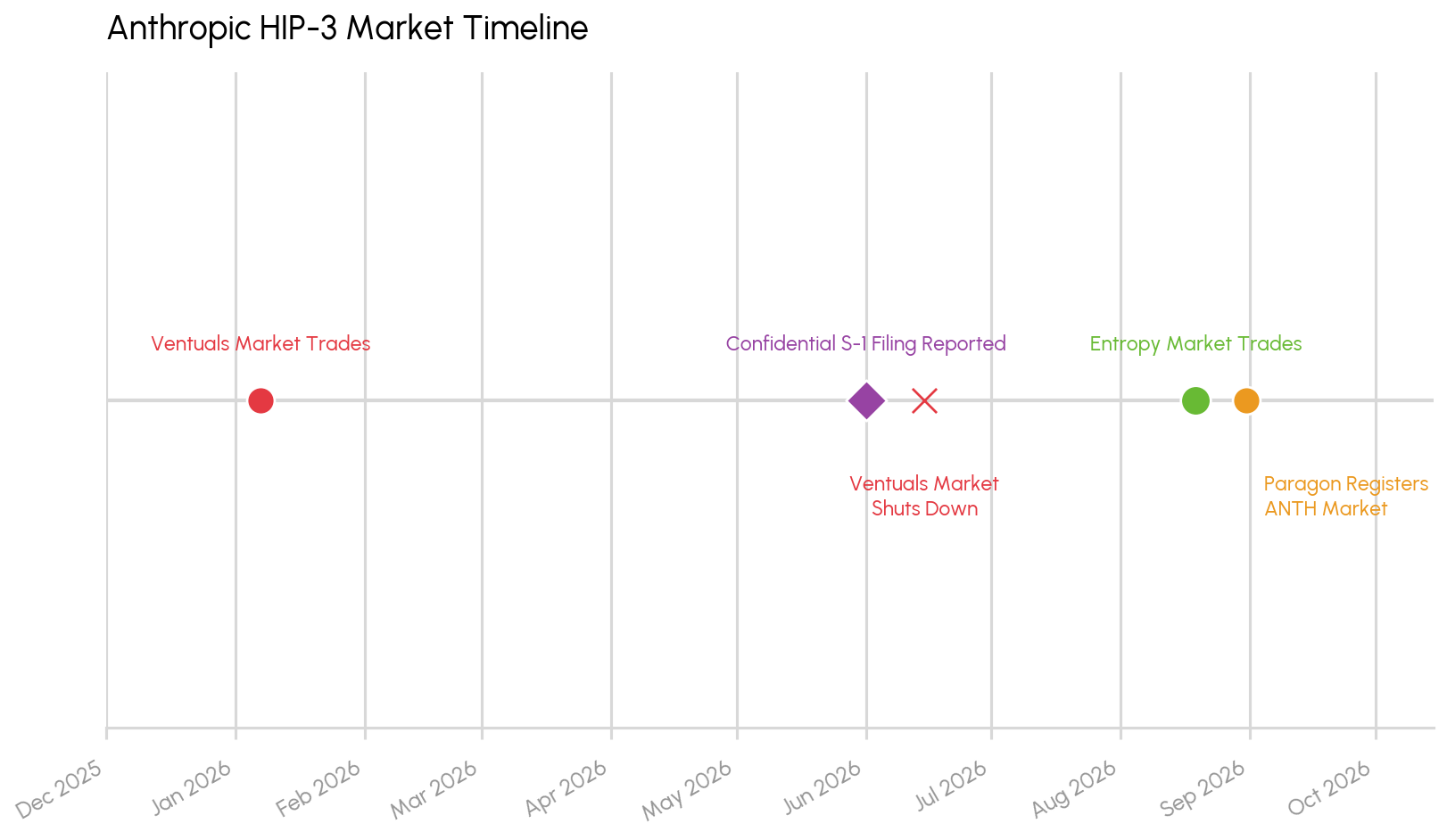
Although there are 12 exchanges providing a pre-listing market for Anthropic, traders have recently shown a clear preference for one: Entropy. Entropy is a Hyperliquid HIP-3 exchange that launched its Anthropic perpetual contract market on August 19. Since then, Entropy's Anthropic market has seen average daily trading volume rise to the top 15% of all markets on Hyperliquid, highlighting the strong interest in the Anthropic IPO.
In this issue of the network status report, we will conduct an in-depth analysis of Entropy's pre-listing perpetual contract market for Anthropic, how it competes for market deployment advantages against other HIP-3 builders, improves simulated aggregated order book depth, and competes with exchanges that charge low or even zero funding rates for pre-listing markets.
The Rise of Entropy as a HIP-3 Builder
The HIP-3 builder mechanism of Hyperliquid allows anyone who stakes 500,000 HYPE (approximately $40 million) to issue three perpetual contract markets at no additional cost. To create more markets, participants must engage in a Dutch auction with a base price of 500 HYPE (approximately $4,000). One of the first three markets created by Entropy is the pre-listing perpetual contract market for Anthropic.
Source: Talos CM Market Data Pro
Other HIP-3 builders have also deployed pre-listing markets to support price discovery ahead of company IPOs. These exchanges rely on internal order books for pre-listing asset pricing, while Entropy uses external market sources in addition to order book prices. The combination of multiple price inputs may offer greater accuracy than competitors, potentially allowing Entropy to gain more market share among HIP-3 builders.
Source: Talos CM Market Data Pro
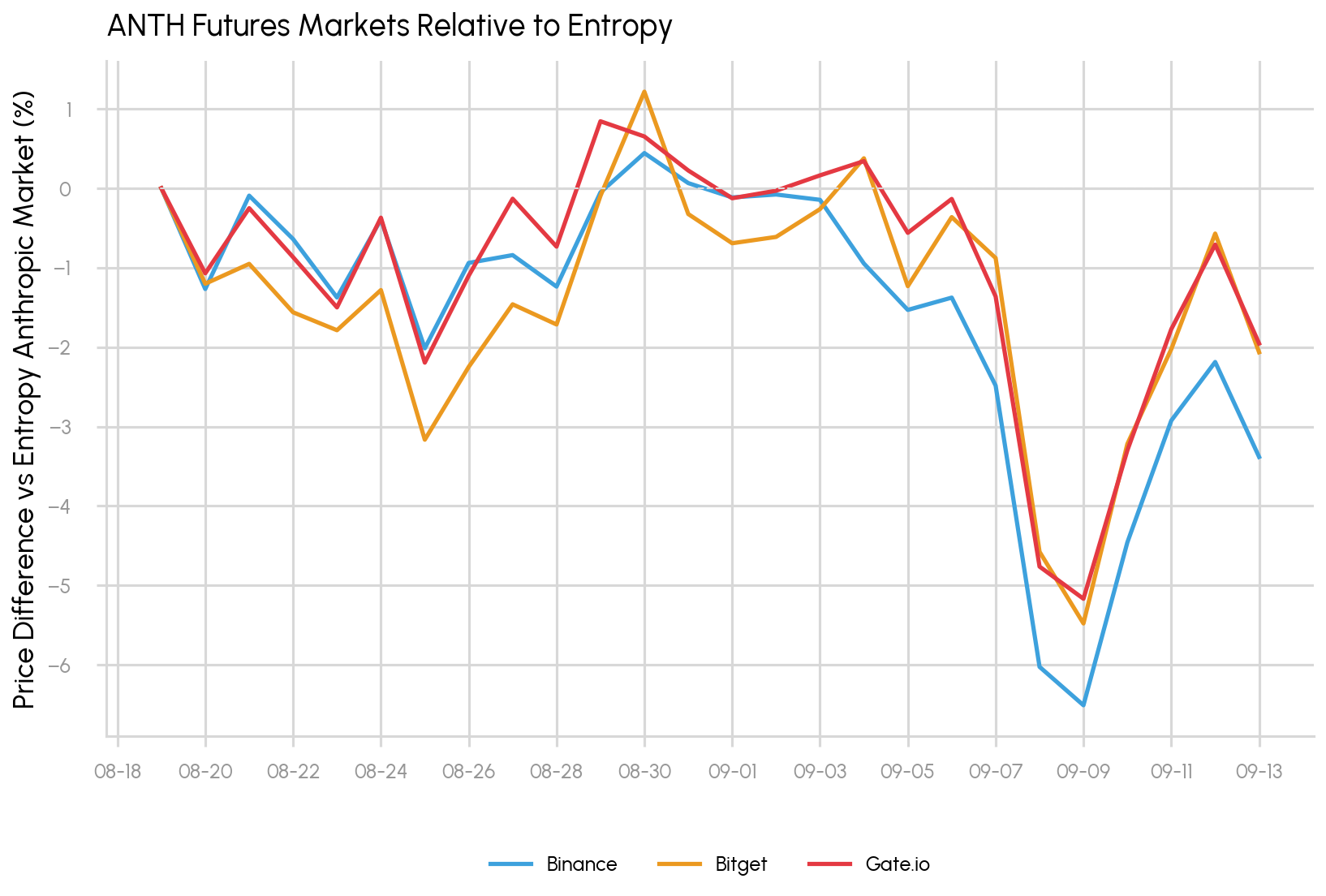
The price divergence between exchanges presents arbitrage opportunities. While these pre-listing markets are inherently speculative without many public valuation references, traders can profit from cross-exchange price differentials. Currently, there is a 2.47% price difference between centralized exchanges and Entropy.
The Timing Game of HIP-3 Builders
Being the first to cover new pre-listing markets on Hyperliquid carries the advantage of early capture of initial attention and generating fees to recoup market deployment costs. However, deploying too early with insufficient market interest may lead to low trading volumes, increased slippage, and higher funding rates.
Source: Talos CM Market Data Pro
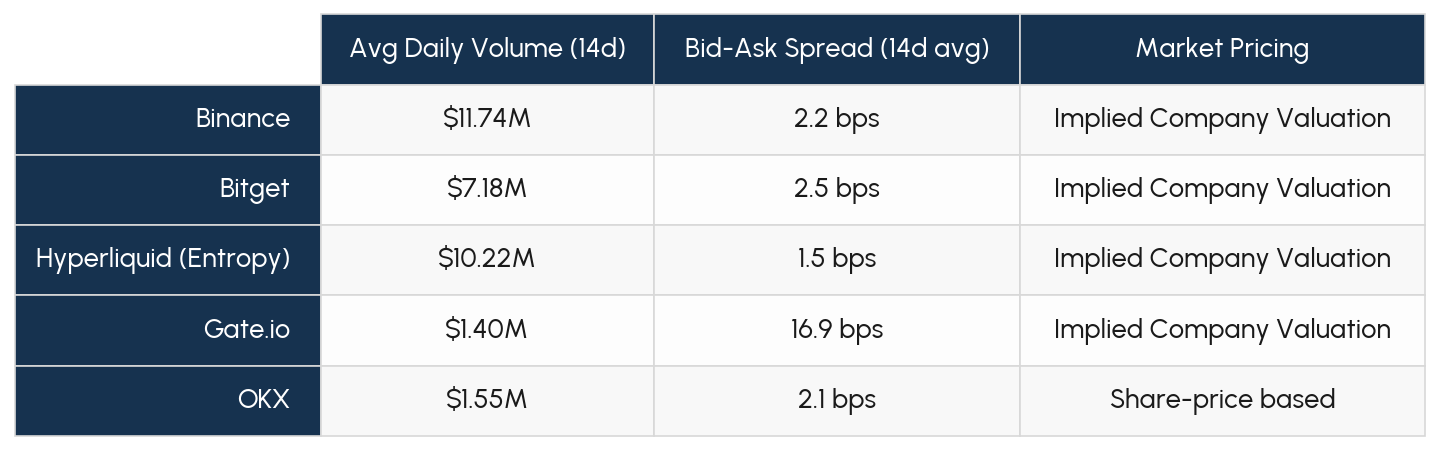
Like Binance, Bitget, and Gate.io, Entropy uses the implied company valuation to price the pre-listing market for Anthropic. This pricing method temporarily prevents HIP-3 builders like Trade.xyz from entering the market, as the latter uses expected stock price for pre-listing company valuations. Trade.xyz can only remain passive until Anthropic publishes its S-1 document or discloses more information regarding the sale of shares. OKX faces a similar challenge, as its managed pre-listing market assumes the sale of 10 billion shares and uses a per-share price valuation.
Source: Talos CM Market Data Pro
Currently, no other HIP-3 builders have launched an Anthropic perpetual contract market, which avoids liquidity fragmentation. Although Entropy launched its Anthropic perpetual contract market over 2.5 months later than Binance and Bitget, its average daily trading volume over the past two weeks ranks second ($10.22 million), while its open contracts rank first ($30.63 million).
Entropy's Order Book Depth and Slippage Compared to CEX
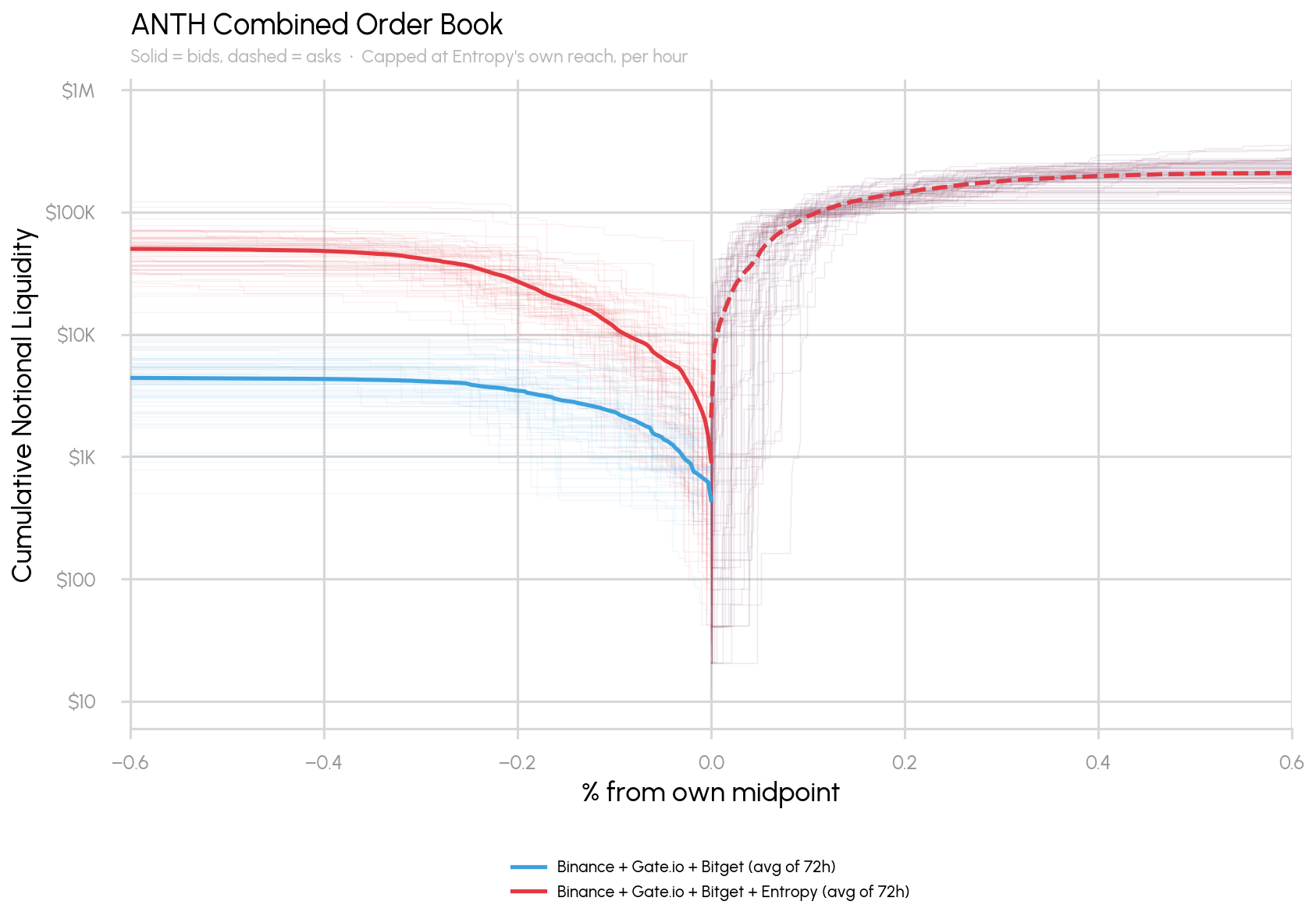
Routing orders to the optimal market based on the narrowest bid-ask spread, deepest order book, or lowest funding rate can enhance liquidity and reduce execution costs. Simulated aggregated order books show that Entropy has deep liquidity near the mid-price.
Source: Talos CM Market Data Pro
Compared to the aggregated average order book depth over 72 hours, within a range of approximately 0.5% around the mid-price, Entropy's liquidity is about 17% of the total liquidity of Binance, Gate.io, and Bitget combined. The order book shown on Hyperliquid highlights deep liquidity near the mid-price within a price range of less than 1%, reducing the price impact for traders trading pre-listing contracts.
Source: Talos CM Market Data Pro
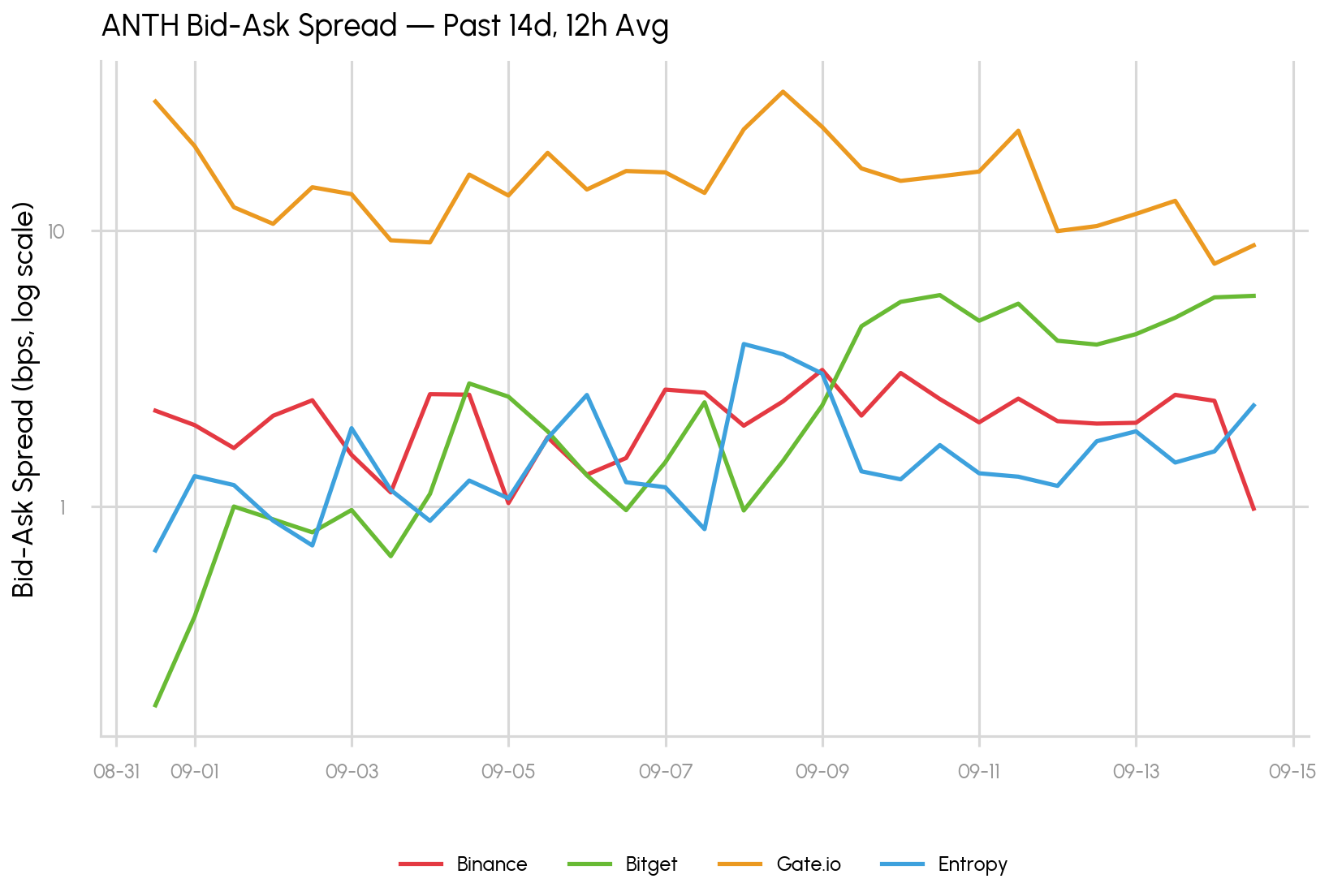
Entropy’s bid-ask spread can compete with that of centralized exchanges, averaging 1.5 basis points over the past two weeks. This is the narrowest spread among all exchanges, further confirming Entropy's high execution quality within Hyperliquid, and reducing trading slippage.
How Funding Rates Affect Exchange Choices
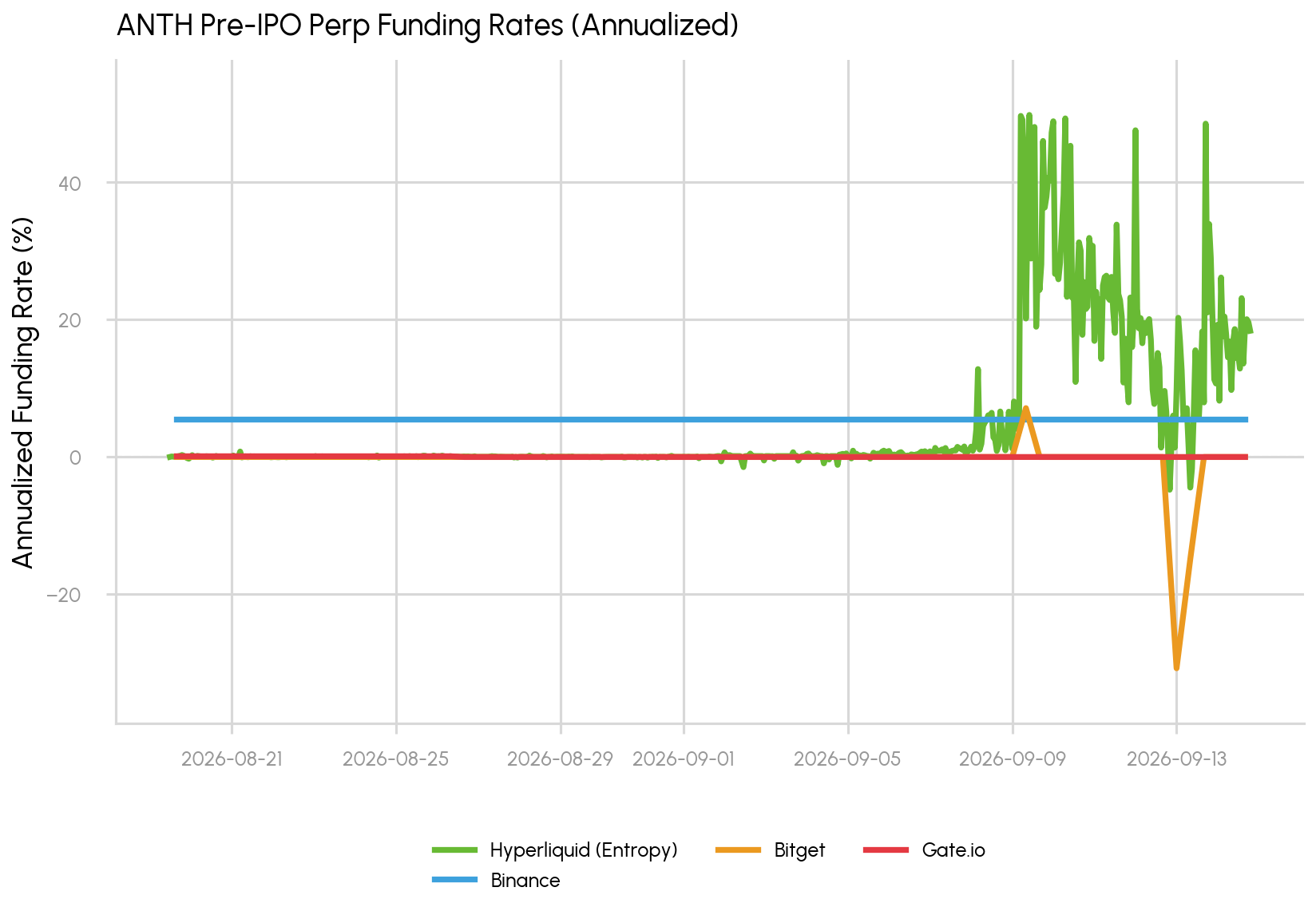
The perpetual contract market ensures that perpetual contract prices do not deviate too far from spot prices through funding rates. If a company has not yet gone public, how do exchanges charge funding rates? The Pre-IPO market created by HIP-3 builders does not require spot prices to charge funding rates. At Entropy, funding rates are calculated based on the difference between the perpetual contract price and the oracle price. The oracle price is derived from external or private market data sources, as well as internal prices from the order book.
Source: Talos CM Market Data Pro
Hyperliquid adopts a floating funding rate that resets hourly, while Binance charges a fixed funding rate of 0.005% every 8 hours. Bitget and Gate.io have extremely low or even zero rates. Recent discussions surrounding AI-related risks have caused a spike in funding rates on Entropy. The existence of funding rates indicates that users are placing real bets, and due to the hourly payment of fees, they are motivated to rationally price Anthropic's IPO. However, when valuation expectations become more volatile, the holding costs can become very high, prompting traders to switch to exchanges that charge lower funding rates.
The Pre-IPO market for Anthropic is the latest case of "perpetualization" of everything. Traders are beginning to speculate on the valuations of companies that are not yet listed. Entropy's growth momentum is strong, rising to become the exchange with the highest open interest, indicating that traders prefer to trade Pre-IPO perpetual contracts within the Hyperliquid ecosystem rather than being limited to centralized exchange markets.
We expect that as public documents related to Anthropic's listing are released, other HIP-3 builders will also join the competition for related trading volume. The emergence of more markets may challenge Entropy's share and divert liquidity. These markets will price Pre-IPO based on implied company valuations or per-share prices.
免责声明:本文章仅代表作者个人观点,不代表本平台的立场和观点。本文章仅供信息分享,不构成对任何人的任何投资建议。用户与作者之间的任何争议,与本平台无关。如网页中刊载的文章或图片涉及侵权,请提供相关的权利证明和身份证明发送邮件到support@aicoin.com,本平台相关工作人员将会进行核查。


