Author: Castle Labs Research
Translation: Deep Tide TechFlow
Deep Tide Introduction: While all public chains are competing for the quantity and scale of RWA, the real competition is just beginning. This article uses Mantle as a case study to dissect a key question: how to turn assets on chain into usable capital instead of just another package lying on the chain.
It All Depends on Utility
Nowadays, nearly all protocols and ecosystems are rushing into RWA, eager to launch new assets and showcase their market size or asset quantity.
However, out of context, these numbers are meaningless.
If no one uses them, what is the point of having thousands of RWA with fragmented liquidity?
Ultimately, for RWA to achieve widespread adoption, they must differentiate themselves by providing additional value compared to their corresponding traditional financial assets.
This report discusses the essence of RWA; we approach it from a pragmatic perspective, exploring how to build a fully functional ecosystem with a focus on utility and composability.
To this end, we take Mantle as a case study.
If you have been following us, you will have noticed we have previously discussed Mantle's early layout in RWA, and we documented their progress in the last report.
The truly interesting part of the RWA roadmap is not whether they can access tokenized stocks. Today, launching assets has become the easiest step: Kraken, Robinhood, Crypto.com, xStocks, Backed, Securitize, Ondo, Franklin Templeton, BlackRock, and a series of exchanges, custodians, and tokenization platforms are all rolling out their own versions of tokenized asset access solutions.
The more challenging question is: once these assets are on chain, can they really become efficient capital?
This time, we will go a step further, shifting our focus from the number of assets and the scale of tokenized assets to a more practical analysis of whether they can become productive capital.
The Key is Utility
RWA has traditionally been described as the crypto industry's pathway to institutional legitimacy. Move traditional financial assets such as government bonds, private credit, funds, stocks, or commodities onto the chain and then watch institutional investors flock in.
This narrative was indeed useful in the early stages, but tokenized assets are no longer scarce, and the marginal utility from each new launch is diminishing. Consequently, the market is flooded with various wrapped products, tracking products, fund shares, stablecoins, tokenized notes, and synthetic exposures akin to stocks.
The competition between chains can no longer rely on simply stacking assets, as anyone can do that today.
Instead, the most critical entry point in this discussion is utility.
With each new asset launched, protocol parties should ask themselves one question: then what?
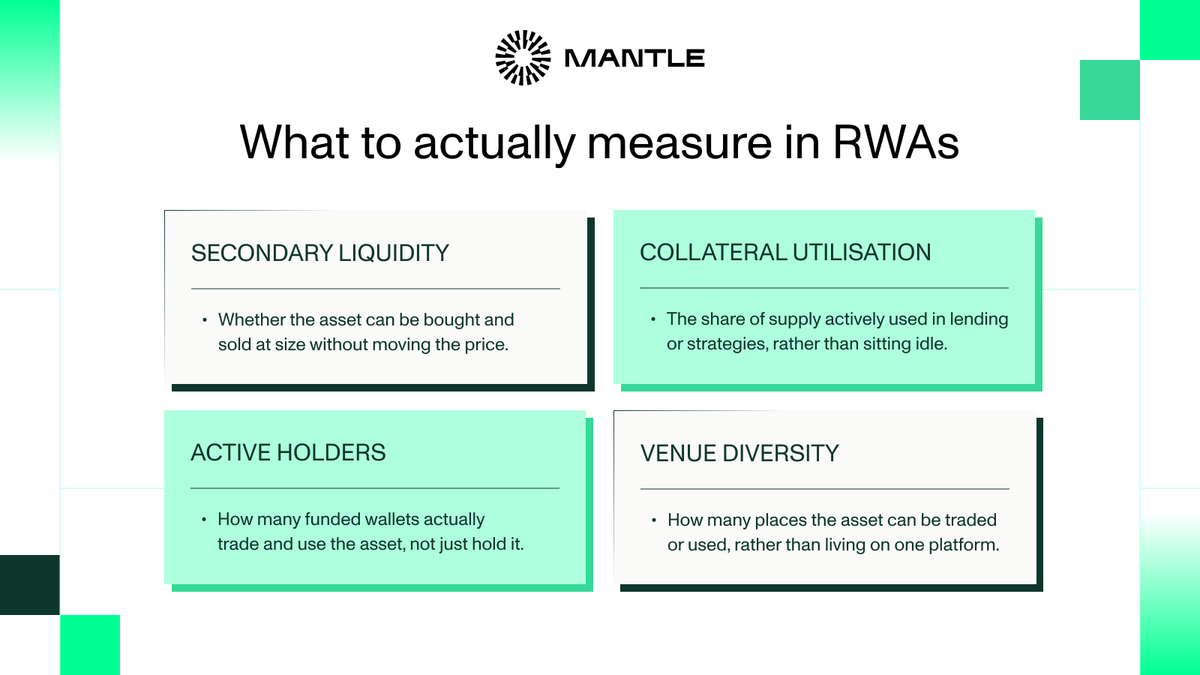
The field of RWA is evolving, and the next stage of competition will revolve around utility rather than asset quantity.
Tokenized assets will only generate true productivity when they meet the following criteria: they can connect to deep liquidity, can be used as collateral, can be composable across venues, and are open to anyone. Otherwise, the effect can be counterproductive: they will only exacerbate fragmentation without bringing any value increment.
We have just mentioned this point, but it is worth emphasizing again: the only way for RWA to achieve widespread adoption is to form differentiation and provide additional utility over corresponding traditional financial assets.
We focus on two dimensions:
Accessibility
Composability
Capital acquisition has historically never been evenly distributed; it has often been determined by geographical location, regulatory environment, brokerage relationships, and minimum investment thresholds, rather than by information and research.
Digital assets have largely changed this landscape, with stablecoins being a prime example. Many people living in high-inflation regions now prefer to keep their savings in stablecoins rather than holding weak domestic fiat currency.
Tokenization promises to do the same for traditional financial assets: government bonds, stocks, ETFs, pre-IPO allocations, etc., are being re-designed as on-chain digital tools.
The result is that this is driving these assets towards broader global access, and Nasdaq is also moving towards 24/7 trading.
The first stage of the RWA wave has consistently focused on building the initial infrastructure that makes such a transformation possible under the impetus of a friendly regulatory process.
Stablecoin frameworks, market structure proposals, Europe's MiCA, and large financial institutions' tokenization pilots have all prevented this field from being marginalized.
This has also propelled the scale of on-chain tokenized assets to surpass $38 billion.
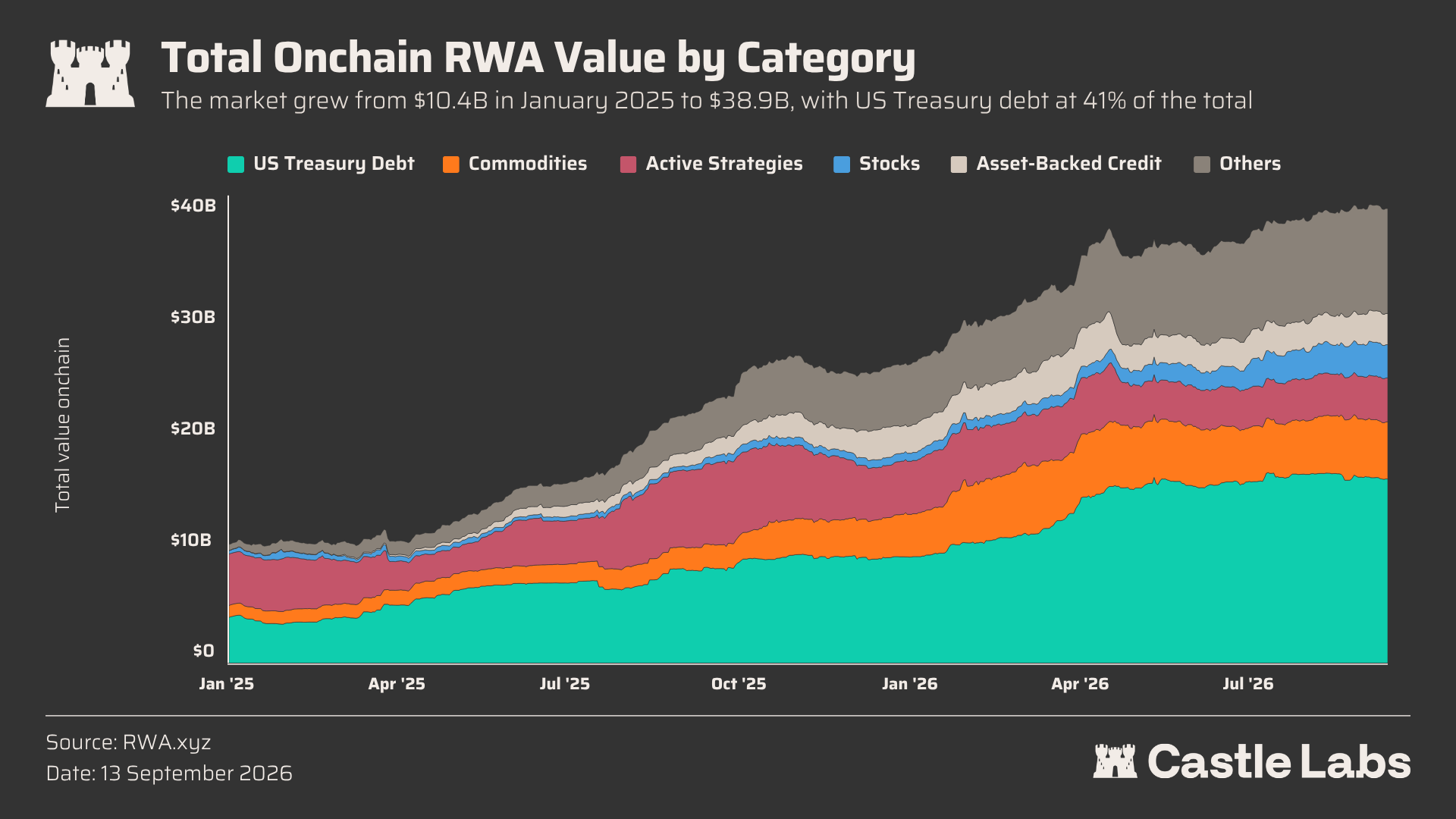
Starting with U.S. Treasuries (over $15.9 billion), users can now access a wide range of RWA tools on-chain, including commodities ($4.9 billion), active strategies ($3.6 billion), asset-backed credit ($2.56 billion), and stocks ($2.52 billion), etc.
From the accessibility perspective, the progress is significant.
Users can now access a wide range of asset classes across multiple networks.
From now on, the focus will not be on launching more assets (this type of assets will continue to increase, especially long-tail assets) but rather on the second utility promised by RWA: capital efficiency and composability.
As access issues continue to be addressed, another question around RWA is: how can both institutions and retail users further leverage these assets and obtain additional benefits through the already established on-chain ecosystem?
24/7 trading will soon no longer be a unique value proposition of the crypto market, as it is likely to become part of the structure of traditional financial stock markets as well.
RWA must evolve from mere digital representations of traditional financial assets to capital-efficient, programmable assets.
While tokenization has greatly improved access to traditional financial assets, these assets need to be embedded within existing on-chain ecosystems to be used more effectively.
Considering the background we previously mentioned (such as the upcoming 24/7 trading, the increasing role of Tradexyz as a trading venue for RWA, rising institutional participation, and enhanced expectations of regulatory clarity, etc.), this transition becomes more important.
Composability can take many forms.
Let's look at a few of them.
RWA Roadmap
As previously mentioned, the key to distinguishing RWA lies in accessibility and composability. Many networks and issuers have begun to explore both dimensions. In this section, we take Mantle as a case study to observe how it addresses both directions through existing products.
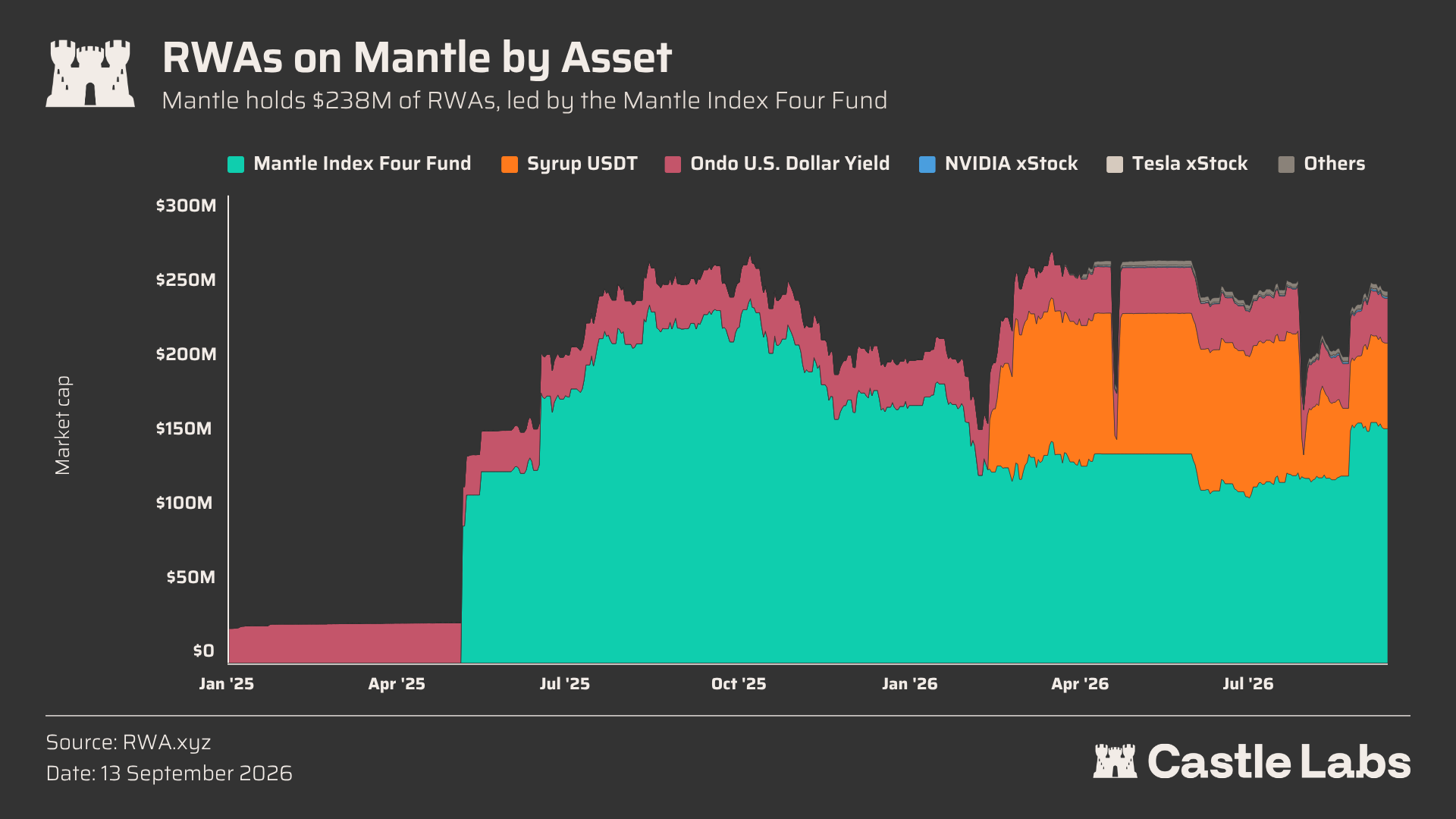
The Mantle ecosystem currently holds over $225 million in assets:
Over 60% of the value is concentrated in the Mantle Index Four Fund, which is an actively managed RWA strategy fund.
21% is represented by syrupUSDT, corresponding to credit or yield exposure in the Maple market.
15% is in Ondo USDY, representing tokenized U.S. Treasuries and dollar yield exposure.
2% is in xStocks, representing tokenized stocks and exchange-traded fund exposure.
The way Mantle handles the RWA roadmap reflects the transition we discussed earlier.
It all starts with a focus on infrastructure, laying a solid foundation to allow the future RWA ecosystem to thrive. This includes deposit and withdrawal channels, vendor integration, tokenization-as-a-service platforms, decentralized exchanges, etc.
Second, a phased approach must be taken to slowly launch key assets, ensuring that liquidity is properly guided. Once these foundations are solid, Mantle will focus on listing as many of these assets as possible to give users enough options.
Once the quantity is no longer an issue, the focus shifts to quality: execution, practicality, and composability. This includes ensuring execution quality through deep on-chain and off-chain liquidity, various integrations, and the potential for using these assets for transferring, trading, and lending.
Only after all these aspects are in place will the focus shift to user acquisition and distribution.
These are clearly not static: for instance, user acquisition will span the entire process, but there will be an optimal time to push for it. Using high incentives to attract users to a barren ecosystem does more harm than good, as they will only mine incentives without truly converting.
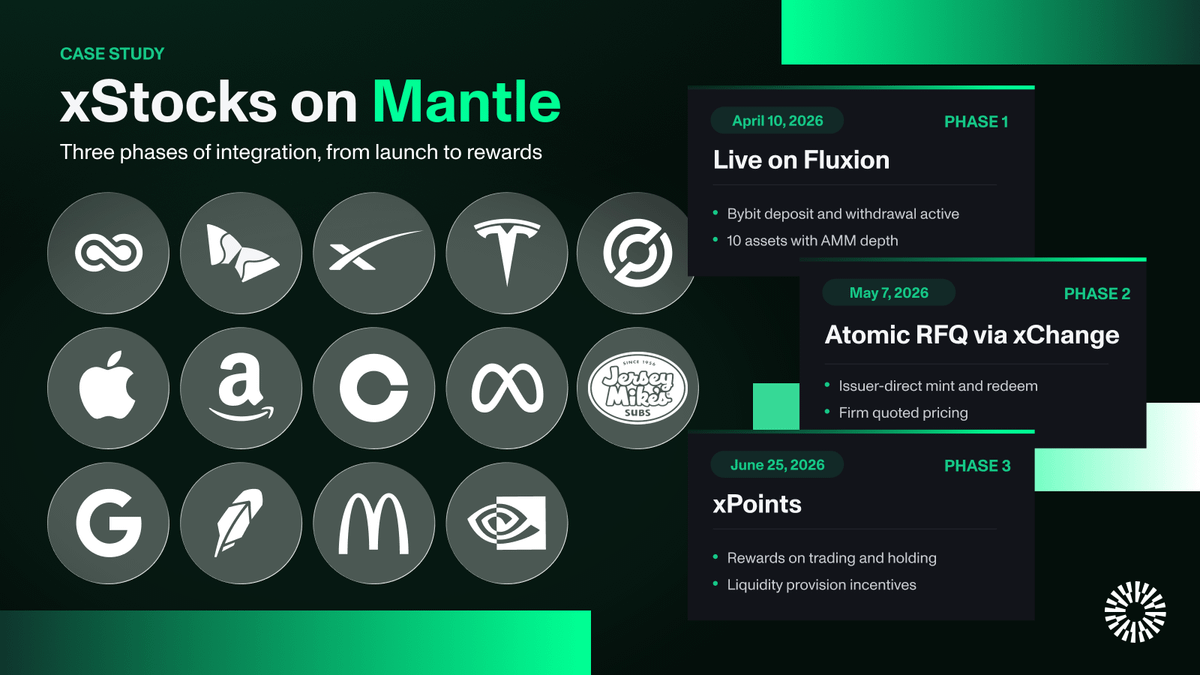
Taking Mantle's xStocks launch as an example, let's see how this process plays out in practice: they initially launched 10 assets only on the Mantle native DEX Fluxion. The phased release ensured the AMM had reasonable depth.
Second, on-chain liquidity is supplemented by the atomic RFQ system of xChange (xStocks' own platform). This addition is crucial for ensuring good price execution, which is the first element many looking at RWA from a TradFi or institutional perspective compare.
If RWA assets wish to compete with similar products in traditional finance, they must provide comparable execution quality. Otherwise, when the core value of an asset is missing, any additional value will just be ornamental.
The final part of the xStock activity on Mantle started running at the end of July, which is an incentive program guiding adoption through xPoints.
This raises another aspect we need to consider: active holders and user acquisition.
User Acquisition of RWA
Unrestricted on-chain access to a wide range of assets brings enormous benefits, especially compared to TradFi. To enhance accessibility and distribution, Mantle works closely with Bybit to make its products available to the user base of the exchange.
However, once Nasdaq launches 24/7 trading, competition will shift from mere accessibility to settlement, liquidity, and composability.
Before delving into user acquisition with Mantle as a case study, it's important to point out that there are several distinct segments among RWA users:
Cryptocurrency users who have never traded TradFi assets: Tokenization brings stocks, funds, and other money market products on-chain, enabling crypto users to access assets that were previously restricted to TradFi institutions.
TradFi retail users: They can now gain more possibilities with assets previously "traditionally" traded.
TradFi institutional users: They seek regulated and compliant solutions to enhance capital efficiency in their on-chain "traditional" trading assets.
These segments may vary depending on the ecosystem's focus, but this classification helps understand user granularity. Remember, everyone is competing for the same batch of users, making differentiation essential.
Considering the attributes of RWA assets themselves, different asset types are expected to have different levels of holders.
The Mantle Index Four Fund holds the majority of RWA value on-chain, but due to its institutional nature, it has only 6 holders.
Meanwhile, xStocks has seen strong retail growth, increasing to over $4.4 million since its launch in March.
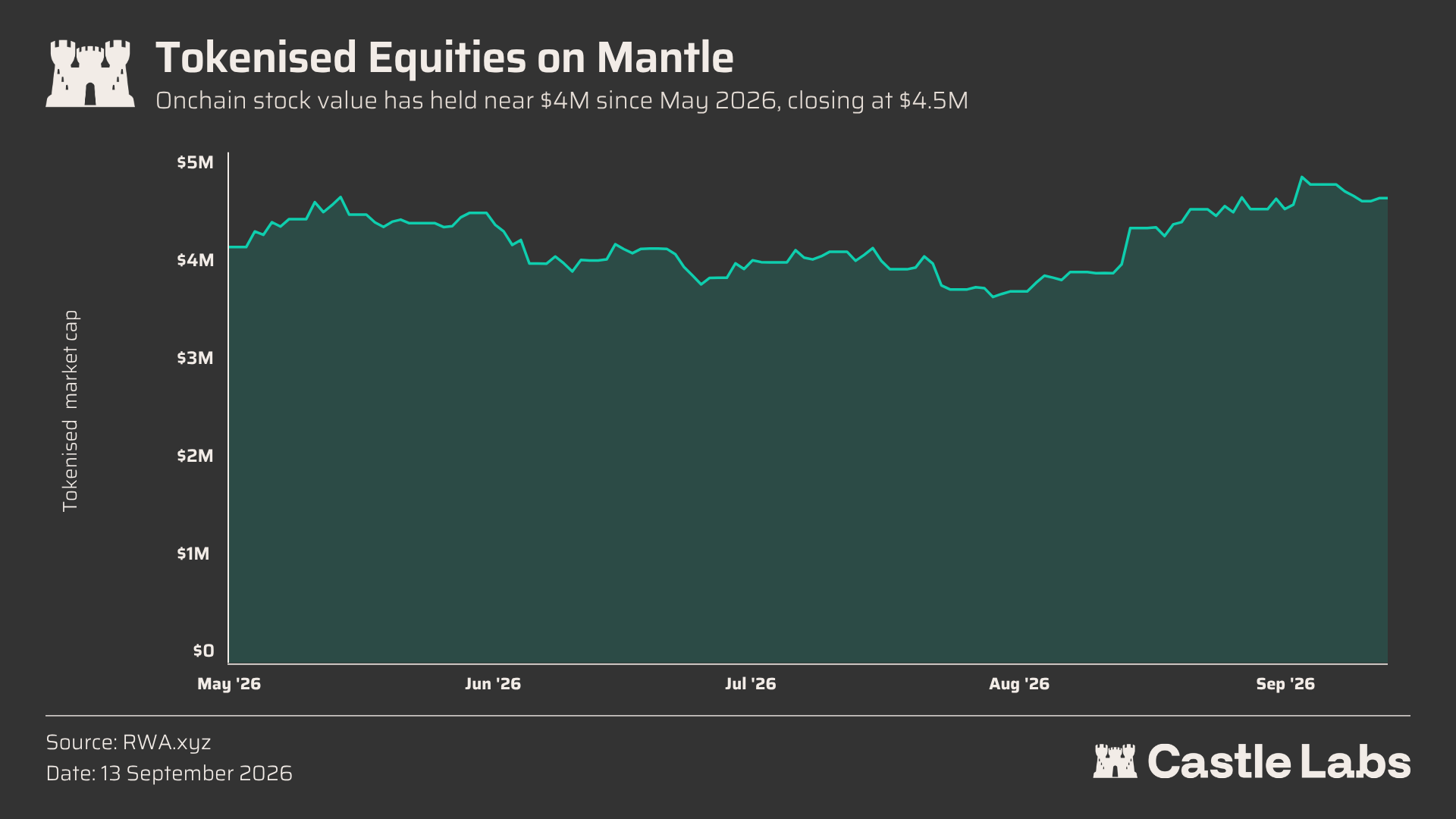
User acquisition for retail, especially for equity-type assets, has been a focal direction in recent months.
The assets currently held most by on-chain users are:
Tesla xStock
CRCL xStock
NVIDIA xStock
Alphabet xStock
In addition to on-chain user growth, this development has a straightforward explanation. Mantle benefits from its unique relationship with Bybit, a larger centralized exchange.
As part of this, Mantle assets enjoy a unique distribution network on Bybit, reaching over 40 million users. Particularly under Mantle's RWA strategy, the cooperation between the two parties has become closer. For instance, Bybit just expanded its Dual Asset product to support 10 tokenized stocks from xStocks, including TSLAx, METAx, CRCLx, and HOODx. Dual Asset is a structured product that allows users to buy or sell cryptocurrencies at target prices while earning yields.
This illustrates Mantle's utility-focused approach: 96% of RWA value is concentrated in income-generating assets, more than half in active strategies, 25% in asset-backed credit, and 14% in U.S. Treasuries.
This is also a significant differentiating advantage for Mantle, positioning it as a network where tokenized stocks can flow between CEX liquidity, on-chain venues, and DeFi.
A tokenized stock that only stays within a single application can only provide product access functionality. If it can enter DeFi or CEX for lending or yield generation, it becomes efficient capital.
Currently, stocks are a simple way to keep user engagement by launching "hot" targets, such as in July with SKHYX, and the recent listing of Jersey Mike's stock after its IPO. Launching mid-cap consumer stocks is a useful test to see if the demand for these assets can truly form on-chain.
However, stocks are just one facet; there are many other assets available. For example, more than 49% of deposits in Openstock's pre-IPO vault on the first day came from Mantle. Additionally, Fluxion has just supported the RWAlpha yield strategy, becoming the first place on Mantle to allow users to obtain yield products through tokenized stocks.
Mantle has also recently joined the Global Dollar Network (GDN), a project operated by Paxos around USDG. USDG is a regulated stablecoin that is now available on Mantle, alongside AUSD, USDe, USDY, and USDT0.
By combining its on-chain users with external distribution channels, Mantle can advance on two fronts, covering CEX audiences while ensuring its yield products can be easily integrated, as demonstrated by xStocks' Dual Assets.
Conclusions and Thoughts
Early tokenization rewarded the ability to bring assets onto the chain. The next stage will reward the ability to make these assets useful.
A "useful" RWA ecosystem can create two simultaneous benefits.
First, they allow on-chain access to liquidity that previously existed outside the ecosystem. Tokenized stocks, money market funds, credit products, and active strategies can bring external capital into on-chain applications. This capital may come from users seeking TradFi exposure, institutions looking for crypto-native distribution, or asset managers seeking faster settlement and broader coverage.
Second, productive RWA can create sticky liquidity. A user coming solely to purchase tokenized stocks may leave immediately after the transaction is complete. In contrast, a user whose tokenized assets can be allocated into strategies, used in DeFi, used as collateral, or paired with stablecoins has more reasons to stay.
When capital has more uses, its stickiness increases.
Before we conclude, we would like to leave you with some questions that might lead to more meaningful metrics to evaluate an RWA ecosystem:
Can users transfer assets between exchanges, wallets, and DeFi venues?
Is there genuine secondary market liquidity, or is it merely theoretical tradability?
Can the asset serve as collateral under conservative risk parameters?
Are there active strategies around these assets?
Are oracles, custody, and legal packaging clear enough for institutional use?
For users, the RWA stack must address four issues: acquisition, movement, liquidity, and usage.
Acquisition means users can access assets that were previously hard to purchase. This could be U.S. stocks, exchange-traded funds, money market funds, treasury-backed products, pre-IPO allocations, or off-chain strategies.
Movement means the assets can leave the application where the user originally purchased them. If assets are technically on-chain but cannot move freely, cannot enter wallets, cannot enter DeFi, and cannot be used across different venues, then the product is closer to a TradFi balance than an asset truly owned by the holder.
Liquidity means users can enter and exit with acceptable depth and spreads. The availability of illiquid assets represents a weak form of acquisition, unable to compare to the execution of TradFi.
Usage means assets can be placed into strategies, paired with other assets, earn yields, or serve as collateral.
For institutions, the questions about RWA are different. They have already been able to acquire many assets. Their issues lie with distribution, settlement, liquidity, reporting, custody, compliance, and integration with crypto-native demands.
For institutions, value is not just cheaper acquisition; it is faster distribution to markets that already understand these assets, along with the ability to connect issuance with liquidity, custody, cross-chain movement, and DeFi use.
The future of RWA is no longer about asset listings, but about making these assets productive and moving towards truly borderless capital acquisition that can move, settle, trade, collateralize, and integrate with other on-chain financial systems.
免责声明:本文章仅代表作者个人观点,不代表本平台的立场和观点。本文章仅供信息分享,不构成对任何人的任何投资建议。用户与作者之间的任何争议,与本平台无关。如网页中刊载的文章或图片涉及侵权,请提供相关的权利证明和身份证明发送邮件到support@aicoin.com,本平台相关工作人员将会进行核查。


