Author: ileana gray
Translation: Baihua Blockchain
Ethereum is behaving unusually calmly.
After rising over 30% in August, ETH has remained in a narrow fluctuation range in early September, repeatedly testing the $2,500 threshold, but has consistently lacked the momentum for an upward breakout.
However, beneath the calm price movements, the Ethereum market is anything but tranquil.
Financial companies continue to buy ETH. The inventory on trading platforms continues to decline. ETF demand has cooled somewhat but overall remains positive. Meanwhile, developers are intensively preparing for a major transformation of Ethereum's infrastructure—the Glamsterdam upgrade is approaching, and the longer-term Hegotá roadmap is also beginning to take shape.
Therefore, despite ETH being in a consolidation phase, several key pieces are accelerating into position.
$2,500 becomes the focal battlefield for both bulls and bears
ETH has recently been fluctuating mainly between $2,480 and $2,520.
Repeated attempts to reclaim $2,500 indicate that buyers are still defending this psychological level, but the resistance in the range of $2,525 to $2,535 limits upward space. Additionally, $2,550 remains a more critical resistance level.
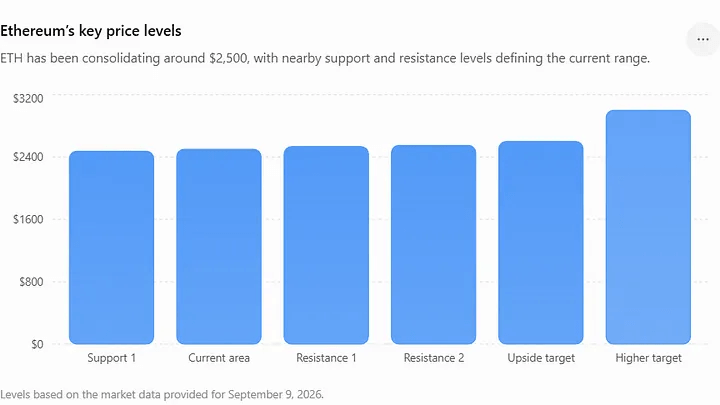
If it can effectively break through $2,550, it could bring $2,600 back into view and open up a path to the $3,000 area if momentum returns.
The downside risk is also clear.
The first support range is located between $2,475 and $2,485. If it falls below this range, it could further explore $2,430 to $2,445.
Some technical charts have shown a golden cross, which is usually seen as a long-term bullish signal, but technical indicators alone cannot change the weak market participation.
This is particularly critical at the moment, as investors are closely watching the Federal Reserve's interest rate meeting scheduled for September 15-16.
In the long run, the current price prediction scenario for Ethereum largely depends on whether ETH can convert this consolidation phase into a sustained breakout trend, rather than just a momentary rebound.
Noteworthy phenomenon: Retail investors cashing out, while whales continue to accumulate
One of the most prominent characteristics of the current market appears among holders of different scales.
Wallet addresses holding between 100 and 10,000 ETH reportedly sold approximately 307,000 ETH last week.
Meanwhile, whale addresses purchased about 82,000 ETH.
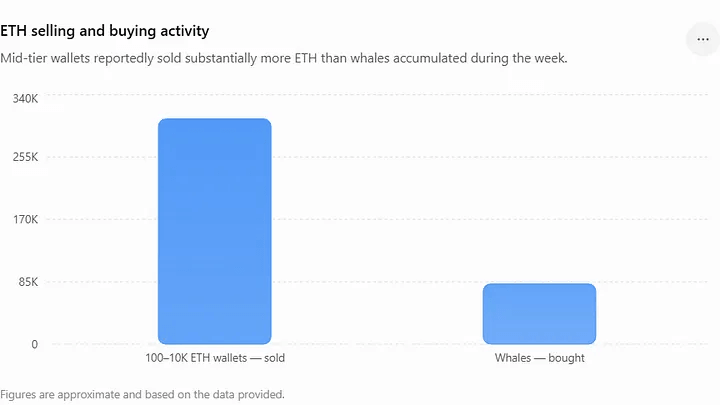
This does not necessarily mean the market is turning bearish; it may simply indicate that some investors chose to take profits after the August rebound, while larger funds are building longer-term positions.
BitMine Immersion Technologies is a typical example.
This company has once again purchased about 28,086 ETH (valued at approximately $69 million to $70 million), bringing its total holdings to approximately 5.93 million ETH.
This accounts for nearly 4.9% of Ethereum's total supply.
This enormous scale is hard for the market to ignore. Even though the book value is still below its average acquisition cost, BitMine continues to accumulate, with its large holdings of ETH being staked.
This stands in stark contrast to short-term trading strategies.
Another whale establishes a short hedge position
Abraxas Capital has also been active recently.
Reports indicate that the institution bought about 13,000 ETH in the spot market, valued at approximately $32 million.
The reason behind this is particularly noteworthy: it is claimed that part of this spot purchase is to hedge its massive short position of about 141,000 ETH on Hyperliquid.
In other words, not every large purchase represents a purely bullish sentiment.
On other developments, an early Ethereum holder sold approximately 11,023 ETH through Wintermute, while Sun Yuchen continued to transfer ETH assets after withdrawing additional funds from Lido.
The conclusion is very clear: whale activity is increasing, but the direction is not consistent.
Some whales are offloading, some are accumulating, and some are hedging.
ETF inflow momentum has significantly slowed
The Ethereum spot ETF market shows a similar divergence.
Weekly inflow has reportedly dropped to about $218 million, a significant decrease from about $824 million the previous week, with some single-day transactions even showing net outflows.
This slowdown is evident.
Nevertheless, it is still early to directly attribute the slowing ETF inflows to a disappearance of institutional interest.
Another indicator from the supply side is developing positively.
In just 48 hours, over 116,000 ETH flowed out of trading platforms. The reduction in circulating tokens on trading platforms indicates an immediate easing of selling pressure, although this does not guarantee that prices will necessarily rise.
Moreover, infrastructure aimed at institutions is steadily expanding. Standard Chartered Bank has reportedly expanded its physical delivery ETH spot trading services for institutional clients in the UAE.
Therefore, the current market reflects a coexistence of localized demand slowdown with overall institutional infrastructure steadily expanding.
The most interesting story about Ethereum may not be about the price
If the price trend appears dull, the technical development roadmap for Ethereum is quite the opposite.
The Ethereum Foundation's protocol cluster has recently published a unified prioritization of 62 proposed EIPs for the upcoming Hegotá upgrade.
Two of these proposals have been marked as the highest priority changes:
EIP-7805 (FOCIL), aimed at enhancing censorship resistance through transactional bundling enforcement.
EIP-8141 (Frame Transactions), which is expected to address the long-standing user experience pain point of having to hold native ETH to pay transaction fees.
This proposal is expected to allow users to pay gas fees directly using stablecoins like USDC or USDT, while providing support for native account abstraction and new verification methods.
This will greatly lower the barrier for ordinary users to interact with Ethereum.
Behind this roadmap is a more long-term goal: to build quantum attack resistance for Ethereum Layer 1, currently set to see December 2029 as an important milestone target.
Glamsterdam upgrade is set to be the next big test
Hegotá is still in the long-term planning stage.
Before that, Ethereum will welcome its next major upgrade—Glamsterdam, currently targeted for Q4 2026.
This upgrade focuses significantly on optimizing the overall performance of Layer 1.
Developers are tackling challenges such as built-in proposer-builder separation (ePBS), block-level access lists, gas repricing, and increasing gas limits.
One of the key goals is to raise the gas limit baseline to around 200 million, which, if successfully implemented, would significantly increase the throughput capacity of the Ethereum network.
The Sepolia testnet fork is expected to occur on September 28 or early October.
This means that the next few weeks will be crucial not only for short-term traders but also as an important window for evaluating Ethereum's underlying technology roadmap moving towards the mainnet.
The ecosystem is showing diverse and differentiated evolution
While the core technology evolution of the mainnet progresses, the Ethereum ecosystem is also undergoing reshuffling.
Lido has launched the 0x02 community staking module testnet, aimed at supporting compound validation nodes with balances of up to 2,048 ETH.
If it goes live on the mainnet, this change will greatly enhance the capital efficiency of staking operators.
In contrast, Scroll has chosen a completely different development path.
This Ethereum Layer 2 project announced plans to gradually transition from a general-purpose public chain to an application-specific dedicated network built around its Compass AI ecosystem.
The transition period is expected to last about nine months. Scroll also plans to migrate the SCR Token to the Ethereum mainnet, while maintaining its existing supply and token economic model.
Additionally, Trezor has added support for ERC-7730 Clear Signing, striving to allow users to better understand specific operational details before approving blockchain transactions.
What is the market waiting for?
Ethereum currently lacks a super catalyst sufficient to determine the next phase of unilateral trends.
Instead, several smaller forces are pushing the market in different directions:
Retail investors are selling.
Financial companies are accumulating.
ETF net inflows are slowing.
The inventory on trading platforms continues to decline.
ETH is hovering around $2,500.
Meanwhile, Ethereum core developers are preparing to implement the most significant underlying network transformation in recent years.
This paints a clear short-term price trend for traders:
Effectively holding above $2,550 would greatly strengthen bullish logic; while falling below $2,475 could shift the market's focus to the $2,430 to $2,445 range.
Until these key levels are broken, Ethereum may continue to maintain its fluctuations.
However, the lack of sharp price volatility should not be misunderstood as the underlying ecosystem falling silent.
The next large-scale price movement of ETH may ultimately depend not on a single heavyweight news story, but on which of the intertwined trends can truly take the lead.
Article link: https://www.hellobtc.com/kp/du/09/6441.html
Source: https://medium.com/coinmonks/ethereum-is-quiet-at-2-500-but-the-bigger-story-is-happening-underneath-bef7fca93cbd
免责声明:本文章仅代表作者个人观点,不代表本平台的立场和观点。本文章仅供信息分享,不构成对任何人的任何投资建议。用户与作者之间的任何争议,与本平台无关。如网页中刊载的文章或图片涉及侵权,请提供相关的权利证明和身份证明发送邮件到support@aicoin.com,本平台相关工作人员将会进行核查。