The government's deficit, inflation, and the surge in AI financing are continuously driving up long-term yields, increasing pressure on the U.S. Treasury market. What the market is really waiting for is Kevin Warsh to further explain the Fed's "reaction function"; compared to utilizing a $6.7 trillion balance sheet, clear communication might be a more realistic choice.
Written by: Xiao Yanyan, Jin Shi Data
Investor concerns about the government deficit and persistent inflation are pushing up funding costs, while the Fed still has room to alleviate the tensions in the bond market.
Last week, the escalation of the Middle Eastern conflict again pushed up energy prices, forcing heavily burdened countries to increase borrowing to expand defense spending and fund the war. Global bonds thus faced further sell-offs, with yields rising to multi-year or even multi-decade highs, pushing up consumer financing costs through mortgages, credit cards, and other channels, while increasing the repayment pressure on the $40 trillion debt of the U.S. government.
Fed Chairman Kevin Warsh had previously remained relatively silent on interest rate prospects. However, at last month's economic symposium in Jackson Hole, Wyoming, he sent out an important signal: there is still more "work to be done" in the fight against inflation, which suggests that further rate hikes may be on the horizon.
This statement was welcomed by investors and reflects a pressing need for clarity on Warsh's economic views. Key driving factors behind the rise in yields currently include fiscal concerns and corporations issuing bonds on a large scale to finance AI development.
Derek Tang, a policy economist at Monetary Policy Analytics, told CNN: "The Fed's responsibility is limited to controlling inflation. If Warsh can better explain policy in the coming months, this source of anxiety may ease."
However, Derek also pointed out that the Fed still possesses the "firepower of an unlimited balance sheet."
On Tuesday, U.S. Treasury yields rose slightly as traders monitored oil price trends while waiting for inflation data to be released later this week. After last week's significant increase, yields are stabilizing this week.
The yield on the 10-year U.S. Treasury bond currently trades at 4.80%, close to the highest level since 2025, and has also approached the peak for 2023.
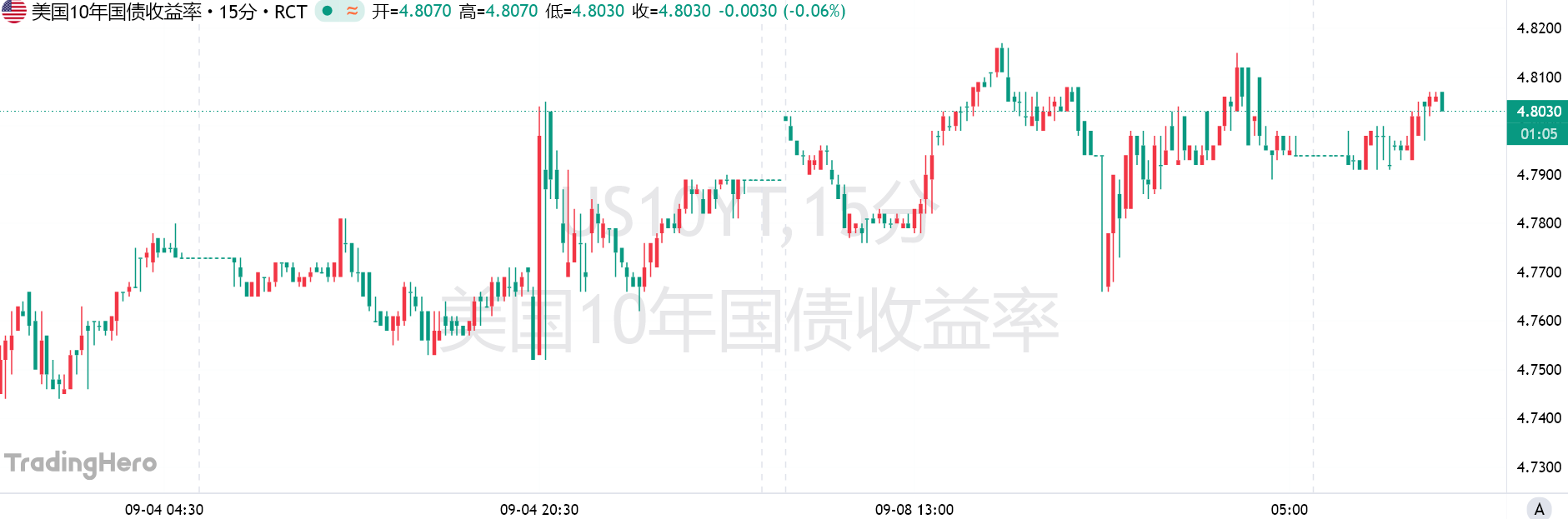
What the market is really waiting for is the "reaction function"
Warsh has repeatedly reiterated that the Fed is committed to achieving a 2% annual inflation target, but this statement alone is not enough to eliminate the concerns of bond investors completely.
Shortly after the press conference following Warsh's chairing of the Fed's July monetary policy meeting, long-term bond yields rose significantly. This may reflect market doubts about Warsh's commitment to controlling inflation or could be related to the Fed entering a more muted adjustment period, or simply investors beginning to factor in the possibility of future rate hikes.
What the market currently lacks is further clarification from Warsh on the Fed's "reaction function." According to the Brookings Institution, this concept involves what the central bank is "paying attention to, how it interprets the economy, how it weighs competing risks, and which changes would alter its judgment."
While Warsh did not detail this framework in his speech in Jackson Hole, signaling possible rate hikes has already been viewed as a step toward communicating with the market.
Jim Baird, Chief Investment Officer at Plante Moran Financial Advisors, stated: "Warsh needs to continue refining the way he communicates with the market." He believes an important aspect of this is to assure the market that policymakers will act within a reasonable timeframe.
Currently, the market estimates about a 60% probability of the Fed raising rates at next week's meeting. If a hike occurs, it would be the first increase in more than three years; investors also expect at least one more hike before the end of the year, but the specific timing remains uncertain.
The pressure faced by the bond market does not solely stem from monetary policy. Fiscal deficits, inflation, and the financing wave surrounding AI development may continue to push long-term financing costs higher. In this context, clearer policy communication could become a direct means to stabilize market expectations.
$6.7 trillion balance sheet is not the preferred option
The Fed does indeed have another tool that can influence long-term yields, namely its balance sheet. However, market participants generally believe the probability of the Fed under Warsh using this tool is extremely low.
Mike Goosay, CIO and Global Head of Fixed Income at Principal Asset Management, stated: "The Fed has enough ammunition to make a greater impact on interest rate levels through the introduction of quantitative easing." However, he believes this scenario is unlikely to occur.
During the Great Recession, the Fed massively expanded its balance sheet by purchasing bonds and mortgage-backed securities, injecting funds into the financial system and stimulating the economy while rates were close to zero.
At that time, Warsh, who served as a Fed governor, supported the first round of quantitative easing (QE), viewing it as an emergency measure taken in extraordinary times. Subsequently, the Fed launched two more rounds of QE, successfully stabilizing the market and spurring economic recovery, but this also became one of the reasons for Warsh's eventual resignation. He labeled the Fed’s massive asset purchases as "reverse Robin Hood," believing that this policy benefitted wealthy asset owners while harming ordinary families.
Since taking on the role of Fed Chairman, Warsh has continuously emphasized that the central bank needs to return to fundamental principles, making his support for QE in the current environment even less likely.
The Fed had previously utilized its balance sheet to directly lower long-term borrowing costs.
Derek pointed out that during World War II, the Fed felt it had an obligation to support the war effort and therefore used its balance sheet to lower bond yields to help the government increase spending. "But we are not in a world war now," he said.
At that time, the Fed maintained low prices for short-term Treasury bills and long-term bonds by purchasing all bonds that private investors were unwilling to buy, while keeping short-term interest rates low.
This policy, however, came at the cost of diminished independence and made it more challenging for policymakers to control inflation. Ultimately, this arrangement ended with the 1951 Treasury-Fed Accord, restoring the Fed's independence relative to the Treasury.
Warsh has previously emphasized that the independence of the Fed is crucial, and this also relates to the bond market.
When investors believe the Fed is willing to take potentially unpopular monetary policy measures to control inflation, they are also more likely to trust the central bank’s commitment to price stability.
For the current bond market, rather than reactivating the $6.7 trillion balance sheet to influence long-term yields, the Fed's more direct choice might still be to convince the market that, in the face of inflationary pressures, it will ultimately take action.
免责声明:本文章仅代表作者个人观点,不代表本平台的立场和观点。本文章仅供信息分享,不构成对任何人的任何投资建议。用户与作者之间的任何争议,与本平台无关。如网页中刊载的文章或图片涉及侵权,请提供相关的权利证明和身份证明发送邮件到support@aicoin.com,本平台相关工作人员将会进行核查。


