
Author: Xiao Lan, Global Zero Carbon Research Center
This year's copper has really gone completely crazy. Known as the king of commodities, "Copper Doctor" has once again reached the pinnacle of history.
First, domestic spot copper broke 110,000, setting a new historical high. Now, London Metal Exchange (LME) copper futures prices also broke through 14,533 USD/ton on the evening of September 7, surpassing the previous high set in January this year.
After this significant increase, copper prices set a new historical record on the London Metal Exchange. As of now, the year-to-date increase in LME copper futures has exceeded 17%, while the increase over the past 12 months has reached as high as 47%.
On September 8, the madness of copper prices continued, briefly touching a historical peak of 14,616 USD per ton during trading. As of 4 PM Beijing time, LME copper futures prices remained high at around 14,600 USD per ton.
This record-breaking trend occurs against the backdrop of the US exchanges being closed for Labor Day and overall market risk appetite being under pressure, highlighting the strong driving force behind the rise in copper prices and reflecting the deep structural contradictions facing this key industrial metal.
The narrative of increased long-term demand for copper driven by grid construction, artificial intelligence, and data center construction has been told for a long time, but this time the immediate catalyst that quickly pushed prices to new highs is the expectation of US copper tariffs and the current global "copper grab" wave.
Cristián Cifuentes, a senior analyst at the Chilean copper industry think tank Cesco, points out that this round of market movements is "more driven by metal transfers caused by tariffs rather than strong terminal demand", essentially a "local shortage rather than a global demand surplus."
At the same time, Bradesco BBI analyst Rafael Barcellos stated that the global copper mine supply situation is deteriorating. He warned that extreme weather in Chile has forced Antofagasta and Lundin to lower production guidance, tightening the already pressured spot market further.
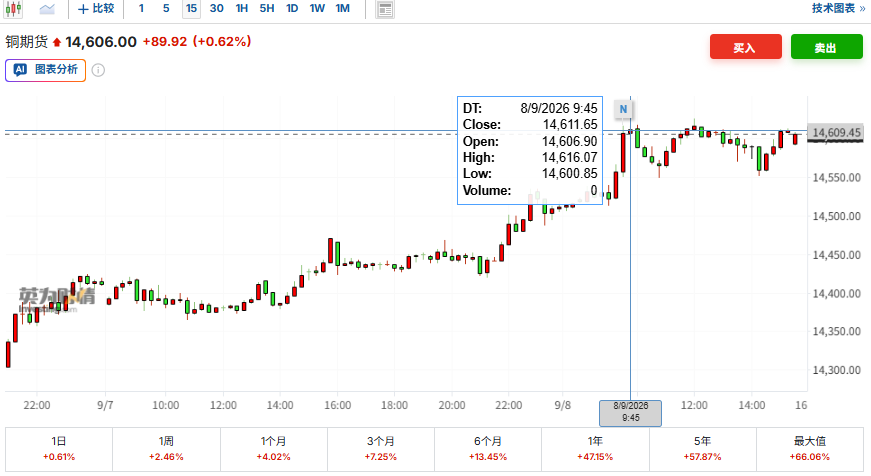
Caption: LME copper futures prices reach a new high
Source: Investing
In the past, copper served as a fundamental building material, entering the previous growth cycle driven by real estate and major infrastructure cycles. This time, the deep engine driving the copper market into a super cycle is AI and new energy.
In particular, the development of artificial intelligence and the rapid construction of data centers have become important driving forces for current copper demand growth. The demand for copper from AI goes beyond just the wires and cables inside data centers; it also encompasses new power generation facilities, transmission lines, substations, transformers, and broader grid upgrades.
High-performance servers used for AI training consume between 15 to 30 kilograms of copper each, which is 3 to 6 times that of ordinary servers. According to industry estimates, the copper consumption of a 1-gigawatt computing data center is 2.5 times that of traditional data centers, adding nearly 400,000 tons of copper demand for global computing cluster construction in 2026 alone, and by 2030, this number may soar to a million tons level.
The long-term bullish consensus on copper demand is already established; however, recently, short-term factors have begun to dominate. Particularly, this year, hundreds of thousands of tons of copper have been shipped to the US, with traders attempting to profit from the higher copper prices in the US, mainly due to the constant premium on copper futures prices at the New York Mercantile Exchange (Comex).
According to a report by Bloomberg on August 4, citing data from financial information service provider IHS Markit, approximately 200,000 tons of copper arrived in the US in July this year, marking the largest monthly influx since data collection began in 2014. When including hidden stocks, the total estimated domestic inventory in the US is about 1.4 to 1.5 million tons, creating a century record.
The market is still betting on the possibility of the US imposing tariffs on refined copper. Approximately two months have passed since the US Department of Commerce was initially scheduled to submit a report to the White House on the necessity of tariffs, but the report has not yet been released, and the market continues to price in the possibility of tariffs on primary copper imports.
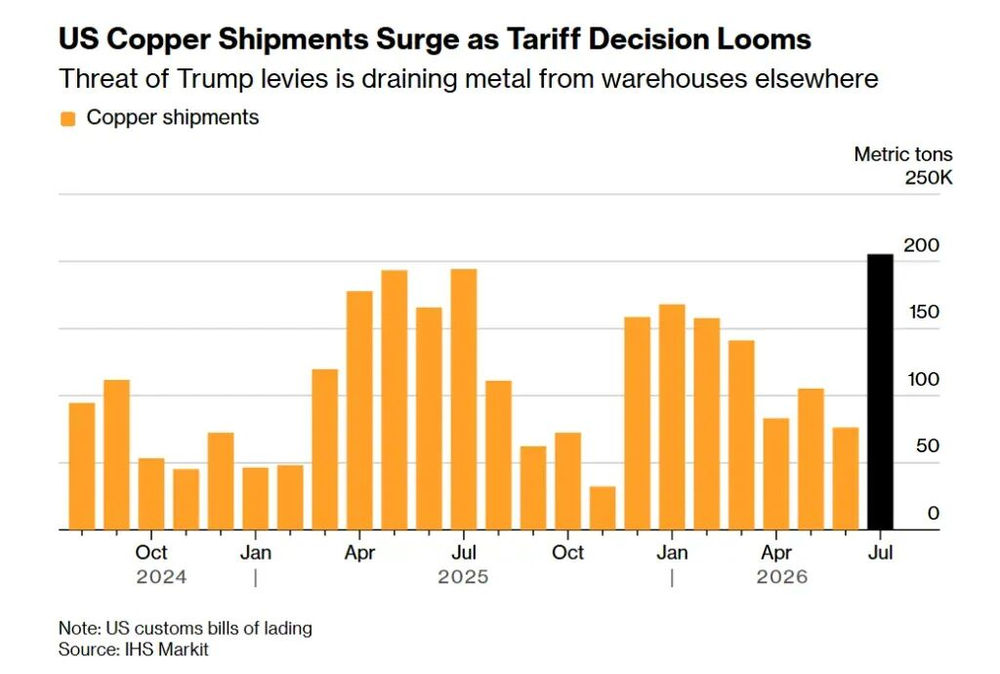
Caption: Hundreds of thousands of tons of copper have been shipped to the US
Source: Bloomberg
In other words, a large amount of spot copper is being drawn away from the European and Asian markets, leading to a continuous decline in LME copper inventories. Global copper has not suddenly "disappeared"; rather, it has been stockpiled in the US, causing other markets to naturally experience tightness, and copper prices rise accordingly.
However, a bigger problem lies on the supply side, as global copper supply is undergoing a rare "multiple collapse." In 2026, global copper mines may experience a decline in output for the first time in a decade.
In the first half of 2026, the combined production of 49 sample copper companies worldwide totaled 8.196 million tons, down 4.3% year-on-year, a reduction of 371,000 tons; in the second quarter, the year-on-year decline further expanded to 4.5%, and supply contraction not only did not ease but rather deepened. At the same time, the annual production guidance has been net revised down by 38,000 tons, with only 6 out of 35 samples increasing their capital expenditure.
The total copper production of these 49 sample copper companies is 8.196 million tons, accounting for 72.3% of global mine copper production. The significance of this sample coverage is that it is not a localized phenomenon in a certain region, but rather encompasses almost three-quarters of global mined copper supply from the "mainstream players" - their collective reduction signifies that the supply contraction is industry-wide.
Adding to the woes, extreme winter storms and mining production disruptions have caused copper exports from Chile, the world's largest copper producer, to drop to the lowest level in over a year in August. Heavy rain, snow, and strong winds in July and August disrupted mining production and periodically halted port operations. The challenges faced by Chilean copper production are also forming strong support for global copper prices.
Data released by the Chilean central bank on Monday showed that copper export values in August amounted to 4.62 billion USD, down 14% from July and down 3.2% year-on-year, marking the lowest monthly level since July 2025.
It is worth noting that the decline in export values occurred against the backdrop of sharply rising copper prices. The average price of copper in August this year was over 40% higher than the same period last year. In other words, although copper prices have surged, export revenues have actually declined, reflecting a more pronounced drop in Chile's actual copper export volumes.

Caption: The global impact of the El Niño phenomenon
Source: FT
An even more subtle line is sulfuric acid. Geopolitical conflicts in the Middle East have interrupted the transportation of sulfur through the Strait of Hormuz, causing the costs of the sulfur-dependent wet copper process in the Democratic Republic of the Congo (DRC) to rise to about 7,000 USD/ton, a 47% increase compared to the end of last year. Overseas wet copper production capacity is facing significant shrinkage. From mining to smelting to sulfur, every link in the copper supply chain is sounding the alarm simultaneously.
At the same time, extreme weather is further amplifying supply risks. For the South American and African copper mining areas, which collectively account for about half of global production, the intense rains and floods brought by the super El Niño are threatening mining and logistics in Chile and Peru, while drought conditions are beginning to suppress hydropower supply in the DRC and Zambia.
Antofagasta and Lundin Mining have both lowered their production guidance ranges for 2026 to 625,000 to 655,000 tons and 300,000 to 325,000 tons, respectively. Data from the International Copper Study Group (ICSG) indicates that global copper mine production fell by 1.1% year-on-year in the first half of 2026, with the decline in copper concentrate output being even steeper at 2.6%, while industry giants Codelco and Freeport-McMoRan both experienced double-digit declines in output.
Morgan Stanley has also revised its previous production increase expectations down to essentially flat or even slightly declining - indicating that global copper mine annual production may experience its first yearly decline since 2017.
As the demands of new energy vehicles, high-voltage grids, and AI data centers on computing power and electricity consumption intertwine, copper is evolving from a basic commodity to a strategic resource that controls the future energy and digital economy lifeline.
In the short term, the core observation variables include Chilean mining production, Congo (DRC) export policies, US tariff policies, and global inventory changes; in the medium to long term, the aging of global mines, the long production cycle of new mines, coupled with continuous demand stimulation from AI computing power, grids, and new energy, the tight balance in copper supply and demand patterns is expected to continue.
免责声明:本文章仅代表作者个人观点,不代表本平台的立场和观点。本文章仅供信息分享,不构成对任何人的任何投资建议。用户与作者之间的任何争议,与本平台无关。如网页中刊载的文章或图片涉及侵权,请提供相关的权利证明和身份证明发送邮件到support@aicoin.com,本平台相关工作人员将会进行核查。


