Written by: Rita
At the Communacopia conference, Broadcom reiterated its AI revenue targets for FY27 and FY28, forecasted at $115 billion and $230 billion, respectively, with supply being the greatest constraint. On September 8, Goldman Sachs released a key points report on Broadcom's participation, noting that Broadcom's management believes that land, electricity, and facility construction for data centers are the real bottlenecks in AI deployment, while supply chain constraints are relatively manageable. Broadcom also disclosed its $35 billion XPV financing partnership with Blackstone and Apollo, which can support over 20 gigawatts of AI computing capacity.
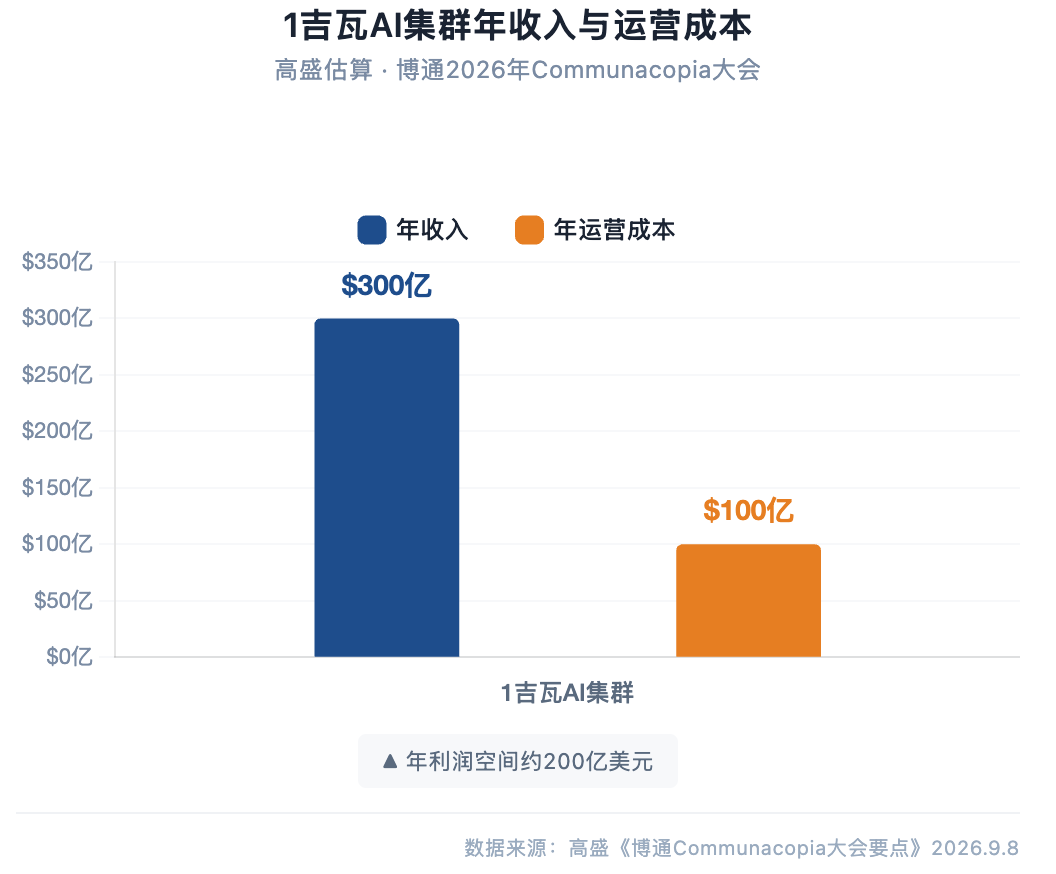
Broadcom expects that most of the economic value of AI will flow to the owners of leading frontier models. Based on current economic calculations, a 1 gigawatt AI cluster generates annual revenue of approximately $30 billion, with operating costs of about $10 billion. This portion of value is distributed among hardware manufacturers, semiconductor suppliers, and data center operators.
Clear AI Revenue Targets, Supply Constraints are Core
Broadcom reaffirms its FY27 AI revenue target of $115 billion and FY28 target of $230 billion. Goldman Sachs points out that this target is based on a clear judgment of customer visibility and readiness for deployment. Broadcom's differentiated capabilities in custom chip design, advanced packaging, and AI networks enable it to maintain and expand its wallet share among strategic customers.
Management particularly emphasized its long-term partnership with Google, while also disclosing the Jalapeno custom chip project with OpenAI and a strategic relationship with Anthropic. Regarding supply constraints, Broadcom believes that land, electricity, and facility construction for data centers are the main bottlenecks in AI deployment, while supply chain constraints are relatively controllable, and the company has a more direct influence over this aspect.
XPV Platform: $35 Billion Accelerating AI Infrastructure Development
Broadcom highlighted the XPV financing platform. The recently announced $35 billion partnership with Blackstone and Apollo can support over 20 gigawatts of AI computing capacity. The core advantage of this structure is to provide attractive financing solutions for emerging AI labs while limiting Broadcom's direct financial liabilities.
XPV helps Broadcom access a broader customer base while removing critical bottlenecks in AI infrastructure expansion. For Broadcom, this is a low-risk way to expand its business, increasing its customer base without bearing the financial pressure of significant capital expenditures.
Open Source and Closed Source: A Watershed in Value Distribution
Management's judgment on open source versus closed source models is clear. Long-term AI value will primarily flow to frontier model developers, not to open source weighted models.
Broadcom supports this judgment with data. Industry training expenditure is about $200 billion annually, with frontier models and the open source ecosystem each accounting for roughly half. Frontier models contribute about 75% of industry revenue, with about $120 billion in revenue corresponding to approximately $100 billion in costs. The revenue from open source models is only about $30 billion, with investment that is roughly equivalent. This stark disparity in input-output ratio explains why Broadcom considers the owners of leading frontier models to be the primary beneficiaries of the AI economy.
Valuation and Risks
Goldman Sachs maintains a buy rating on Broadcom with a 12-month target price of $540, based on a normalized earnings estimate of $18 per share at a multiplier of 30. The current stock price is about $357, implying about 51% upside potential.
Downside risks include four aspects: a slowdown in AI infrastructure spending, loss of market share in custom computing businesses, continued inventory digestion in non-AI businesses, and intensified competition in the VMware space. Goldman Sachs believes that a slowdown in AI spending is the biggest potential risk, but Broadcom's current backlog and customer visibility provide high visibility for short-term performance.

Disclaimer
This article is a整理与解读 of a third-party brokerage research report (Goldman Sachs, September 8, 2026) by潮向研究, along with整理 of publicly available market information. The ratings, target prices, earnings forecasts, and related judgments cited in the text represent the views of the respective brokerage analysts and solely reflect the positions of their institutions, not the views of潮向研究 and do not constitute any investment advice.
Markets are risky, and decisions should be made independently. This article should not be regarded as the basis for buying or selling any securities.
免责声明:本文章仅代表作者个人观点,不代表本平台的立场和观点。本文章仅供信息分享,不构成对任何人的任何投资建议。用户与作者之间的任何争议,与本平台无关。如网页中刊载的文章或图片涉及侵权,请提供相关的权利证明和身份证明发送邮件到support@aicoin.com,本平台相关工作人员将会进行核查。


