The game of locked share release and passive buying may dominate SpaceX's fourth quarter pricing.
Written by: Yang Chen, Wall Street Insight
The upcoming wave of buying for SpaceX is not driven by fundamental improvements, but rather a mechanical result triggered by a little-known index compilation rule— the release of locked shares driving an increase in weight, which is also the largest potential selling pressure source in the coming months.
The Nasdaq 100 index is set for quarterly rebalancing effective September 21, expected to raise SpaceX's weight from 1.25% to about 1.51%. According to calculations by JPMorgan strategist Min Moon's team, this adjustment will trigger about $12.4 billion in passive net buying.
The direct impetus for the weight increase is the free float ratio rising from less than 10% post-IPO to nearly 30%—after over a billion locked shares are released, index rules automatically amplify this over $2 trillion giant's inclusion weight.
But the release is not over: by the end of October, over 1 billion shares will be unlocked, and after the third quarter earnings report in mid-November, another approximately 1.3 billion shares will gradually enter tradable status, totaling over 2.3 billion shares. The game of short-term mechanical buying versus mid-term supply pressure is becoming the core variable for SpaceX's fourth quarter pricing.
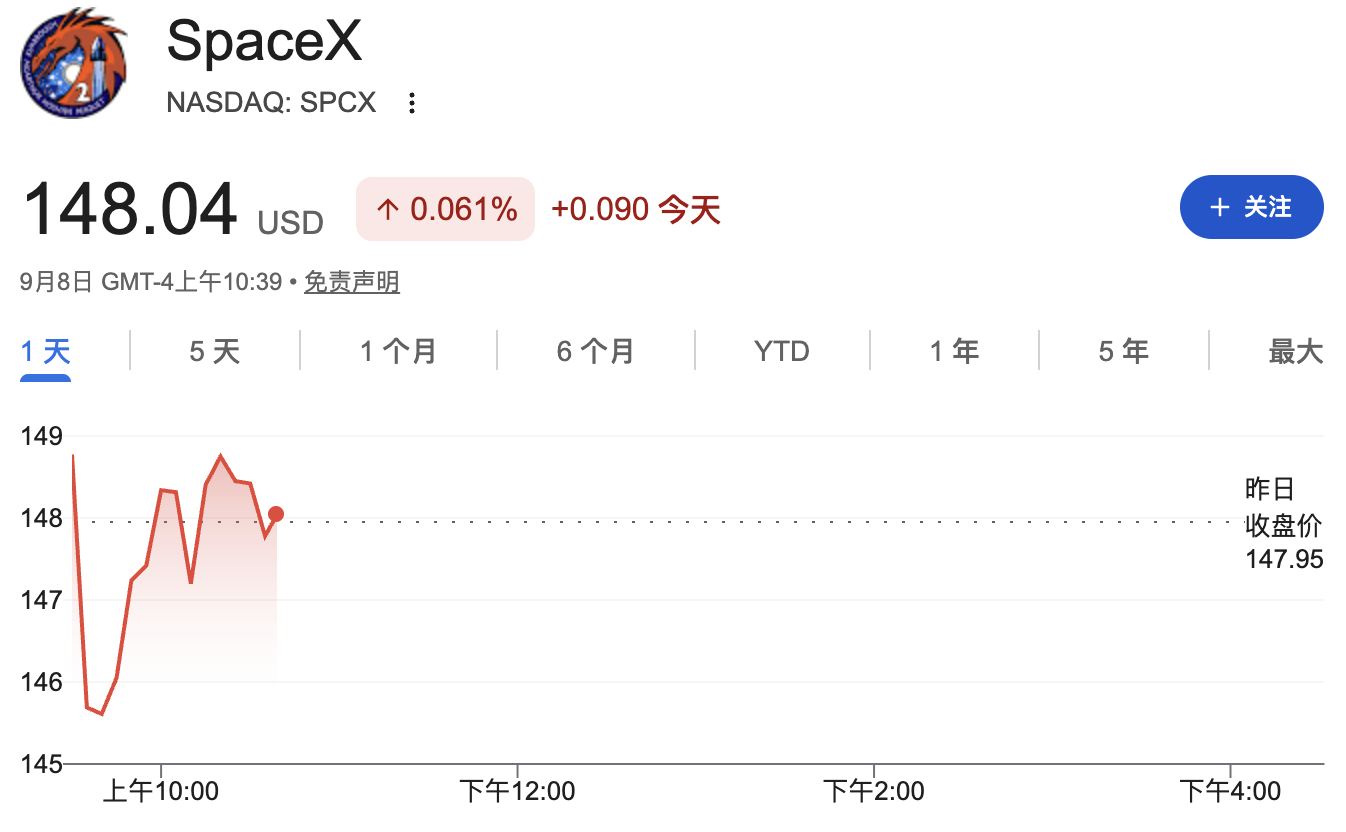
As of the time of this writing, SpaceX rose 0.06% on Tuesday, with its share price at a nearly two-month high.
The Doubling Weight Mechanism: The Chain Reaction from the Surge in Free Float Ratio
The weight calculation of the Nasdaq 100 is based on the lower of total equity and three times the number of freely circulating shares. Stocks with a low free float ratio are significantly discounted in market cap during the calculation—free float stocks exclude insider holdings and shares subject to lock-up constraints.
SpaceX was previously in this situation. Due to lock-up restrictions, its free float ratio was less than 10%, and despite having a market cap over $2 trillion, ranking sixth in the index, its weight was only 1.25%, placing 19th. With over 1 billion shares unlocked, the free float ratio rose to nearly 30%, directly triggering a recalculation of weight.
According to JPMorgan strategist Min Moon's team calculations, after the weight rises to about 1.51%, it will generate around $12.4 billion in net passive buying demand.
As per Nasdaq statistics, as of the end of the second quarter, approximately $1.7 trillion in assets tracked the Nasdaq 100 index, including the well-known Invesco QQQ ETF (ticker QQQ). The rebalancing plan will be announced after the market closes on Friday. With more shares unlocked over the next year and the free float ratio continuing to rise, SpaceX's weight may further increase.
2.3 Billion Shares Unlocking: The Supply Surge Behind Short-Term Buying
The surge in the free float ratio is essentially the result of the unlocking of locked shares, and an even larger amount of unlocking is yet to come.
According to the timeline, by the end of October, over 1 billion locked shares will be released; after the third quarter earnings report in mid-November, another approximately 1.3 billion shares will enter tradable status, totaling over 2.3 billion shares.
The first batch of unlocking in August (coinciding with SpaceX's first earnings report) raised concerns about massive sell-offs, but insiders mostly held their shares, and the selling pressure did not materialize.
Ed O'Gorman, CEO of River Wealth Advisors, believes the critical event will only come when the November earnings report triggers further unlocking, at which point a large amount of stock will enter the market.
Steve Sosnick, chief strategist at Interactive Brokers, stated that newly unlocked shares will either be sold to potential passive buying or the stock price will rise due to increased demand from index funds, with products like QQQ expected to bring more demand.
Discrepancy Between Bulls and Bears: Can Passive Buying Offset Unlocking Selling Pressure?
In the short term, approximately $15.5 billion in passive buying is relatively certain; in the mid-term, the scale and pace of unlocking selling pressure depend on insiders' willingness to reduce their holdings, which constitutes the current largest expectation gap.
Over the past four weeks, SpaceX's stock price has hovered between $133 and $150, oscillating around the IPO price of $135, lacking fundamental catalysts. Ed O'Gorman noted that market prices will be driven to some extent by forced buying, and it will take some time to truly understand the market's view on this stock.
Similar rules are not unique to Nasdaq. The S&P Dow Jones index also adjusts market cap calculations by free float; two years ago, after Berkshire Hathaway reduced its stake in Apple, Piper Sandler estimated it would trigger about $40 billion in passive fund buying.
SpaceX was included in the Russell 1000 index in June of this year, but the S&P 500 requires at least 12 months of trading history, meaning it will not qualify for inclusion until mid-2027, leaving further room for passive buying in the future.
The unlocking triggered by the third quarter earnings report in mid-November will be a key point to test SpaceX's true market depth and determine the short-term outcome between bulls and bears.
免责声明:本文章仅代表作者个人观点,不代表本平台的立场和观点。本文章仅供信息分享,不构成对任何人的任何投资建议。用户与作者之间的任何争议,与本平台无关。如网页中刊载的文章或图片涉及侵权,请提供相关的权利证明和身份证明发送邮件到support@aicoin.com,本平台相关工作人员将会进行核查。


