$28.5 billion in on-chain lending is almost entirely at floating rates, and the pressure period has seen rates soar, forcing borrowers to liquidate.
Written by: @castle_labs
Translated by: AididiaoJP, Foresight News
Currently, the active loan scale in the lending sector is about $28.5 billion, with nearly all demand coming from floating rate products. This model operates normally during stable market conditions; once it enters a pressure period, the utilization curve shifts upward, causing borrowing rates to soar sharply. Sudden increases in rates often force some borrowers to exit or deleverage, rendering the entire credit market inefficient.
The DeFi money market solves something traditional credit cannot: almost instant collateralized borrowing. However, there is still a problem that remains unsolved — borrowers cannot know the cost of debt in advance before the loan ends.
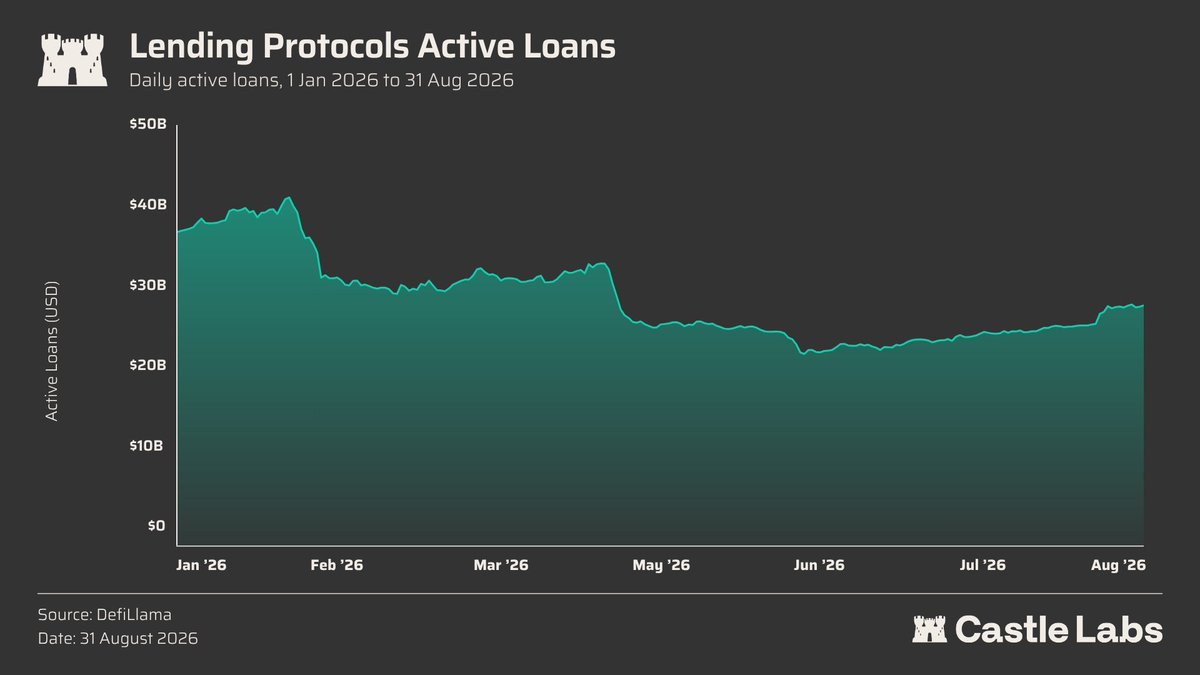
This is precisely the direction many products are currently tackling: shifting towards fixed-rate, fixed-term credit products. In such a market, lenders can lock in yields in advance, and borrowers are clear about how much interest they need to pay.
The demand for this type of market mainly comes from three types of entities:
- Term-matching borrowers: funds, vaults, RWA issuers, basis/arbitrage trading desks that need the debt maturity date to align with asset maturity dates, redemption windows, or strategy cycles.
- Deterministic demand borrowers: users of revolving loans, leveraged yield players, and traders who may not care about exact maturity dates but need stable borrowing costs to avoid compressing spreads.
- Lenders/curators: vaults, market makers, and allocators who wish to choose the term, collateral, and returns themselves rather than passively accept the outcomes dictated by the utilization curve.
Early fixed-rate lending primarily faced three issues:
Fragmented liquidity. Fixed-rate markets can be fragmented into multiple markets based on maturity dates, rates, collateral, and terms, making matchmaking far more difficult than a single floating rate liquidity pool.
Inability to exit early. Once a loan starts, lenders find it hard to exit before maturity unless there is secondary liquidity, redemption pathways, or a buyer. The floating rate market does not have this problem.
Cold start issues. Lenders are unwilling to lock up funds while waiting to match with counterparts, leading to idle capital with no returns.
With the increase of institutional funds and the rise of more complex strategies like revolving borrowing, user structures have changed, and demand for fixed-term markets is on the rise. A major pain point of on-chain lending is the uncertainty of floating rates; fixed-rate products can allow users to lock in returns and costs in advance. It also forces protocols to directly price term, collateral quality, exit liquidity, and refinancing risk, thus improving user experience.
This article outlines the practices of several established floating rate protocols, including Morpho, Jupiter, and Kamino. These three collectively have $6.83 billion in active loans and have recently entered the fixed-rate and fixed-term markets with the awareness of the aforementioned issues.
Morpho Midnight and Tenor Finance
Morpho, as an established floating rate protocol, launched Morpho Midnight in July of this year. It is an intent-based zero-interest lending protocol: lenders and borrowers express their intent, with positions represented as debt units (an obligation to repay one loan token per unit before maturity) and credit units (the right to claim repaid loan tokens). Midnight offers position negotiability by making loans tradable, providing term flexibility and more predictable underwriting for institutions. Rates are determined by the prices of fixed-term credit units and debt units traded by borrowers and lenders.
In Midnight, lenders and borrowers post "quotes" that do not lock up funds but simply express the intent to lend or borrow under specific market, price, maturity, and collateral configurations. Funds only actually come into place during the settlement (rebound), thus solving the cold start problem—lenders only deploy funds after successful matchmaking, increasing capital efficiency. This also helps attract more liquidity. The Morpho team stated: "Allowing users to continue earning floating rates on protocols like Morpho Blue will eliminate the opportunity cost of waiting for matches, thus encouraging more people to place orders and enhance overall available liquidity."
Another issue in the fixed-rate market is the fragmentation of funds: each maturity date, collateral type, and interest rate range could turn into independent markets. Midnight does not occupy funds at the intent stage, and users can also place orders across multiple markets. "The same funds can quote multiple markets simultaneously; the total liquidity a single market maker can provide = available funds × number of markets."
Since its launch in July 2026, the Midnight market has seen active loans of about $3 million. The number is small, but the team believes it will change soon, as it can inherit the existing network effects and ecosystem of Morpho. For example, Morpho Vaults currently manage over $4 billion. Once the vault adapter is online, those funds can begin quoting in Midnight, significantly impacting liquidity depth.
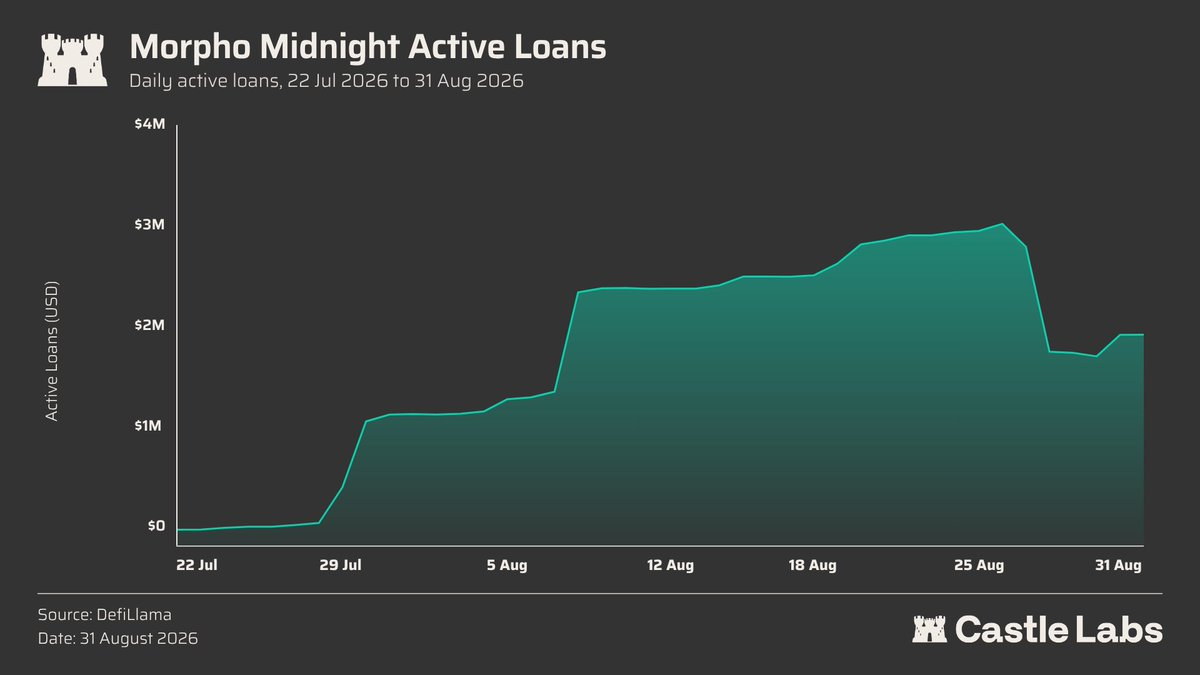
What’s most noteworthy about Midnight is that it solves the early exit problem. In early or illiquid fixed-term markets, borrowers and lenders often lack exit channels before maturity. Midnight allows positions to be interchangeable: lenders can sell credit units, and borrowers can buy debt units to reduce outstanding obligations.
Midnight can be viewed as the underlying infrastructure for fixed-rate loans, while an access layer is being built on top — Tenor Finance. Some have referred to it as Midnight’s “HIP-3.”
Tenor Finance inherits the underlying capabilities of Midnight and adds new features:
Automatic rollover and fallback options. Tenor introduces automatic rollovers to avoid liquidation after maturity. It rolls loans into new fixed-rate terms via an independent keeper before maturity. If a fixed-rate counterpart cannot be found, it can fallback directly to Morpho Blue's floating rate liquidity pool.
On-chain OTC protocol. Users can request and broadcast customized OTC quotes, which can be shared with whitelisted counterparties, supporting direct negotiations.
Institutional tools and access control. Tenor offers institutional accounts with role-based permissions. Institutions can deploy customized, tiered credit markets through these accounts, setting KYC requirements to restrict who can borrow and who can lend.
By lowering friction at maturity through automatic rollovers and fallback options, fixed-term positions can continue more smoothly when there is matching liquidity or fallback conditions are met. Coupled with customizability, it is more suitable for institutions. The team's long-term expectation is to serve asset managers on one side and enterprises on the other.
Jupiter Offerbook
The Offerbook of Jupiter Exchange entered public testing in June 2026, around the same time as the release of the Morpho Midnight white paper. The floating rate product Jupiter Lend launched last year marked Jupiter's first attempt to enter the lending space; now it is entering the fixed-term market through Offerbook.
Offerbook is an intent-based lending protocol characterized by no price-based liquidation, thus supporting fixed-term lending for long-tail assets.
Loans on the platform tend to be short-term, typically ranging from 1 to 30 days. If the borrower fails to repay after maturity, the lender directly takes the collateral without liquidation occurring. This design allows assets like NFTs, RWAs, or others that lack active price discovery to serve as collateral, provided the lender is willing to underwrite. It utilizes collateral transfer after maturity to substitute continuous price liquidation, thereby creating specialized markets that traditional models would find difficult to support.
Users can post their intent to lend or borrow, which will appear in the app; liquidity only becomes available when the quote is accepted. Since users only confirm when matchmaking occurs, funds can still be put to other uses before the transaction completes, alleviating cold start issues. Both lenders and borrowers can continue using funds to earn returns until they find fully matching terms.
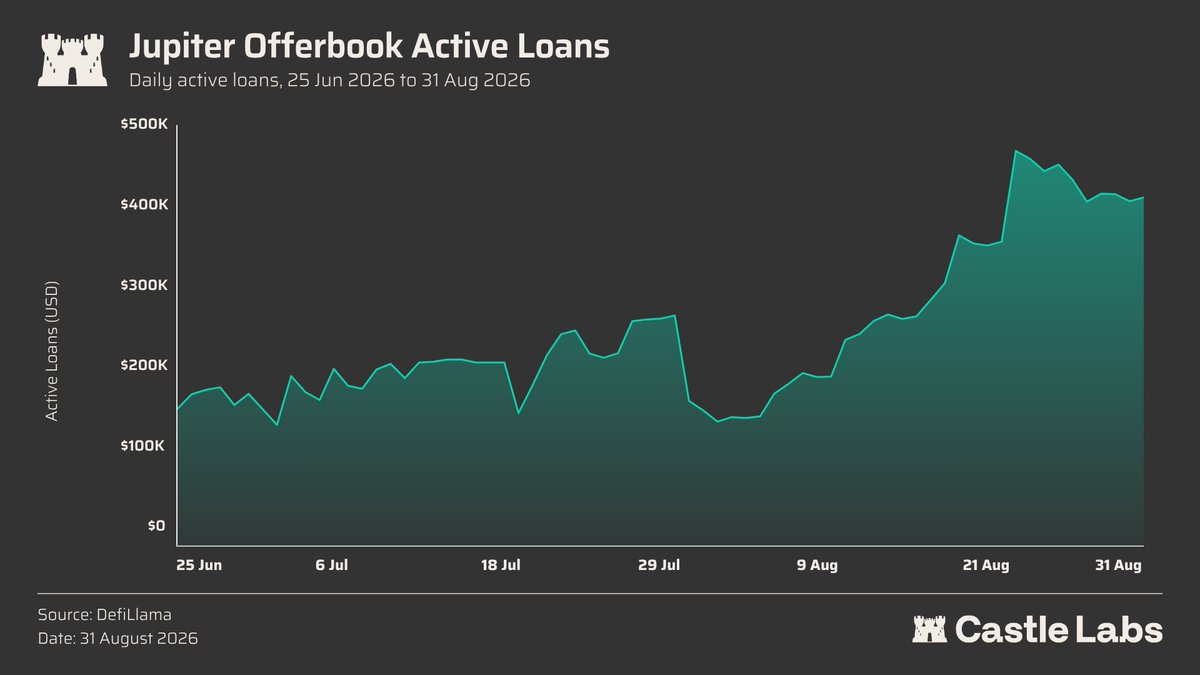
Since its launch, Jupiter Offerbook has seen active loans of about $450,000. The model is unique, but proving the market and scaling it is not easy due to its scalability being limited by whether lenders are willing to directly underwrite these collaterals.
Kamino
Kamino recently released a white paper for its fixed-rate lending protocol. It does not create a separate fixed-rate market but instead adds fixed-rate reserves within Kamino Lend. The benefit is distribution: borrowers can directly see the term structure, and lenders can offer specific rates and terms without fully exiting the floating rate system, thus fixed-rate borrowing becomes incremental.
Each reserve on the platform is defined by interest rates and terms, such as USDC loans with different maturities and rates. These different rate and term combinations form a grid.
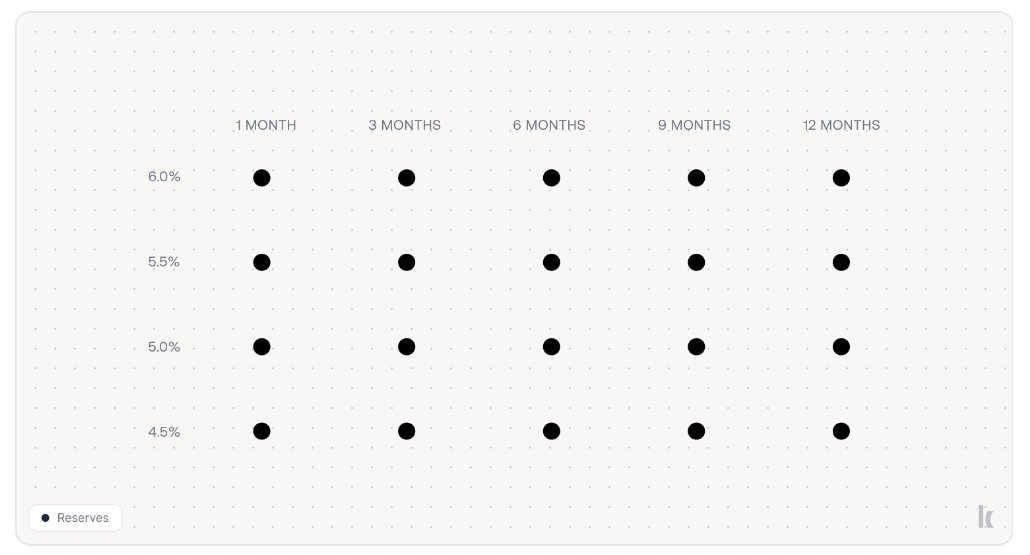
With the grid, Kamino allows borrowers and lenders to express trading intentions along both the price and time dimensions simultaneously. Borrowers post lending intent, specifying the collateral, size, maximum interest rate, and term; lenders post conditions for liquidity, specifying the rates, terms, and amounts they are willing to provide. The grid serves as the execution surface: borrowers can withdraw from the available fixed-rate liquidity of the predefined interest rate and term combinations.
Matchmaking is not directly one-to-one; lenders quote on a structured grid, such as 4.5% for 1 month, 5% for 3 months, etc., forming visible term structures and yield curves for different assets. Leveraging Kamino’s existing infrastructure, borrowers can either post intentions while waiting for a match or directly withdraw fixed-rate liquidity from the grid. Moreover, Kamino can automatically roll loans into the next term when liquidity allows, similar to Tenor; if no fixed-rate liquidity is available, it rolls back to floating rates. This mitigates maturity issues and lessens the burden on borrowers to manually manage each maturity date.
Lenders must go through a withdrawal queue. If capital has already been deployed and cannot be exited immediately, lenders enter a FIFO queue and are gradually compensated as loans in that reserve mature. The design ensures that lenders do not wait longer than the term of that reserve.
During the matchmaking process, funds remain deployed and can still earn returns in the floating rate reserves, which also helps address cold start issues.
Conclusion
Fixed rates do not eliminate risks that floating rate lending has revealed in recent years, but they do clarify the cost of debt. And this is precisely what DeFi credit has been lacking.
The strength of floating rate pools lies in their ability to provide instantaneous borrowing, but they compress everything into a single utilization curve. Fixed rate markets allow borrowers to set pricing for terms, lenders to choose duration and collateral risks, curators to allocate across terms, and applications to package more predictable credit products. Aave has launched Stable Vaults in July, and the early form of predictable credit products has already emerged.
This is significant because DeFi lending is expanding. It now supports revolving lending, basis strategies, treasury management, RWA-linked assets, and applications aimed at ordinary users. These users seek not only liquidity but also clear, fixed financing terms.
Competition in this space is expected to intensify, with more new solutions emerging to scale fixed-rate lending. Currently, the penetration rate remains low, with floating rates still dominating the market, but the goal is to grow the pie — these products can cover many scenarios that current DeFi lending cannot.
They also aim to resolve pitfalls encountered by earlier similar protocols while having stronger distribution: the floating rate side is already mature. For instance, funds in floating rate markets can continue earning returns while maintaining efficiency, while also quoting in the fixed rate market.
As products mature, some previously unfeasible strategies will emerge, and the lending sector may develop a new flywheel.
免责声明:本文章仅代表作者个人观点,不代表本平台的立场和观点。本文章仅供信息分享,不构成对任何人的任何投资建议。用户与作者之间的任何争议,与本平台无关。如网页中刊载的文章或图片涉及侵权,请提供相关的权利证明和身份证明发送邮件到support@aicoin.com,本平台相关工作人员将会进行核查。


