Author|Zhang Yongyi
Editor|Jing Yu
For a long time, there has been a table maintained by Microsoft employees to exchange salary and bonus figures, a common underground project of “salary transparency” in big companies.
This year, a new column appeared in this table, later obtained by Business Insider: “Monthly AI Expenses.”
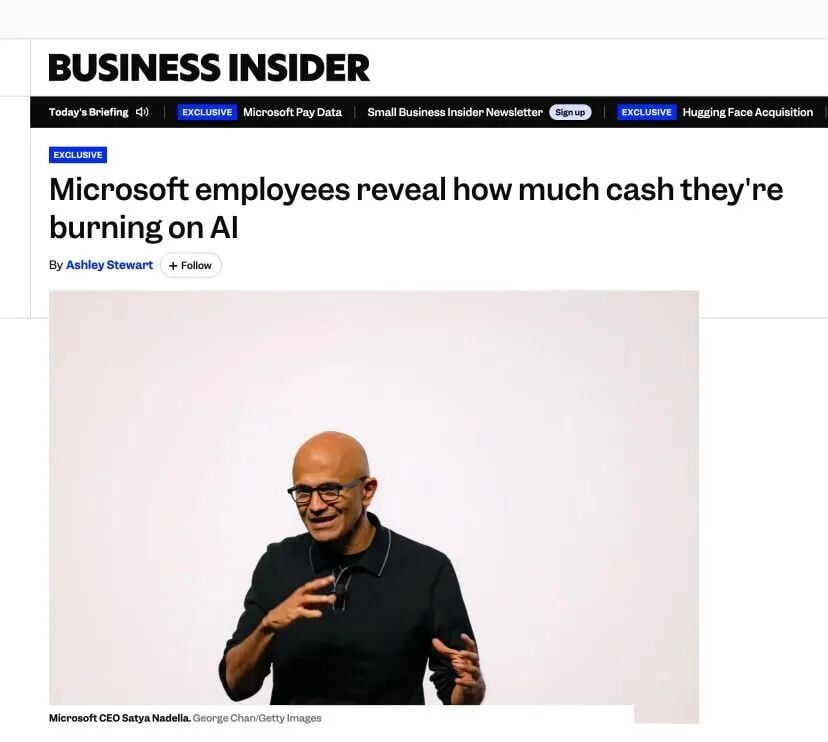
Employees report their AI usage, 28-day metric|Image source: Business Insider
About 350 employees in the US filled out this column. The highest figure noted: 28 days, $28,000 (approximately 190,000 yuan).
Microsoft’s response was not to reward this individual. According to Android Headlines, the company has begun to tighten token usage management: department-level budgets have been implemented, personal token expenditures are displayed on dashboards, and the default internal model has been switched to OpenAI’s GPT-5.6 Sol.
In translation, that means Microsoft has started internal audits.
01 Token Usage Divides Classes
The most significant information in this table is not in the numbers but in their placement—the “AI Expenses” column appears alongside the salary data.
Employees record their AI usage next to their salaries, clearly indicating that in Microsoft 2026, how many tokens you burn each month is a number that deserves visibility just like how much money you earn.
These numbers are not shot in the dark. An easily overlooked detail in the report: Microsoft provided employees with an internal tool to check their AI expenditures over the past 28 days. The current median voluntarily reported across the company is $300 per month, approximately 2,000 yuan.
To be honest, this price is actually not surprising, after all, the total labor cost for a Silicon Valley software engineer starts at $20,000 to $30,000 per month; a $300 AI bill is a drop in the bucket.
But the real expense comes later. In the departmental summary provided by BI, the median expenditure in Microsoft’s Core AI engineering department is $975 (approximately 6,577 yuan), more than three times that of the entire company; Microsoft AI department approximately $490, Experiences and Devices approximately $250, Azure approximately $241. The highest individual expenditures in several departments exceeded $10,000, with some in CoreAI burning $16,000. The record holder burning $28,000 over 28 days is from the Customer and Partner Solutions department.
Although 350 people represent only 0.16% of the 223,000 global employees and participation is voluntary, not a census, and those willing to reveal their AI bills are not a random sample, the real distribution is likely to be even more extreme, not more moderate.
Burning $28,000 in 28 days is a significant concept—averaging $1,000 a day. Three months ago, when Geek Park wrote “Microsoft Hits Pause on Vibe Coding,” they calculated a hypothetical account: an engineer with an annual salary of $300,000 has a daily cost of over $800. At that time, the article’s title was a statement—“Burning tokens has already become more expensive than having employees.” Now it has become a line in the table: the money this employee burned is more expensive than having another engineer sit beside them.
In fact, the term for this behavior has already been coined within Silicon Valley: tokenmaxxing, referring to the act of maximizing token usage.
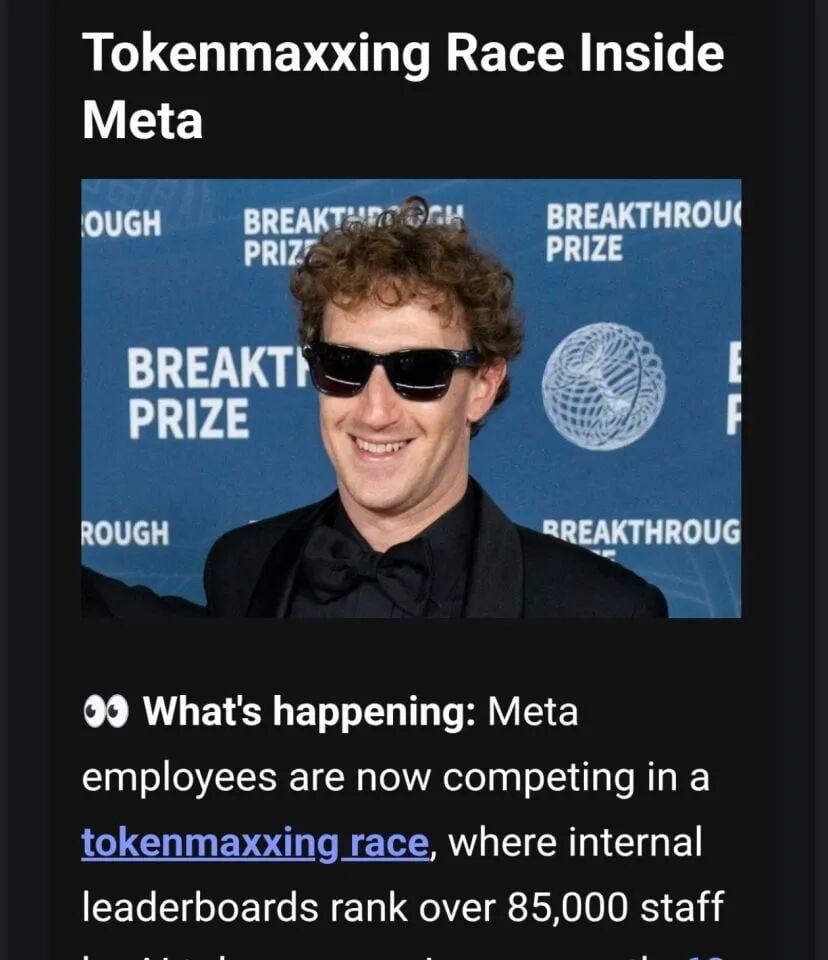
Meta’s internal tokenmaxxing leaderboard|Image source: X
The specific practices include intentionally sending huge prompts, filling the context window, and running automated queries; the goal is not to solve problems but to make one’s own usage figures look good on the company’s usage dashboard.
Clearly, a behavior only gets a name when it becomes sufficiently common. The existence of this term is proof itself.
In the past year, this token frenzy has sent the same message to nearly every tech company’s employees: embracing AI is a sign of advancement, and those who can use AI will replace those who cannot. When bosses emphasize using AI every day, and usage is a visible number, inflating that number becomes the easiest way to manage upwards. The quality of the output can be debated for days, while the level of usage is immediately evident.
As usage becomes a visible number, burning tokens inevitably devolves into a new performance of overtime.
This scene has already played out more than once this year: Uber’s CTO admitted in an interview with The Information that the company established internal rankings to encourage employees to use AI more, which led to their annual AI programming budget being spent in just four months.
Meta's version is even more exaggerated: in April, an employee created a dashboard called Claudeonomics, ranking 85,000 colleagues by token usage, with the entire company burning 600 trillion tokens in 30 days; the top individual consumed 281 billion, and Fortune estimates that this person alone was worth $1.4 million; The Information reported the dashboard went offline two days after it was exposed, and Mark Zuckerberg himself didn’t even make the top 250. Android Headlines reported that a similar trend emerged internally at Amazon.
The difference is that Uber's leaderboard was set from the top down, whereas Meta's and Microsoft’s “leaderboard” grew organically by employee initiative: there were no orders, and the incentive structure blossomed by itself.
Microsoft executives clearly understood the entire context of this incident. CoreAI head, Executive Vice President Jay Parikh, directly criticized in an internal memo in August: “Tokenmaxxing is not the true objective we should pursue. I want everyone to focus on the results that truly create change for customers and the business.”
The implication that the memo didn’t directly state is very obvious: the company has realized that a significant portion of tokens burned by employees do not buy productivity but merely posturing.
In BI's report, it also heartbreakingly compared the salary data from the same table: at least so far, those who use AI more heavily have not received higher raises, bonuses, or promotions. The returns from the performances have yet to materialize, but the bills have arrived.
And just the day after Microsoft began retracting Claude Code licenses, someone on social media revealed another much larger bill.
On May 15, 2026, OpenClaw developer Peter Steinberger tweeted, casually advertising his menu bar tool CodexBar: the new version displays API costs in a much nicer way. The real explosion was in his accompanying image: $1,305,088.81 in OpenAI API usage over 30 days, 603 billion tokens, 7.6 million requests, main model GPT-5.5, burning nearly $20,000 in a single day on the day he tweeted it.
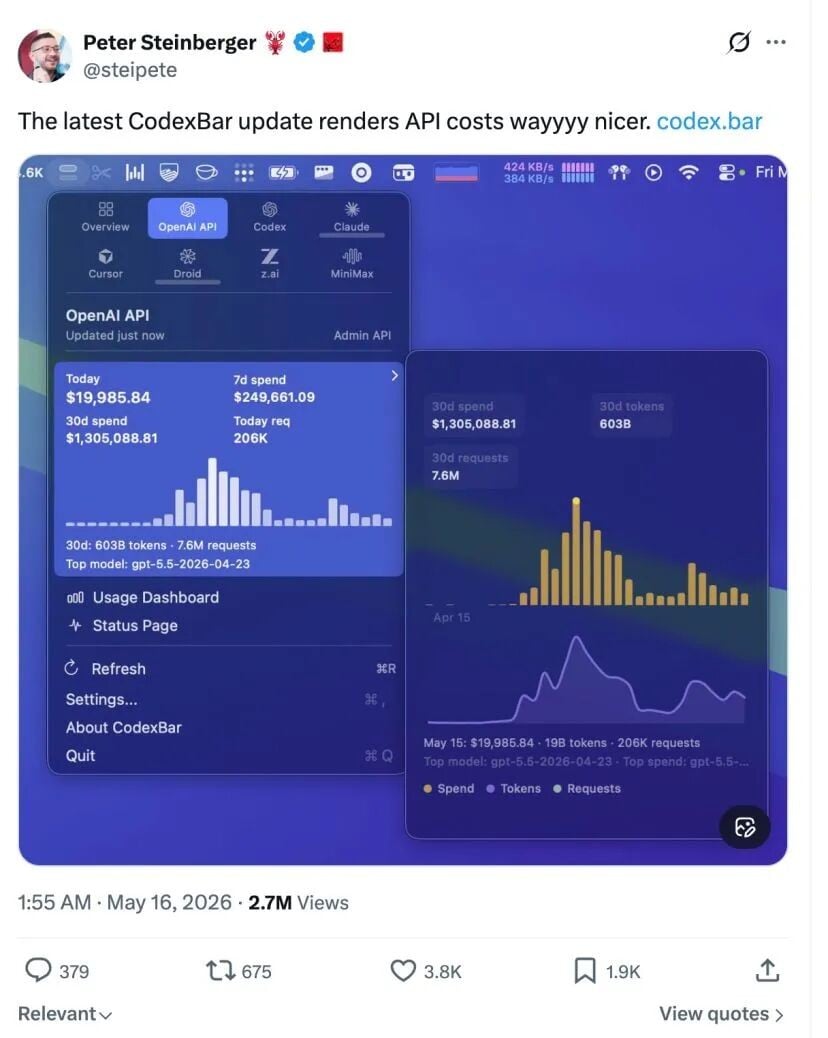
The enormous bill posted by Lobster author|Image source: X
Steinberger joined OpenAI in February this year, and this bill will evidently also be reimbursed by OpenAI. The money was spent on about 100 concurrently running Codex intelligent coding agents; behind them, only three people maintain the OpenClaw open-source project. His definition of this “extravagant behavior” is to validate a question:
If tokens were free, how would we write software in the future?
$1.3 million is about 46 times the amount of Microsoft’s record holder. But the nature of the two bills is completely opposite: one is 100 agents working in place of three people, while the other is an individual inflating their usage for assessments. Both are displays, one showcases productivity while the other showcases posturing. In the same May, some people rushed to exams at night, while others resigned their posts and returned to their hometowns.
02 From Cutting Tools to Auditing Bills
Stretching the timeline a bit, Microsoft’s attitude towards AI costs has changed rapidly three times in one year, which belongs to the fastest “face-changing” speed among leading internet companies.
In December 2025, it opened up Claude Code to thousands of employees, encouraging everyone to reshape their workflows with AI.
By May 2026, it revoked most employees’ Claude Code licenses, citing “toolchain unification,” but retained a step: the Claude model could still be used via Copilot CLI.
By August, that step was also removed. CNBC reported that the default model for the employee version of GitHub Copilot had been switched to OpenAI’s GPT-5.6 Sol. According to GitHub’s official statement, Sol is not a cost-saving model, but the one with the highest reasoning ceiling in the GPT-5.6 family; interpretations in foreign media suggest that this move is not about the tier but about the direction of the bills—reportedly, it is more cost-effective than the Claude family, and Android Headlines stated that Microsoft is no longer encouraging employees to use third-party tools like Claude for programming tasks.
First cutting products, then changing models, and finally implementing budgets and dashboards. The granularity of management has shifted from “what tools you use” to “how much you spent this month.”
The timing itself is also informative: the cut-off date for the license revocation in May was set to June 30— the last day of the Microsoft fiscal year; the implementation of budgeting and monitoring came in the first two months of the new fiscal year. Putting it all together means: the last action of the previous fiscal year was to cut off an uncontrollable cost item; the first move of the new fiscal year is to establish a formal budget item for AI.
AI expenditure on Microsoft’s books has completed its journey from “experiment” to “financial entry” in just one year. The cloud computing industry has already undergone this process: first, encouraging all teams across the company to go to the cloud, then the bills exploded, resulting in the creation of a dedicated role for cloud cost governance. Now it’s token’s turn.
When Microsoft hit the vibe coding pause button three months ago, Geek Park concluded that the real reason for hitting the wall was not that AI was too expensive, but that the organization had not changed, and most companies wouldn’t change in the short term.
Now Microsoft has provided its official answer. It indeed has not changed the organization—what it changed is the budgeting system: updated internal guidelines, departmental budgets, and personal expenditures displayed on dashboards. In Parikh’s words, “manage token expenditure with the same discipline as managing other key resources.”
It sounds flawless. Tokens are indeed resources, and resources should have budgets.
But within this solution lies a cycle: the internal tool that makes usage visible was originally issued by Microsoft; as employees inflated their numbers, Microsoft’s remedy was to place each person’s expenditure on another dashboard. The previous number rewarded high burn, while the next number will reward low burn. As the indicators change direction, employees’ reactions to them will not change. Six months later, I wouldn’t be surprised to see a column for “output per unit token” arise in this table.
This has some significance for domestic internet companies, possibly containing some “pioneering” trial and error: many Chinese companies are still stuck at Microsoft’s “December 2025 stage,” issuing quotas, setting benchmarks, and including AI usage rates in OKRs.
Microsoft has simply arrived at the latter half of the story first: first encouragement, then ranking, and finally auditing. The time difference is just a trailer.
What needs management is never the price of AI, but people’s reactions to “visible numbers.”
And as long as there is a visible column of numbers, someone will always be responsible for inflating it.
免责声明:本文章仅代表作者个人观点,不代表本平台的立场和观点。本文章仅供信息分享,不构成对任何人的任何投资建议。用户与作者之间的任何争议,与本平台无关。如网页中刊载的文章或图片涉及侵权,请提供相关的权利证明和身份证明发送邮件到[email protected],本平台相关工作人员将会进行核查。
