Author: Castle Labs
Translation: Deep Tide TechFlow
Deep Tide Guide: The on-chain lending market has nearly $28.5 billion, almost entirely reliant on floating rates, leading to uncontrolled borrowing costs in extreme market conditions. This article dissects how Morpho Midnight uses intent matching and tradable positions to solve the most challenging cold start problem of fixed-rate lending, making it a must-read for practitioners focused on DeFi lending.

This article is excerpted from our research report on fixed-rate lending, "Market Structure and Protocol Design," highlighting emerging design schemes in this sector.
Why Fixed-Rate Lending is Needed
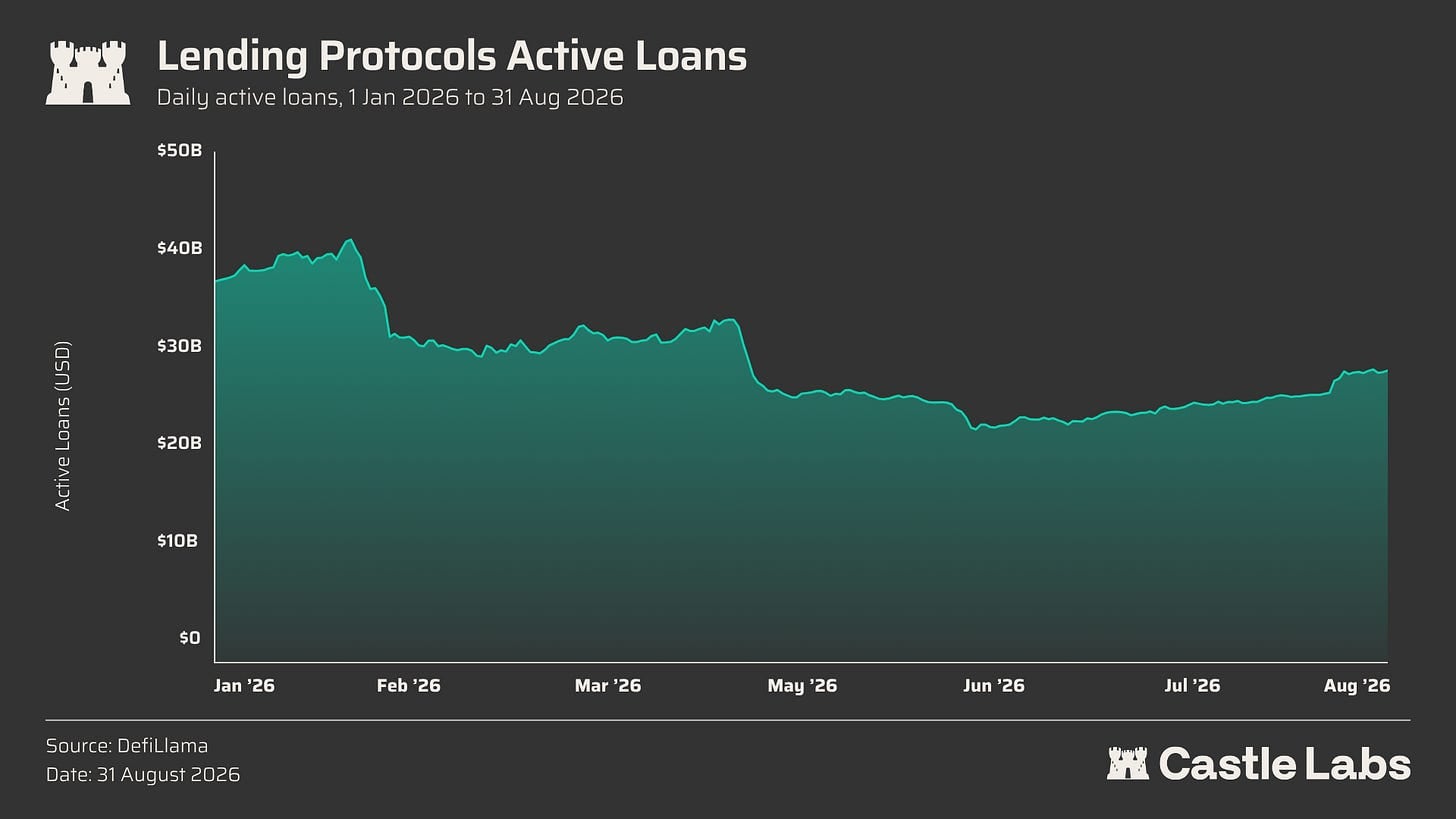
Currently, the active loan scale in the lending sector reaches $28.5 billion, with nearly all demand coming from floating-rate lending. This works well in stable times; however, during stress events, as the utilization curve shifts, borrowing rates can skyrocket. The sharp rise in interest rates forces some borrowers to exit or de-leverage, rendering the overall credit market inefficient.
In fact, DeFi money markets address a problem that traditional credit cannot provide: achieving near-instant borrowing via collateral.
However, there is still an unresolved problem: before the loan ends, you cannot determine the cost of debt.
This is precisely the direction many current products are focusing on: transitioning to fixed-rate, fixed-term credit products. In such a market, lenders receive fixed yields and clearly know how much their deposits can earn; borrowers also know exactly how much they have to pay.
The demand in this type of market can be roughly categorized into three types of entities:
Duration-matching borrowers: funds, treasuries, RWA issuers, basis/arbitrage trading desks that need debt terms to match asset terms, redemption windows, or strategy cycles.
Certainty borrowers: users that leverage cyclically, users seeking leveraged yield, and traders who may not care about the exact maturity date but need stable borrowing costs to avoid margin compression.
Lenders/curators: vaults, market makers, and allocators who wish to autonomously choose terms, collateral types, and returns rather than passively accepting the outcomes imposed by utilization.
Early iterations of fixed-rate lending faced three major issues:
Liquidity fragmentation: fixed-rate markets segment liquidity by maturity date, interest rate, collateral type, and terms, making it significantly more challenging to match than a single floating-rate pool.
No early exit: once a loan period begins, it is difficult for lenders to exit before maturity unless there is secondary liquidity, a redemption channel, or another buyer, which is not a problem in floating-rate lending.
Cold start problem: lenders are reluctant to have collateral locked up without receiving earnings, just to wait for a counterparty to appear.
As more institutional funds enter the market, and as more complex strategies such as cyclic leveraging emerge, the user base has evolved, and the demand for fixed-term markets continues to grow. One of the main issues in on-chain lending is the uncertainty of floating rates; with fixed-rate lending, users know their yields and costs from the start. Moreover, this also brings a better user experience, as protocols are forced to price directly against maturity, collateral quality, exit liquidity, and refinancing risks.
In this article, we will outline the designs adopted by several established protocols in floating-rate lending, including Morpho, Jupiter, and Kamino. These three protocols collectively have $6.83 billion of active loans and have recently entered the fixed-rate and fixed-term market with awareness of the aforementioned issues.
Morpho Midnight and Tenor Finance
Morpho, as an established protocol for floating-rate lending, launched Morpho Midnight in July. This is a zero-interest bond lending protocol based on intent, where lenders and borrowers express their respective intents, with their positions represented by debt units (each unit represents the obligation to repay one loan token before maturity) and credit units (the claim on repaid loan tokens). The solution of Midnight is to make loans tradable, therefore providing maturity flexibility and predictable underwriting for institutions. Interest rates are determined by the prices of fixed-term credit units exchanged between borrowers and lenders.
In Midnight, lenders and borrowers post "quotes," which do not lock up funds but express their intent to borrow or lend with specific prices, maturity dates, and collateral configurations in a specified market.
Funds are only called upon at settlement (callback), which solves the cold start problem; lenders only put in funds after a match is executed, enhancing capital efficiency. This also helps attract more liquidity, as the Morpho team states:
“By allowing users to earn floating rates on protocols like Morpho Blue, you can eliminate the opportunity cost typically incurred while waiting for quotes to be matched, creating more quote incentives and increasing the total liquidity available to users.”
Another challenge faced by fixed-rate markets is liquidity fragmentation, as each maturity date, collateral type, and interest rate range can become independent markets. In Midnight, funds are not tied up during the intent phase, and users can post cross-market quotes: “As the same amount of funds can be quoted to multiple markets simultaneously, the total liquidity a single market maker can provide to users = available funds × number of markets.”
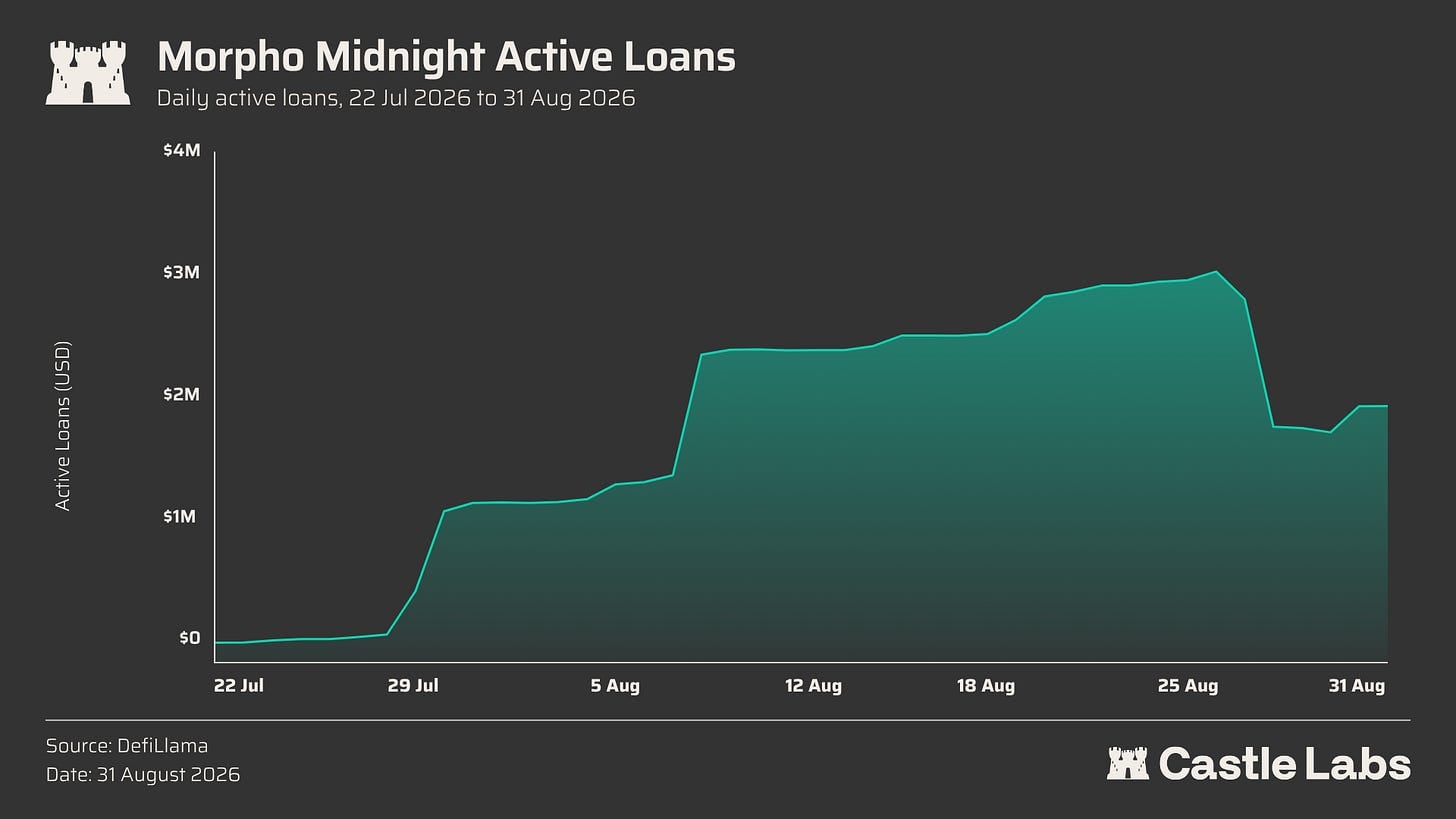
Since its launch in July 2026, the active loans in the Midnight market have reached $3 million. Although this number is small, the team expects it to change soon, as “it also inherits the existing network effects and ecosystem of Morpho. For example, Morpho's vault currently holds over $4 billion in funds. Once the vault adapter is released, these funds can begin to quote on Morpho Midnight and play a crucial role in building deep liquidity.”
The most interesting issue Midnight addresses is early exit. In older or less liquid fixed-term markets, both borrowers and lenders often have limited exit options before maturity. Midnight improves this by making positions interchangeable: lenders can sell credit units, and borrowers can buy debt units to reduce outstanding debt.
While Midnight can be understood as the underlying architecture for fixed-rate loans, an access layer has been built on top of it: Tenor Finance. DeFi Frontier calls Tenor the “HIP-3 of Midnight.”
Tenor essentially inherits all the functionalities of the underlying Morpho Midnight and builds additional features on top of that:
Automatic renewal and fallback options: Tenor introduces automatic position renewal to prevent liquidation after maturity. It utilizes independent keepers to roll loans into a new fixed-rate term before maturity. If a fixed-rate match cannot be found, it can directly fall back to the floating-rate pool on Morpho Blue.
On-chain OTC protocol: Tenor allows users to request quotes and broadcast customized OTC quotes. These quotes can be shared with whitelisted counterparties, allowing for direct negotiation.
Organizational tools and access control: Tenor provides role-based permission organizational accounts for institutions. Through such accounts, they can deploy customized, access-restricted lending markets, restricting who can borrow or lend based on compliance or KYC requirements.
Tenor reduces maturity friction by adding automatic renewal and fallback options, allowing fixed-term positions to carry on more smoothly as long as there is matching liquidity or fallback conditions met. On top of this, customizability makes it more institution-friendly; in the long run, the team expects the platform to be used by “one side being asset managers and the other side being enterprises.”
Jupiter Offerbook
Jupiter Exchange launched Jupiter Offerbook, which entered public testing in June 2026, around the same time as the release of the Morpho Midnight white paper. Jupiter Lend, a floating-rate product launched last year, was Jupiter's first attempt to enter the lending space. Now, through Offerbook, they are entering the fixed-term market.
Offerbook is an intent-based lending protocol characterized by no price-based settlement, supporting fixed-term lending for long-tail assets.
Loan terms on the platform are relatively short, typically ranging from 1 to 30 days. At maturity, if the borrower does not repay, the lender directly receives the collateral without any liquidation. Such markets allow the use of any long-tail collateral, whether NFTs, RWAs, or any assets without active price discovery, as long as the lender is willing to underwrite. This is a unique arrangement because it replaces continuous price-based settlement with maturity-based collateral transfer, helping to create specialized markets that support assets that would otherwise be difficult to facilitate.
On Offerbook, users can express their intent to lend or borrow, which displays in the application; when a quote is accepted, liquidity is matched. Since users only accept when matching occurs, they are free to utilize their funds elsewhere until the matching order is executed, thus solving the cold start problem. This creates opportunities for both lenders and borrowers to earn yields before finding a match that perfectly meets the terms.
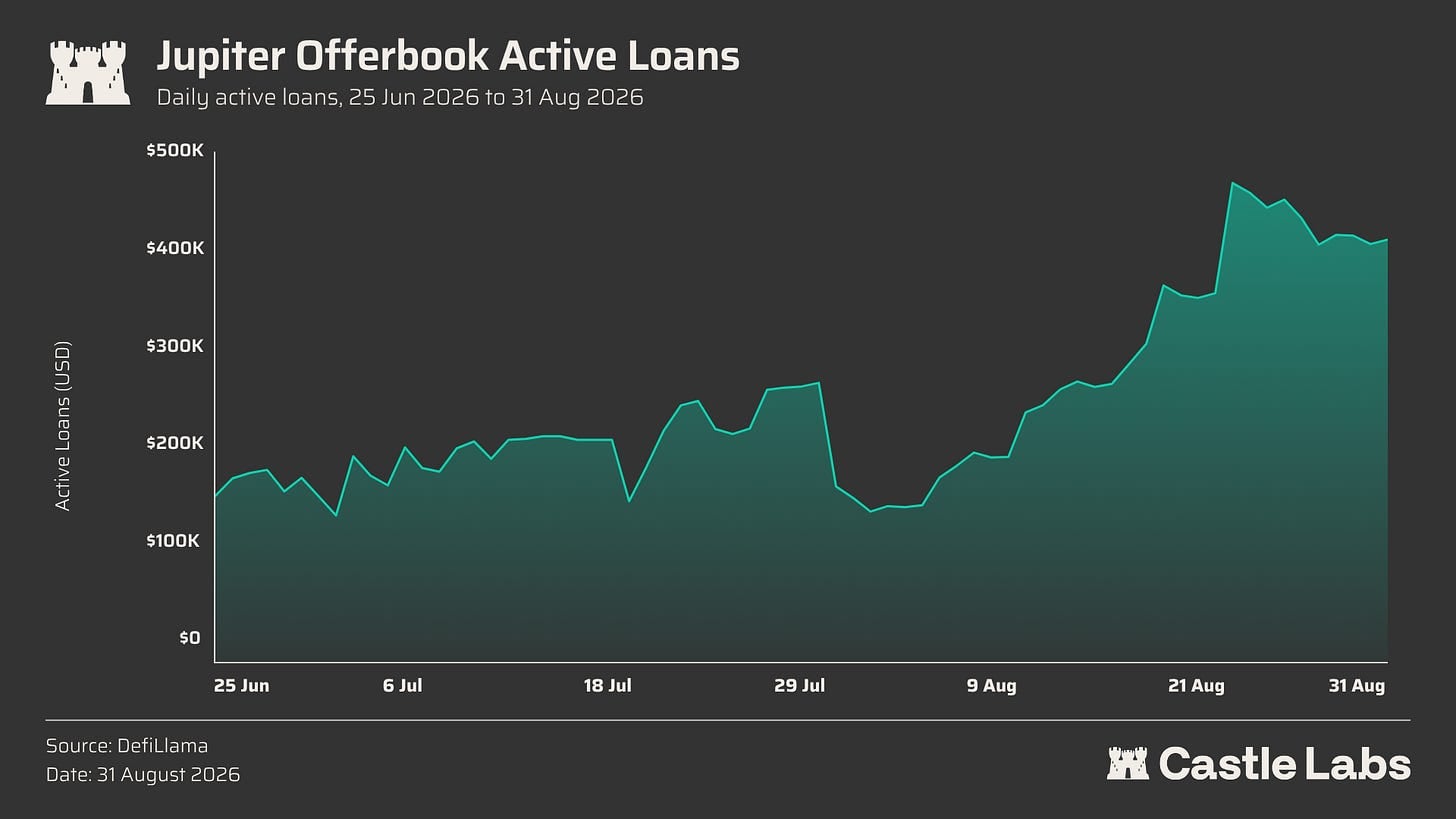
Since its launch, active loans on Jupiter Offerbook have reached $450,000. Although their model is quite unique, it is challenging to prove its market and generate demand, as its scalability is limited to lenders' willingness to directly underwrite collateral.
Kamino
Kamino has recently released its white paper on a fixed-rate lending protocol. It does not build a separate fixed-rate market but adds a fixed-rate reserve pool within Kamino Lend. The benefit of this layout is the distribution capacity: borrowers can see a clear term structure while lenders can quote specific rates and terms without fully exiting the floating-rate system, making fixed-rate lending an additional feature.
Each reserve pool on the platform is defined by interest rates and terms: for instance, borrowing USDC at different rates and terms. All these different rates and terms constitute a grid.
Through this grid, Kamino enables borrowers and lenders to express the trading positions they desire across price and time dimensions. Borrowers post borrowing intentions specifying collateral, scale, maximum interest rate, and term. Lenders post conditional liquidity, specifying the rates, terms, and amounts they are willing to offer. The grid becomes the execution layer: borrowers extract available fixed-rate liquidity from predefined rate and term combinations.
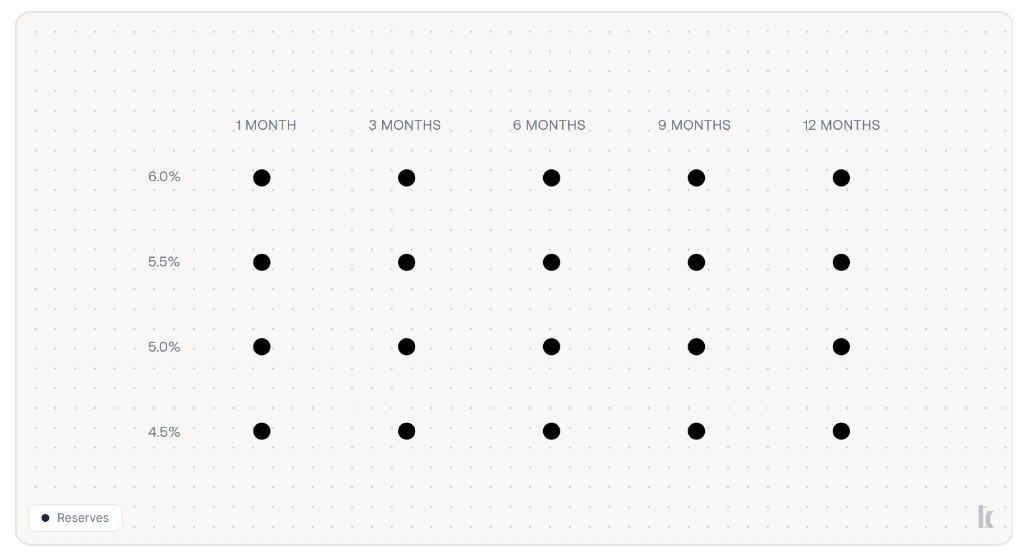
Lenders do not match directly but quote on the structured grid of predefined rates and terms (e.g., 1 month at 4.5%, 3 months at 5%, etc.), building visible term structures and yield curves for different assets. By utilizing Kamino's infrastructure, borrowers can post their intentions waiting for matching liquidity or extract available fixed-rate liquidity directly from the grid. Based on this, if liquidity allows, Kamino can automatically roll loans into the next term, similar to Tenor; if no fixed-rate liquidity is available, it can revert to floating rate. This addresses the maturity issue and supports loan continuity, reducing the need for borrowers to manually manage each maturity.
For exits, lenders must go through a withdrawal queue. If lenders cannot exit immediately due to deployed liquidity, they enter a first-come, first-served queue and receive repayment when the loans in that reserve pool mature. This design ensures that lenders' maximum waiting time is constrained by the reserve pool's term.
While matching occurs between the two parties, funds do not remain idle. They continue to earn rates from the floating-rate reserve pool, helping to solve the cold start problem.
Conclusion
Fixed rates do not eliminate any risks that floating-rate lending has exposed over the years, but they make the cost of debt clear.
This is precisely what has been missing in DeFi credit.
The strength of floating-rate pools lies in their ability to make borrowing instantly available, but they compress everything into a single utilization curve. In contrast, fixed-rate markets allow borrowers to price for terms, lenders to choose term and collateral risk, curators to allocate funds across terms, and applications to bundle more predictable credit products. We are also beginning to see preliminary iterations of predictable credit products, such as Aave launching Stable Vaults in July.
This is significant as DeFi lending expands. It now supports cycle lending, basis strategies, fund management, RWA-linked assets, and consumer-facing applications. These users need more than just liquidity: they need clear and fixed financing terms.
We expect competition in this space to intensify, and more innovative solutions to emerge to scale fixed-rate lending.
The current adoption rate is still relatively low, with floating-rate lending occupying most of the market; however, the goal is to enlarge the pie, as these products can serve many use cases that current DeFi lending cannot address.
Furthermore, these products aim to address the issues early protocols in this space faced, and they have stronger dissemination capabilities because their corresponding floating-rate lending products have become mature. For example, funds in the floating-rate market can quote in fixed-rate markets while still earning yields and maintaining efficiency.
As these products mature, we should see a considerable number of strategies previously deemed impossible to implement, as well as a new flywheel in the lending space.
免责声明:本文章仅代表作者个人观点,不代表本平台的立场和观点。本文章仅供信息分享,不构成对任何人的任何投资建议。用户与作者之间的任何争议,与本平台无关。如网页中刊载的文章或图片涉及侵权,请提供相关的权利证明和身份证明发送邮件到[email protected],本平台相关工作人员将会进行核查。
