Author: Shaurya Malwa
Translated by: Shenchao TechFlow
Introduction by Shenchao: A cat-themed Meme coin on Solana named ZCAT has cumulatively distributed approximately 2,320 Zcash (around $2.8 million) to holders through a 3% transfer tax on each transaction, involving over 470,000 distributions. Meanwhile, the privacy coin ZEC has increased more than 23 times this year, once breaking $1,200, drawing attention to this method of “distributing funds to Meme holders using Zcash.”
A Cat and a Zcash Dividend
ZCAT is a cat-themed Meme coin running on Solana, issued by an anonymous developer. Its most notable aspect is not the “cat” but the method of “distributing funds.”
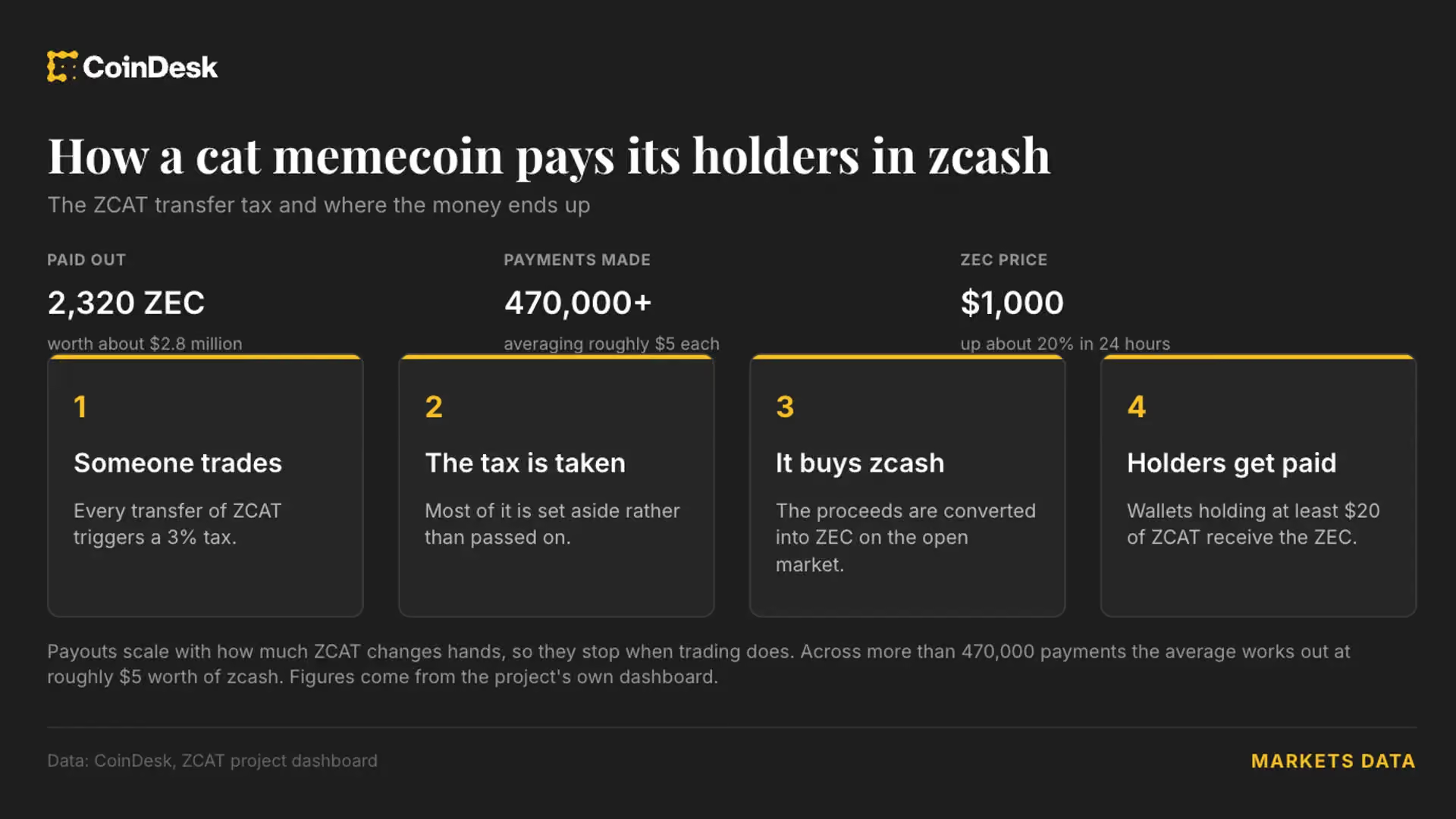
According to data from the project dashboard, ZCAT charges a 3% tax on each transfer, most of which is converted to Zcash (ZEC) and distributed to wallets holding at least $20 worth of ZCAT. So far, it has distributed approximately 2,320 ZEC, valued at around $2.8 million based on Monday morning’s Asian trading session coin prices, with distribution exceeding 470,000 times.
This is more like an experiment of “holding coins means dividends,” except the dividend is not in stablecoins like the US dollar but in a privacy coin.
ZEC Increased 23 Times, Making “Dividends” Valuable
The reason ZCAT's method has gained attention is closely related to the recent performance of ZEC.
Zcash is a well-established privacy coin, with the core feature of hiding the sender, receiver, and amount of transactions. In the past year, ZEC has risen over 2,300%, and briefly broke $1,200 last Sunday night, driven by a resurgence in the market’s demand for privacy-related crypto assets.
Progress on the institutional front has also boosted sentiment: Grayscale launched a spot Zcash ETF on the NYSE Arca sector at the end of August, allowing investors to indirectly allocate ZEC through a U.S. stock-listed fund without needing to purchase and hold the tokens themselves.
The higher ZEC rises, the more valuable the “tax” distributed by ZCAT appears on paper, reinforcing the narrative of “holding ZCAT to earn ZEC.”
The Operating Logic of “Yielding Meme”
ZCAT is not an isolated case. Its trading pair with ZEC launched on the launchpad platform StonkFun on Solana, and what sets StonkFun apart is that it allows new tokens to use assets other than SOL or stablecoins as trading pairs.
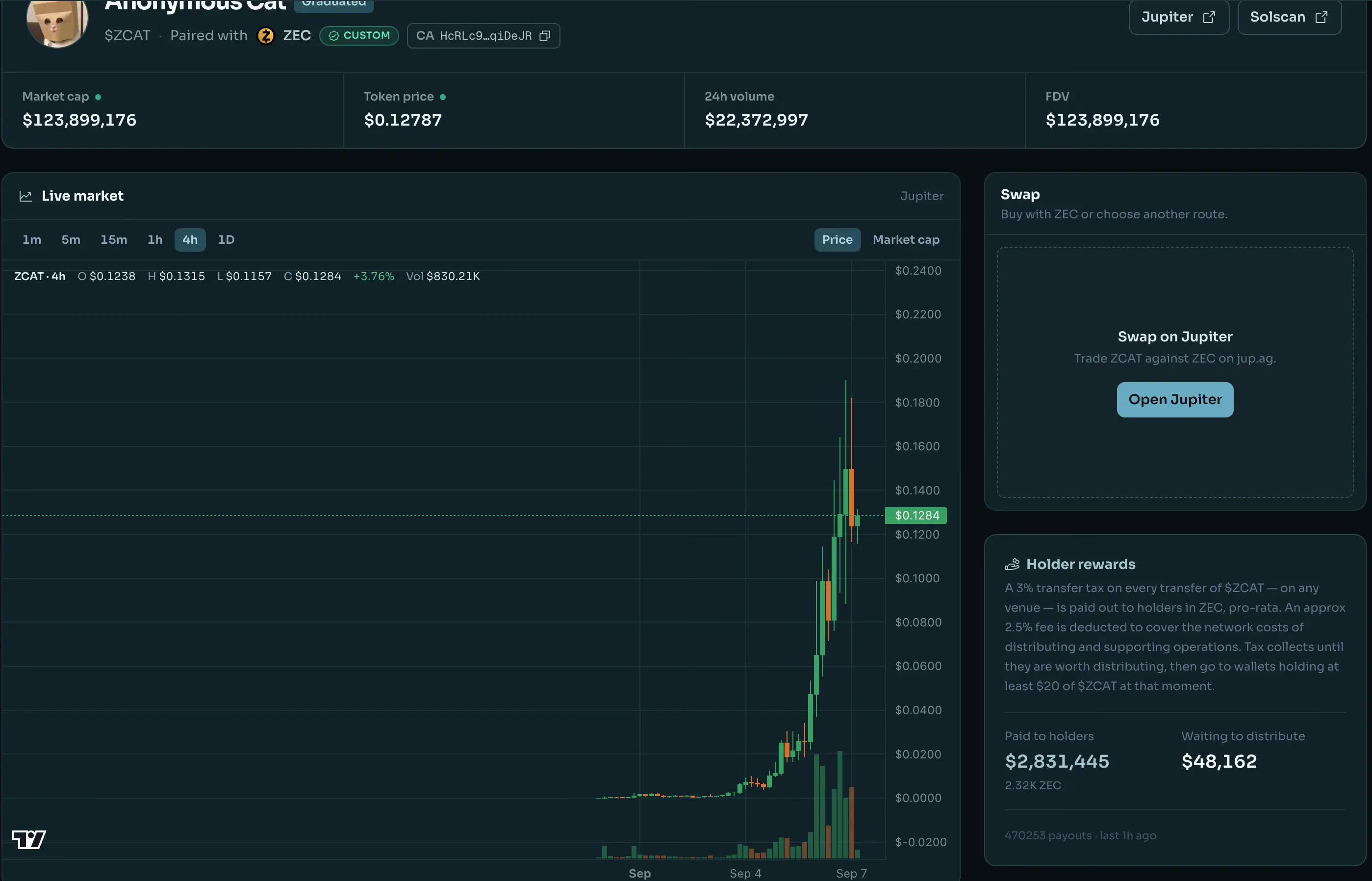
ZCAT itself has also risen alongside ZEC. On Monday, the token’s price was around 13 cents, with a market cap of about $124 million and a 24-hour trading volume of about $22 million; over the weekend, it briefly touched 19 cents, and then significantly fell back on Monday morning.
The appeal of this model lies in “having coins means producing output,” but its vulnerability is also evident: returns depend entirely on the trading activity of the tokens, rather than any income generated from business or investments. Once the trading fervor wanes, the transaction tax used to distribute funds will dry up, and the scale of distributions will plummet accordingly.
Cat-themed Meme Coins Gaining Popularity
ZCAT’s popularity coincided with the overall trend of “cat-themed Meme,” suggesting a logic that seems quite disconnected from the fundamentals.
Cash Cat is a recent example that demonstrates how quickly a Meme can be linked with a new crypto scene. When Robinhood Chain launched in July, Cash Cat gained popularity, becoming an object of niche admiration, partly because the name was associated with Robinhood early on, before the brokerage adopted its current branding.
Some traders turned about $800 into over $1 million in the first week of Cash Cat’s launch, and Memecoins rapidly became one of the most active uses on the Robinhood Chain, which was originally built around tokenized stocks.
This trend is accelerating. Meme coin applications now dominate much of the activity on the Robinhood Chain, with the token issuance platform Pons recently generating over 22,000 new tokens in a single day, bringing millions of dollars in user fees to the platform.
The Sustainability of Returns Remains a Question Mark
Returning to ZCAT itself, its dividend story relies on one premise: trading must continue. The transfer tax comes from every buy and sell, not from any business revenue, meaning that when market attention shifts and trading volume shrinks, the scale of distributions will also decrease.
With ZEC soaring, this “Zcash dividend” looks enticing; but when the tide recedes, whether a cat can continue to distribute funds to holders will ultimately depend on trading volume.
免责声明:本文章仅代表作者个人观点,不代表本平台的立场和观点。本文章仅供信息分享,不构成对任何人的任何投资建议。用户与作者之间的任何争议,与本平台无关。如网页中刊载的文章或图片涉及侵权,请提供相关的权利证明和身份证明发送邮件到support@aicoin.com,本平台相关工作人员将会进行核查。


