A risk provenance report from a $130 million on-chain default exposure.
Written by: Andjela Radmilac
Translated by: Saoirse, Foresight News
Imagine an investor purchasing Ethereum for $1,000, and subsequently, the price rises to $4,000. Now, he wants to cash out $1,000. If he sells a quarter of his Ethereum, although he can receive cash, according to U.S. tax rules regarding investment-type digital assets, he will incur $750 in capital gains.
However, DeFi offers an alternative solution. Holders can deposit all their Ethereum into a lending protocol as collateral and borrow a dollar-pegged stablecoin worth $1,000.
This loan does not count as taxable income, and the Ethereum can still benefit from future price increases; the holders can access spendable funds that can be exchanged for fiat currency without selling the original asset.

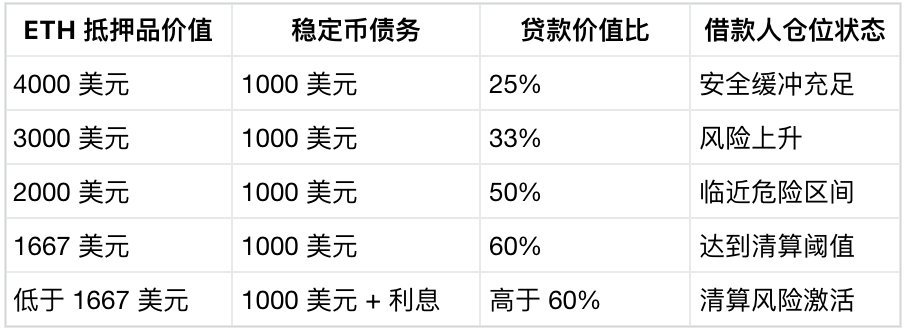
While this method can help holders save a significant amount on taxes, it also introduces fragile risk vulnerabilities. The initial collateralization ratio of this $1,000 debt is 25% (with collateral valued at $4,000); if the price of Ethereum falls to $2,000, the loan-to-value ratio will double to 50%. With the added interest accruing on the debt, this ratio can increase further.
When the ratio exceeds the upper limit set by the protocol, the code will trigger collateral liquidation: external traders can repay part of the loan and acquire some Ethereum at a discount.
While the borrower has postponed a taxable sale, the lending pool must bear the risks from collateral price fluctuations, debt size, and whether the borrower is willing to proactively manage their position before liquidation.
Individual tax decisions effectively become part of a shared credit market funded by other users, with most lenders only seeing a string of wallet addresses.
Researchers Lisa De Simone from the University of Texas at Austin, Peiyi Jin from the National University of Singapore, and Daniel Rabetti from the National University of Singapore investigate these connections in a working paper on tax planning and DeFi credit risk.
The study focuses on the DeFi lending protocol Venus on the BNB Smart Chain, which executes rules via smart contracts, allowing users to stake crypto assets and borrow other tokens.
The research sample period is from November 12, 2020, to July 31, 2022, covering 15 mainstream tokens on the Venus platform. About 13 million transactions were analyzed, generating 1.36 million daily observation data points for borrowers (with one record generated per active wallet each day), and around 3% of traders were defined as defaults in the paper.
Defaults in the DeFi context are different from mortgage delinquencies and require explanation. The paper defines a default as the loan-to-value ratio of the loan remaining consistently above Venus's 60% threshold for at least 7 days, during which the borrower has not added deposits or taken additional loans; the total default debt exposure amounts to $133.34 million. A loan at risk will continue to count in statistics across multiple reporting dates, hence this total represents cumulative daily risk exposure rather than the actual loss of principal from a single event.
Billionaire Strategies Enter the Ordinary Wallets
The traditional version of this strategy is called "Buy, Borrow, Die." Investors purchase assets, wait for appreciation, then use the assets as collateral to borrow funds for living expenses, without ever selling the assets or cashing out the gains.
Continuous borrowing can defer capital gains taxes for years; U.S. estate-related regulations stipulate that heirs can reset the tax basis when inheriting assets, wiping out much of the tax burden accumulated during the original holder’s ownership period.
This was previously an operation exclusive to the wealthy: private banks exclusively served high-net-worth clients who had sufficient collateral and strong downside resilience. Banks could assess clients' overall financial situation, determine lending limits, negotiate collaborative terms, and before collateral was forcibly liquidated, both parties had space to mitigate risks.
DeFi has completely transformed this highly personal due diligence business into code. Software doesn't need to assess clients' overall qualifications; it simply reads the assets within wallets and applies the same collateral rules to all users.
This significantly lowers the service threshold, but the cost is that the entire system is built on excessive collateral: borrowers must initially pledge assets valued higher than the loan.
According to the parameters described in the paper for Venus: a qualified collateral worth $10,000 can have a maximum debt of $6,000. Fully leveraged, there is almost no price drop buffer; borrowing only $2,000 provides a thick safety net. Both accounts are monitored continuously through oracle market prices by the code.
When the collateral value depreciates beyond the threshold, liquidators can repay part of the debt and acquire the collateral at a discount, completing account restoration and earning rewards. This mechanism is intended to protect the funds pool before the collateral value falls below the debt. However, rapid asset sell-offs and insufficient market liquidity weaken the effectiveness of liquidation, and congestion in the blockchain network can prevent liquidators from acting in a timely manner.
Tax motivations further complicate the risks on the borrower's side: to reduce risk, they need to execute trades, repay debts, or sell off part of their appreciated holdings.
Borrowers who take out loans to postpone taxable transactions often delay the timing of position disposal; the higher the book profit, or if the holding period is approaching the lower long-term capital gains tax threshold, this tendency to delay becomes more pronounced.
Stablecoins enhance the attractiveness of this trading model. Dollar-pegged tokens transform volatile collateral assets into directly usable dollar purchasing power. Traders can continue to stake Ethereum and borrow USDT or USDC for other purposes.
Many large holders are using crypto assets as collateral to borrow stablecoins, obtaining funds while retaining price exposure to the underlying assets.
When a loan is opened, the protocol sees the collateral ratio as perfectly normal. However, the protocol cannot know that the borrower initially purchased Ethereum at a very low cost; selling would realize substantial gains, or that holding for a few more months could yield significant tax benefits. These factors will influence the borrower's behavioral choices when the loan is heading toward danger.
IRS: Venus Becomes a Natural Experimental Field
Researchers need to distinguish tax-driven behavior from the price fluctuations inherent to the crypto market itself. The Infrastructure Investment and Jobs Act, effective November 15, 2021, provides an opportunity for research.
Section 80603 of the Act expands the reporting obligations of digital asset brokers. As a result, traders anticipate that their large on-chain activities will be reported to the IRS in the future.
This Act alters traders' expectations regarding third-party reporting for tax purposes, constituting an external shock event: the behavior of potential U.S. taxpayers will be influenced while international users remain unaffected by this policy change.
This tax reporting system took a long time to implement. Custodian-type brokers will report the total income from applicable trading exchanges using Form 1099-DA starting January 1, 2025. Subsequent IRS rules additionally require that starting January 1, 2026, certain transactions report asset cost basis.
These regulatory rules only bind institutions that actually hold user assets, while non-custodial DeFi services are currently not covered by regulations.
However, the research value of this paper lies in the market participants' expectations at the moment the law was enacted in November 2021 - people predicted that future transaction records would be reported, rather than waiting for formal tax forms to be implemented.
The researchers compare data before and after the law's enactment (well before the formal regulations took effect) to capture the market's reaction to the notion that "future trades will be subject to regulatory scrutiny," rather than the passive feedback to the formal tax forms that have been implemented.
The blockchain itself does not disclose users' nationalities or tax residency, so researchers can only make inferences about which wallets likely belong to U.S. users: wallet transactions are concentrated during U.S. working hours, exhibit anomalous behavior during U.S. holidays, and concurrently hold U.S.-regulated dollar stablecoins.
Each inference dimension carries the possibility of misjudgment, hence the paper provides multiple sets of calculation methods and employs strict standards based on multiple conditions.
The entire research logic is akin to: the same financial system experiences a policy shock event. Two groups of users face the same token market behavior and the same Venus protocol rules; only the presumed American user group is highly attentive to the new reporting regulations. This allows for the disaggregation of behavioral changes driven by tax motives from the broader market behavior disruptions.
Main model calculation results: After the law took effect, presumed U.S. borrowers showed a 24.5% decrease in asset trading probabilities compared to international users. For borrowers with stablecoin liabilities, trading activity declined an additional 23%. This aligns with the paper's logic: cash obtained through stablecoins allows collateral to remain staked while still retaining asset appreciation.
In this paper, "liquidity" is defined narrowly at the wallet level: the probability of borrowers conducting any asset trades daily. Public perception of liquidity often refers to exchange depth, buy-sell spreads, and significant sell-pressure costs; however, this study measures user portfolio trading activity and whether appreciated assets are "locked up."
The higher the book profits and loan-to-value ratios of borrowers, the more pronounced these behavioral characteristics are. Every December (especially the last week), investors generally defer gains to the next tax year, resulting in decreased trading activity; once holdings exceed a year, and meet the lower long-term capital gains tax conditions in the U.S., trading activity rebounds. These behaviors corroborate that the observed changes indeed stem from tax motivations, rather than merely temporal coincidences due to the legislative point.
Researchers estimate that U.S. borrowers in the sample defer an average of $3,357.42 in capital gains tax annually, accounting for about 17% of the portfolio size during the same period. This estimate is based on the assumption that the wallet belonged to U.S. taxpayers, reconstructed holdings through on-chain data, and applied the corresponding tax rate for calculation; it only represents a rough magnitude for the overall sample.
Cost Transmission to the Funds Pool
The final part of the study examines how declining trading activity affects loan quality. Borrowers with low trading frequency may maintain high-risk positions longer, miss repayment opportunities, and fail to supplement collateral before hitting thresholds. Tax preferences originally outside of Venus ultimately convert into unpaid debts within the protocol.
There exists a risk of causal inversion: defaults can also lead users to abandon wallets or cease trading.
The researchers employed an instrumental variable method to isolate the decline in trading activity caused by the legislative shock (independent of the protocol itself) to eliminate reverse causation interference.
Model calculations indicate that with every 1% increase in non-liquidity attributed to tax factors, the number of default accounts rises by 11.2%, and the scale of default loans increases by 39.6%. An increase in non-liquidity by one standard deviation corresponds to an approximate $350 increase in a single borrower's default debt, which is 2.7 times the model's baseline value.
Percentages may appear high, but this is a statistical limitation: results only apply to the subset of samples affected by this policy event and sensitive to tax issues and cannot be treated as a general multiplier for all DeFi loans; they solely explain how motivations influence credit outcomes.

This exposes the inherent blind spots of automated lending. Smart contracts read collateral prices, debt balances, interest payable, and liquidation thresholds, but neglect to factor in borrowers' holding costs and tax motivations.
Two wallets, with identical Ethereum collateral and loan conditions, are seen as posing the same risks by the Venus system; yet one party is willing to sell to mitigate risk, while the other seeks to avoid selling at all costs. This creates a borrower selection bias issue.
Over-collateralization can withstand ordinary price fluctuations; however, borrowers who are extremely reluctant to liquidate appreciated assets may still maintain debt while their safety net thins, concentrating risk on a group whose motivations the protocol cannot discern.
If liquidation is executed smoothly, external participants repay debts and dispose of collateral, lenders will not incur losses. However, if liquidation fails, losses will be distributed according to the protocol’s loss allocation mechanism, shared by the protocol's reserves, token holders, and liquidity providers. Individual tax preferences ultimately become financial consequences borne by all contributors to the liquidity pool.
The paper also points out that tax considerations are just one of many sources of risk.
This research only targets a single protocol during the 2020-2022 bull-bear cycle; U.S. identities of users are inferred from behavior; and defaults are defined in a special way, considering only accounts with persistently high loan-to-value ratios. The study also confirms that drastic fluctuations in collateral prices and deficiencies in the liquidation mechanism can cause issues within Venus loans.
Other protocols with stronger liquidity or different collateral parameters will yield different results; liquidation bots in more specialized market environments will behave differently than Venus during the sample period.
Even so, this paper presents a perspective that traditional lending data finds difficult to achieve: a complete observation of collateral, debt, user behavior, liquidation, and abandonment processes at a single wallet granularity.
DeFi has relocated lending strategies originally meant for private banks onto public chains, making them accessible to the general public. However, automation replacing credit auditors does not erase human subjective motivations. Tax considerations, obsessions with appreciated assets, and the unwillingness to sell penetrate through the code, ultimately shared in the costs by all who provide liquidity to the funds pool.
免责声明:本文章仅代表作者个人观点,不代表本平台的立场和观点。本文章仅供信息分享,不构成对任何人的任何投资建议。用户与作者之间的任何争议,与本平台无关。如网页中刊载的文章或图片涉及侵权,请提供相关的权利证明和身份证明发送邮件到support@aicoin.com,本平台相关工作人员将会进行核查。


