Author: Nancy, PANews
Arbitrum is becoming one of the hidden winners behind the surge of Robinhood Chain on-chain, continuously earning considerable profits through fee sharing while the "selling shovels" narrative drives ARB prices higher.
However, as trading activities on Robinhood Chain rapidly increase, its persistently high Gas fees have ignited a remote confrontation between Solana and Arbitrum co-founders, also putting the question of how public chains can commercialize and capture on-chain value front and center.
Two months of rent nearly equals annual income, Arbitrum "makes money while lying down" through sharing
Robinhood is crazily raking in cash, while Arbitrum is "lying back" collecting rent behind the scenes.
According to the latest data from arbdata, since the launch of Robinhood Chain’s mainnet in early July, the cumulative fee income has risen to $37.56 million, setting a historical high with a staggering increase of 362.6% over the past seven days. Based on the annualized average fee income of the last 30 days, its annual revenue scale is approximately $406 million.
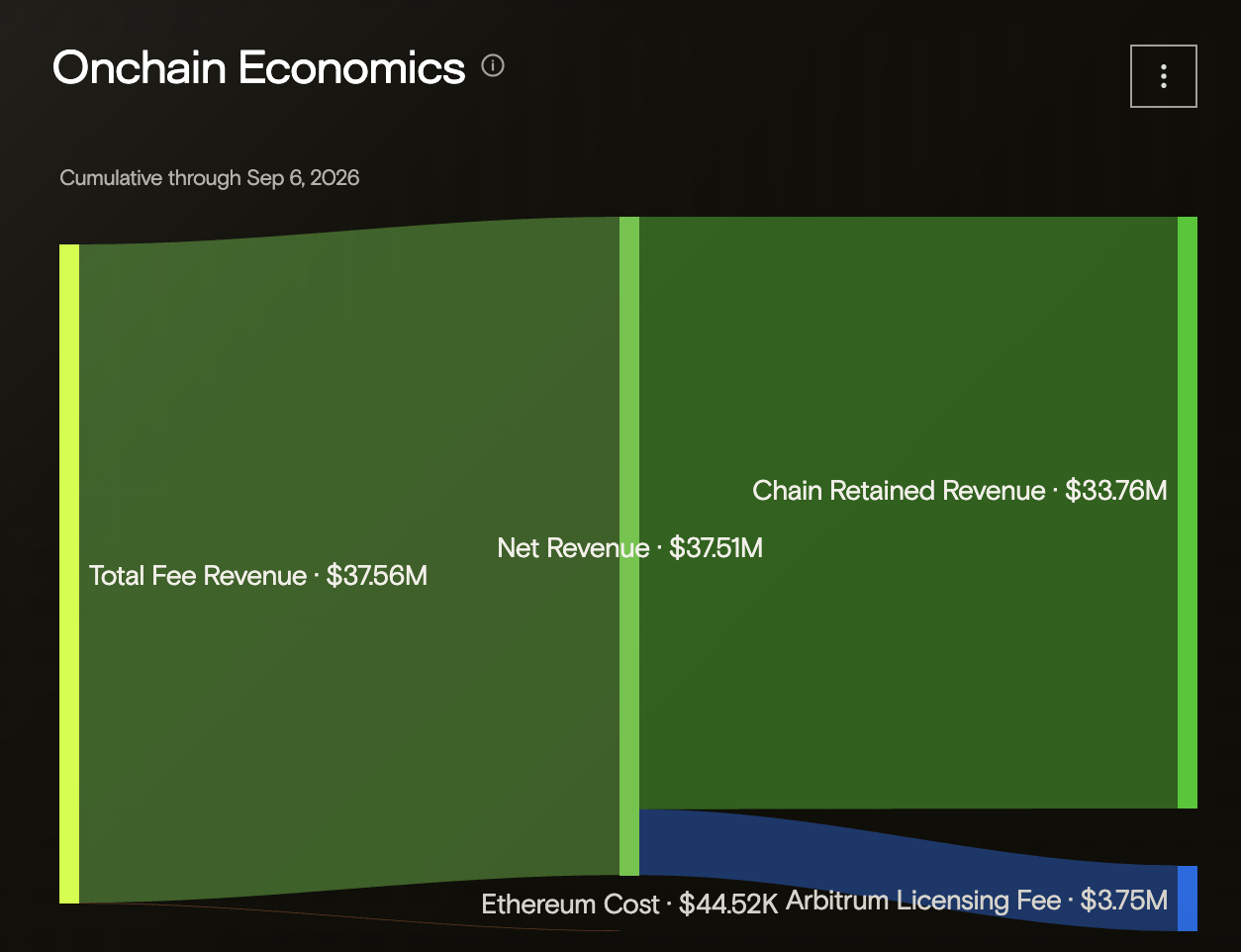
The continuous "money printing" by Robinhood Chain has also allowed its partner Arbitrum to "reap the benefits." According to the cooperation agreement between the two parties, Robinhood Chain is required to return 10% of the net income from the agreement to the Arbitrum ecosystem. Based on the current cumulative income of Robinhood Chain, approximately $3.75 million will flow directly to the Arbitrum ecosystem.
However, the fees earned by Arbitrum's own network are far lower than its share from Robinhood Chain. Data from DeFiLlama shows that this year, the total fees earned by the Arbitrum network itself amount to about $3.87 million, whereas the revenue share generated by Robinhood Chain in just two months is already close to Arbitrum's total annual fee income.
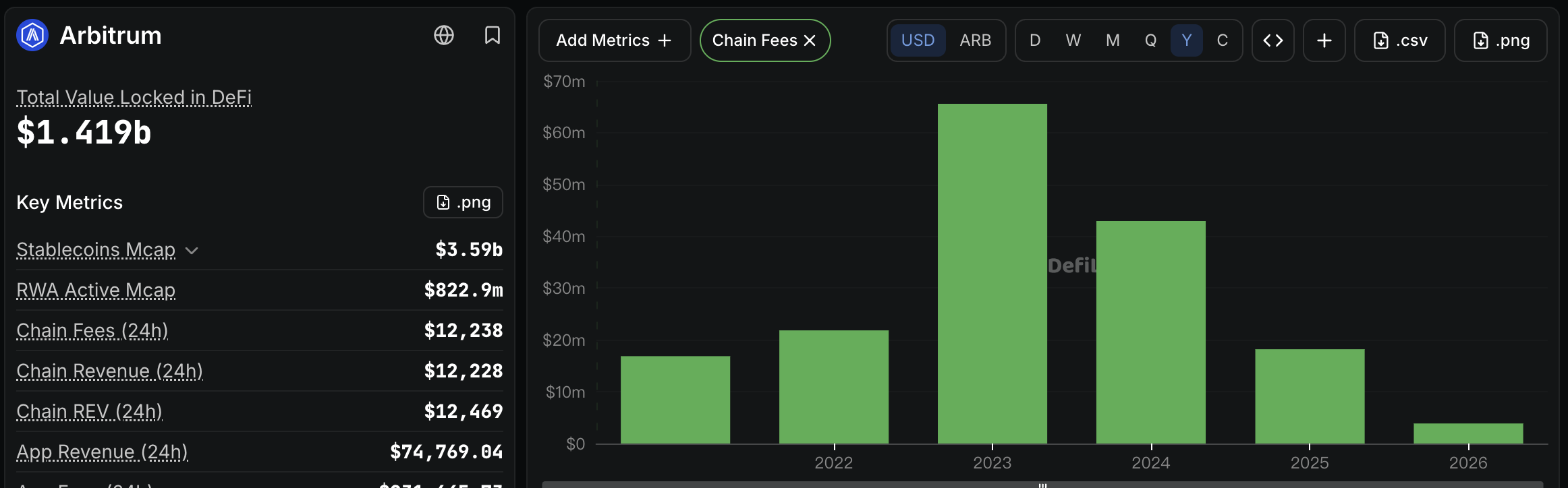
Looking at the latest daily fees, this gap is even more pronounced. In the past 24 hours, the daily fees of Robinhood Chain reached $2.9 million; based on the 10% revenue sharing ratio, Arbitrum could receive about $290,000. During the same period, the Arbitrum network itself had daily fees of only $12,000. In other words, the daily rent of Robinhood Chain is approximately 24 times that of Arbitrum's own network fee income.
This “selling shovels” business has further heightened market expectations for Arbitrum's future revenue growth and value capture capabilities, becoming an important driving force for the continuous rise of ARB.
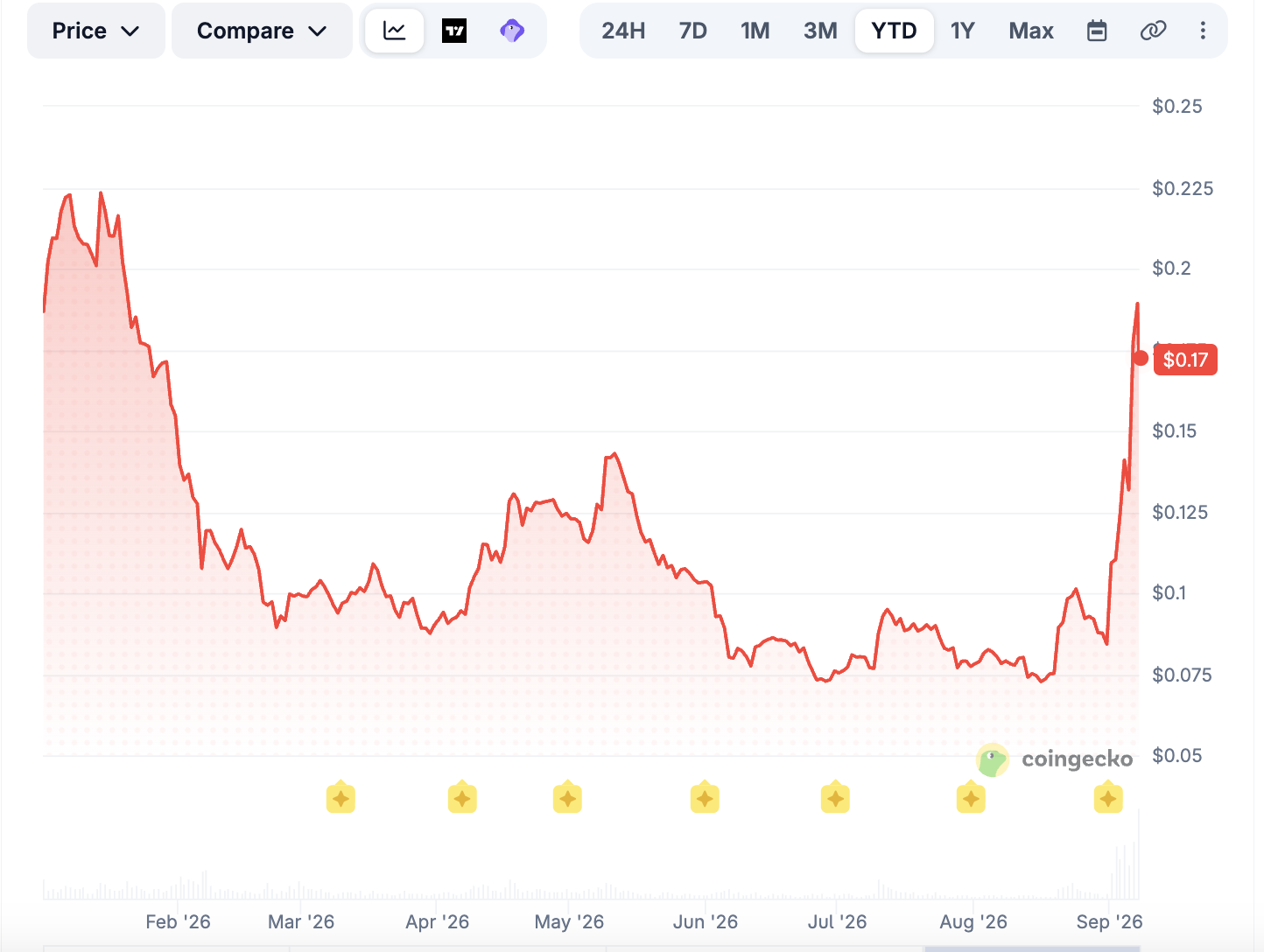
Data from CoinGecko shows that over the past 30 days, ARB has risen by more than 135.8%, reaching a new high since January this year. During this period, ARB's daily increase even surpassed that of several mainstream assets, becoming one of the leading assets in the crypto market.
It is important to note that the income contributed by Robinhood Chain has not undergone any token buyback or destruction. According to the agreement, 8% of the 10% income returned by Robinhood Chain flows into the Arbitrum DAO treasury, while 2% goes to the Arbitrum Developer Guild. In other words, the high income from Robinhood Chain is generating cash flow for the Arbitrum ecosystem, but this cash flow has yet to be directly transformed into the value return of ARB; the market is essentially speculating on an undeveloped value capture expectation.
Additionally, it is crucial to note that ARB itself still faces ongoing token unlock pressures, with the unlocking period extending until March 2027. Data from Token Unlocks indicates that the next unlock of ARB is anticipated on September 16, which will release approximately 92.65 million ARB, valued at about $17.1 million at current prices, accounting for about 1.59% of the total supply.
However, Arbitrum co-founder Steven Goldfeder recently pointed out that the market might misinterpret the actual increase in circulating supply of ARB in the future. He stated that the token unlock for ARB investors and team members is nearing completion and will be fully unlocked by March next year. Currently, the portion of yet-to-be-unlocked tokens accounts for about 7.7% of the total supply. Meanwhile, the Arbitrum DAO treasury currently holds 2.84 billion ARB; however, these tokens are not locked-up tokens in the traditional sense, but are controlled by circulating token holders, and their transfer must be approved by voting from other token holders.
Therefore, for ARB, the income growth brought by Robinhood Chain indeed opens up new imaginative spaces for value capture. However, whether the trading activity and high fees of Robinhood Chain can be sustained, whether share income can flow back to ARB holders in the future, and how the ongoing token unlock pressure will be released remain key issues that the market needs to focus on.
The two public chain co-founders confront each other, high Gas fees spark controversy over public chain business models
However, as trading activities on Robinhood Chain rapidly grow, its constantly rising Gas fees have also sparked discussions in the market about on-chain costs and value capture models.
Recently, Solana co-founder Anatoly Yakovenko (Toly) clashed remotely with Arbitrum co-founder Steven Goldfeder over the fee model of Robinhood Chain. Interestingly, when Robinhood initially decided to build its own L2, it listed Arbitrum, Ethereum, and Solana as candidate options, ultimately choosing Arbitrum.
As on-chain trading activities surged, the average single transaction fee on Robinhood Chain skyrocketed to about $0.4, more than 100 times higher than Solana during the same period. Toly shared this data and pointed out that the 10% revenue share paid by Robinhood Chain to Arbitrum is already sufficient to cover four times the equivalent trading costs on Solana.
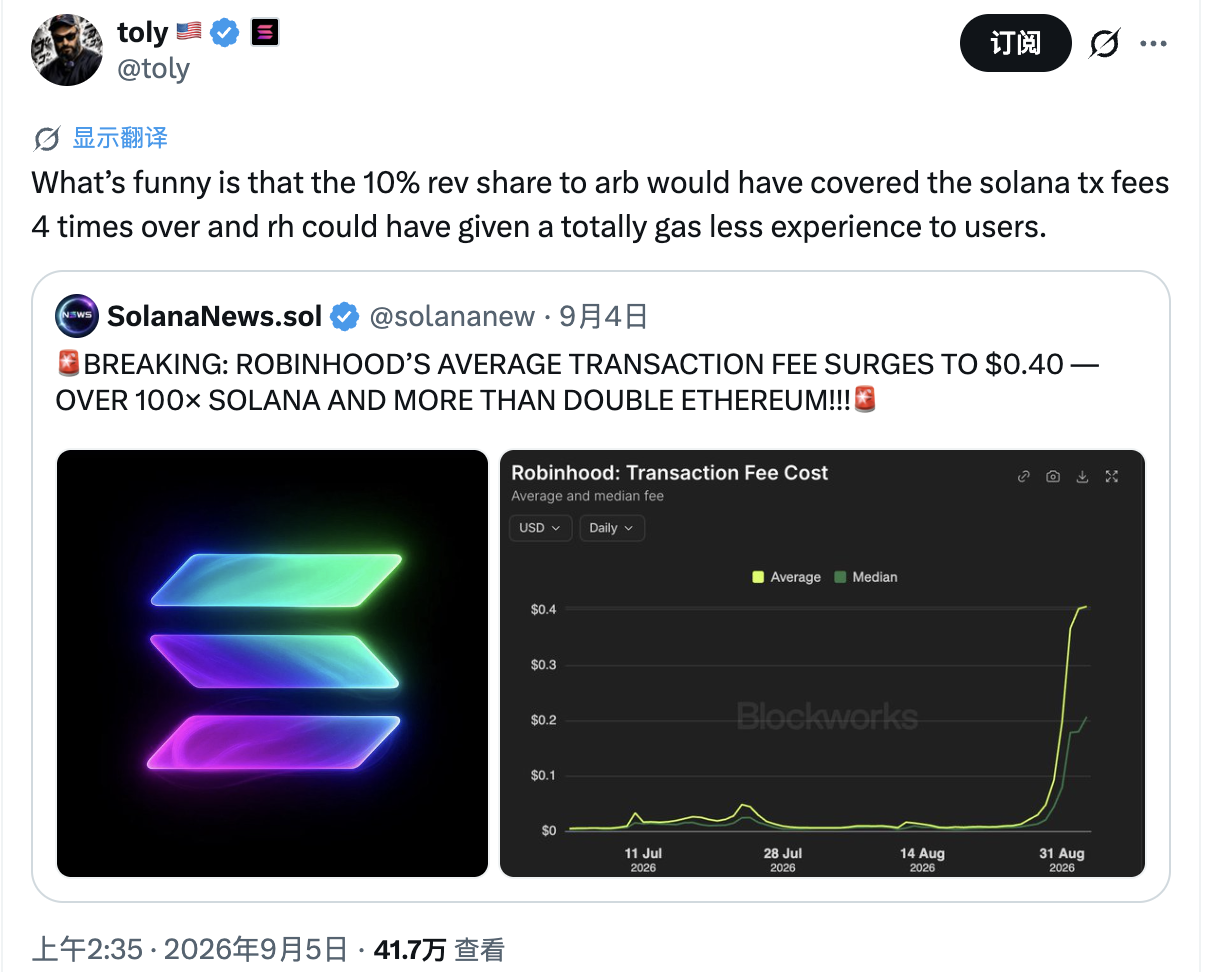
In Toly's view, if Robinhood Chain had initially been built on Solana, Robinhood could have chosen to cover Gas fees for users, enabling almost gas-free transactions for them. He believes that front-end applications should realize commercial monetization by charging their own users and products, rather than relying on underlying infrastructure to make money by raising the overall transaction costs.
Toly even referred to the current model of Robinhood Chain as "brain dead" and further questioned why Robinhood could not directly charge users on the app while utilizing lower-cost underlying infrastructure to reduce its operational costs. Is it necessary to sacrifice revenue in pursuit of lower congestion and greater scale?
In Toly's opinion, income from the application layer and the underlying infrastructure should be independently generated. Robinhood could entirely monetize the front end by charging a certain proportion of fees while treating the chain as a low-cost, high-efficiency backend infrastructure, rather than making on-chain transaction fees a part of the business model.
In response to this criticism, Steven Goldfeder asserted that Toly's viewpoint is "outrageous." On Arbitrum, Robinhood can retain 90% of the Gas revenue; should it directly utilize Solana, the underlying fees would belong to the Solana network and its validators, and if Robinhood wants to provide users with fully gas-free transactions, it would have to bear the costs itself. Robinhood chose Arbitrum to be the "landlord" rather than the "tenant". By controlling its own sequencer, Robinhood can retain the majority of fee income. More importantly, most of the transaction fee income on-chain does not actually come from trades initiated directly by Robinhood's front end. If it were merely acting as a "tenant," even bringing users and trading activity onto a public chain could not benefit from the incremental transaction revenue generated.
However, Toly does not agree with this value capture method. He further pointed out that the actual transaction costs on Arbitrum are not limited to the surface-level Gas fees; users also incur implicit costs such as the buy-sell price spread and MEV. According to his estimates, just the 10% income share collected by Arbitrum translates into costs in basis points that exceed the losses caused by sandwich attacks, even reaching about 10 times that of the latter, not to mention the price spread impact. He emphasized that a single sequencer aimed at maximizing shareholder value cannot outperform permissionless competitors in the long run.
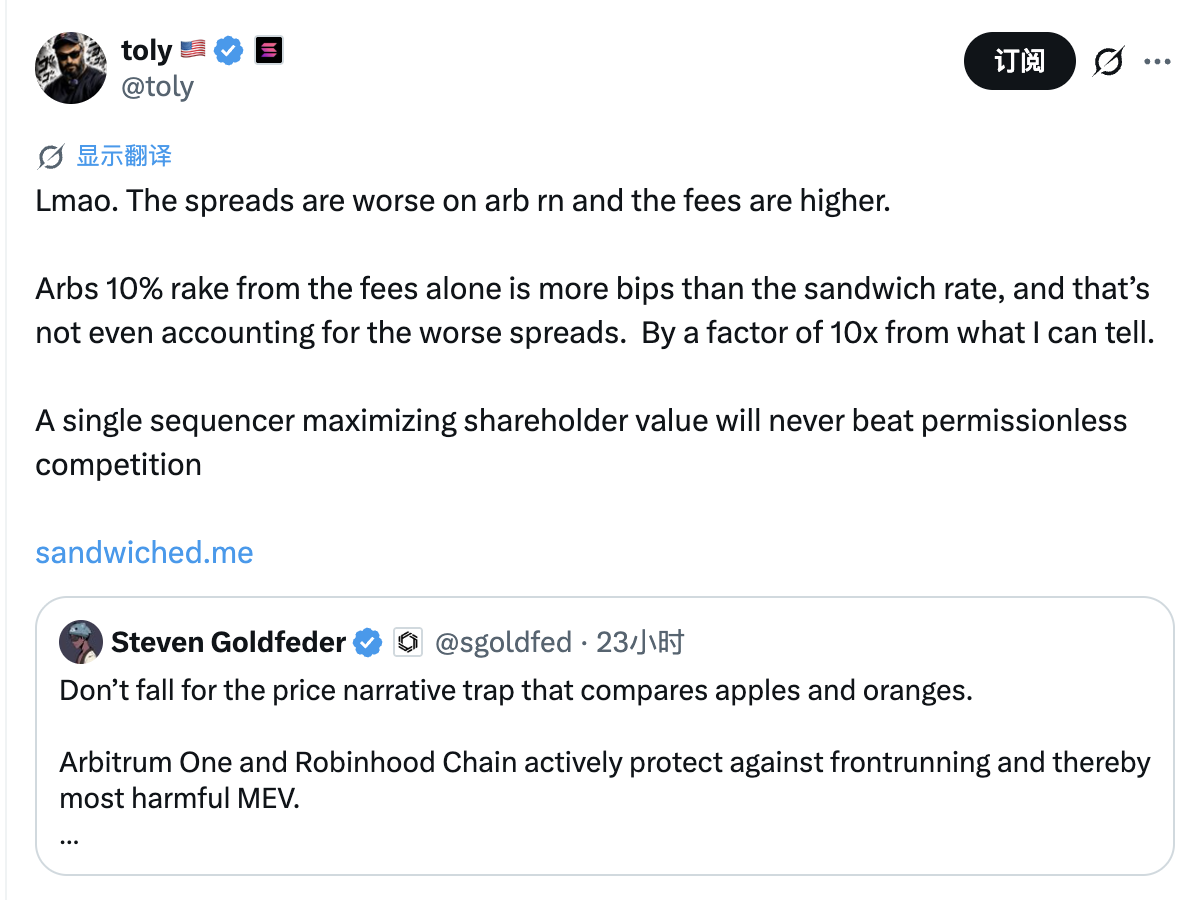
To this, Goldfeder believes that we cannot just compare the surface-level fees. Arbitrum One and Robinhood Chain actively prevent frontrunning and most harmful MEV, whereas chains that claim to have lower fees may actually incur higher MEV costs, including frontrunning against retail users. He stated that he would rather prepay certain explicit fees than incur hidden costs such as frontrunning or sandwich attacks for lower fees.
Steven also indicated that operating a chain itself is a profitable business, and Robinhood has proven that it does not need Solana's traffic and distribution capabilities. Of course, it similarly does not need the traffic and distribution capabilities of Ethereum or Arbitrum One; however, the combination of Arbitrum + Ethereum allows Robinhood to possess and operate its own chain. Therefore, in his view, the market can certainly continue to discuss what business model should be adopted and how fees should be priced for operating a chain. But the core issue is that Robinhood does not need to rely on other public chains, so there is no reason to share the revenue it creates with other public chains.
It can be seen that the core of the argument between the two founders is not merely the cost of a single transaction, but rather two distinctly different public chain value capture models. The model represented by Toly aims to have public chains act as low-cost backend infrastructures, charging users directly from the application layer for commercial monetization; while the model emphasized by Goldfeder seeks to enable applications to control the sequencer and fee pricing power through building their own chains, keeping more revenue from on-chain economic activities within their own ecosystem.
In fact, from a technical perspective, the Gas fees of L2 are mainly composed of L1 data availability (DA) fees and L2 execution fees. Among these, DA fees have significantly decreased in recent years, while L2 execution fees are primarily determined by their respective sequencers. This means that L2 has greater freedom to price fees, allowing them to adjust execution fees according to their business models, or even lower user costs through subsidies or by setting fixed low prices. In other words, the level of fees on Robinhood Chain is an active choice made as part of its business model.
However, with the end of gas subsidies for Robinhood Wallet users on September 29, as well as the gradual withdrawal of CEX gas exemptions and subsidies in the future, users will begin to bear the real transaction costs more. At that point, whether Robinhood Chain can maintain its current trading activity and ecological prosperity under higher actual transaction costs will also serve as a stress test to evaluate the sustainability of its high-fee model.
免责声明:本文章仅代表作者个人观点,不代表本平台的立场和观点。本文章仅供信息分享,不构成对任何人的任何投资建议。用户与作者之间的任何争议,与本平台无关。如网页中刊载的文章或图片涉及侵权,请提供相关的权利证明和身份证明发送邮件到support@aicoin.com,本平台相关工作人员将会进行核查。


