Written by: Rita
The demand for network bandwidth in AI data centers is driving the optical module market into a period of simultaneous volume and price increases.
In September, Goldman Sachs released a global optical module industry report, raising the forecast for the global optical module market value for 2026 to 2028 to 68 billion, 131 billion, and 148 billion dollars, which is an increase of 33%, 81%, and 115%, respectively, compared to previous forecasts. The market for high-speed optical modules of 800G and above is expected to have a compound annual growth rate of 69%. Goldman Sachs believes that the expansion of rack-level AI servers and ASIC servers, the increase in the use of optical modules per GPU, and the continued transition of specifications to 1.6T and 3.2T are the core factors driving this round of upward revision.
Rack-level AI Servers Drive the Release of High-speed Optical Modules
AI servers are evolving from single-card to rack-level, which is a structural support for the significant upward revision of optical module demand.
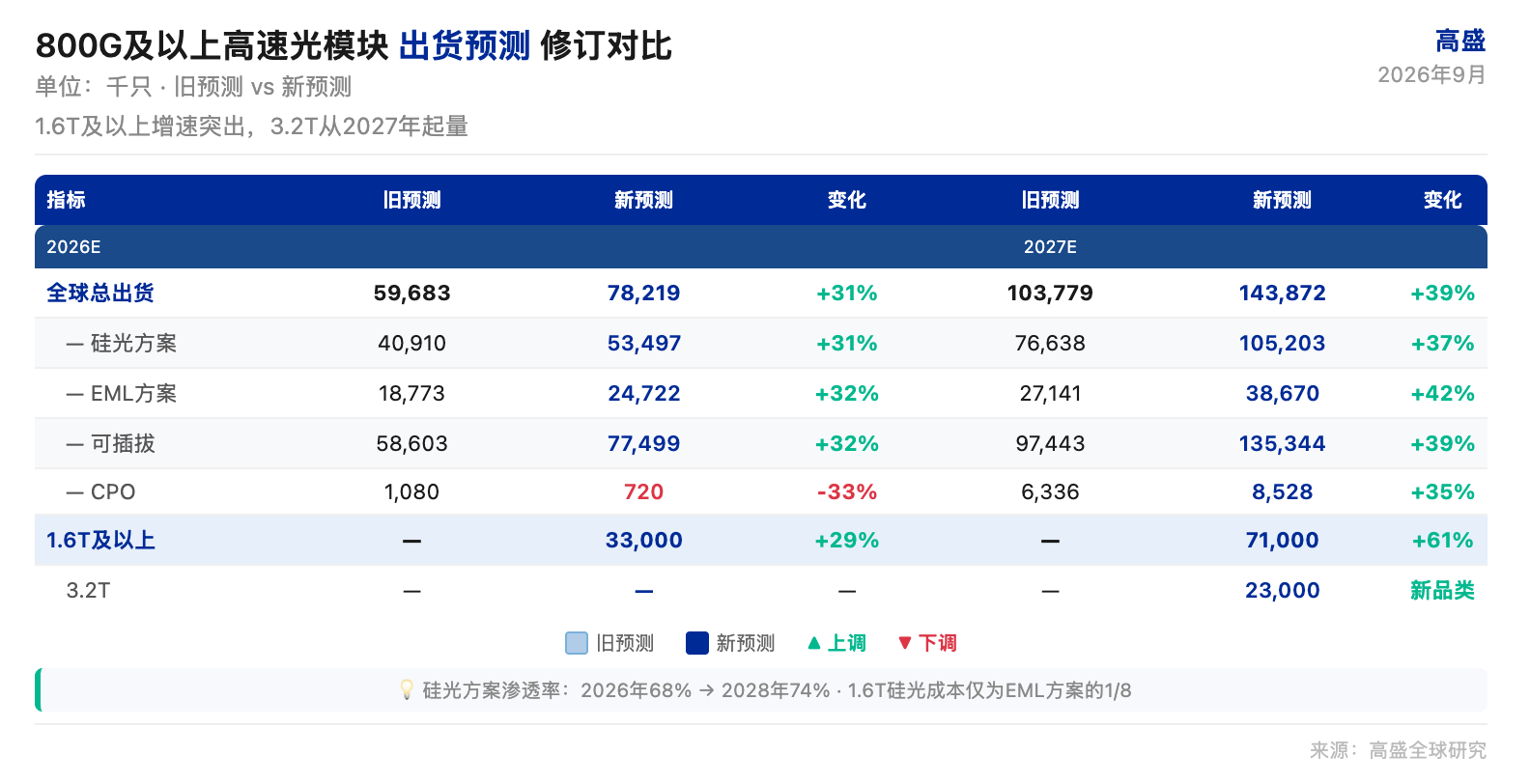
Goldman Sachs has raised the shipment forecasts for 800G and above optical modules for 2026 to 2028 from 59.7 million, 104 million, and 126 million units to 78.2 million, 144 million, and 171 million units, representing increases of 31%, 39%, and 36%, respectively. The growth rate for products of 1.6T and above is particularly prominent, with estimated growth from 2026 to 2028 of 29%, 61%, and 50% respectively.
Specifically, the shipment volumes for 800G and 1.6T in 2026 are expected to be 45 million and 33 million units respectively; by 2027, they are expected to increase to 49 million and 71 million units respectively; and 3.2T is expected to grow from 23 million units in 2027 to 68 million units in 2028. The rapid penetration of 3.2T is the most noteworthy structural change in this forecast, with 3.2T accounting for 40% of the shipment volume of high-speed optical modules by 2028, whereas this proportion was nearly zero in 2026.
The expansion of rack-level AI servers is the core driving force. Goldman Sachs expects Nvidia's rack-level AI server shipments for 2026 to 2028 to be 50,000, 92,000, and 148,000 racks respectively, while AMD's will be 5,000, 13,000, and 15,000 racks respectively. Higher density rack architectures mean more GPU interconnect needs, which will further drive a multiple increase in the per rack optical module usage.
The expansion of ASIC servers is also important. Goldman Sachs expects ASIC chips to account for 50%, 52%, and 55% of the total AI chip volume from 2026 to 2028. Unlike GPU servers, which typically configure 2 to 3 optical modules per GPU, ASIC servers, due to their relatively lower single-chip computing power, rely more on network interconnection to share the workload, resulting in even higher optical module usage.
Silicon Photonics Solutions Have Significant Cost Advantages, with Increasing Penetration Above 1.6T
Silicon photonics solutions are becoming the mainstream technology route for high-speed optical modules, driven primarily by cost.
Goldman Sachs calculates that a 1.6T silicon photonics optical module uses 4 pieces of 70mW CW lasers, costing about 15 to 20 dollars per laser; the 1.6T EML solution uses 8 pieces of 200G EML, costing about 160 dollars per laser. Just in terms of lasers, the cost advantage of silicon photonics solutions is nearly an order of magnitude.
Goldman Sachs predicts that the penetration of silicon photonics solutions in 800G and above optical modules will rise from 68% in 2026 to 74% in 2028. In higher-speed products such as 1.6T and 3.2T, the proportion of silicon photonics is even higher, estimated at 60%, 80%, and 80% from 2026 to 2028.
CPO (Co-Packaged Optics) is another emerging technology direction. Goldman Sachs expects the penetration of CPO in 800G and above optical modules to rise from 1% in 2026 to 9% in 2028. CPO is still in its early stages, and with the increased integration of switch chips and optical engines, a more noticeable increase in volume is expected between 2027 and 2028.
Beneficiaries in the Supply Chain
Goldman Sachs covers multiple links in the optical module supply chain in this report, all of which are rated as "Buy."
For optical module or optical engine manufacturers, New Ease Semiconductor and FOCI are recommended. For CW laser or epitaxial suppliers, LandMark and VPEC are recommended. For equipment, RoboTechnik is recommended.
The accelerated penetration of silicon photonics solutions means traditional EML laser suppliers face structural pressures, while CW laser suppliers and silicon photonics integration solution providers will benefit from the upgrade in product structure. The long-term trend of CPO opens up new incremental space for optical engine and packaging equipment suppliers.
The optical module market is undergoing a transition from "quantity-driven" to "specification-driven." Shipment volume growth is slowing while unit value is increasing. The unit price of 1.6T and 3.2T products is significantly higher than that of 800G, and the cost advantage of silicon photonics solutions is accelerating this upgrade process. As the selling price of each optical module jumps from hundreds of dollars to thousands of dollars, the expansion speed of the market scale will far exceed the growth rate of shipment volume.

Disclaimer
This article is a整理与解读 of a third-party brokerage research report (Goldman Sachs, September 7, 2026) by潮向研究, combined with整理 of public market information. The ratings, target prices, profit forecasts, and related judgments quoted in the text are the views of the analysts of the brokerage, representing only the position of their respective institutions and not the views of潮向研究, nor do they constitute any investment advice.
The market carries risks, and decisions must be independent. This article should not be used as a basis for buying or selling any securities.
免责声明:本文章仅代表作者个人观点,不代表本平台的立场和观点。本文章仅供信息分享,不构成对任何人的任何投资建议。用户与作者之间的任何争议,与本平台无关。如网页中刊载的文章或图片涉及侵权,请提供相关的权利证明和身份证明发送邮件到support@aicoin.com,本平台相关工作人员将会进行核查。


