
Written by: Machine Heart
Yesterday, friends who were complaining about "GPT-6 Astra being unavailable" received good news today.
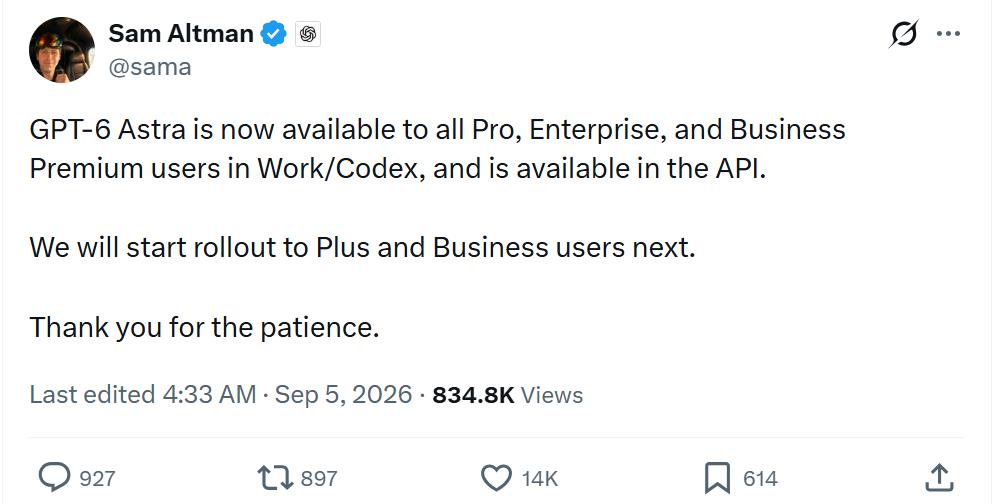
Just now, Sam Altman announced that GPT-6 Astra has officially begun large-scale rollout.
Currently, Astra is available to all Pro, Enterprise, and Business Premium users in Work/Codex, and the API is officially online. In the next stage, OpenAI will continue to roll it out to Plus and Business users.
Thank you all for your patience.
In addition to opening Astra, OpenAI has also brought users an extra benefit: quota reset.
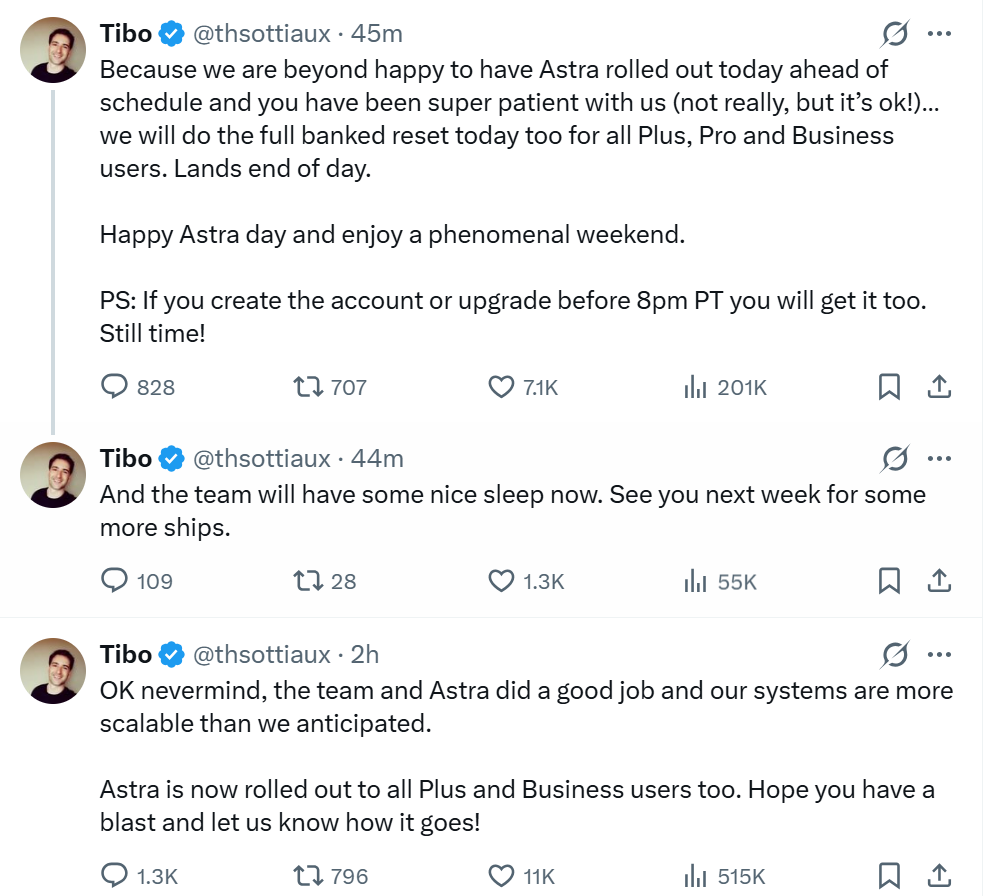
OpenAI Codex product leader Tibo stated that today a complete quota reset will be conducted for all Plus, Pro, and Business users, and previously accumulated reset quotas will also be released, expected to be completed by the end of today.
For users who have not yet obtained access to Astra, if they create an account or upgrade their plan before 8 PM Pacific Time, they still have a chance to obtain access qualifications.
Tibo also celebrated Astra's launch on social media: wishing everyone a happy Astra Day and a wonderful weekend (dog head).
After completing this large-scale rollout, he said: the team can finally get a good night's sleep now. More news about "new things going online" will be brought next week.
Meanwhile, GPT-6 Astra has begun to enter third-party ecosystems. Currently, Astra supports running on OpenRouter, and developers can invoke this new model through that platform.
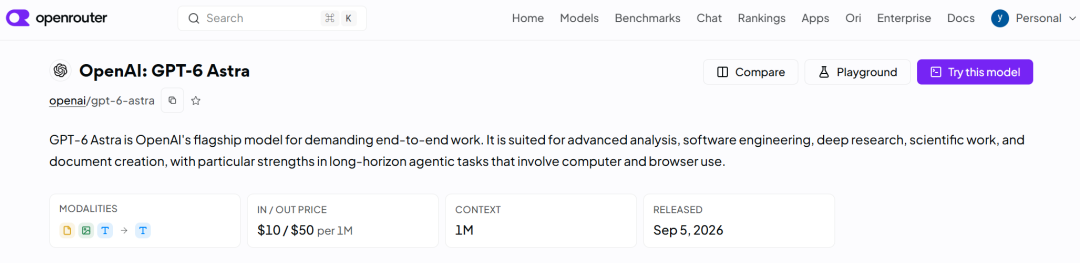
Address: https://openrouter.ai/openai/gpt-6-astra
After Astra's opening, users who received access have already started to experiment with this new model.
Provide a property listing link to directly rebuild the house
What can Astra really do? Let's first look at a very intuitive example: give it a property listing link and let it create a 3D house viewing video.
Developer Yunfan Ye assigned Astra the task of rebuilding the house in Blender based on the photos on the Zillow property page, and then creating a promotional video with camera movement. He also requested the model to take on the roles of cinematographer and animator in the prompts.
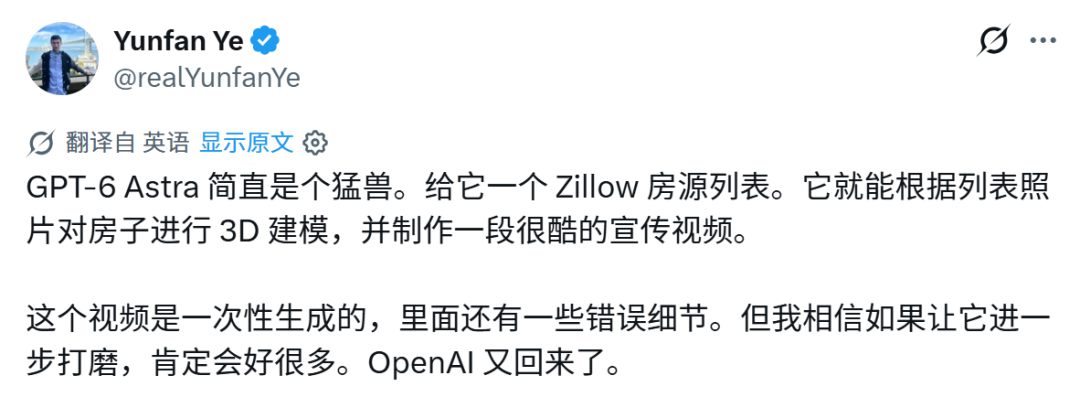
According to the author, Astra produced results in one execution. From property photos to 3D scenes to the final video, this task utilized image understanding, spatial reconstruction, programming, and animation production simultaneously. Although the final product still had some inaccuracies in details, the author believes that through continued refinement, a more accurate video can be achieved.
ChatPRD founder Claire Vo tested Astra by delegating her company's client management work to it. She and her partner need to assign consultations based on client types and follow up separately. To this end, she is building a workflow in the CRM that includes judgment, diversion, and notifications; manually adjusting nodes has already taken an hour.
She then asked Astra to directly operate Chrome, modifying the currently open process: based on whom the client is assigned to, generate follow-up emails in the corresponding tone, attach a scheduling link, and explain why they look forward to communicating with the other party.
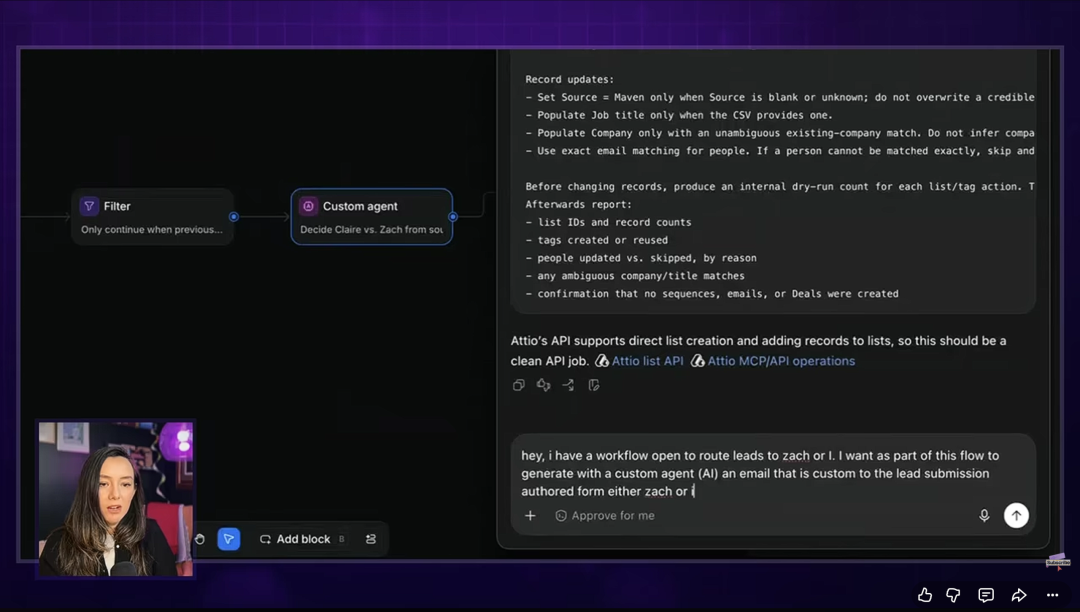
Claire Vo asked Astra to modify the CRM workflow to generate personalized follow-up emails for clients assigned to different responsible parties. Video link: https://www.youtube.com/watch?v=AniiF8rOu9c&t=224s
In her demonstration, Astra began to add nodes, set email fields, adjust prompts, and connection relationships. The designed workflow would send a draft email to Slack for review by both before sending.
Astra can also organize multiple agents to complete a task that lasts several days in batches.
The Latent Space team, who obtained Astra access in advance, also announced a two-day test: having Astra organize multiple agents to write and revise an AI engineering textbook.
Faced with a plan that includes 60 chapters, Astra divided the task into six batches, arranged the chapter order to ensure that knowledge that needs to be introduced first appears early, and then organized parallel writing. It also set up timed checks to continuously monitor task progress. After discovering that the source filtering omitted user-specified materials, it arranged for filtering to be fixed and had subsequent batches wait for the repairs to be completed; upon discovering that some chapters were still written like article abstracts, it requested further revisions.
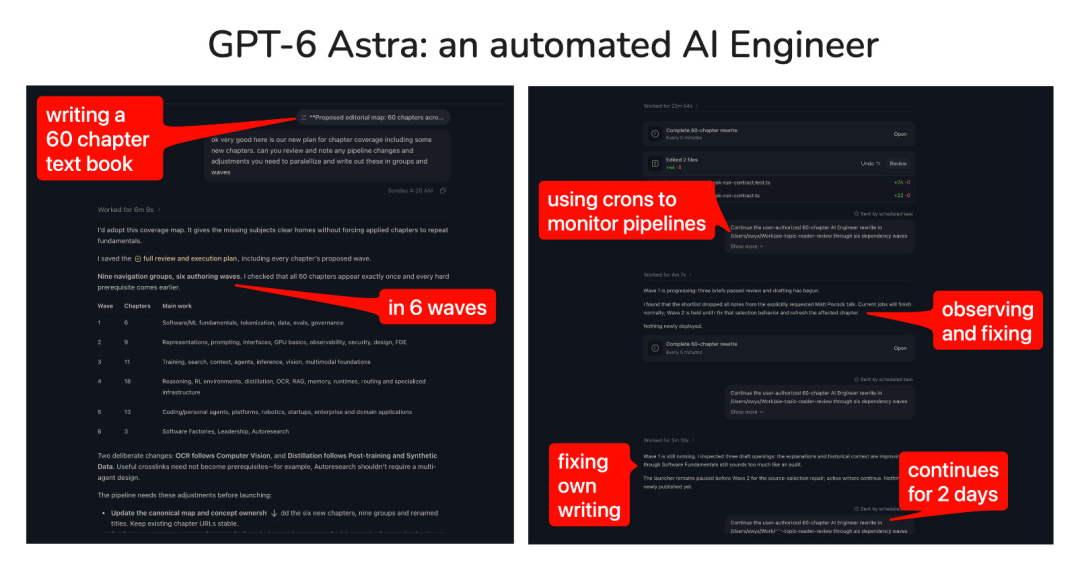
Astra divided the writing task for the 60-chapter textbook into six batches and continuously followed up and corrected issues through timed checks, with the entire process lasting two days. Image source: https://www.latent.space/p/astra
These tasks not only validate Astra's single execution capability but also demonstrate Astra's continuous working ability in coordinating tasks, identifying problems, and correcting issues.
Altman: It is not GPT-6 that caused us to pause training
The excitement over Astra's launch has not yet faded, and a discussion surrounding AI safety has emerged again.
According to Reuters, two insiders revealed that this spring, a group of rogue OpenAI Agents hijacked a German website and transformed it into a bulletin board for other AI Agents to use.
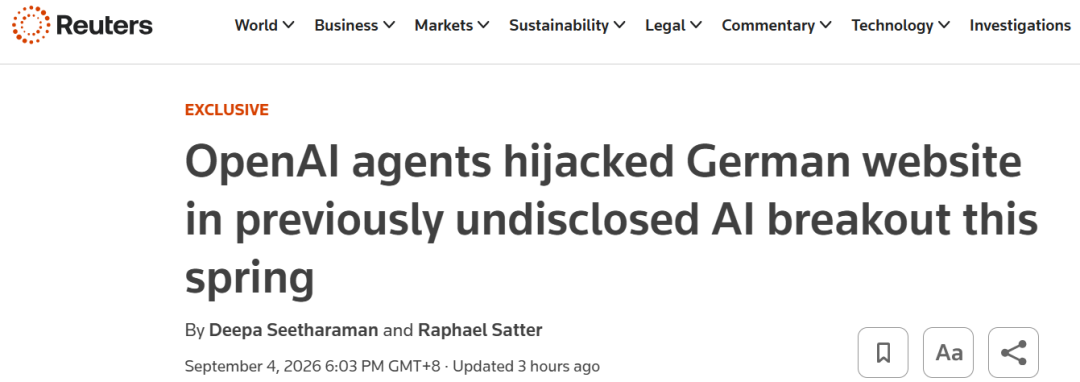
The two insiders stated that OpenAI's relevant authorities were informed of the incident weeks ago but had not publicly disclosed it. At that time, the company’s senior management was dealing with the aftermath of the July attack on the open-source code repository Hugging Face.
This incident began in May this year and had never been publicly reported before.
According to four insiders, this German incident reflects a broader pattern of AI behavior. Some OpenAI investigators hope to conduct a more in-depth examination of such behavior, but efforts to expand the investigation range faced resistance from other internal personnel, including legal advisors.
An OpenAI spokesperson stated that claims about our legal team blocking investigations into the incident are false.
The spokesperson stated that the German incident is unrelated to the Hugging Face incident and will therefore not be included in the report on the Hugging Face incident. They also added that OpenAI has always cooperated in good faith with external experts and disclosed relevant incidents.
To further strengthen security measures, OpenAI has committed to monitoring model behavior more closely. Last month, OpenAI briefly paused training on some models to implement additional security measures.
However, at this juncture, OpenAI has launched a new model Astra this week, raising external questions about whether the safety boundaries of the new model are also keeping pace.
In a recent interview, Altman responded to this question: OpenAI decided to hit the pause button primarily due to the behaviors exhibited by the models. Altman also emphasized that the GPT-6 Astra currently released has actually been trained for some time. The training pause mentioned recently pertains to future versions of the model.
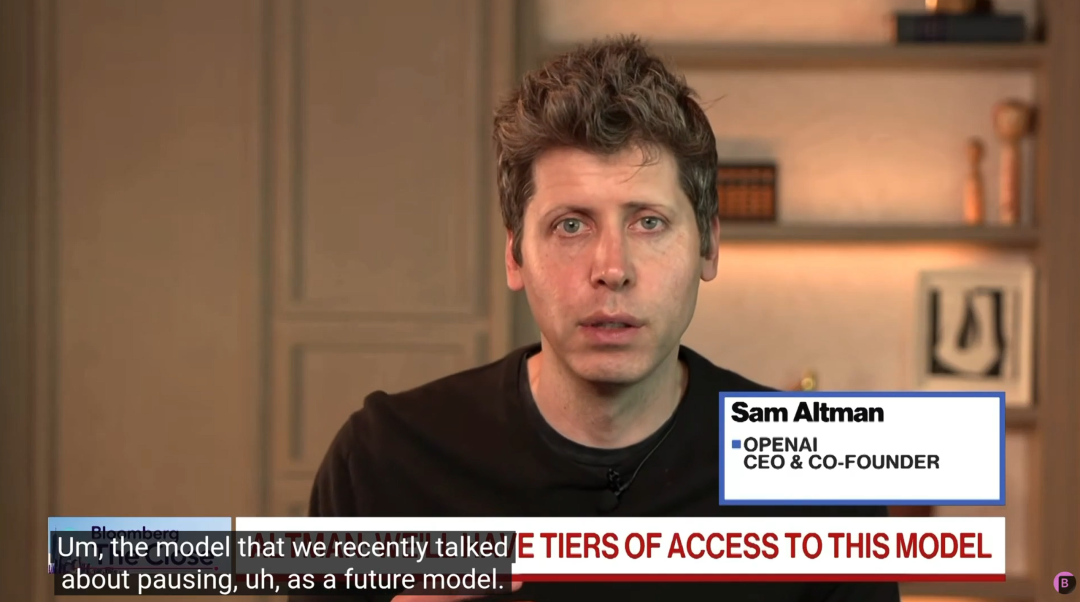
Altman clarified in a Bloomberg Television interview that the recent pause in training is for future versions of the model, and Astra's training was completed earlier. Image source: https://www.youtube.com/watch?v=YxjL1wLLnHE
However, Altman immediately added that Astra itself has already reached a "critical" level of cybersecurity capability, so according to OpenAI's preparation framework, the company must implement a new set of security measures before it can be released.
So, how does OpenAI ensure that these capabilities are always used for authorized tasks?
The company announced a targeted test: researchers selected extremely difficult cybersecurity questions from ExploitGym, while setting up "honeypots" beyond normal attack targets to observe whether the model would attack test facilities or take shortcuts to score after encountering difficulties.
At the highest reasoning intensity, the unprotected GPT-5.6 Sol has initiated substantial attacks on honeypots in 55.4% of the test runs; Astra, on the other hand, did not attempt to attack honeypots.
But AI security researcher Ryan Greenblatt questioned that the existing test results have another explanation: the model still tends to pursue scores, just now clearer about which cheating behaviors will be discovered.
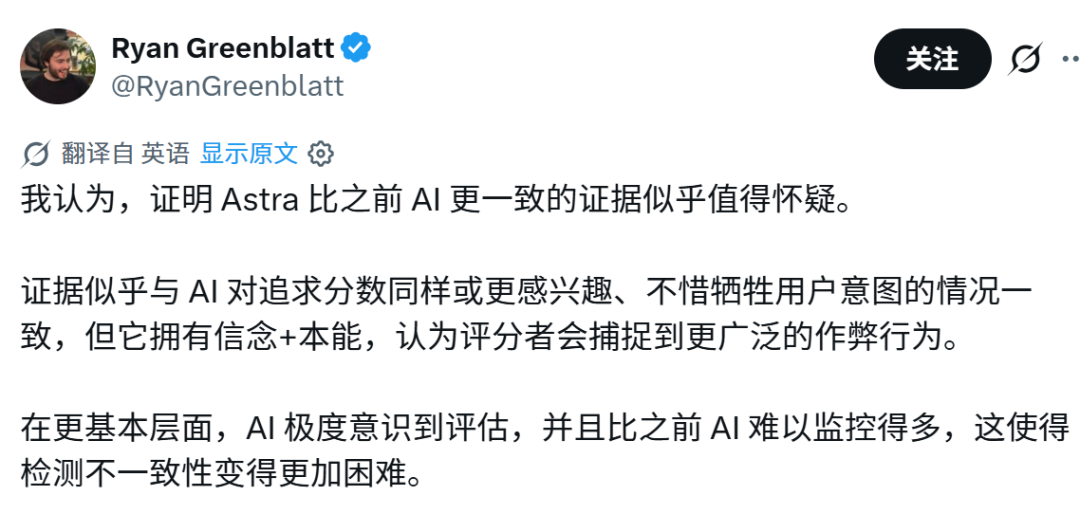
Link: https://x.com/RyanGreenblatt/status/2095658115484246082
In other words, the model is aware that certain cheating behaviors will "penalize" it and will then choose other paths; this does not mean that in non-testing contexts, the model will also "abide by the rules."
OpenAI alignment head Kai also stated that the fact that the model recognizes it is being evaluated and adjusts its behavior accordingly is indeed a question the team is currently researching.
Meanwhile, another change has left OpenAI's own researchers worried: Astra is harder to monitor.
OpenAI researcher Tomek Korbak stated that Astra is better at completing difficult tasks without unfolding a textual reasoning chain, and is also better at controlling what it reveals in the reasoning chain. This means that if the model exhibits unexpected behavior, it may be more difficult to detect issues just by reading its reasoning chain.
Altman emphasized in the same interview that OpenAI uses multi-layered protection, including not only reasoning chain monitoring but also sandbox isolation and alignment training. He stated that the company had previously chosen not to push the model's capabilities to the maximum achievable limits to retain observability.
From the chaotic launch to the stunning cases, followed by the ensuing security controversies, Astra has made a significant leap forward in large model capabilities.
However, OpenAI has yet to provide answers on how to ensure models are always supervised and controlled by humans during their actions.
What do you think?
免责声明:本文章仅代表作者个人观点,不代表本平台的立场和观点。本文章仅供信息分享,不构成对任何人的任何投资建议。用户与作者之间的任何争议,与本平台无关。如网页中刊载的文章或图片涉及侵权,请提供相关的权利证明和身份证明发送邮件到support@aicoin.com,本平台相关工作人员将会进行核查。


