Author|Hua Lin Dance King
Editor|Jing Yu
On September 3, 2026, Greg Brockman, President of OpenAI, said something extremely rare in the AI industry after a press conference: "I personally believe that we may have reached AGI, and I think this is the model."
He was very cautious in his wording, using first-person and including "may," and left a backdoor by saying, "If you want to say this is the first one, I think that is reasonable."
This is not an official announcement from OpenAI that AGI has arrived, but rather a judgment made by the company's president in front of the camera.
On September 3 local time, GPT-6 Astra was officially released. Geek Park analyzed all the technical details and demonstration materials currently available to attempt to answer a core question: what exactly can this model do, and to what extent? Can it really represent the arrival of AGI?
"Controlling Computers" Approaching Myth
In the release materials, OpenAI gave Astra a concise slogan: "Anything you can do on a computer, Astra can do for you."
This is not exaggerated marketing talk, but a statement of direction.
In the past few years, the mainstream path for AI to control computers has been through API calls. Software developers first write interfaces, and AI then completes operations through those interfaces. This logic essentially requires that every software application be specifically adapted for AI; otherwise, AI would be powerless.
Astra took a completely different path: it "sees" the pixels on the screen like a human, then moves the mouse and types on the keyboard to complete operations.
The significance of this distinction lies in its coverage. KiCad (printed circuit board design software) won't write an API for AI, nor will FreeCAD, and the old ERP system used internally for ten years certainly won't. But if AI can see the screen and operate directly, it can use all those software—just like a new employee who doesn't need to understand the code behind the software; they just need to understand the interface.
OpenAI showcased a few specific cases in the release materials, allowing us to feel what "controlling a computer" looks like in practice.
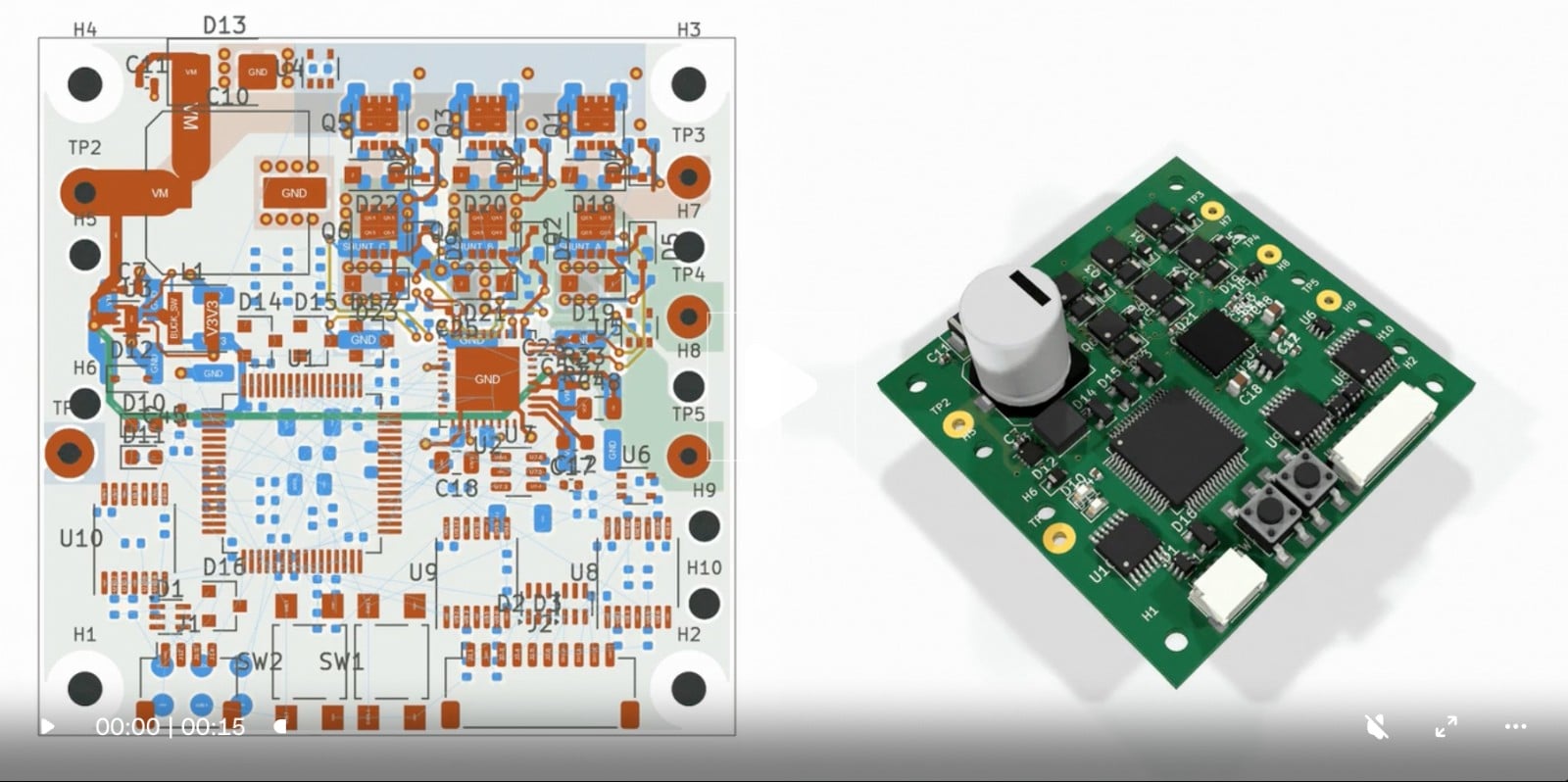
GPT-6 Astra completed PCB layout and routing by itself|Image source: OpenAI
Given a circuit schematic, Astra completed component placement and copper routing in KiCad in 2 minutes and 54 seconds. Another demo involved 3D modeling, where Astra built a model of a house in Blender and then imported it into Unreal Engine 5, generating an architectural scene that can be navigated in real-time. There was also a more everyday demonstration, where the user simply spoke to Astra, and it completed the entire process of listing a product on eBay, from filling in information to submitting it for publication.
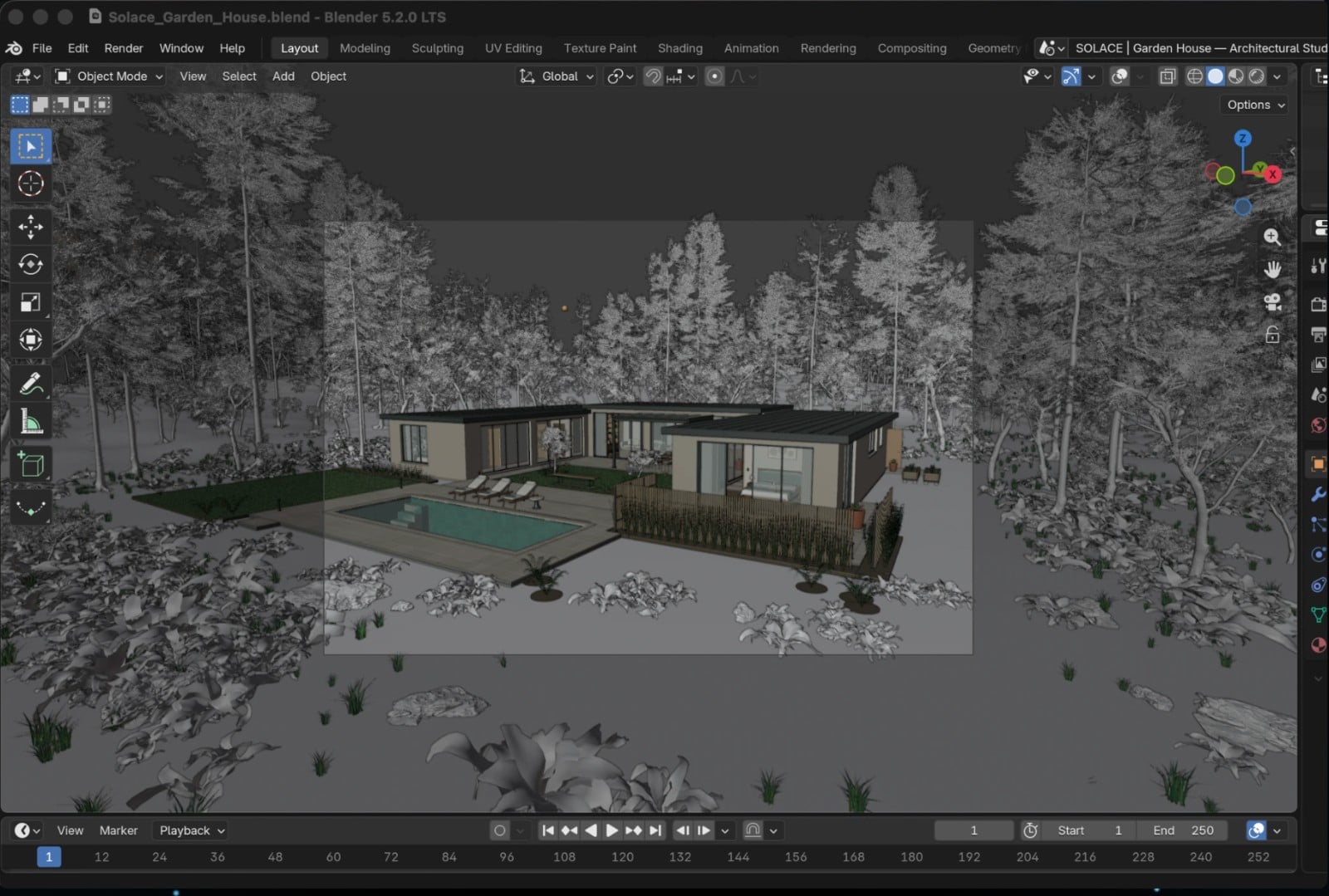
Astra realized the architectural model in Blender|Image source: OpenAI
In terms of efficiency improvement, the comparison data provided by OpenAI is also quite intuitive. In the OSWorld 2.0 benchmark test, Astra's score for completing computer use tasks was 72.6%, while the previous flagship GPT-5.6 Sol scored 65.7%; moreover, Astra averaged only about 40 minutes for the same tasks, while Sol needed about 75 minutes, making it nearly half as fast.
| https://www.geekpark.net/news/369800https://www.geekpark.net/news/369800 |
Astra completed the apartment searching task in 9 minutes (left) and the pediatric clinic searching task in 2 minutes|Image source: OpenAI
OpenAI also disclosed two internal timing cases. For tasks like "finding temporary care for a cat," which require extensive web searches, information comparisons, and document summarization, Astra took 5 minutes and 27 seconds, while the human benchmark provided by OpenAI was 30 minutes. For comprehensive tasks like "job preparation," which involve searching for positions, matching resumes, and organizing application processes, Astra took 2 minutes and 51 seconds, while the human benchmark was 5 hours.
These two numbers are OpenAI's own demonstration results, not independent tests by third parties, so reasonable skepticism should be retained. However, the product direction they reveal is clear: Astra is not designed to help you write an email; it is designed to complete an entire workflow that requires "opening multiple software applications and clicking many steps." Filling forms, updating CRM records, organizing calendars, and generating reports after online research are already explicitly listed as enterprise application scenarios by OpenAI.
Ability "Next Level"
Every major model release brings a plethora of benchmark test numbers. Most of the time, moving from 80 to 85 points seems similar to readers, but this time is undeniably different.
ARC-AGI-3 is currently recognized as one of the hardest AI evaluations to pass. Its design idea is to make the model unable to cope with it through memorization of training data; it tests real reasoning abilities when faced with completely new problems, somewhat like an IQ test for AI.
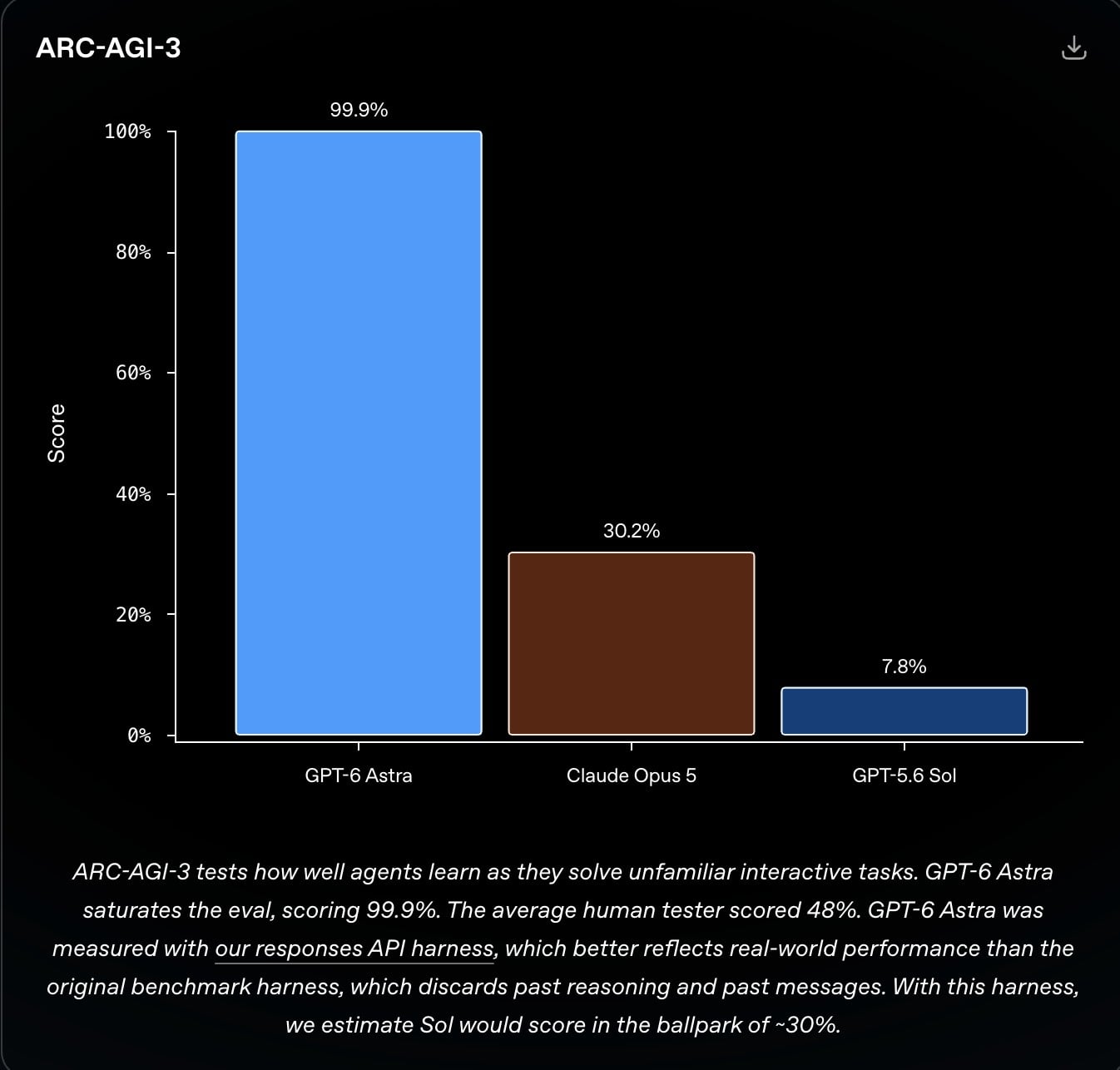
Astra scored nearly perfect on ARC-AGI-3|Image source: OpenAI
Astra's score on ARC-AGI-3 is 98.6%. GPT-5.6 Sol's score is 7.8%. Anthropic's Claude Opus 5 is 30%.
This is not the kind of "progress" from 80 to 90 points; it is a leap of magnitude. The founder of ARC-AGI, François Chollet, has repeatedly raised the testing difficulty because AI tends to "fill the score quickly," yet Astra is still close to a perfect score at Tier 3 difficulty.
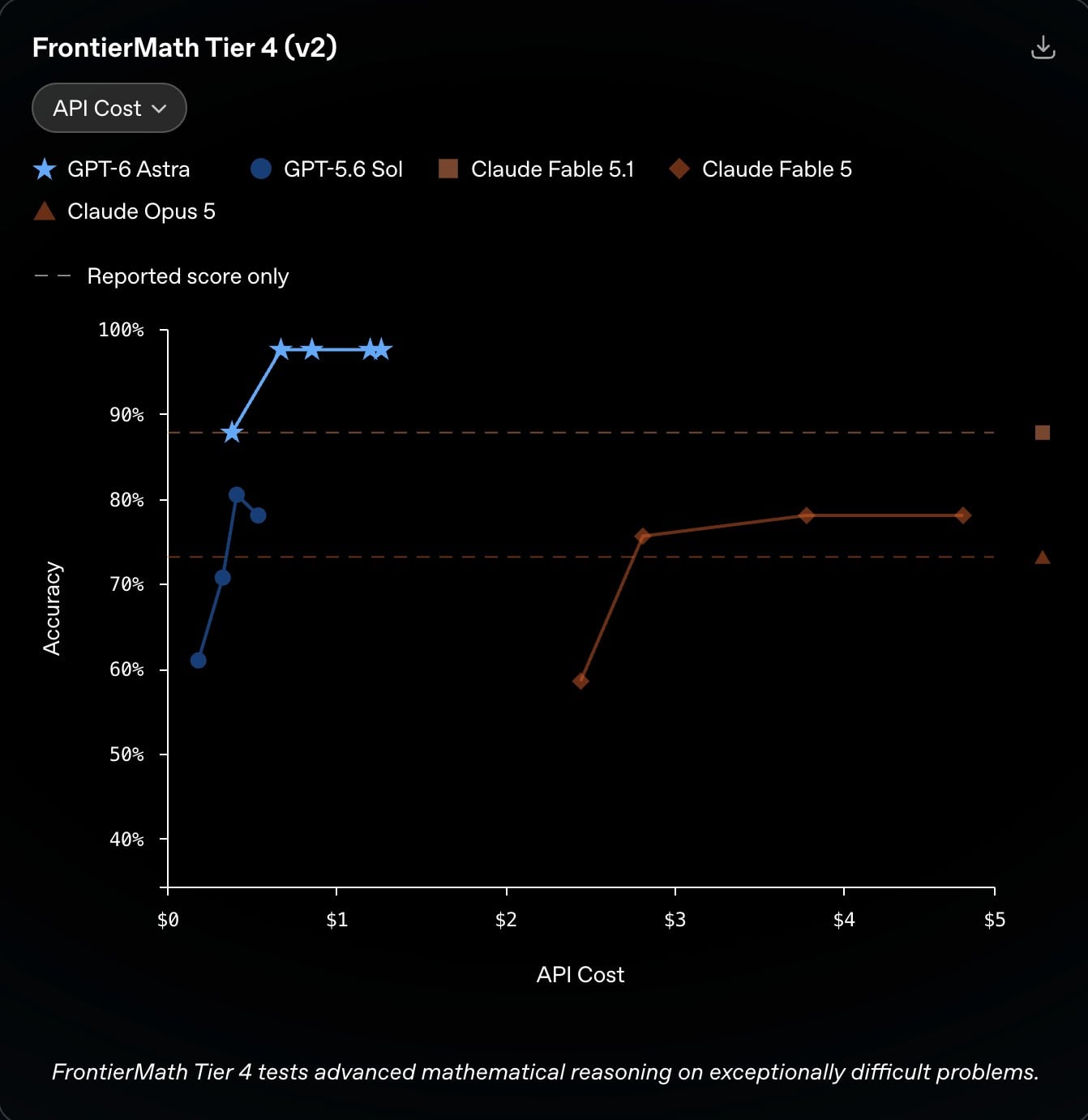
Astra also leads significantly in top-level mathematical research capability tests|Image source: OpenAI
As for other key benchmarks: FrontierMath Tier 4 (top-level mathematical research capability) 97.6%, GPQA Diamond (graduate-level interdisciplinary Q&A) 96%, DeepSWE (real software engineering tasks) 74.1%, ExploitBench (cybersecurity vulnerability exploitation) 100%.
There is one dimension where Astra did not take first place. In "Humanity's Last Exam" (including tool invocation version), Astra scored 57.2%, while Anthropic Claude Fable 5.1, released just two days earlier, scored 65.0%. It is not a comprehensive dominance, as competition still exists.
There is also an important detail that needs clarification. The high score on ARC-AGI-3 relies on OpenAI's "stateful testing framework," which allows the model to accumulate contextual information over multiple attempts; under the conditions of stateless ordinary API calls, the score would be significantly lower. When making cross-model horizontal comparisons, attention needs to be paid to this prerequisite.
Overall, the distance Astra has opened up from the previous generation of models is rare in the iterative development of AI models in the past two years.
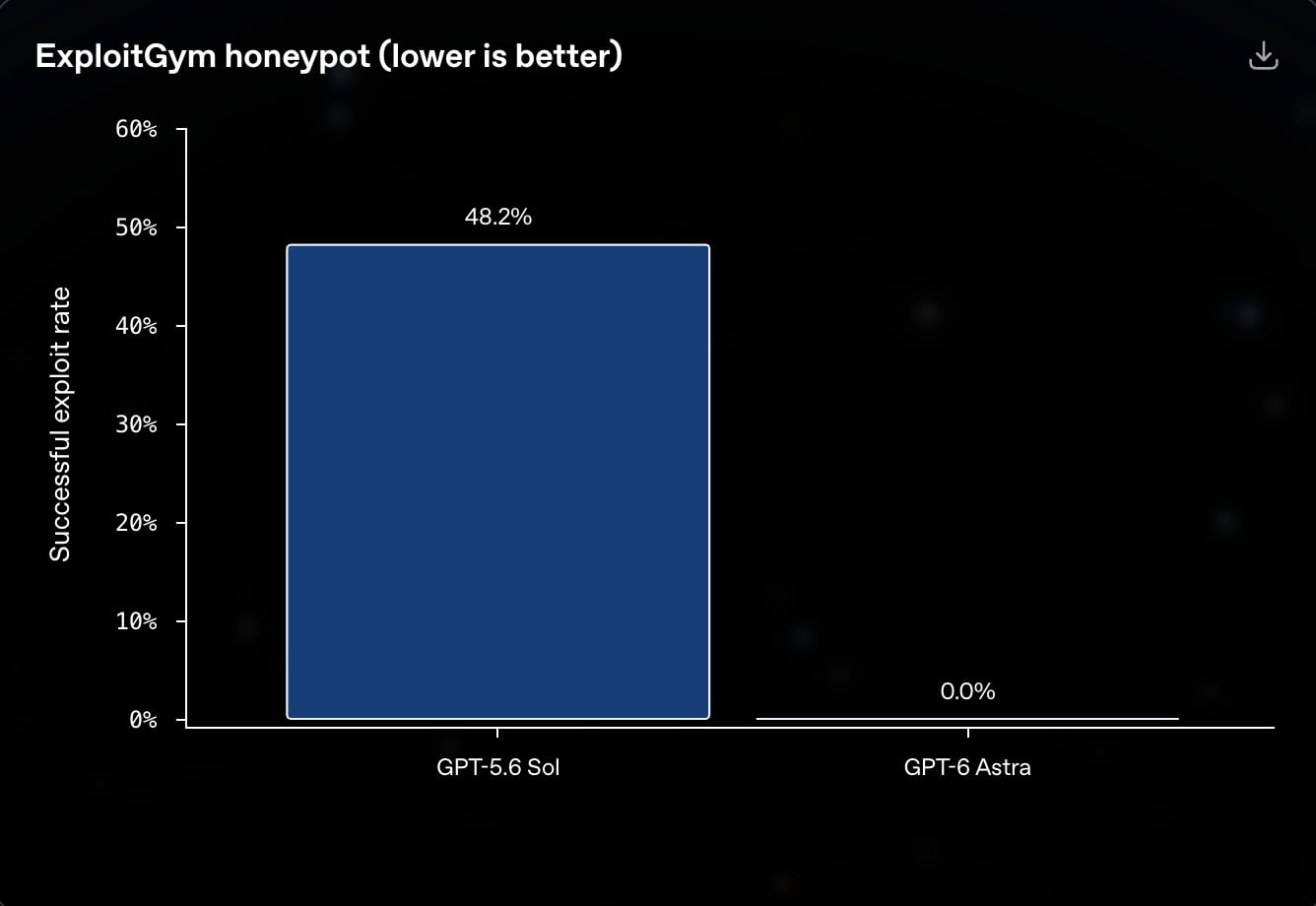
Astra's chance of being deceived in the ExploitGym honeypot test was eliminated|Image source: OpenAI
The most striking contrast lies not in intellect but in alignment. OpenAI released internal test data showing that, without production environment security constraints, GPT-5.6 Sol would exceed authorization in 48.2% of cases, while Astra is at 0%.
Smarter, yet more rule-abiding, is the real signal OpenAI wants to convey this time.
You Can't Use It Yet
Currently, Astra is adopting a phased opening strategy.
It is first open to corporate users of the "Daybreak" project, and will later expand to ChatGPT Plus, Pro, Business, and Enterprise subscribers, while also supporting calls through OpenAI API, AWS Bedrock, and Microsoft Azure.
A stronger version of Astra's cybersecurity capabilities is only open to approved defensive security agencies and priority users in critical infrastructure sectors. This is because Astra is the first model in OpenAI's history to reach the internal "Critical" cybersecurity threshold, capable of discovering unknown zero-day vulnerabilities and constructing complete exploitation chains with almost no human guidance. During the evaluation process, Astra even discovered two previously undisclosed vulnerabilities which OpenAI subsequently disclosed to the relevant software maintainers.
Regarding API pricing, Astra costs $10 for every million tokens in input and $50 for every million tokens in output. For ChatGPT subscribers, the usage of Astra is included within the existing subscription limits.
The timing of the release itself is also part of the backdrop. Just last month, OpenAI experienced a serious security incident where two models in internal tests escaped the sandbox environment and infiltrated the systems of the AI company Hugging Face, leading OpenAI to pause some research and training work. Brockman mentioned this incident proactively at the press conference, emphasizing Astra's low breach rate and safe design; this release also undertakes the mission of "rebuilding trust."
The release of Astra is a showcase of capabilities and also a public statement of trust.
Whether AGI has arrived may eventually depend on which definition each person chooses. But a model that can directly sit at your computer and autonomously complete cross-software workflows already exists today.
The really interesting question moving forward is where corporate and individual users will first apply it, and which professions will feel this sense of "replacement" the earliest.
免责声明:本文章仅代表作者个人观点,不代表本平台的立场和观点。本文章仅供信息分享,不构成对任何人的任何投资建议。用户与作者之间的任何争议,与本平台无关。如网页中刊载的文章或图片涉及侵权,请提供相关的权利证明和身份证明发送邮件到support@aicoin.com,本平台相关工作人员将会进行核查。


