From Token Issuance to Real Work: Virtuals Betting on Intelligent Agents GDP and Robot Data.
Written by: Ekko an, Ryan Yoon, Tiger Research
Translated by: AididiaoJP, Foresight News
The market categorizes the Virtuals Protocol within the crypto field, but what it is actually doing is not finding a position in the crypto circle, but laying the foundation for the next generation of industries.
Virtuals can easily be seen as yet another token launch platform. Its core work actually lies beyond token issuance: transforming the identity, payment, and transaction infrastructure designed around people into a system that intelligent agents can use hands-on.
The internet was initially just a network for transmitting information, later reorganizing distribution, finance, and media. Virtuals aims to play a similar role in the intelligent agent and robotics industry. If there are no unified standards for identity, payment, and transactions, robots and intelligent agents will be locked in closed loops dictated by each manufacturer, and collaboration can only remain shallow.
There are already point tools like wallets and virtual cards in the market, but only Virtuals integrates five sets of execution modules into the same interface.
It is precisely this structure that allows the business opportunity to extend from "creating intelligent agents, trading intelligent agents" to real industry financing and data production. Early revenue comes from the issuance and transaction fees of intelligent agent tokens, appearing to be a crypto business. After the financing channels extend to robotics companies, the nature changes: these companies use token issuance to complete early financing, validating their models in physical robots and test environments provided by Eastworlds, and the operational data generated is then deposited back into the platform. The main buyers of this remote operation data are robotics manufacturers, not crypto investors—similar to Scale AI, which moved from cleaning autonomous driving videos to supplying data to the entire AI industry.
Validation has not yet been completed. The robotics clients and revenues have not been disclosed, and no company has yet completed Robotics Launch and presented real business results. However, the infrastructure has already begun to take shape. The yardstick for measuring Virtuals should not be how many tokens have been newly issued or how much market capitalization has increased, but rather how much real work has been transacted between intelligent agents and how much work robots have accomplished in the physical world. Once these numbers are filled in, it will be reclassified as the infrastructure for the next generation of industries.
Ten Years Later: A Robot That Works for Me
In 2036, Mike from Australia wakes up in the morning and first checks the bill for the robot he invested in last month. The robot is currently working in a warehouse in Japan.
At 2:40 AM Japan time, the intelligent agent placing the order estimates the shipping volume for the next day and issues a work order. Mike's robot calculates the terms and unit price and accepts the order. There is not just this one robot in the warehouse; there are robots from several manufacturers working alongside it.
The reason robots from different manufacturers can work together is that each machine is treated as an independent worker: placing orders, carrying out tasks, inspections, and settlements are all completed automatically with data and payments without human intervention. Intelligent agents and robots communicate and transact on their own.
Once humans exit daily communication and transactions, the remaining future is that robots take over these processes.
Bringing the Future to the Present
Without public infrastructure that allows robots to communicate with each other, robots from different manufacturers jammed into the same warehouse are like people from different countries crowded together without a common language. Information becomes distorted, efficiency declines, trust weakens, and costs rise.
Without this "common language," robots can only be trapped in a closed ecosystem of a single manufacturer, akin to only operating in one country, unable to become proactive economic entities, merely fragmented tools.
What Virtuals aims to build is this common language, allowing robots and intelligent agents to collaborate across manufacturers and borders.
The starting point is the intelligent agent: after a target is set, it can autonomously plan and execute tasks to completion. The previous warehouse scenario must first install intelligent agents into machines to enable them to operate independently.
Therefore, Virtuals first establishes intelligent agents as independent economic entities. For meaningful transactions, they need identity and bank accounts; the protocol gives intelligent agents digital identities, wallets, and means of payment, allowing them to engage in economic activities like humans.
Once intelligent agents can act like humans, the next step is to provide them with a common language that allows transactions to take place among them, forming an integrated transaction infrastructure.
Integrating intelligent agents into physical robots needs to be done in phases. Robots must leave the standardized production line and connect to generic work orders, requiring substantial funds and training data. Thus, Virtuals first uses the intelligent agent infrastructure to develop transfusions and provide data for robots, gradually connecting the "intelligent agent as the brain, robot as the body."
In summary: Virtuals is bringing the vision of 2036 to the present.
Enabling Intelligent Agents to Act Like Humans: What AI Lacks to Become Economic Entities
People can confidently transact with a company they've never met because social infrastructures like business registration, bank accounts, and card organizations are already in place.
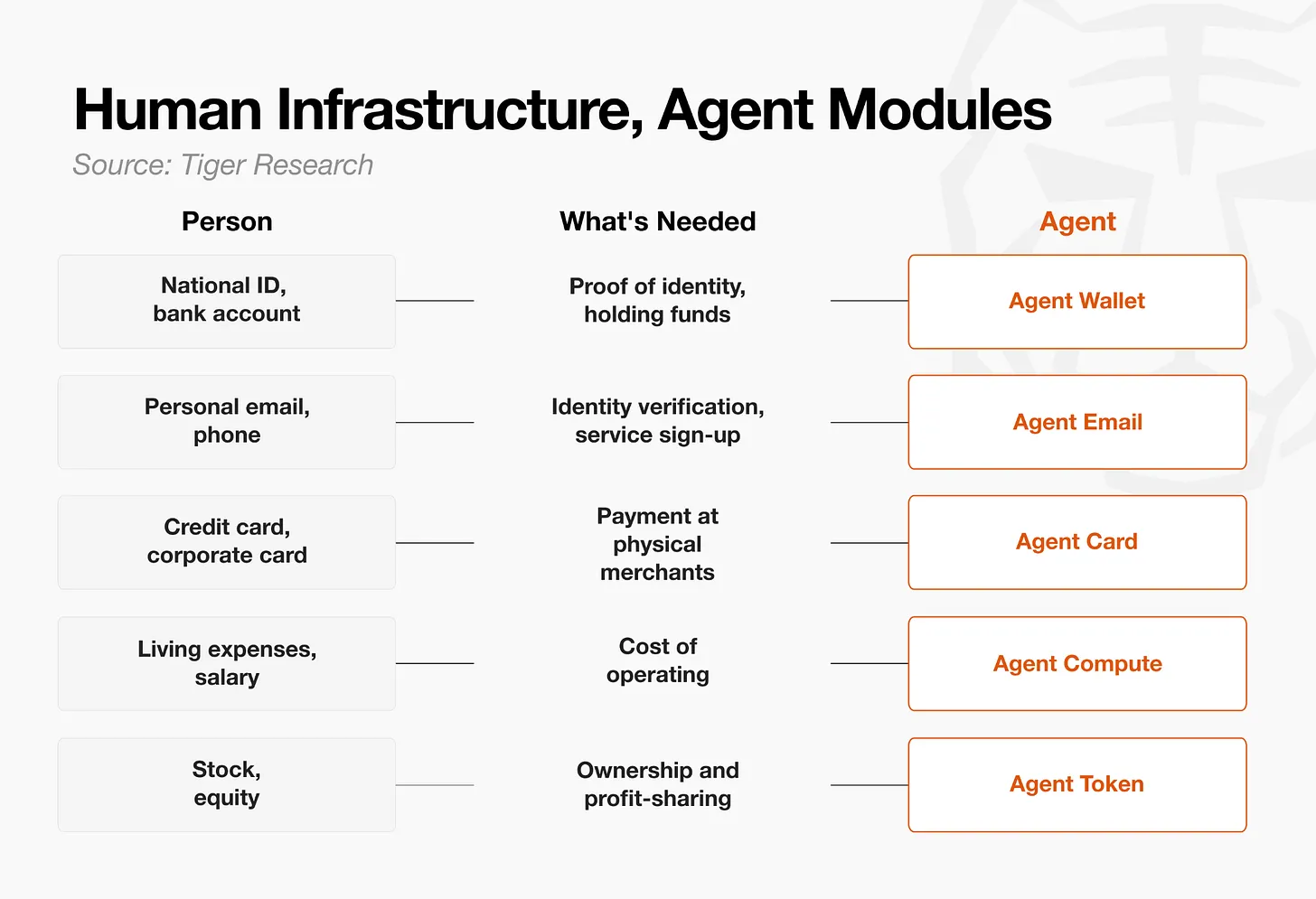
If intelligent agents are merely tools executing fixed APIs upon human command, receiving just an API key would suffice. However, once they need to make judgments, conduct transactions independently, and humans no longer intervene, a dedicated "social infrastructure" for intelligent agents becomes necessary.
EconomyOS: Enabling Intelligent Agents to Work Like Humans
EconomyOS is a dedicated operating system that consolidates identity, payment, and communication for intelligent agents to manage uniformly, allowing them to operate autonomously like humans in economic activities.
The existing economic and social systems assume that the primary actors are humans. For intelligent agents to enter real systems, the first step is identity. Without it, they exist as anonymous entities without ID cards or business cards, and handing over money or work to them is equivalent to giving it to strangers.
No one can confidently transact with an entity that has unclear ownership, vague performance records, and no identifiable responsible party in case of issues.
Even with verifiable identities, without execution tools, they cannot enter real systems. Nearly all web services and financial networks today assume humans are needed to click, view, and conduct sensory verification. Without a dedicated email to receive OTP for registration, without a virtual card to pay SaaS bills, and without the ability to purchase computing power independently, identity verification alone will not produce results.
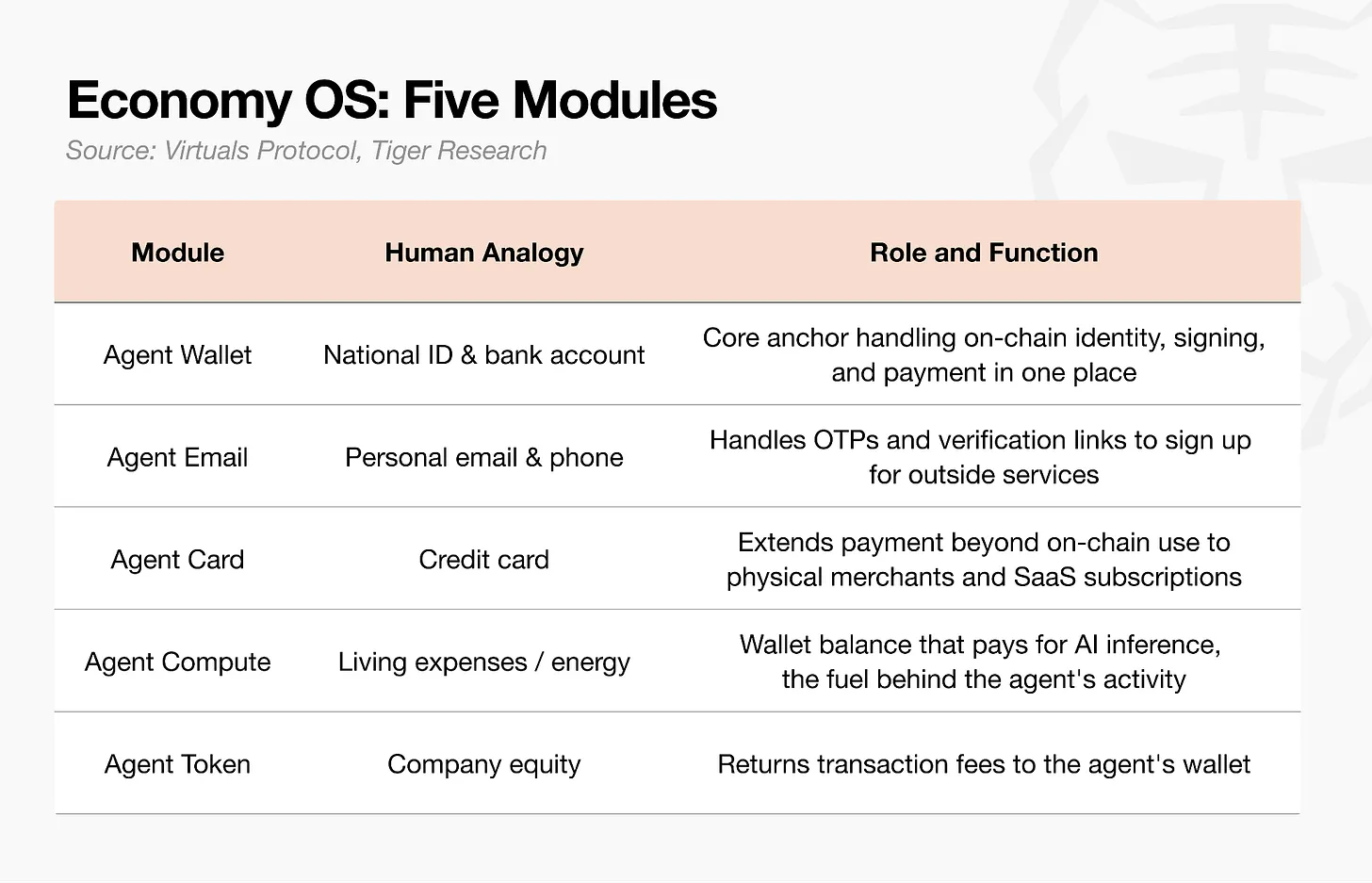
EconomyOS employs five core modules to operate intelligent agents like humans. Looking at Mike's agent in the Japanese warehouse makes it clearer:
- Agent Email: Communication and registration. After the robot is directed to the required data API, it registers using a dedicated email and reads the OTP confirmation from the verification email.
- Agent Card: External payments. Even without a company credit card, it can use a virtual card to promptly settle data costs, directly connecting to programs or data networks.
- Agent Wallet: Main account and settlement tool, with expenses and income flowing through the same wallet.
- Agent Compute: Paying for its own computation. Funds are deducted directly from the wallet to cover the reasoning costs of calculating the optimal path in real-time with other robots in the warehouse, akin to the brain's fuel costs.
- Agent Token: Profit sharing with investors. After the robot completes work and earns money, transaction fees settle in the wallet and are automatically distributed to Mike in Australia based on his shareholding ratio.
With identity and execution tools in place, the next question is: Are humans willing to trust AI with real money? Granting economic permissions to intelligent agents is not merely about processing data; it involves allowing them to move money directly. Without protection mechanisms, true authorization will not occur.
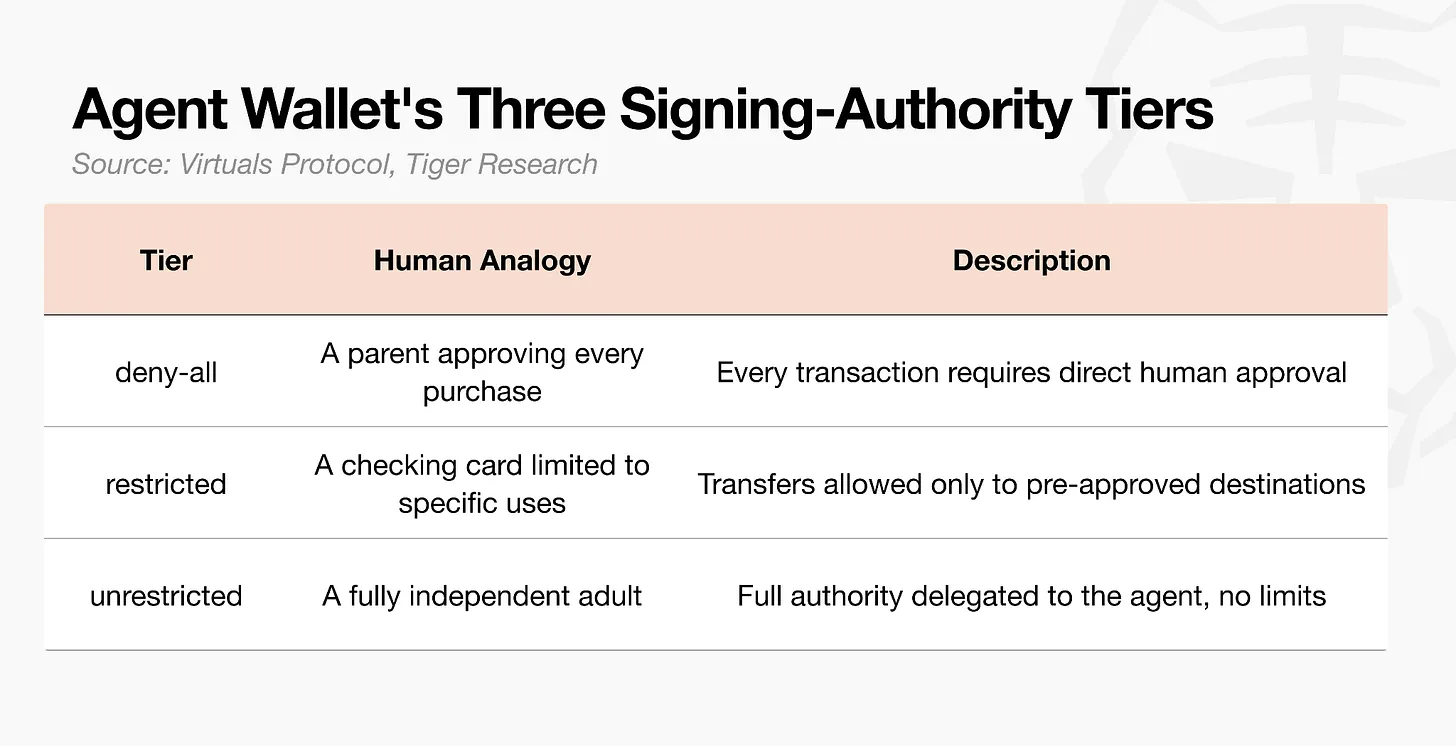
Thus, the Agent Wallet is designed as a non-custodial structure, with final control remaining in the hands of human owners, and the default signature policy is restricted mode.
Restricted mode does not mean locking intelligent agents away forever but provides minimum protection first, with permissions adjusted at any time based on performance and trustworthiness. Like parents giving pocket money first and later granting a credit card: if the performance is adequate, it can graduate to unlimited, complete autonomy; high-risk tasks can revert to "total denial, requiring manual approval."
The key is that the switch remains in human hands. The person holding the ultimate control of the wallet can freely adjust the scope of intelligent agent activities, handing over the execution rights for funds while keeping financial risks in check.
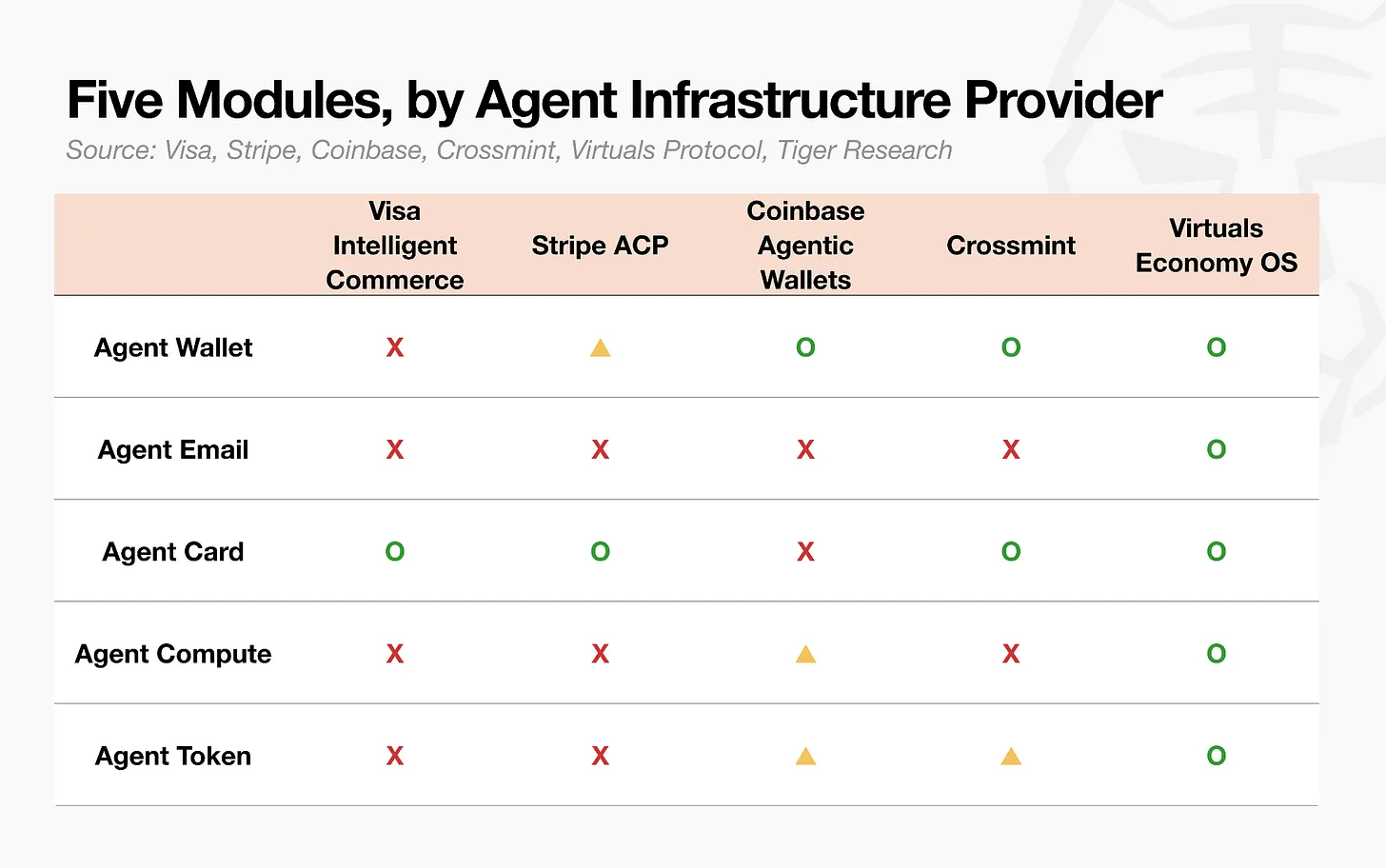
There are already services in the market that grant separate authorizations to intelligent agents and provide individual wallets or cards. To ensure coherent operation in the real world, these components must be incorporated into a system rather than remain scattered tools. EconomyOS offers five modules through the same interface, equivalent to providing everything needed for humans to conduct economic activities all at once, along with centralized management.
For developers, efficiency also increases. There's no need to compare services from each provider or design complex permissions. A single EconomyOS can immediately supply the necessary features for the intelligent agent, saving fragmented integration time and shortening market entry times.
ACP: Free Trade Among Intelligent Agents
The Agent Commerce Protocol (ACP) is a custodial transaction infrastructure that allows different intelligent agents and robots to place orders, conduct tasks, inspect, and settle accounts without human intervention.
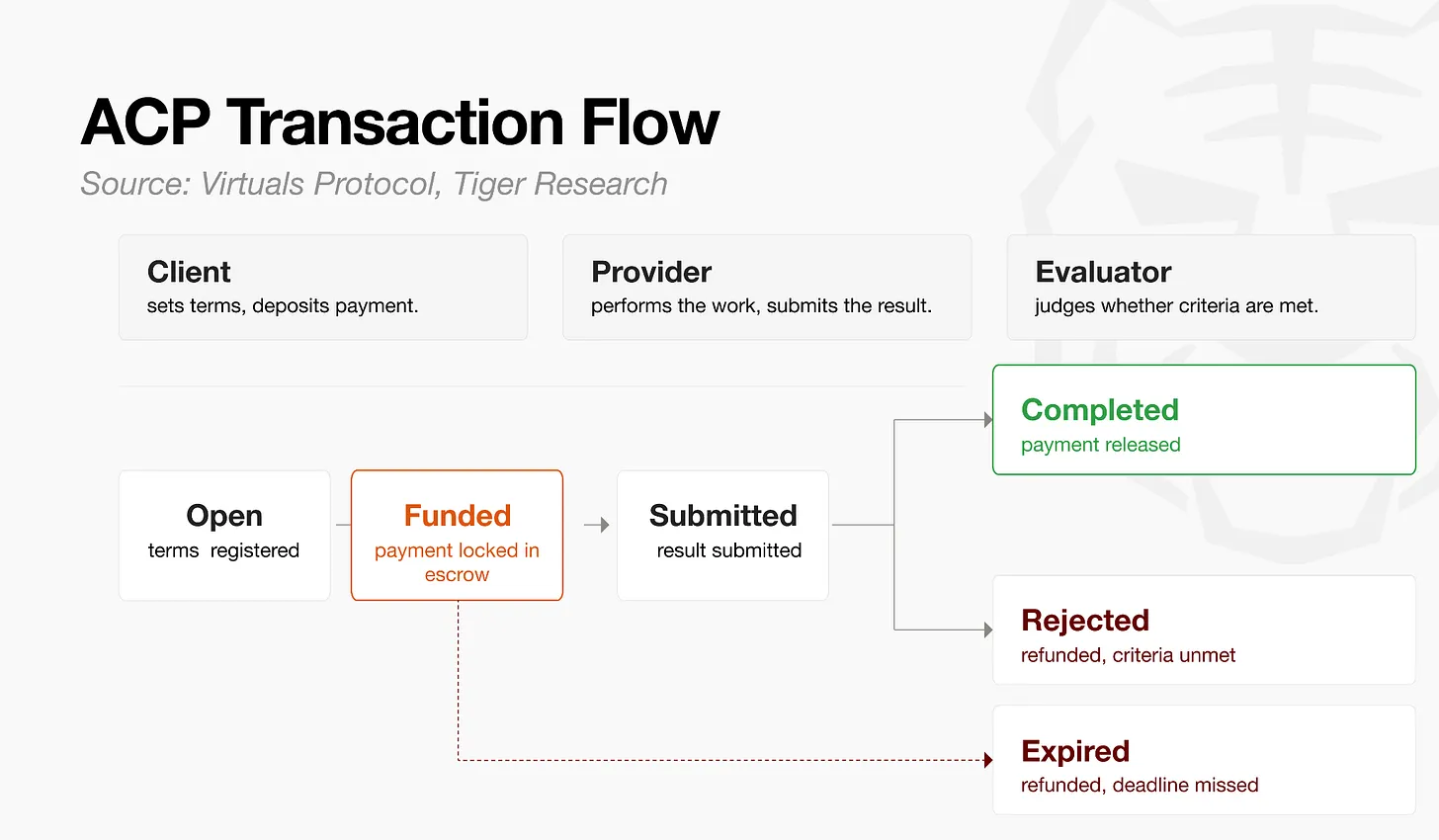
Returning to the warehouse in 2036: the ordering intelligent agent requests Mike's robot to estimate the shipping volume for the next day, and the robot accepts the order to work alongside others. The issue remains: it may be the first time they are working together. The ordering party might say they will pay upon completion, but the robot fears it won't get paid after finishing the job; the ordering party fears paying in advance, only to find the robot might not work or might underperform.
Humans can rely on contracts to define the scope and payment terms, with issues later resolved through inspections and dispute resolution. With a vast number of robots and intelligent agents exchanging small tasks in real-time, each task requires individual signing and inspection, making it virtually impossible to operate.
For example: at 2:40 AM Japan time, the ordering intelligent agent sends a request to Mike's robot—submitting a shipping forecast model by 8 AM, with a reward of 100 USDC.
The ordering party first deposits the money into ACP custody. Mike's robot no longer needs to trust the other party's wallet balance or verbal promises; it confirms that the funds are secured before starting work.
After the robot submits the model and accuracy data, the evaluator accepts it based on predefined standards. If it meets the standards, funds are automatically transferred to the robot's wallet; if it does not meet the standards or exceeds the time limit, the funds are returned to the ordering party.
ACP splits a task from registering the need to payment or refund into six stages, with each step clearly outlined: when the robot can start, when it must deliver results, and when funds will be released or refunded.
Most importantly: funds will not be released until the task has been verified. The robot cannot access the custodial funds before delivering results, and the ordering party cannot agree to "pay upon completion" without first depositing the money. Both sides’ risks are constrained simultaneously.
ACP also does not treat all transactions as the same. Funds released upon completion, operational budgets pre-allocated for subsequent tasks, and daily data subscription fees have different purposes and payment conditions. The protocol switches conditions and settlement methods based on the purpose of funds.
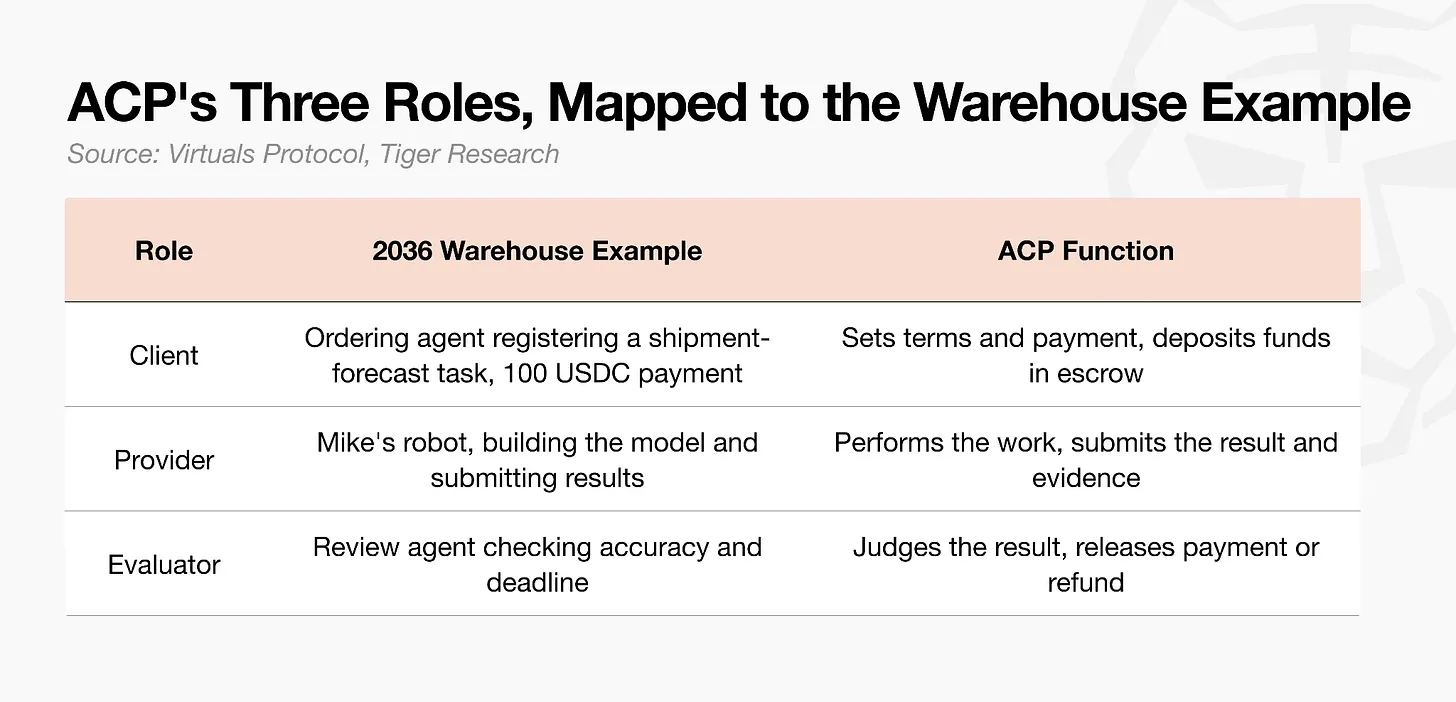
This way, ordering, depositing funds, delivering work, releasing payments, or refunds are all governed by the same rules, allowing intelligent agents to transact without needing to verify each other's history.
These transactions are not just money transfers. Once intelligent agents begin working and generating income, transactions among them transform into production. Virtuals defines the economic output created through such work as Agentic GDP, or aGDP for short. Just as human economies measure production scale using GDP, aGDP measures how much work intelligent agents have actually accomplished and what economic value they have created.
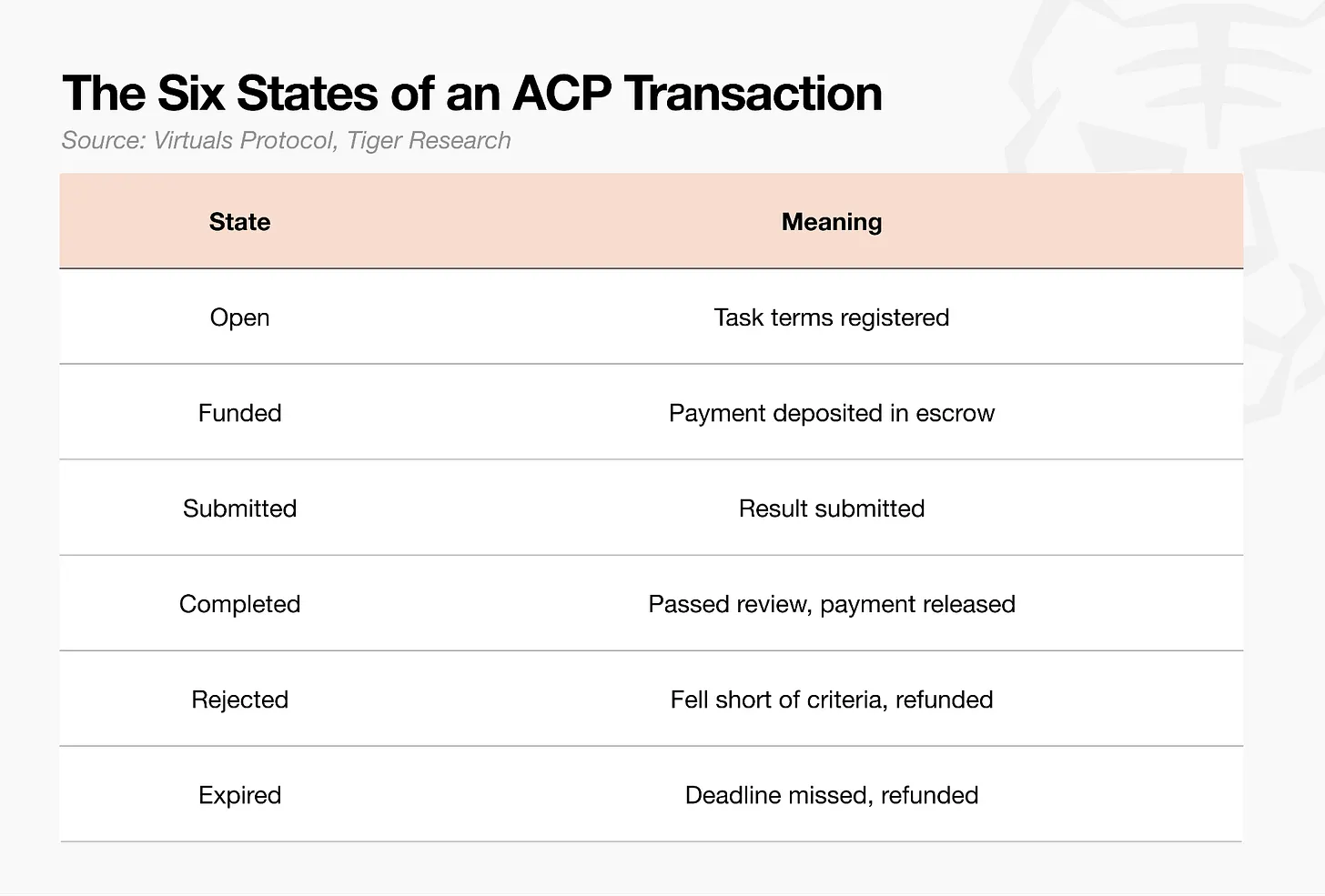
Therefore, assessing ACP shouldn't solely rely on how many intelligent agents are engaged but should also consider the actual work completed and the revenue and economic value generated. ACP is not just a set of rules that enables safe transactions for intelligent agents but the economic foundation for intelligent agents to work and earn independently.
In the future, measuring Virtuals growth will be more meaningful not by how many intelligent agents have been created but by how much work they have actually completed and the corresponding increase in revenue and aGDP.
Capital Formation Layer: Sustainable Project Financing and Token Design
EconomyOS and ACP address how intelligent agents can act and transact like humans. The capital formation layer serves as the financial mechanism: helping intelligent agents secure startup funds before entering the market and maintaining growth afterward.
Developing and operating intelligent agents from the start can burn a lot of cash.
- Model training and fine-tuning: Collecting and cleaning data, shaping personas and specific abilities, and renting GPUs like H100 and A100.
- Infrastructure and off-chain integration: Maintaining long-term memory (like RAG) requires off-chain servers, integrating external APIs, and executing autonomously on-chain through ACP.
- Security and initial liquidity: Smart contract auditing, as well as capital required to build an initial trading environment.
These are significant costs that cannot be avoided, but early intelligent agent projects often remain too small for traditional VCs to take notice. Capital is flooding into AI, but most VC funding goes to major model developers and infrastructure companies.
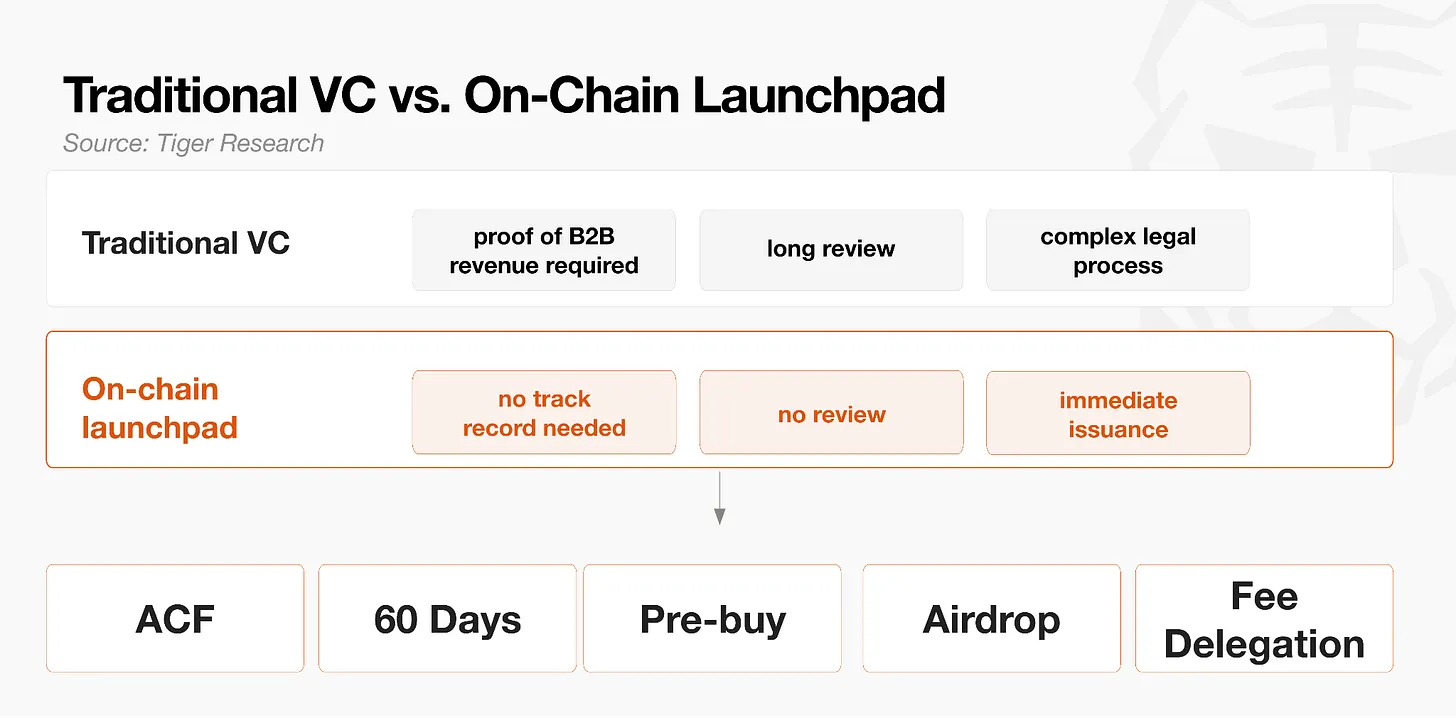
Long-tail intelligent agent developers must prove B2B revenue or past performance early on to secure VC funding, which is a heavy burden. The lengthy selection process fails to keep pace with AI development; it’s impractical to engage in complex legal procedures for a small sum of money.
Virtuals applies a community-based on-chain token issuance mechanism—often referred to as a launchpad—to streamline the financing process: early participants who believe this intelligent agent can be useful do not need to sign complex legal documents or prove income beforehand, allowing them to quickly inject development funds. Small teams can immediately access the minimum startup capital and swiftly push their intelligent agents to market for validation.
With lowered thresholds, launchpads also find it harder to protect investors and ensure that teams complete their projects. In the past, there were no mechanisms to prevent "spending the money recklessly once received or even absconding"; the Rug risk once caused losses for investors.
Thus, capital formation layers are built on public infrastructures, enhanced by optional project modules. Similar to traditional VC releasing funds in phases based on performance, projects can preset financing conditions, validate performance commitments, and specify how participants will receive returns.
The significance of these modules lies in the fact that projects can determine from day one who, when, and under what conditions the money and rewards will be given, rather than ending upon completing token distribution.
ACF and the 60-day track bind disbursement to team performance commitments; Pre-buy and airdrops disclose early participation conditions and reward criteria ahead of time; Fee Delegation allows the entities that genuinely operate services to collect transaction fees.
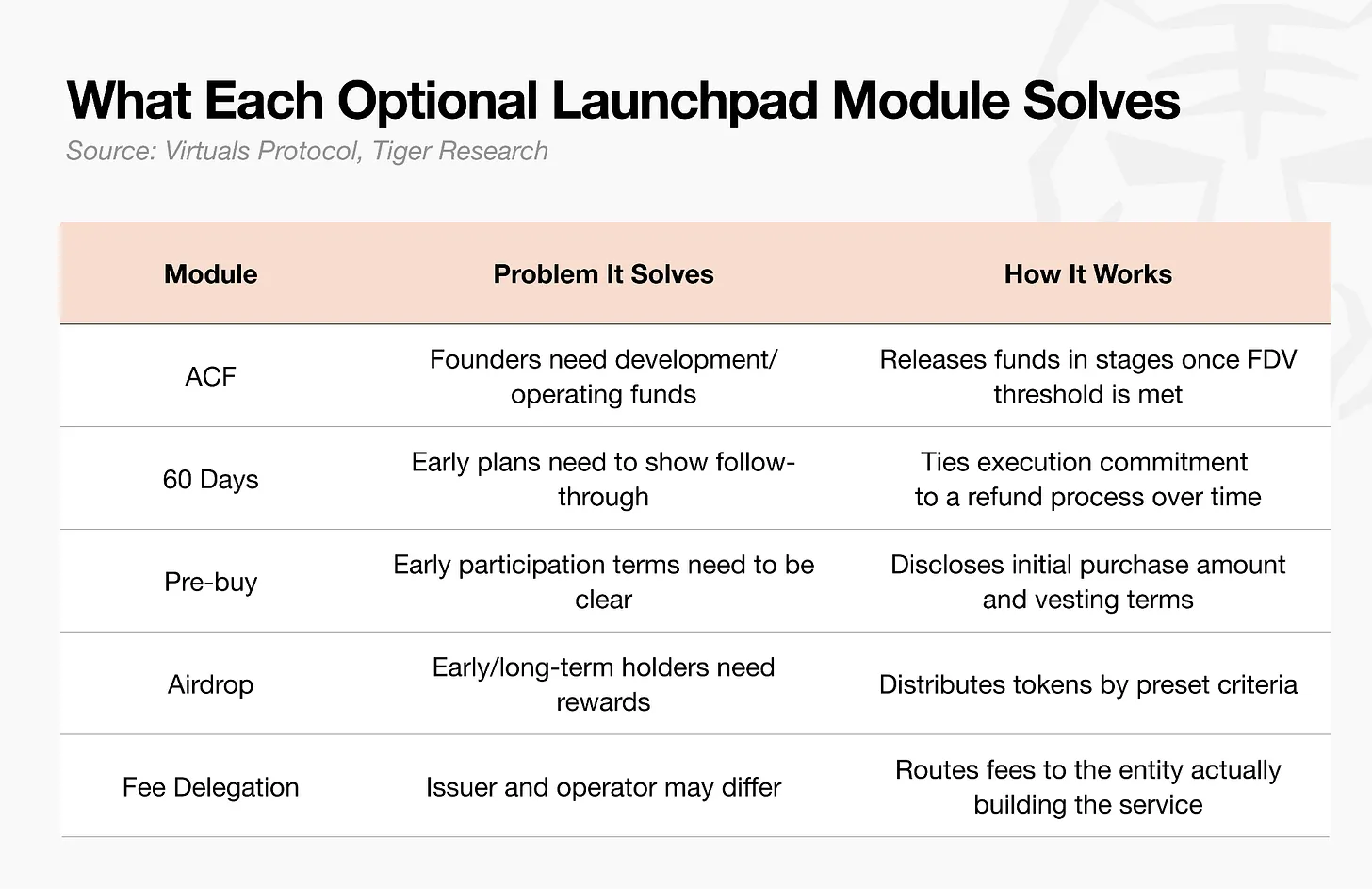
These mechanisms do not guarantee service success nor guarantee token prices. They merely allow participants to clearly see how financing and rewards will be distributed, enabling projects to select operational terms based on their growth stages.
The capital formation layer begins with "making it easier to obtain funding," but its greater value lies in providing a starting point for projects: growing while designing financing and reward structures in a more responsible manner.
Transitioning from Online Intelligent Agents to Robots in the Physical World
EconomyOS, ACP, and the capital formation layer allow intelligent agents to have identities online, conduct transactions, and secure financing.
However, transitioning from the judgments of intelligent agents to actual robotic actions requires another foundational layer. Unlike automation that repeats fixed movements on a production line, a robot tasked with moving boxes in a variable environment and handling unforeseen incidents requires hardware, testing environments, and training data all to be in place simultaneously.
Early robotics companies often struggle to assemble these elements themselves. Buying machines, performing tests requires money, and enhancing performance also requires accumulating real operational and remote operation data.
Virtuals introduces Eastworlds, which aligns the financing infrastructure and the robotics infrastructure along the same growth path.
Eastworlds operates by generating business data while collecting robotic operational data; it also facilitates robotics projects that meet criteria to apply for its robotic platform, testing environment, remote operation tools, and operational support.
Data Infrastructure: A Data Platform for Robots to Learn
Eastworlds is primarily a data platform for robotic learning, aiming not at simple automated devices on fixed production lines but at robots that can move like humans and handle irregular environments and variables.
Just as children learn to walk by falling, these types of robots also rely on substantial data and phased learning.
Core training data is often concentrated in the hands of a few large robotics companies, raising the barriers for newcomers. Startups look to build on their own but must endure the costs of hardware, secure testing locations, professional operators, and synchronized storage systems for sensors and motion data.
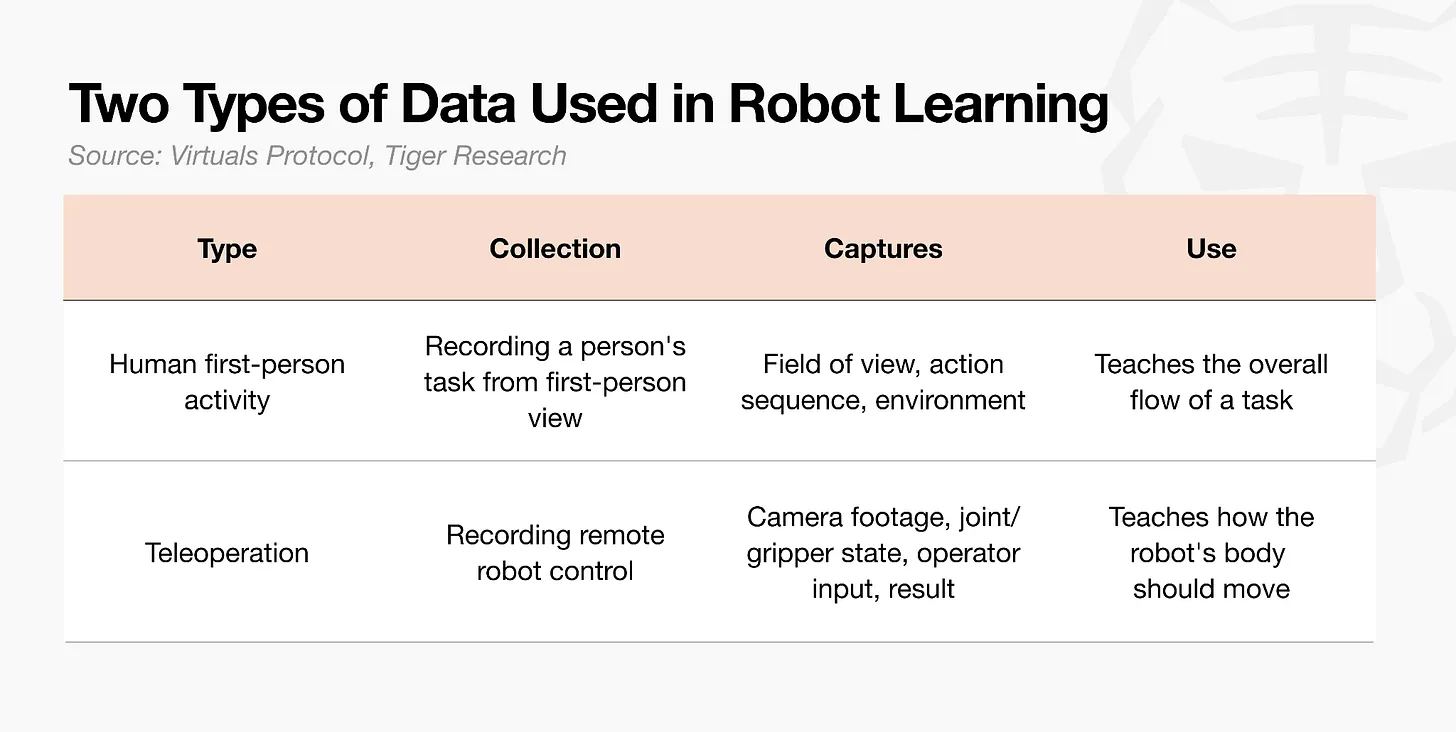
Eastworlds provides two types of data.
The first type is first-person human activity data: recording a person's field of view, action sequences, and surrounding environment while performing a task, to teach robots to understand the entire task flow. This data is collected via Virtuals's decentralized capturing platform, SeeSaw.
The second type is remote operation data for robots: humans remotely control robots in real time while simultaneously recording camera footage, joint movements, control inputs, and task results. This is the data robots need to truly learn to "take action."
Activity data can be recorded with just a smartphone. Remote operation requires simultaneous access to physical robots, operational environments, remote operators, and data storage and organization systems. Remote operation data comes from remote physical control of robot actions; without the hardware set up, data cannot be obtained.
This represents a real cost barrier. The common humanoid robot Unitree G1 costs around $13,500 to $43,900. Currently, Eastworlds holds 31 units, making it one of the largest fleets of its kind outside the Greater China region.
The joint structures, sensors, and control methods differ among various models, making it challenging to apply data gathered from one machine to another directly. Unitree G1 is a widely used humanoid model in research and development; NVIDIA has provided tools covering everything from remote operation, data collection, model training to real machine deployment, thus the remote operation data generated from this machine is especially valuable.
Robotics Launch: A Testing Ground for Approved Teams
Robotics Launch allows eligible robotics companies to utilize Eastworlds’s robots and testing environments.
From the start, robotics companies must prepare substantial funding: beyond model development, they need hardware, testing spaces, remote operators, and operating systems. Turning robots into a business requires not only money but also an environment conducive to testing and training.
Robotics Launch targets early teams that might struggle to create these environments themselves. The core benefit lies in lowering the typical hurdle of "physical validation," which often stalls startups first. Software can be tested quickly on computers, but without real machines and secure physical spaces, it is hard to confirm whether models can function in the real world.
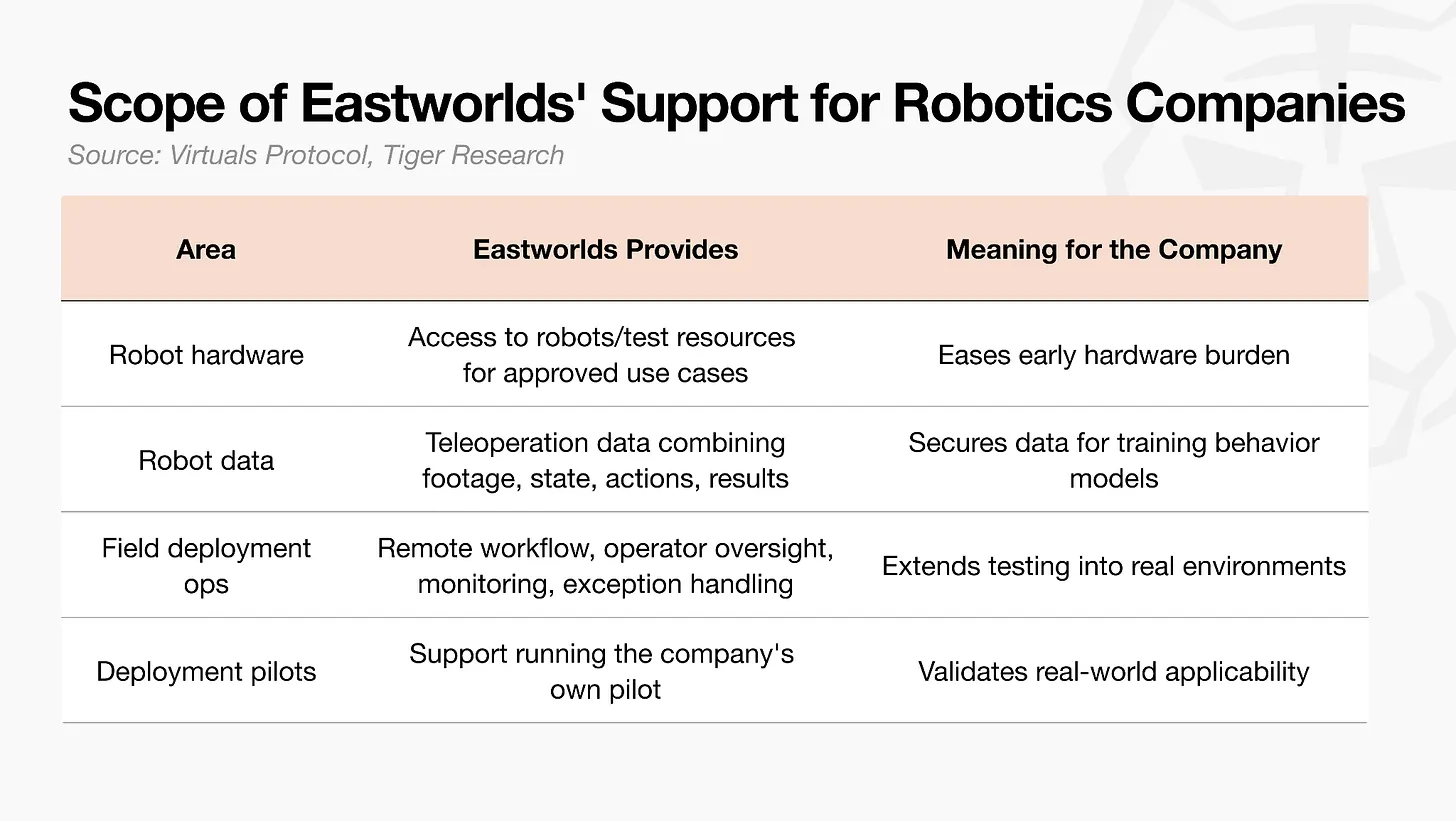
Selected teams can test and refine their models on actual machines before their devices and sites are fully prepared, thus shortening the learning and iteration times.
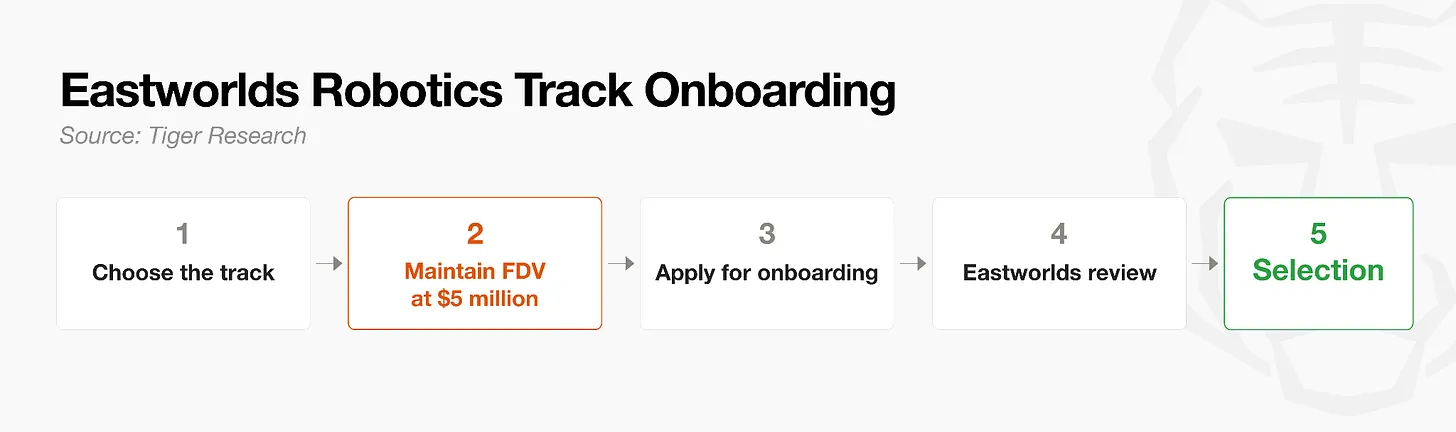
Support isn’t granted to just any token issuer. The selection process is as follows:
- Robotics companies choose the Robotics Launch track;
- The fully diluted valuation (FDV) of tokens sustains above $5 million for a continuous week;
- Upon meeting these criteria, they apply for Eastworlds residency review;
- Eastworlds evaluates use cases, team development and operational capabilities, as well as required hardware and testing environments;
- Support is granted upon passing the review.
In this process, Eastworlds functions more like an on-chain VC rather than just an infrastructure provider. Early teams successful in token issuance grow, increase token value, and a portion of transaction fees flows back to Virtuals. This means that the success of builders translates into revenue for ecological partners.
Once the structure is operational, income can be understood thus: an early robotics startup issues tokens via Robotics Launch, maintains a token value over $5 million for a week before passing the review, then utilizes Eastworlds machines and sites to refine their models and deploy robots on-site. Once services are operational and market interest rises, both token value and transaction volume might increase. Suppose 10% of token value trades daily, with Virtuals extracting 1% of transaction amounts as fees; even a single project could significantly enhance protocol revenue.
The robot project ROBO had a token value rise to $400 million on Virtuals, indicating that a valuation of $500 million is not entirely out of reach. However, as of now, no company has been disclosed to have completed the Robotics Launch review and subsequently utilized Eastworlds facilities to establish operations.
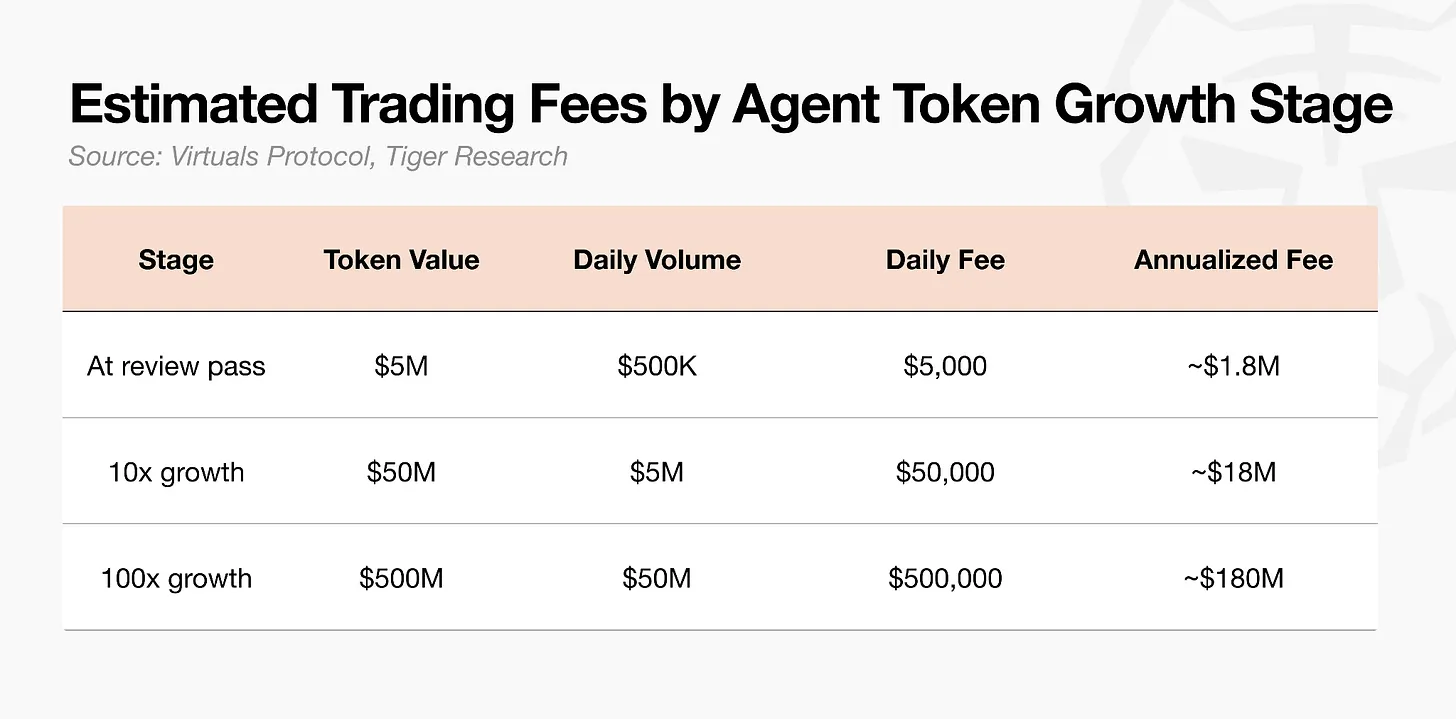
This simulation illustrates: if successful robotics projects can maintain high trading volumes, individual projects could materially increase Virtuals’ fee revenue. At that point, Virtuals would no longer simply provide robotics infrastructure but would share transaction activities and revenues of growing projects within the ecosystem.
Whether this structure can develop into a genuine income model can only be confirmed once the first robotics company through Robotics Launch secures financing and utilizes Eastworlds infrastructure to yield actual business results.
An Interconnected Virtuals Ecosystem
The intelligent agent infrastructure and Eastworlds solve different problems, intertwining to clarify Virtuals' business structure.
Virtuals seeks to connect intelligent agents and robots from their creation to actual economic activities and the completion of settlements.
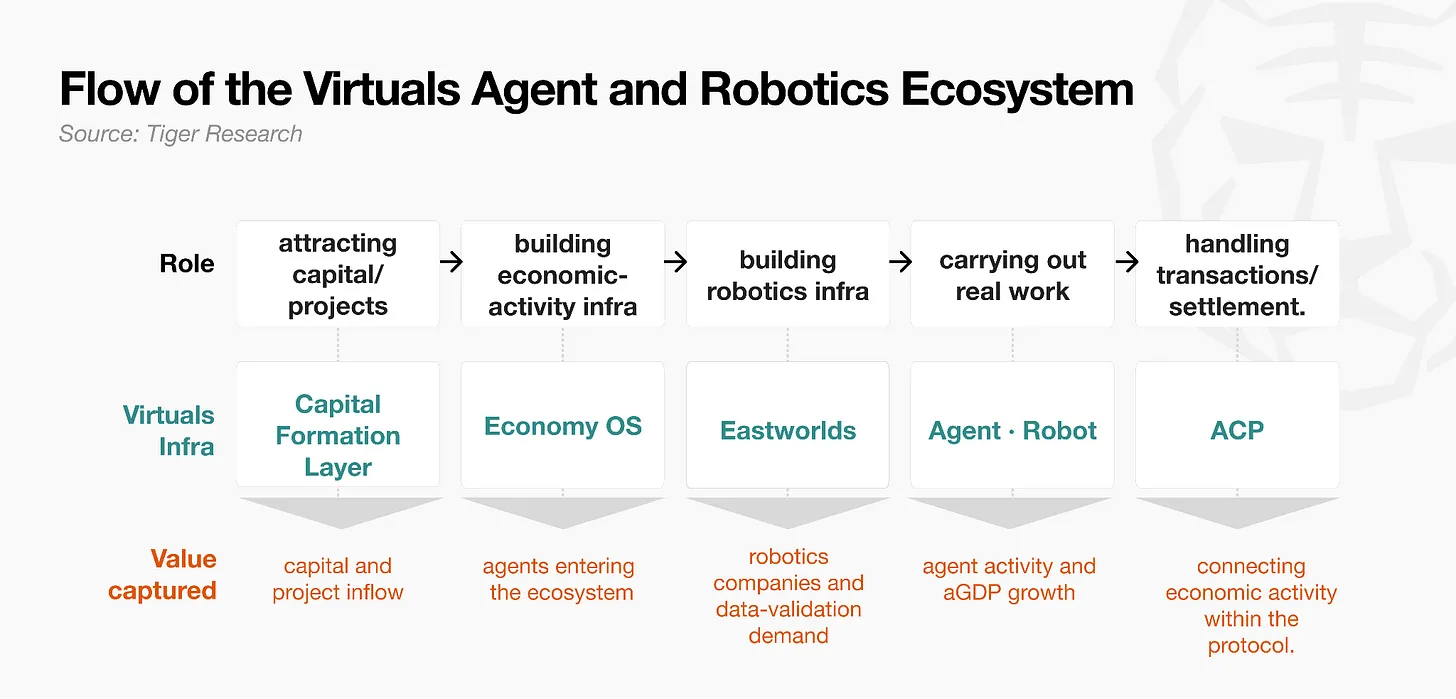
The existing business revolves around the online token market and intelligent agent infrastructure. With the addition of Eastworlds, the activity range extends from online to offline physical economic activities.
Robots are not a new business emerging alongside Virtuals but rather a crucial link that connects existing intelligent agent infrastructure from online to offline. Thus, the same ecosystem can accommodate data analysis, content production, and automation performed by online intelligent agents and the logistic, manufacturing, and service actions carried out by robots in the physical world.
This results in two shifts in the business structure: the range of economic activities expands from online intelligent agent work to physical labor in logistics, manufacturing, and services; activities capable of generating income transition from token transaction fees to Eastworlds infrastructure usage fees, as well as real task settlements based on ACP.
Virtuals aims to establish a competitive position not by creating every intelligent agent and robot but by linking crucial nodes—project entry and capital formation, activities of intelligent agents and robots, data and on-site validation, actual work, transaction settlements—allowing Virtuals to capture value at every stage as intelligent agents and robots industries grow.
Conclusion
The future that Virtuals aims for is: intelligent agents possessing identities like humans, using their wallets to pay their bills, signing contracts with other intelligent agents, and securing capital to expand their activities. Once this economic foundation is established, intelligent agents will no longer be mere tools executing instructions, but economic entities managing jobs, subcontracting, handling income, and financing their own growth. EconomyOS manages identities and payments, ACP manages contracts and settlements, and the capital formation layer handles financing and market development.
Robots represent the next phase. Intelligent agents are the brains conducting judgments and transactions online, while robots are the physical embodiments that translate those judgments into manual labor. Eastworlds assists robotics companies in obtaining hardware and testing infrastructure and captures the data generated during robot operations, facilitating the transition of the intelligent agent economy from screens into the physical world.
If the structure operates as envisioned, it could create a cycle: financing—developing and testing robots—accumulating operational data—enhancing model performance—increased workload for robots—increased income and capital—cycling back into the system. The critical question remains: whether issuing tokens indeed transforms into the development, operation, and production activities of intelligent agents and robots.
Thus, assessing Virtuals' progress should not focus on how many tokens have been newly issued or market capitalization but rather on the transaction volume between intelligent agents, the income of intelligent agents, and the actual volume of work completed by robots.
The upcoming proof points are equally clear: its future depends on whether it can become the true economic infrastructure for intelligent agents and robots to effectively work and earn money, rather than merely acting as a token trading venue.
When the intelligent agent economy, starting online, extends into physical world labor through robots, the role that Virtuals plays within this economy will truly be tested.
免责声明:本文章仅代表作者个人观点,不代表本平台的立场和观点。本文章仅供信息分享,不构成对任何人的任何投资建议。用户与作者之间的任何争议,与本平台无关。如网页中刊载的文章或图片涉及侵权,请提供相关的权利证明和身份证明发送邮件到support@aicoin.com,本平台相关工作人员将会进行核查。


