For Web3 payment projects, the real product boundary is not whether users can pay with USDT, but what financial capabilities that should be regulated have been brought under the platform's control to achieve this step.
Written by: Gao Mengyang
On August 27, the Shanghai police reported a case that is very worthy of attention from the Web3 payment industry when disclosing the situation regarding new economic crimes involving virtual currencies.
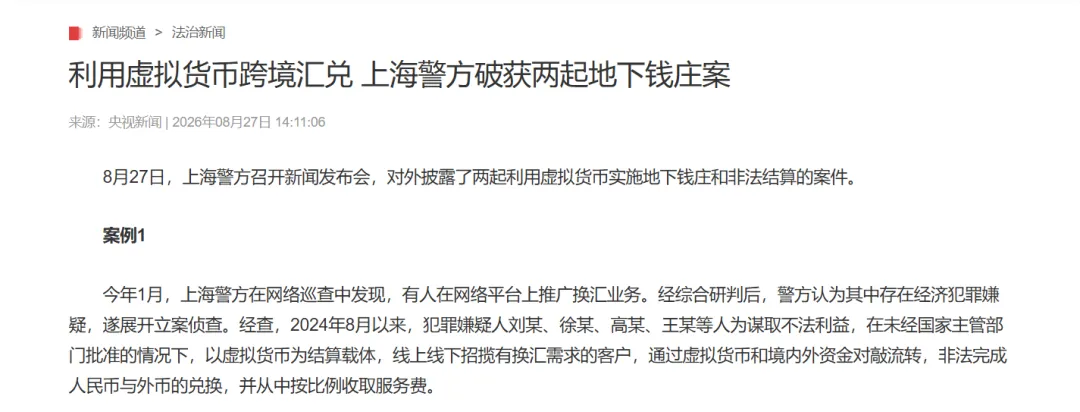
News information screenshot | Compiled based on public reports
Unlike traditional underground banks, this case appears more like a FinTech company in terms of product form: the suspects established a technology company, building two platforms on the internet for "cross-border currency exchange" and "virtual credit card issuance and settlement." Users can complete virtual currency top-ups, multiple currency cross-border exchanges, virtual credit card applications, and repayments within the platform, which profits through transaction fees, consumption service fees, card issuance fees, and withdrawal fees.
According to the police report, nine criminal suspects were arrested in this case, involving an amount of over 200 million yuan. Currently, five of them have been approved for arrest by the procuratorial agency for the crime of illegal business operations, while the remaining individuals have been subjected to criminal coercive measures, and the case is still under further investigation.
If we only look at the product page, "USDT top-up," "global consumption," "multi-currency exchange," and "virtual card payment" are all very familiar features in the Web3 payment industry and there are already several similar products in overseas markets. Therefore, what is truly worth studying in this case is not whether "virtual credit cards can be made," but how the nature of the business will change as a payment product transitions from providing stablecoins into a model involving currency exchange and cross-border settlement.
1. The issue is not "Is there a virtual card?" but how much financial responsibility the platform has taken on
Virtual credit cards are not inherently a criminal product.
From a global payment market perspective, the combination of bank card networks and digital assets has formed multiple mature models. For example, some Crypto Card products allow users to spend crypto assets, but in the actual payment chain, crypto assets usually need to be converted into fiat currency before entering traditional bank card payment networks, with merchants ultimately receiving fiat currency. These products often also involve various regulated financial institutions, card issuers, card organizations, KYC, anti-money laundering, sanction screenings, and continuous transaction monitoring.
This overseas model certainly cannot directly serve as a basis for the legality of operations within China, but it helps us understand a very important industry logic: "A card that allows spending USDT" is not simply about connecting a wallet with a bank card; rather, it involves multiple independent links such as digital asset conversion, fiat currency funding, card issuance, clearing, and merchant settlement. Who completes each link and what qualifications they have is what the legal review truly concerns.
The reason this case disclosed by the Shanghai police is worthy of attention lies precisely in the fact that the relevant platform did not merely provide a card entry.
According to the police report, on the "cross-border currency exchange" platform, the relevant personnel received customer virtual currency overseas and exchanged it into foreign currency to form a capital pool, then fabricated false reasons for cross-border currency settlement, achieving the exchange transfer between virtual currency and RMB; on another "virtual credit card issuance and settlement" platform, the relevant personnel cooperated with virtual card operators to provide users with virtual credit cards. After users made purchases, they repaid using virtual currency, and the platform subsequently converted the virtual currency into foreign currency overseas, then completed settlement with virtual card operators through false cross-border settlement methods.
In other words, the analysis of this case is no longer just a single "card issuance" action but a whole set of closed-loop financial services that includes receiving virtual currency, exchanging for foreign currency, organizing cross-border funds, completing card settlements, and charging users.
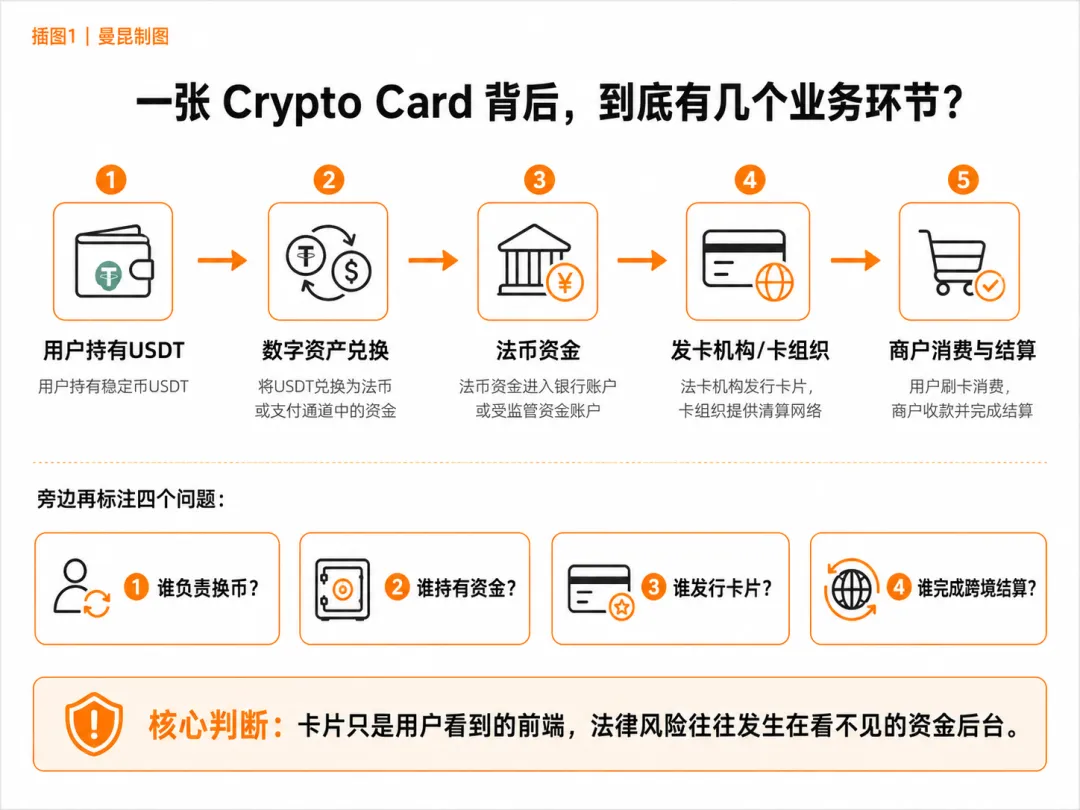
2. Once the platform completes the "currency to cash" for the client, the nature of the business begins to change
Many Web3 payment products may have initially sought to solve a very simple problem: users hold USDT, but everyday merchants only accept US dollars, Hong Kong dollars, or other fiat currencies. Can a card enable these digital assets to have more convenient payment capabilities?
What really needs to be wary of is that to achieve this experience, products gradually consolidate all the capabilities that were originally the responsibility of different licensed entities under their own control.
For example, users first top up USDT into the platform account, and the platform calculates how many US dollars can be exchanged at its own price; users then apply for a virtual card, and the platform is responsible for loading the exchanged value into the card system; after consumption occurs, the platform again handles the sale of virtual currency, foreign currency payments, and cross-border settlements, with all funding paths, exchange rates, and settlement arrangements being unified by the platform.
At this stage, what the platform provides is no longer just a technical interface or card management page, but may simultaneously involve multiple regulated links such as virtual currency exchange, monetary fund transfers, and cross-border payment settlements.
In February 2026, the People's Bank of China and eight other departments issued a notice on "Further Preventing and Dealing with Risks Related to Virtual Currencies," clearly stating that activities conducted within the territory that involve the exchange of fiat currencies for virtual currencies, exchanges between virtual currencies, acts as a central counterparty to buy and sell virtual currencies, and provides information intermediary and pricing services for virtual currency transactions are considered illegal financial activities and are strictly prohibited. It is also stipulated that overseas entities and individuals are prohibited from providing any form of illegal virtual currency-related services to domestic entities.
Meanwhile, conducting payment business that transfers monetary funds based on user electronic payment instructions within the territory requires obtaining the corresponding licenses according to existing payment regulations, and overseas institutions providing cross-border payment services to domestic users must further consider various regulatory requirements including payment, foreign exchange, cross-border RMB, and data.
Therefore, for Web3 payment products aimed at users within China, the truly critical question to address in advance is not "Our card is issued by an overseas company; does that mean there's no problem?" but rather, from the moment the user submits their first USDT into the system, who completes the subsequent exchange, accounts, payments, and settlements, and what business functions the domestic team actually assumes within this process.
3. "Cooperating with overseas licensed institutions" is important, but it cannot just be about who is responsible in contracts
In reality, Crypto Card projects typically do not have a single Chinese tech company applying for Visa or Mastercard card issuing qualifications; rather, they employ more complex cooperative structures. For example, overseas licensed institutions provide cards, a BIN Sponsor manages the card program, and another payment institution handles settlement, while the Web3 project mainly undertakes wallet, user interface, technical development, and customer operations.
This structure does significantly differ from "building a platform and handling all financial business," but criminal and regulatory analyses cannot merely be confined to the roles listed in the contracts.
Suppose the contract states, "the overseas partner is responsible for payment and card issuance," but in actual operations, the Chinese team is responsible for attracting users domestically, providing USDT to USD quotes, controlling user recharge wallets, deciding when to exchange assets, arranging withdrawals and refunds, while earning income based on recharge volumes or exchange amounts; in this case, the term "technical service provider" in the contract cannot fully explain its true business.
On the contrary, if the domestic team indeed only provides software development, API integration or other technical capabilities, does not control customer funds, does not determine exchange rates, is not involved in virtual currency transactions or fiat settlements, and does not directly provide related financial services to domestic users, then it should be independently evaluated based on its actual behavior rather than being directly equated with a funding operation entity due to the product's eventual connection with virtual currencies and bank cards.
This is also why it is often more important to analyze a Web3 payment project's business architecture in terms of cash flow compared to its equity structure. Which company holds shares can illustrate business relationships, but which wallet the customer's USDT enters, who can utilize it, where the exchange happens, which account the fiat currency enters, who pays the card-issuing agency, and who ultimately receives transaction fees will truly determine what business each entity actually assumes.
4. Another noteworthy signal in the Shanghai case is "false cross-border settlement"
If we only discuss stablecoin exchanges and virtual cards, it is easy to overlook a more traditional but legally significant detail in this case.
The police disclosed that in the cross-border funding operations of the relevant platform, the criminal gang engaged in "fabricating false reasons for cross-border settlement;" in the virtual credit card settlement business, the gang similarly completed settlements with virtual card operators after exchanging virtual currencies for foreign currencies overseas via false cross-border settlement methods.
This means that the case is no longer merely about "how USDT is exchanged for US dollars," but also touches on why cross-border funds can enter regulated financial channels under certain trade, service, or other names.
For legitimate cross-border payment companies, this point is particularly important, as normal international settlements often require an ability to explain the transaction background, whether it involves goods trade, software services, advertising fees, technical service fees, or other genuine commercial transactions, which need to be matched with contracts, orders, invoices, or other business materials. If funds are compelled to return from overseas to domestic markets by artificially creating contracts, fabricating services, or using trade backgrounds irrelevant to genuine business, then the legal issues faced by the product no longer concern just virtual currency regulation, but may further involve foreign exchange management and other financial business risks.
Therefore, what stablecoin payment projects should be most vigilant about is not just about whether a product manager added a "USDT top-up" button on the page, but rather that the backend begins to establish funding arrangements that cannot be explained by real commercial relationships to facilitate this payment.
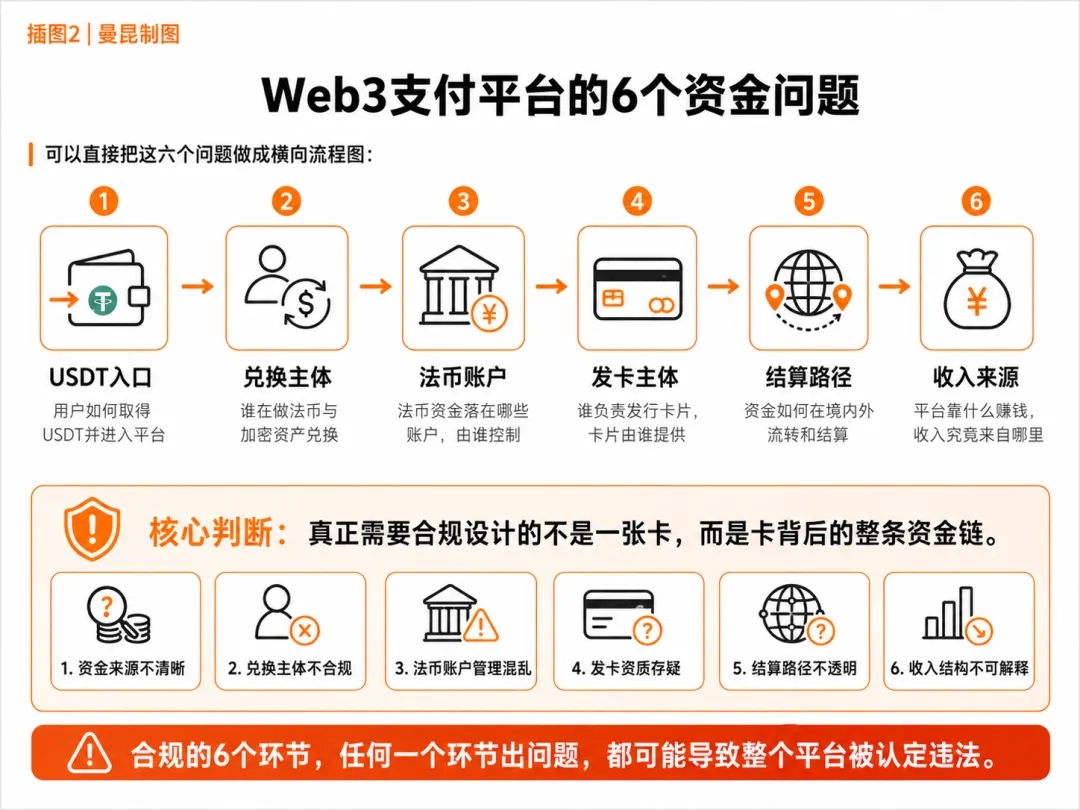
5. To determine whether a Web3 payment product has crossed boundaries, one can first look at six funding relationships
If we place the Shanghai case alongside current regulatory rules, for teams designing stablecoin payments, Crypto Cards, PayFi, or global payment and receipt products, it's better to first run a complete product test without delving into complex legal jargon.
First. What assets does the user hand over to whom? If domestic users directly hand over USDT to a wallet controlled by the platform, we need to further confirm whether the platform merely provides technical custody, or has already formed actual asset control.
Second. Who is responsible for selling the USDT? Is it a regulated overseas financial or crypto institution completing the exchange according to local rules, or does the project team independently find coin merchants, set uniform quotes, and finalize payments themselves?
Third. Who's account does fiat currency enter? If the exchanged funds enter an account controlled by the project itself, which then organizes payments, its funding role will clearly weigh more than merely providing API technical services.
Fourth. Who actually issues the card and bears settlement responsibility? The presence of a brand logo on the card does not substitute for the confirmation of the actual issuer, BIN sponsor, payment institution, and settlement entity.
Fifth. What is the real service that the customer purchases? If users are simply using an overseas payment card, the underlying business needs do not align with simply stating, "Exchange my USDT into US dollars and pay overseas for me."
Sixth. How does the platform make money? Software subscription fees and technical service fees differ in their explanatory significance to the platform's true business nature compared to earning spreads based on exchange amounts, withdrawal fees, and funding settlement fees.
Legal Observations
The reason the Shanghai police's disclosure of a 200 million yuan case is worthy of attention from the Web3 industry is that it demonstrates a very typical trend towards platformization: the functions originally scattered among coin merchants, exchange institutions, payment institutions, card issuers, and cross-border settlement entities have been integrated into the same user entry point by internet platforms, leading to a smoother user experience, but also increasing the financial functions undertaken by the platform.
Therefore, when discussing the legal risks of Crypto Card, stablecoin payment, or PayFi projects, merely asking "Is the virtual credit card legal?" often does not yield truly useful answers. A more effective method is to follow the funding step by step to trace back, breaking down the digital asset exchange, monetary fund control, payment instructions, card issuing, cross-border settlements, and charging models, then assessing what entity completes each link based on what rules.
While there are already plenty of mature Crypto Card products overseas, this does not imply that the same product structure can be copied for users in China without adjustments; similarly, using overseas companies, overseas card organizations, or overseas partners will not automatically change the legal nature of the domestic team's actual implementation.
For Web3 payment projects, the true product boundary is not whether "users can swipe their cards with USDT," but rather what financial capabilities that should be regulated have been brought under the platform's control to achieve this step.
免责声明:本文章仅代表作者个人观点,不代表本平台的立场和观点。本文章仅供信息分享,不构成对任何人的任何投资建议。用户与作者之间的任何争议,与本平台无关。如网页中刊载的文章或图片涉及侵权,请提供相关的权利证明和身份证明发送邮件到support@aicoin.com,本平台相关工作人员将会进行核查。


