Written by: Rita
NVIDIA's confidence in growth for FY28 comes from broad market demand expansion rather than a single driving factor.
On September 2, JPMorgan held an NVIDIA investor meeting, communicating with Vice President of Investor Relations Toshiya Hari. After the meeting, JPMorgan's minutes pointed out that NVIDIA is “comfortable” with its framework of a 70% year-over-year growth for FY28, and that this guidance results from supply constraints rather than demand constraints. If supply were sufficient, business could have grown more than double. Inference has become the largest and still expanding portion of the data center business, with the customer structure continuously broadening beyond just hyperscalers.
The 70% growth framework is the baseline for supply constraints
Hari explicitly stated that the FY28 guidance for 70% year-over-year growth is based on a broadly improving overall market demand, including hyperscalers, emerging cloud vendors, AI laboratories, sovereign AI, and enterprise on-premise deployment needs. One of the motivations for providing annual guidance is the significant gap between internal expectations and market consensus; if this gap is allowed to persist, it could complicate planning for supply chain partners.
Management repeatedly emphasized that 70% is a “comfortable” number. Under the current guidance, NVIDIA's business remains supply-constrained rather than demand-constrained. Without supply constraints, business could achieve more than double growth.
Inference has surpassed training in proportion but is difficult to quantify accurately
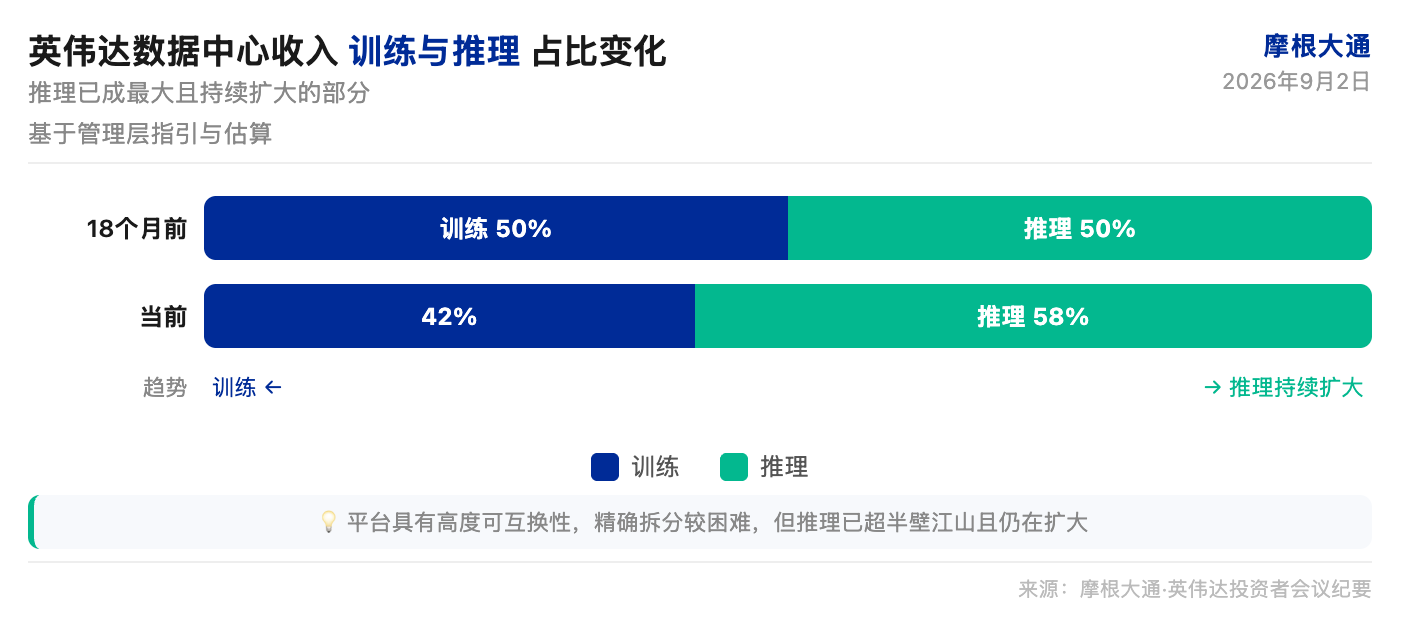
The revenue split between training and inference was a recurring topic in the meeting. Hari pointed out that NVIDIA's platform has a high degree of interchangeability, allowing customers to use Grace Blackwell products for training and subsequently shift the same assets to inference workloads, making the precise split between training and inference revenue somewhat challenging.
However, Hari noted that about 18 months ago, the ratio of inference to training was roughly 50/50, and he is confident that inference has now become the larger and still expanding part of the data center business. The proportion of inference in total revenue will continue to rise over time.
Advanced wafers and memory are the two major supply bottlenecks
In discussing how to meet demand for next year amid ongoing supply constraints, Hari particularly emphasized memory and advanced wafers, which play a critical role in NVIDIA's materials list.
NVIDIA maintains deep cooperation with TSMC and the three major memory suppliers (Micron, SK Hynix, Samsung) to engage in ongoing discussions around increasing supply availability. Hari did not mention advanced packaging (CoWoS) as the current major bottleneck, which is noteworthy. Previously, CoWoS capacity was viewed as a key constraint on NVIDIA's shipments; while this does not mean CoWoS is entirely unbound, it at least indicates that the most critical period may have passed and the bottleneck is shifting upstream to wafers and memory.
Customer structure continues to broaden, with emerging cloud vendors now exceeding 50%
The concentration of end demand from AI model developers is declining. Hari stated that OpenAI and Anthropic, the two leading model developers, currently account for about 20% of NVIDIA's end demand, and this proportion may approach 25% in FY28.
This end demand does not directly reflect in NVIDIA's customer structure. NVIDIA sells computing power to hyperscalers and emerging cloud vendors, who then resell capacity to model developers. Emerging cloud vendors have now become an important part of NVIDIA's business, accounting for over 50% of AI computing infrastructure, indicating that growth is not solely reliant on top hyperscalers but is driven by a broader customer ecosystem.
Open-source and closed-source coexist, with continuous improvement in model economics
On the debate between open-source and closed-source LLMs, Hari reiterated Jensen Huang's earlier view: AI advancement requires coexistence of both, rather than choosing one over the other.
NVIDIA internally uses both closed-source models like OpenAI and Claude, while adopting a combination of closed-source and open-source solutions for critical tasks like chip design. As long as model developers can continue to improve their economics, demand will flow to chip suppliers. Hari particularly pointed out that the gross margins of model developers are improving, and NVIDIA's continued decline in unit token costs across generations is a significant support.
Financing tools support long-term demand without constituting cyclical financing
Hari detailed several financing arrangements from NVIDIA: revenue-sharing agreements with some emerging cloud vendors, the PORTS-Pike data center campus program, and a $500 billion private capital financing platform in collaboration with institutions such as Apollo, BlackRock, Blackstone, Brookfield, Goldman Sachs, and KKR.
In the revenue-sharing agreements, NVIDIA helps to cover the base price and shares upward revenue when computing power is rented above market prices, creating an option for recurring revenue above core hardware sales. Management believes their financing arrangements are limited, capped, and supported by strong end demand, ecosystem returns, and the credit status of end computing power buyers.
NVIDIA's FY28 guidance of 70% growth is a conservative baseline under supply constraints, with inference becoming the largest and still expanding part of the data center business, a continuously broadening customer structure, and financing tools pointing towards real demand rather than financial cycles. JPMorgan maintains an overweight rating with a target price of $320, based on approximately 20 times expected earnings per share of $15.87 for CY2026.
Disclaimer: This article is a compilation and interpretation of a third-party brokerage research report (JPMorgan, September 2, 2026) by ChaoXiang Research, combined with publicly available market information. The ratings, target prices, earnings forecasts, and related judgments quoted in this text are solely the views of the brokerage's analysts and represent the organization they belong to, not the views of ChaoXiang Research, nor do they constitute any investment advice. The market carries risks, and decisions should be made independently. This article should not be the basis for buying or selling any securities.
免责声明:本文章仅代表作者个人观点,不代表本平台的立场和观点。本文章仅供信息分享,不构成对任何人的任何投资建议。用户与作者之间的任何争议,与本平台无关。如网页中刊载的文章或图片涉及侵权,请提供相关的权利证明和身份证明发送邮件到support@aicoin.com,本平台相关工作人员将会进行核查。


