Written by: David Christopher
Translated by: Saoirse, Foresight News
Regrettably, I have to inform everyone that the grand vision the market holds for stock-paired Meme coins is ultimately difficult to realize.
Some readers may not be familiar with the background; I am referring to a narrative widely spread in the market: there is a short squeeze effect on the supply of on-chain stocks, which could transmit to the real stock market. Unfortunately, the underlying mechanism is inherently incapable of achieving this.
If you didn't keep an eye on the market last weekend, you most likely missed out on that outrageous price dislocation. The liquidity pool is essentially a one-in, one-out trading mechanism. When users buy Meme coins like BONER that are linked to tokenized stocks (TEQ), a large amount of capital is locked up, monopolizing the supply of the paired stock tokens. The supply gets severely compressed, directly pushing the token price to spike violently.
AMC's stock token once soared to $166.86, while its real stock closed at only $2.59 last Friday. Although HIMS's price action was not as extreme, it was similarly absurd: the on-chain token peaked at $132.64, while the real stock price closed last Friday at $28.84, only returning to rational levels after the traditional market opened on Monday. The on-chain prices reached approximately 64 times and 4.6 times the real stock prices respectively.
In the past few days, this phenomenon of "monopolizing token supply" has ignited market imagination, and everyone is particularly interested in what chain reactions this will produce for heavily shorted stocks. Can a group of fervent Meme coin holders drive the token price to extremely high levels, relying on locked-up tokenized chips, not only completing a short squeeze on-chain but also transmitting the squeeze effect to the real stock market?
Unfortunately, the answer is no.
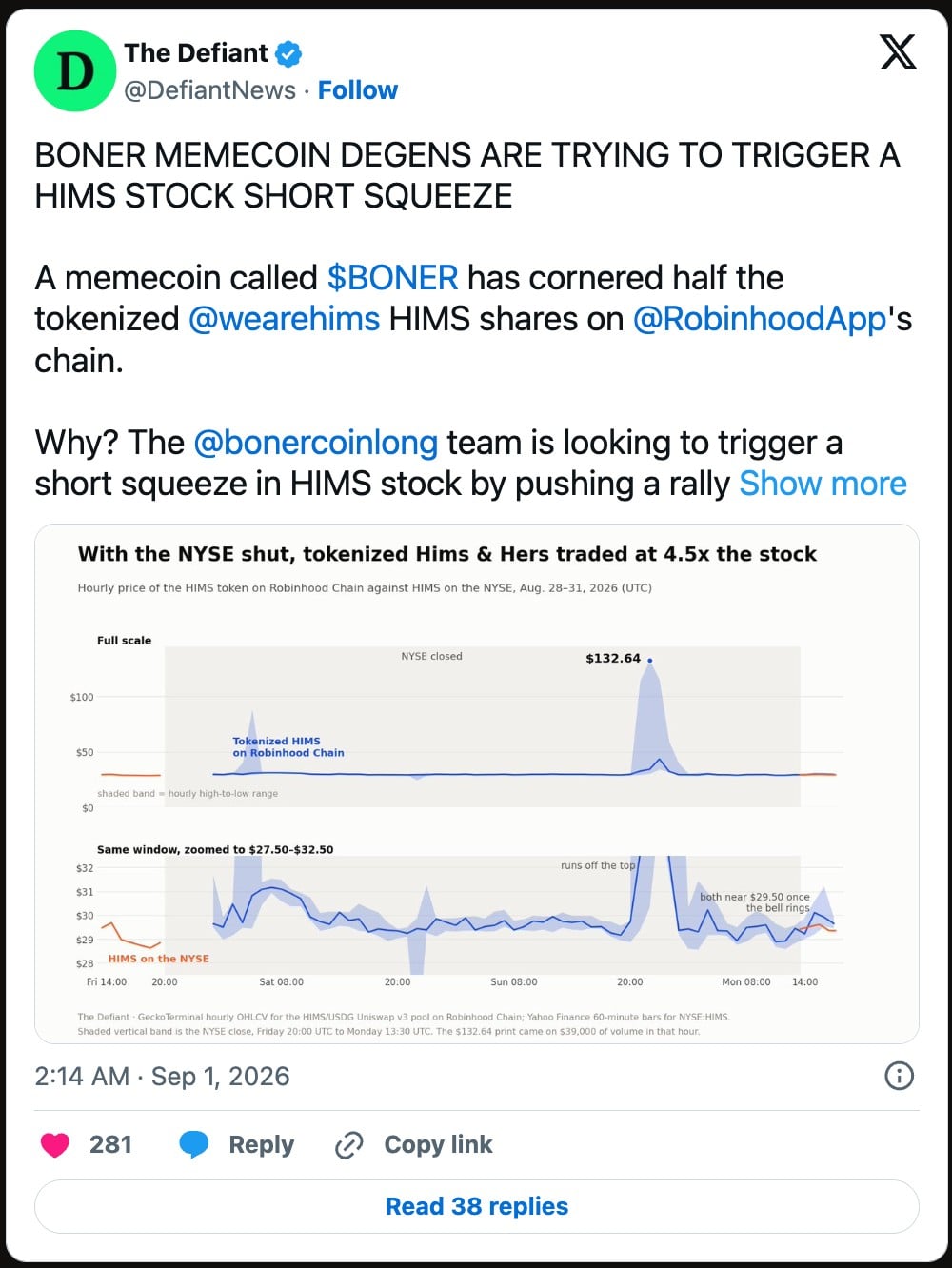
BONER hoarded Robinhood's on-chain HIMS tokens, causing the on-chain token price to skyrocketed to 4.5 times the real stock price over the weekend, attempting to create a short squeeze market, as illustrated in the attached image showing the huge divergence in price trends.
Why the short squeeze strategy doesn’t work
The first core issue is the volume discrepancy. The circulating supply of most TEQ tokens is insignificant compared to the corresponding underlying real stock volume. Taking BONER as an example, it cumulatively holds 53% of HIMS stock tokens, a percentage that looks astonishing, but converts to only about 0.014% of HIMS's total real shares.
Even if the token scale is further enlarged, there is a more fatal problem: controlling stock tokens does not equate to controlling real stocks.
The stock tokens issued by Robinhood are backed 1:1 by real stocks in a custodial account. Users only gain exposure to price returns but do not own the shares themselves. Therefore, when BONER deposits a large amount of HIMS stock tokens into the liquidity pool, it merely creates scarcity in the on-chain stock tokens without making the real HIMS stocks scarce.
Once on-chain token scarcity pushes the on-chain HIMS price far above the real stock price, Robinhood's authorized participants can mint new stock tokens, arbitraging the price difference. Minting new tokens does require purchasing additional real stocks as underlying backing, thus the issuance will generate a small amount of buying pressure for the underlying stocks. However, hoarding already existing tokens does not induce the mandatory purchase of an equivalent amount of real HIMS shares. The main outcome is pushing the platform to issue more stock tokens, increasing the token supply, pulling the on-chain token price back to levels closer to the real stock price.
The market movement last weekend has already confirmed this: HIMS tokens could break through $100 on-chain, yet the real HIMS stock still lingered around $29. After the traditional market opened, about 4,000 new HIMS tokens flowed into the market, and the enormous price difference on-chain and off-chain quickly disappeared.
Of course, the legendary short squeeze is not impossible to achieve forever. The premise is that we need a set of TEQ infrastructure that is more closely bound to real equity.
What a more refined TEQ (tokenized stock) should look like
Ironically, the solution currently closest to this goal has emerged on the Solana public chain.
Last year, Galaxy partnered with Superstate to migrate GLXY on-chain. The difference between the two is quite straightforward: Robinhood provides users with tokens that track stock prices; in contrast, under the Galaxy model, the tokens themselves are the stocks.
Former Galaxy shareholders can convert their GLXY into the on-chain version GLXY. These on-chain tokens are actual Galaxy Class A common stock, with identical legal rights, economic interests, and voting rights to traditional GLXY. When token transfers occur, the official shareholder register of Galaxy is also updated simultaneously.
This makes the link between the on-chain and off-chain markets much more direct; transferring on-chain GLXY is equivalent to transferring the very equity itself, not merely generating a mirrored certificate of the stock.
However, the Galaxy solution is still not fully mature. At this stage, its on-chain shares are only allowed to be transferred between approved wallets, and Galaxy has yet to open up permissionless automated market maker (AMM) trading.
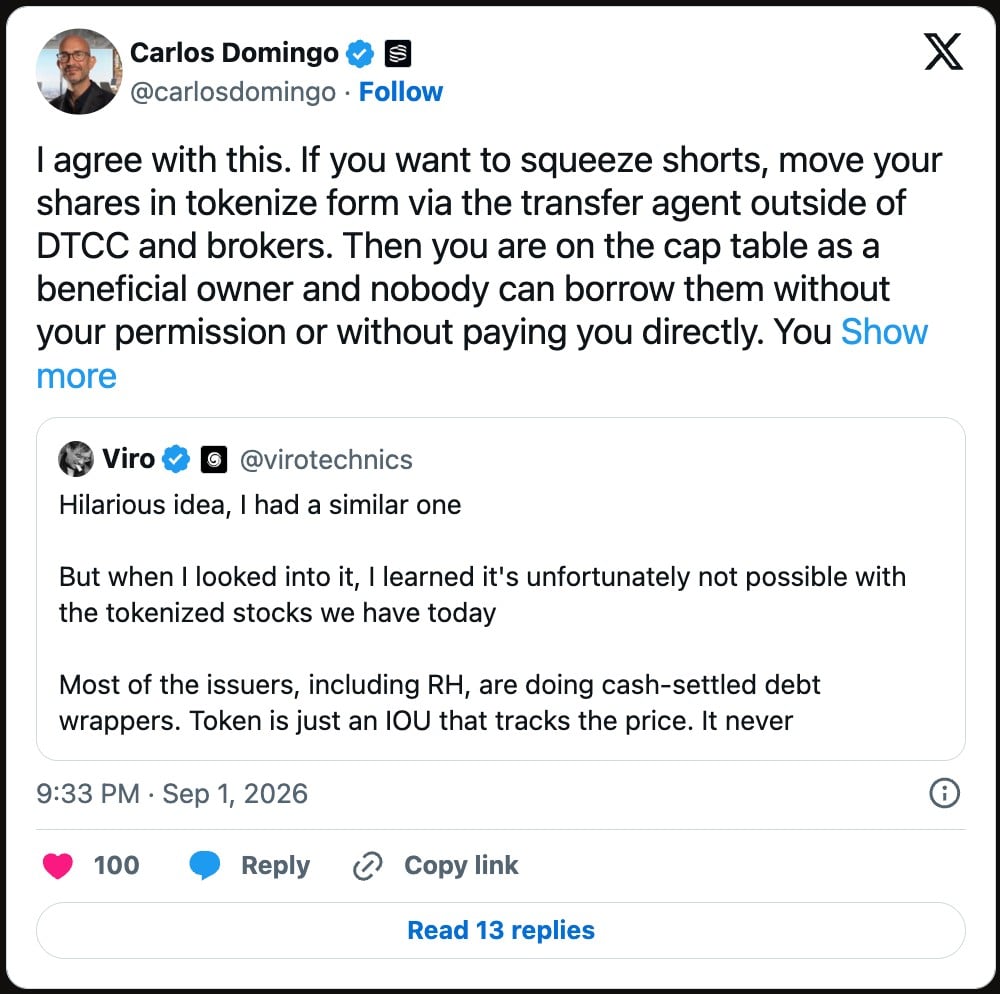
Discussing the conditions for achieving an on-chain short squeeze points out that current tokenized stocks like Robinhood's are merely price accounting IOUs, not true equity, and cannot realize a genuine short squeeze.
What is the real value of stock-paired Meme coins
So, is all of this merely a fresh gimmick for speculators to hype capital?
I don't think so.
The short squeeze effect is only the narrative that captures the public's attention first, the most thrilling one. Even if a short squeeze cannot be achieved, the bond between stocks and tokens still generates entirely new market logic.
Eric Conner has put forth a mainstream viewpoint: these Meme coins can become decentralized marketing tools for the corresponding listed companies. Token holders will actively track financial performance, product dynamics, short positions, industry news, and all information related to the underlying stocks, while generating a substantial amount of memes and content.
However, this model has clear limitations. The name of the BONER token may fit well with HIMS's product tone, but a medical publicly listed company seeking mainstream market credibility finds it difficult to publicly accept a token named "BONER."
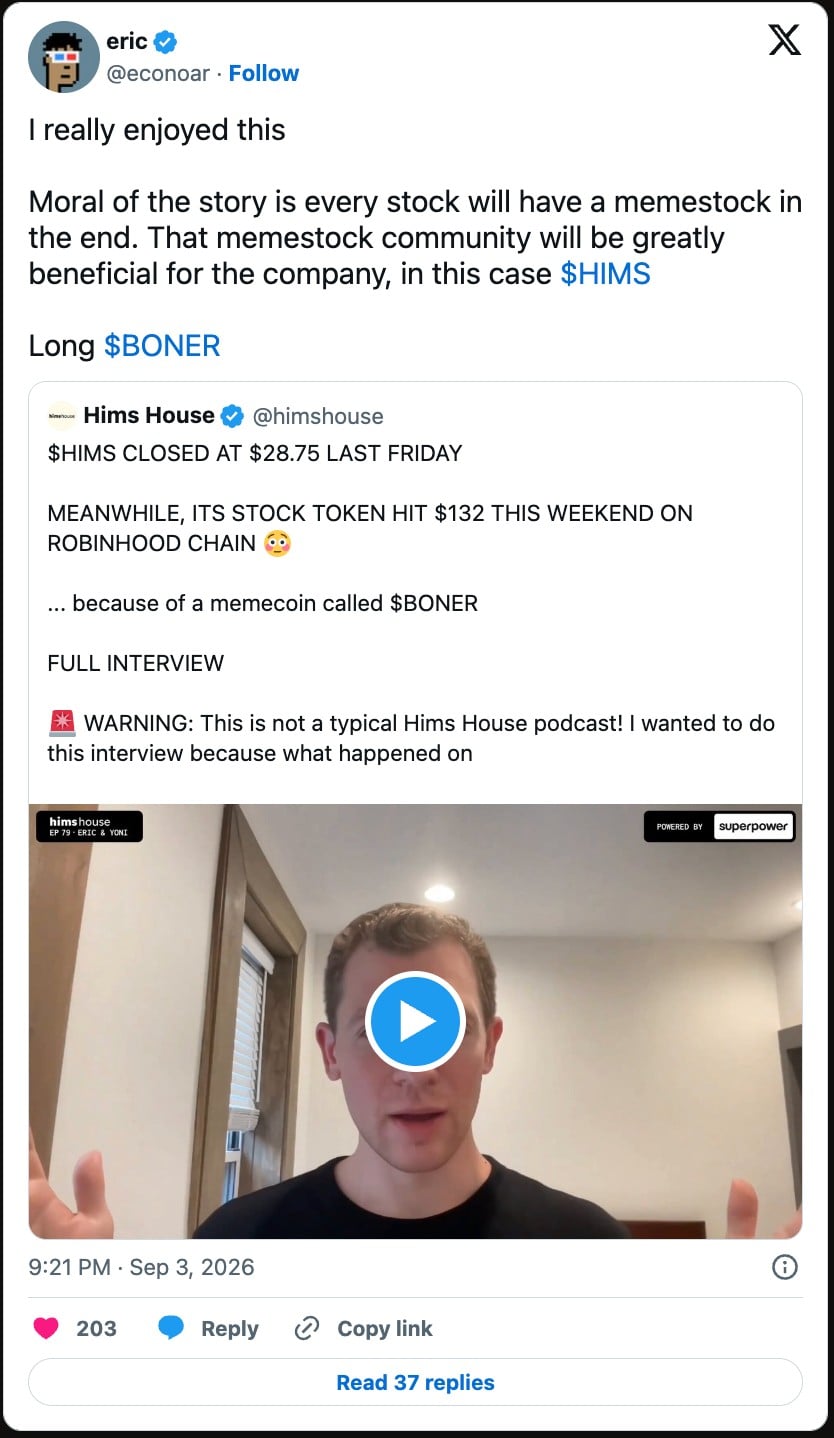
There is a belief that every stock will one day spawn corresponding Meme coin communities, which can deliver promotional dividends to listed companies and share related podcast content about the soaring HIMS on-chain tokens.
However, reality exists in an intermediate state. Nowadays, excellent companies understand guerrilla marketing, and token communities will spontaneously form communication channels. Companies do not need to acknowledge it and certainly do not need to control it.
The second, and more interesting direction for development: building TEQ as new financial and gamified underlying components.
NetNet Capital has proposed the concept of "RW-Play," which focuses on using tokenized stocks as programmable modules within games and DeFi products. COINflip uses tokenized Coinbase stocks as rewards for winners; SpaceX Invaders offers tokenized SpaceX stocks as prizes; MSFT Flight Simulator rewards with tokenized Microsoft stock.
Tokenized stocks are no longer limited to mere buy-and-hold but can serve as trading pairs, collateral, reward prizes, and sources of liquidity, embedded in various new applications.
In the current market, most merely replicate the old playstyles of 2020's DeFi using new assets. But what’s more worth contemplating is what the market will evolve into once TEQ develops its own native underlying components.
Setting aside the on-chain skyrocketing candlesticks of Robinhood, the combination of stocks and tokens can be considered one of the most innovative developments in the on-chain field recently. At this stage, Robinhood’s stock tokens position the chain as the main battlefield in this arena, but this status will not remain unchallenged indefinitely.
Galaxy has already demonstrated that Solana can support TEQ that is closely bound to real equity; the Base public chain will likely launch its own similar solution in the future. The core of competition in this field will not be who moves more stocks on-chain but who builds a more valuable bridge between on-chain assets and real equities, ultimately, who can discover more interesting applications for tokenized stocks.
It is quite intriguing to witness the birth of a new narrative. While there certainly exists an opportunity for speculative profit, more importantly, a vast number of unprecedented financial mechanism designs will emerge in the future.
The co-founder of Robinhood has stated that Robinhood Chain positions itself as a high-quality RWA real asset chain, while also adapting to the speculative play of meme coins.
免责声明:本文章仅代表作者个人观点,不代表本平台的立场和观点。本文章仅供信息分享,不构成对任何人的任何投资建议。用户与作者之间的任何争议,与本平台无关。如网页中刊载的文章或图片涉及侵权,请提供相关的权利证明和身份证明发送邮件到support@aicoin.com,本平台相关工作人员将会进行核查。


