
Author: Nancy, PANews
As the FOMO sentiment of Robinhood Chain remains high, the market unexpectedly throws a cold shower.
On the evening of September 2, Robinhood Chain saw another rapid transaction. Riding on the wealth-creating effect of coin-stock pairing, the meme coin JINQIAN, which focuses on a narrative of short-squeezing US stocks, and the token FAMI, named after a Nasdaq penny stock, ignited market sentiment and attracted a large amount of funds and attention as soon as they launched, but after the community questioned the shelling out profit, both market capitalizations plummeted. When the excitement faded, the ones truly left holding the bag were the trend-following participants.
At the same time, the trading fees on Robinhood Chain are rising due to the on-chain frenzy, driving the platform's revenue to new heights, while users have begun to complain they "can't afford to play," even jokingly referring to it as the "noble chain."
Did the narrative of short-squeezing US stocks crash? Is Robinhood Chain facing a cooling moment?
Stock memes have become a popular play on Robinhood Chain. Especially after the meme coin BONER's narrative of short-squeezing stirred market sentiment a few days ago, funds began to look for the next target with similar speculative space.
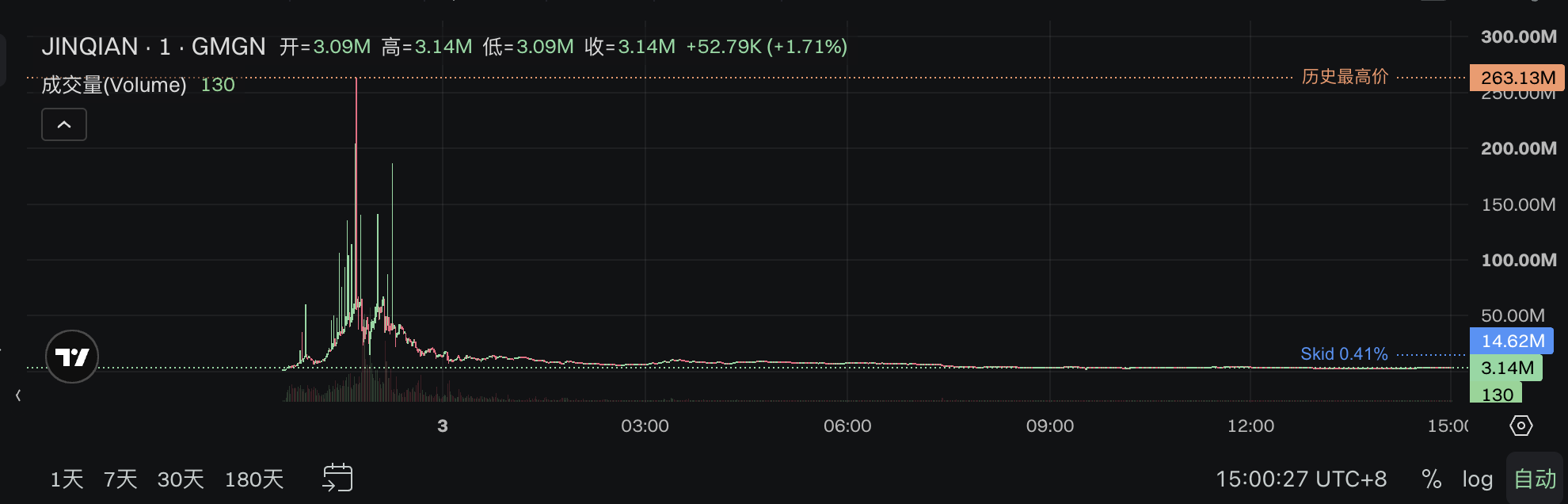
Last night, a token named FAMI launched and quickly attracted a flood of funds within minutes. Following that, the meme coin JINQIAN paired with FAMI also rapidly gained market attention. Notably, JINQIAN's market cap peaked over $73 million, and FAMI reached over $53 million, with both tokens' total trading volume approaching $240 million, showing their popularity.
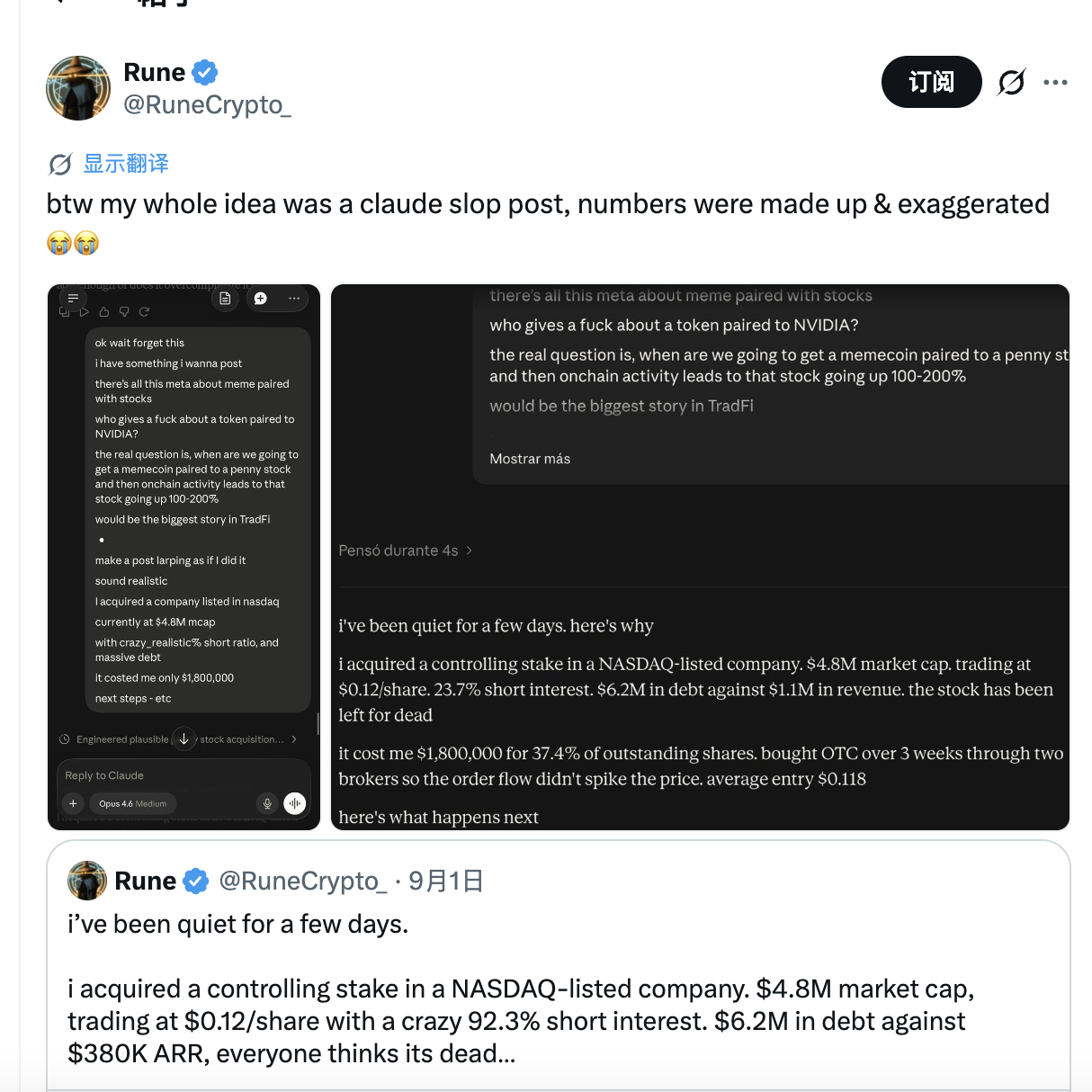
The quick rise of these two meme coins is related to a prior announcement by crypto KOL Rune. A few days ago, Rune announced his plan to acquire about 37.4% of a Nasdaq penny stock for approximately $1.8 million OTC, where the short ratio reached 92.3%, and he intended to tokenize it on Robinhood Chain, pairing it with a meme coin for "squeezing shorts."
Quickly, the community matched this clue with Farmmi, a Nasdaq-listed Chinese agricultural product supplier. The company mainly engages in the processing and sales of agricultural products such as shiitake mushrooms, wood ear mushrooms, and other edible fungi, as well as related agricultural trade; interestingly, its annual report also mentions a mushroom variety called "Jinqian mushroom." As a result, Farmmi's stock price soared by 350% during trading. Even more intriguingly, the on-chain token FAMI's peak market cap once reached ten times that of Farmmi's actual market cap.
However, this revelry soon took a turn. The community discovered that FAMI was not an officially issued stock token from Robinhood; its supply mechanism and reserved methods resembled a carefully crafted script, with the story behind it packaged as a liquidity bait.
On-chain data shows that FAMI has a total supply of 37,430,000 tokens, close to the total circulating shares of Farmmi. This supply was generated in one go through two minting instances during the creation of the transaction, where the deploying wallet retains 38% and a contract named PoolRepricer is deployed to self-manage the price, with no further changes to the supply. Meanwhile, FAMI has no clear issuer and lacks a stock redemption mechanism, having no connection to the actual Farmmi stock. In contrast, the official stock tokens from Robinhood are issued by Robinhood Assets (Jersey) Limited, allowing only authorized participants to conduct subscription and redemption.
Rune subsequently clarified that the previous acquisition post was generated by Claude, and the figures therein contained fabrications or exaggerations. At the same time, the chain's FAMI was not issued by him.
In light of this reversal, both FAMI and JINQIAN plummeted, with market caps falling to approximately $4.9 million and $2.7 million, significantly down from their peaks.
This may be a microcosm of the recent FOMO sentiment on Robinhood Chain; the mechanisms are fake, the narratives are fake, but the on-chain attention is real, even flowing toward Nasdaq. For the market, this farce also pressed a cooling key on the continuously warming sentiment.
Sixty percent of players incur losses, yet Robinhood Chain profits immensely
For ordinary players, what seems to be a sea of opportunities in the on-chain casino may only reward a few with actual profits.
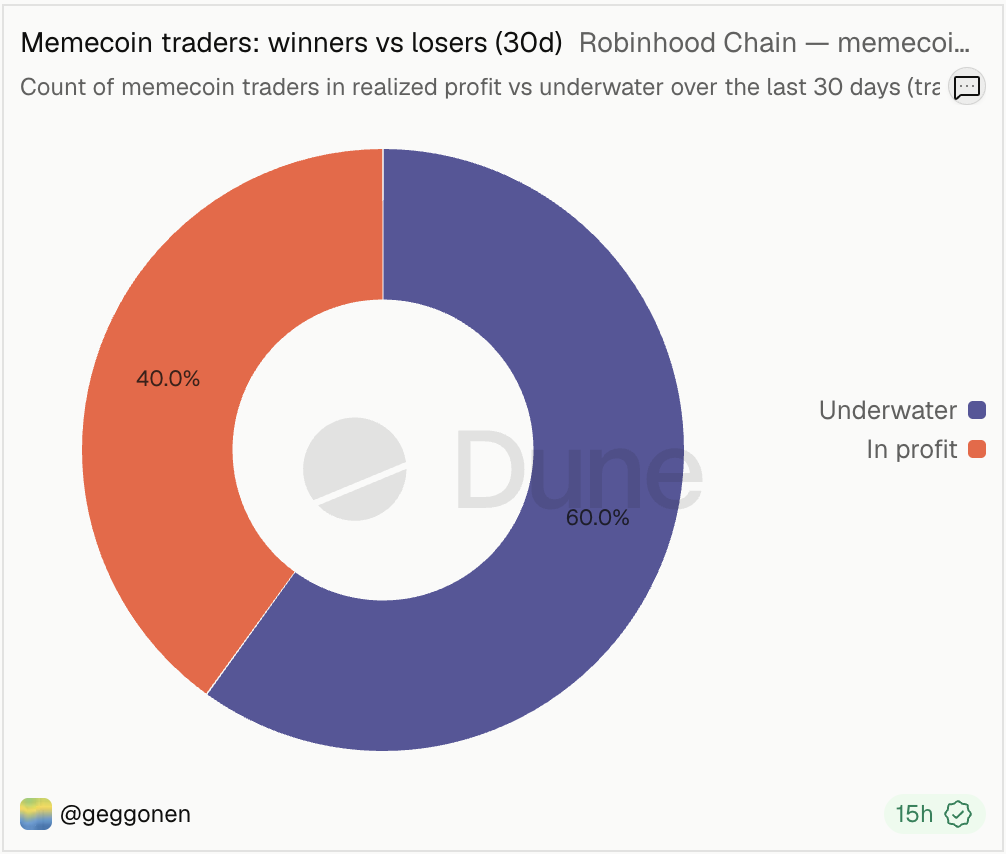
Dune data shows that in the past 30 days, the proportion of traders on Robinhood Chain who achieved profits and losses (traders who have sold at least one transaction) are 40% and 60%, respectively.
Moreover, on FOMO App, one of the main trading platforms for Robinhood Chain, the situation is even more dire. Dune data shows that in the past 90 days, FOMO App had approximately 477,000 trading addresses, among which over 441,000 were loss-making addresses, accounting for about 94.27%; profitable addresses total only about 27,000, making up approximately 5.7%. This means that on average, out of every 100 trading addresses, only about 6 are profitable, while 94 are in a loss state.
Even more noteworthy is that some traders have incurred significant losses. About 63.6% of trading addresses lost less than $100, but around 30% experienced losses exceeding $500, with 8.9% losing over $1,000, 7.3% losing over $5,000, and even 3.98% losing over $10,000. In contrast, among the few profitable addresses, 87.5% of profits are less than $100, and only about 0.14% of addresses achieved profits over $1,000. This indicates that most addresses have extremely limited profits.
Meanwhile, the continually rising trading costs on Robinhood Chain are also squeezing the already limited profit margins for players.
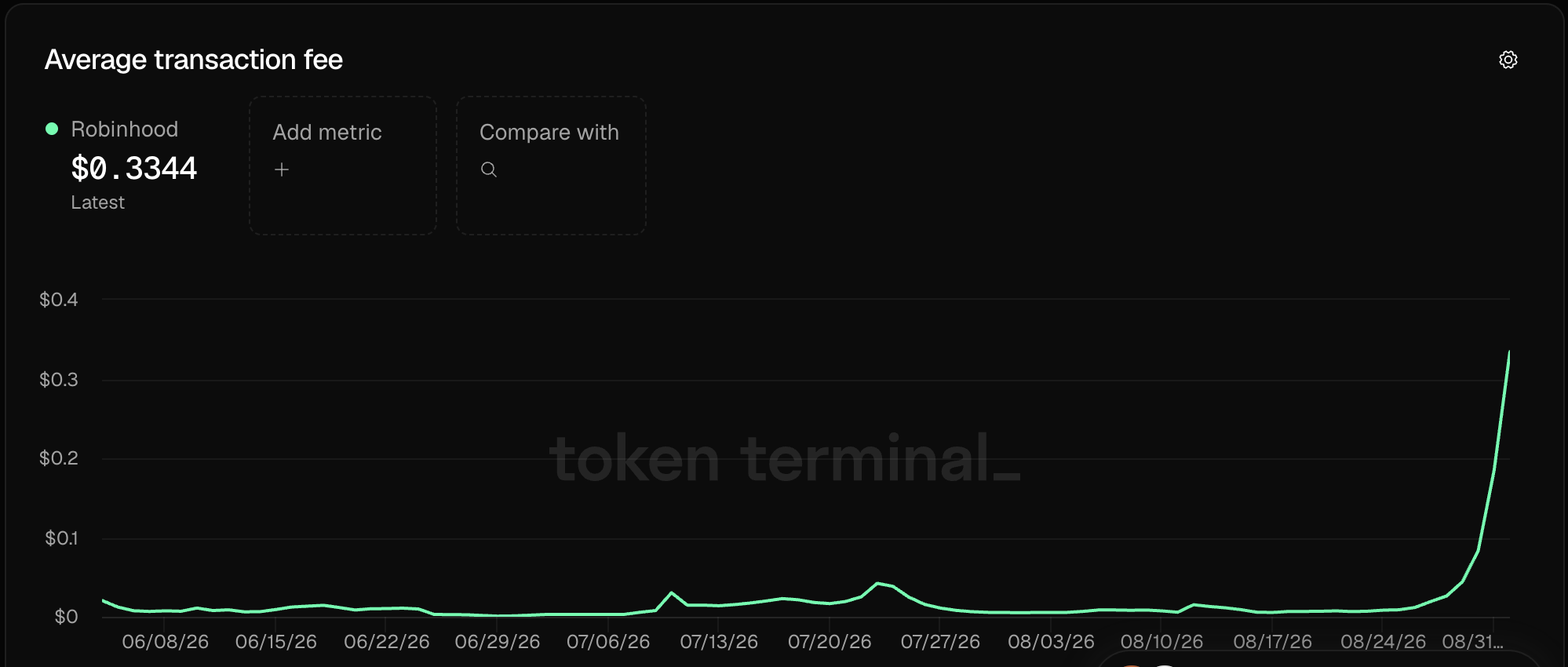
Token Terminal data shows that as of September 1, the average trading fee on Robinhood Chain has risen to $0.33, over 64 times higher than early August. In comparison, Base’s average trading fee during the same period is only about $0.0026, while Solana's is approximately $0.013. During peaks of popular meme coin trading, congestion, failed retries, token platform taxes, and routing losses combine, resulting in the actual cost of a single trade far exceeding this level. However, Robinhood’s official wallet currently still provides trading fee subsidies for eligible exchanges, which will continue until September 29.
Rising trading costs mean higher barriers to participation for players, but for Robinhood Chain, it also represents a stronger revenue capture ability.
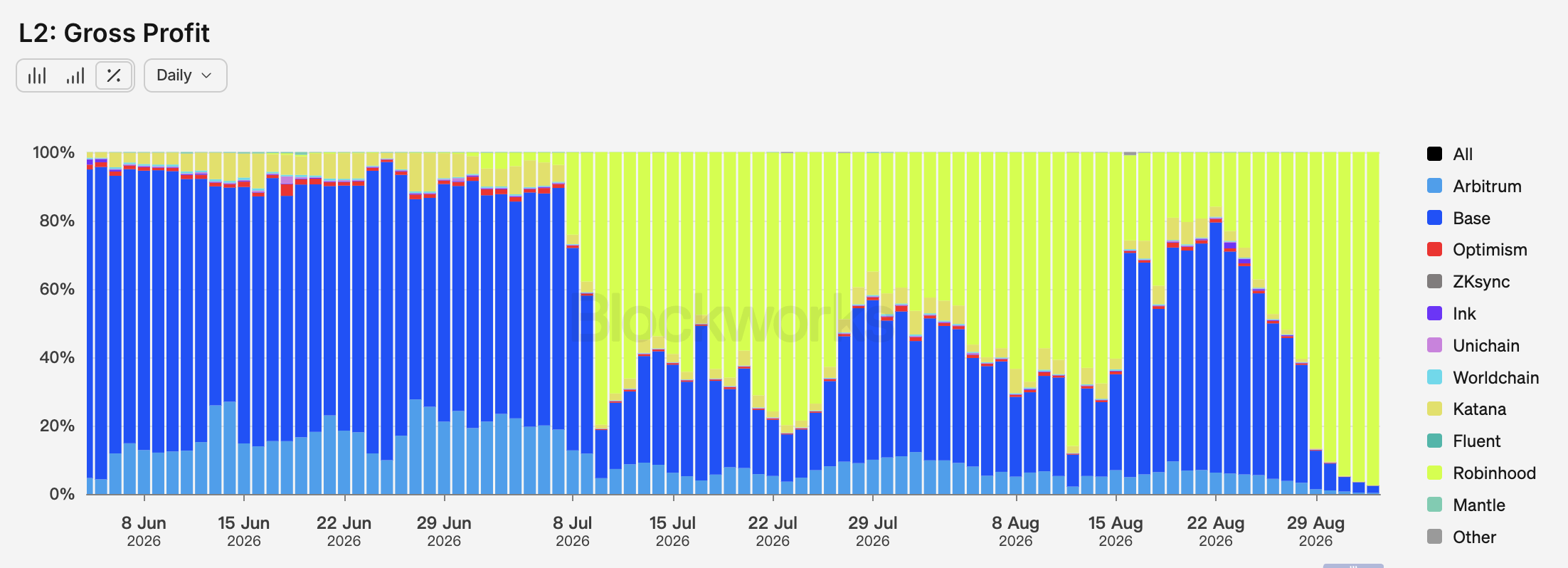
According to the latest data from arbdata, its cumulative fee revenue has risen to $18.6 million, setting a new historical high. At the same time, Blockworks data shows that as of September 2, Robinhood Chain's Layer 2 gross profit ratio reached an astonishing 97%. The continually rising fees also indirectly reflect the sustained influx of on-chain trading enthusiasm.
For players, the hotter the on-chain becomes, the more expensive it is to seize opportunities; for Robinhood Chain, however, it's a continuously growing revenue celebration.
免责声明:本文章仅代表作者个人观点,不代表本平台的立场和观点。本文章仅供信息分享,不构成对任何人的任何投资建议。用户与作者之间的任何争议,与本平台无关。如网页中刊载的文章或图片涉及侵权,请提供相关的权利证明和身份证明发送邮件到support@aicoin.com,本平台相关工作人员将会进行核查。


