Author: Alea Research
Translation: Shenchao TechFlow
Shenchao Guide: LayerZero aims to become the underlying exchange for all trading platforms: centralizing matching, clearing, settlement, and risk under Zero, while the front end is responsible only for customer acquisition. 75% of the fees are used for burning ZRO, and this economic design will directly change the value distribution in the trading landscape, requiring platform operators and token holders to re-understand their positions.
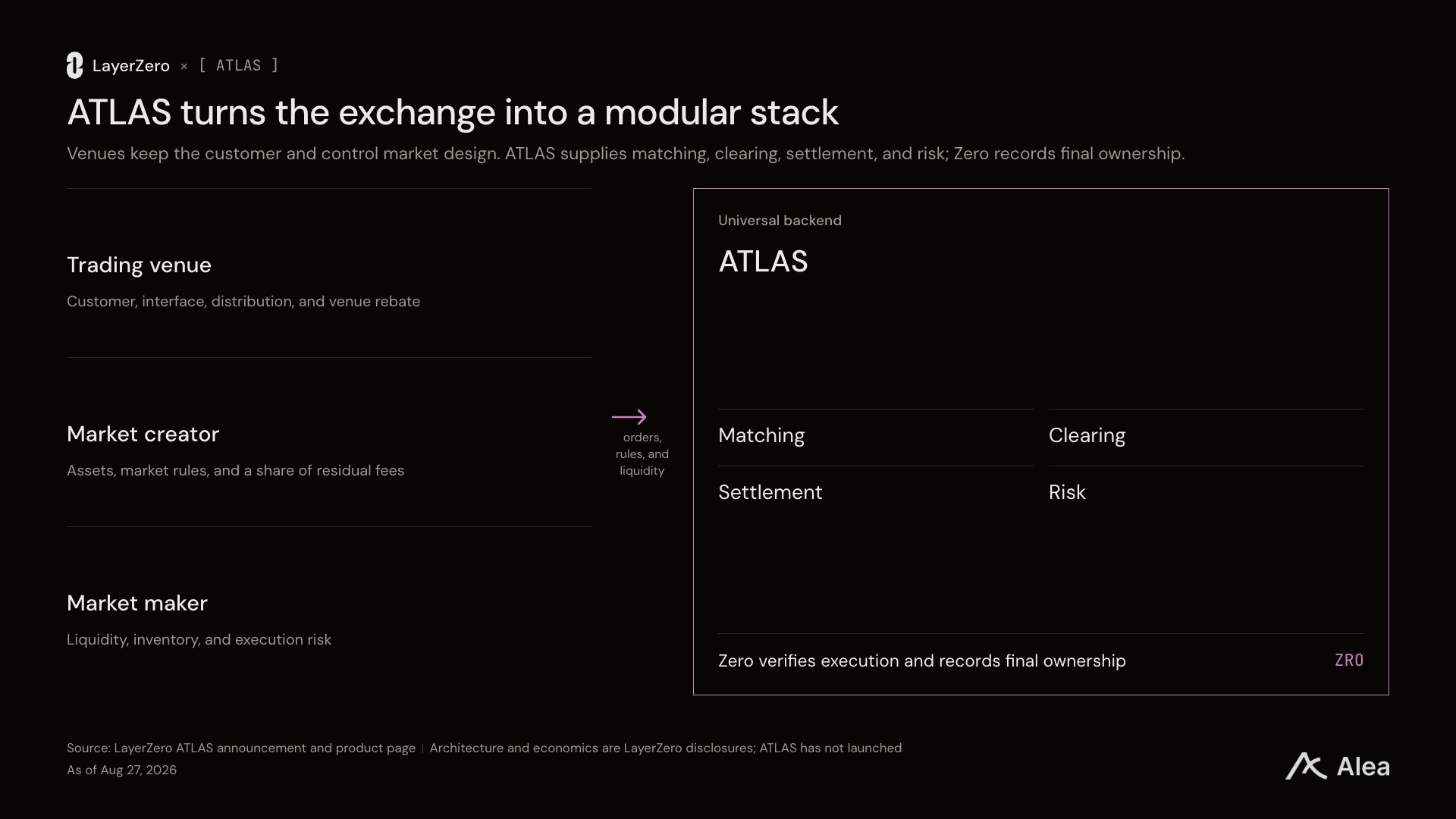
LayerZero announced the launch of ATLAS on August 25, 2026, aiming to become the trading engine at the core of various trading venues.
ATLAS stands for Aggregated Trading Liquidity and Settlement, a headless exchange built on Zero. It has no consumer applications. Trading venues maintain their own users and distribution channels through their interfaces.
Market creators decide the trading content.
Market makers provide liquidity.
ATLAS handles matching, clearing, settlement, and risk, while Zero records final ownership and validates execution.
This shifts the problem from traders to market operators. Exchanges, brokers, wallets, and market operators must trust LayerZero's backend rather than the infrastructure controlled by direct competitors.
ATLAS can cover a market far beyond crypto perpetual contracts, and large institutional demand should convert into ZRO economic value. It is planned to launch later in 2026.
Why Now: Tokenized assets have exceeded the capacity of market infrastructure
LayerZero's initial judgment was that assets and ledgers would become multi-chain. ATLAS expands this judgment from assets to price discovery and settlement.
This timing reflects a real infrastructure gap. Stablecoins, tokenized stocks, prediction markets, perpetual contracts, and private market debts are now traded around the clock. However, systems that match buyers and sellers often separate risk management from clearing and final settlement. Therefore, each handover increases reconciliation costs and dependence on balance sheets.
The existing crypto market has separated distribution from exchange infrastructure. Orderly reported on July 24, 2026, that over 400 brand perpetual contract DEXs use its shared order book. Hyperliquid released HIP-3, allowing builders to deploy independent perpetual contract markets after staking 500,000 HYPE. Injective launched a module that manages the order book throughout the entire process from execution to settlement.
These systems prove that distribution and exchange infrastructure can be separated. ATLAS promotes this model to a broader trading lifecycle and enters markets configured by institutions.
The business premise is that distributors will build on neutral infrastructure, retaining customers and sufficient economic interests. This transaction will determine the adoption rate; throughput only sets the technical threshold.
Mechanism: Trading venues become the native path of exchanges
Trading venues control user experience and order flow:
Market creators choose assets and the oracle, then set market rules.
Liquidity providers quote and bear inventory risk.
ATLAS provides a shared exchange engine.
Zero separates the execution of block producers from the verification of settlement layer validators.
This architecture creates two configurations:
Open ATLAS serves permissionless products, including crypto-native applications and prediction markets.
Institutional ATLAS uses the same engine while allowing institutions to implement access control and define product and market rules.

The headless design eliminates conflicts that undermine many exchange builders’ projects. Front ends built on top of exchanges often add an extra layer of fees on top of the exchange's own fees, competing with the exchange's native applications for the same pool of mature users. ATLAS has no native applications. The trading venue itself is the native path.
LayerZero reports a median latency of 965 microseconds for perpetual contracts. It announced that in a simulated public deployment environment, p95 latency is 1.418 milliseconds, and p99 latency is 2.641 milliseconds. ATLAS will be configured to handle 200,000 transactions per second upon launch.
Every transaction is verified on-chain using zero-knowledge proofs. More details can be found in the Zero paper published on February 10, 2026, which states that Jolt Pro implements succinct proofs and lists zero-knowledge proofs in its recent roadmap.
Operational Economics: 75% becomes gross fees of 26.25% to 60%
ATLAS charges an all-inclusive trading fee. Open ATLAS trading venues earn a rebate between 20% and 65% based on a combination of ZRO staking amount and total trading volume. The highest tier may require up to 1% of ZRO supply. The remaining fees are allocated 25% to market creators and 75% to purchase and burn ZRO.
With 100 gross fee units and a 20% trading venue rebate, the trading venue earns 20. The creator earns 20, leaving 60 for the purchase and burn of ZRO.
At a 65% rebate, the trading venue earns 65. The creator earns 8.75, leaving 26.25 for ZRO.
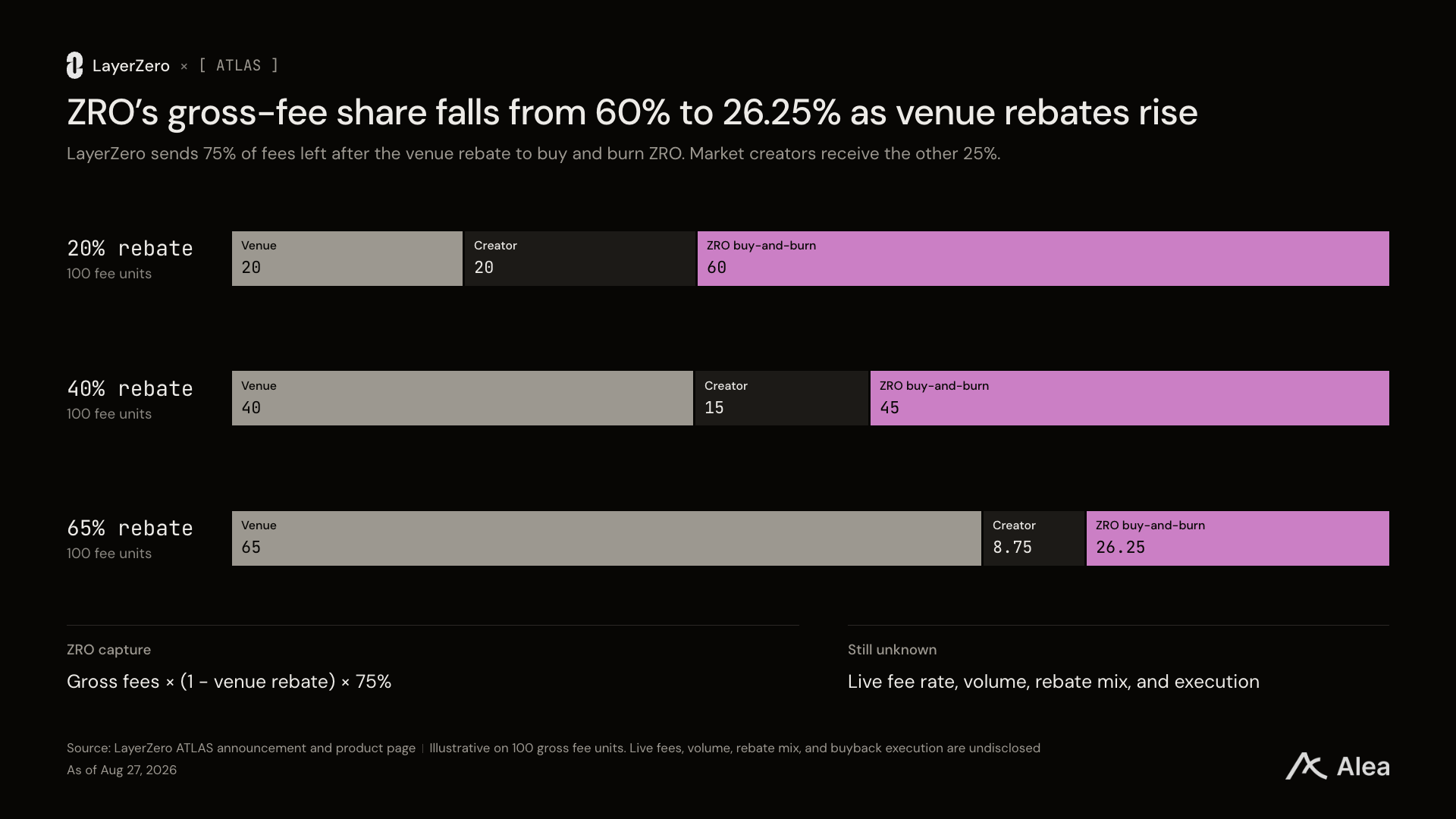
The 75% allocation applies only after the trading venue rebate. Therefore, within the disclosed rebate range, ZRO actually captures 26.25% to 60% of gross fee units. The actual capture rate depends on four undisclosed variables: actual rates, trading volumes, distribution of trading venues across rebate tiers, and the execution of purchases and burns.
This model aligns revenue with each role. Trading venues profit from distribution, creators profit from market expertise, while purchases and burns tie ZRO demand to shared infrastructure. Higher trading venue rebates can improve distribution and liquidity but decrease the proportion available for ZRO in each gross fee.
ATLAS grants ZRO direct effects. The token protects Zero through delegated proof of stake, pays gas, manages upgrades and zones, qualifies trading venues for rebates, and generates demand for purchases and burns from remaining trading fees. This creates a clear value capture path, provided there is sufficient activity and execution.
In an optimistic scenario, staking ZRO can yield better economic outcomes for trading venues. Better economic outcomes attract distributors, followed by market makers and creators. More trading volume increases demand for purchases and burns, enhancing the value of moving to higher tiers.
Adverse paths also arise from the same mechanism. Large trading venues demand the highest rebates. Liquidity concentrates, with smaller venues unable to compete with dominant order books; residual token capture declines. The system gains activity volume, but the actual capture of ZRO is below the level implied by the surface numbers.
What Consensus Overlooks: LayerZero's Advantage is Neutral
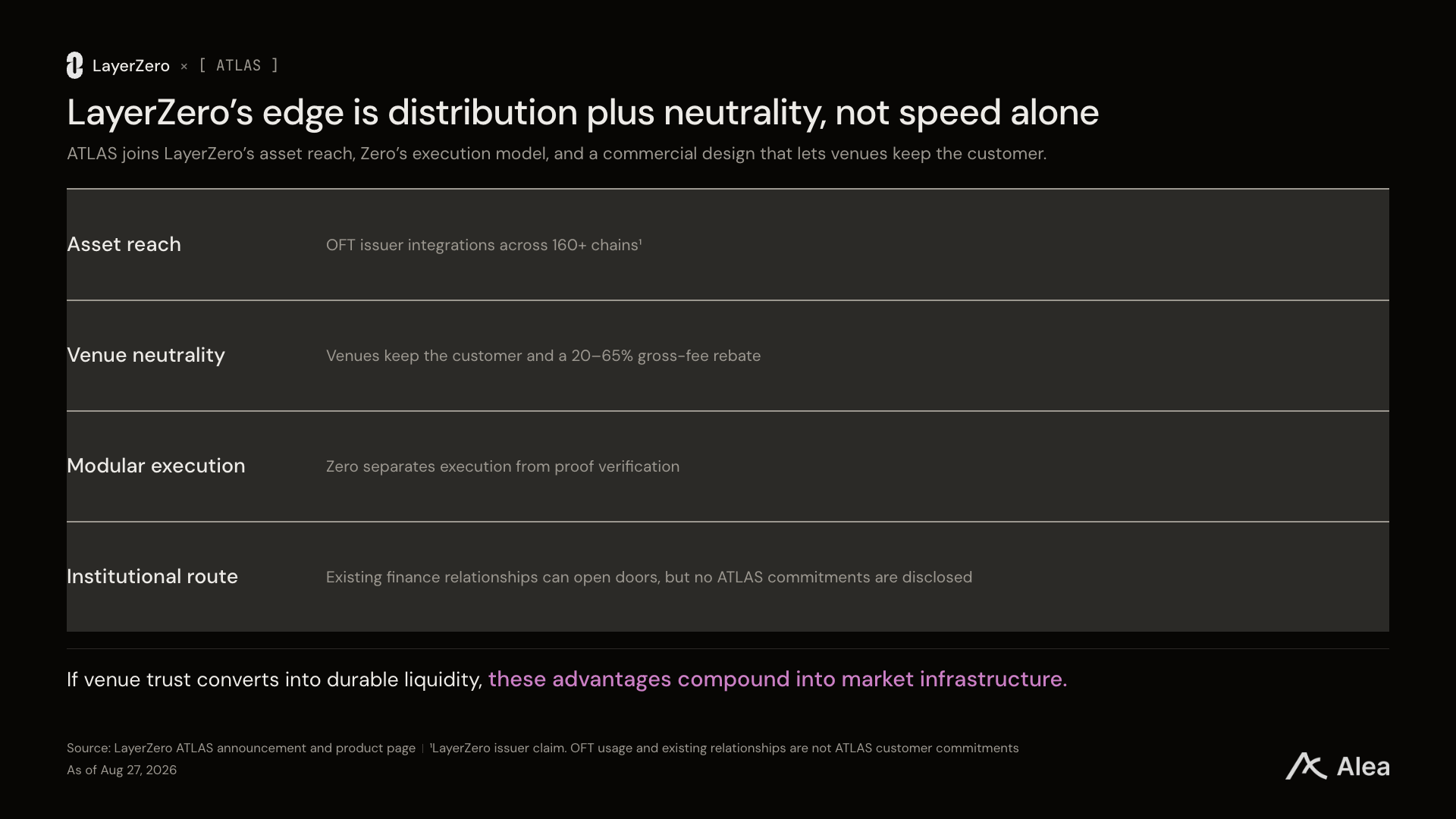
Performance is merely an entry threshold. LayerZero's strategic advantage comes from neutrality plus distribution capability.
LayerZero has lived beneath applications rather than standing in front of their users. It has integrated cross-chain assets, established relationships with issuers and financial institutions, and designed its commercial identity as infrastructure.
The headless exchange continues this stance. GTE, Bullish, defined.fi, and TrueNorth provide the first venues for Open ATLAS. LayerZero states that institutional partners will follow.
The company shares 20% to 65% of the economic benefits of each transaction with the venues. This choice acknowledges a lesson often resisted by exchanges: the party that earns customer trust and owns customer relationships needs a sustainable business model.
What to Watch Next
ATLAS is expected to launch later in 2026. LayerZero has not disclosed the exact launch date.
Compressing the trading lifecycle eliminates handover phases. This also concentrates responsibility. Failures in matching, risk, proof generation, data availability, governance, or settlement may impact every venue using the shared backend.
Another layer of risk comes from market creators. New assets need reliable oracles and margin rules, as well as a clear path from clearing to final settlement. Open access will also widen the product range and increase the costs associated with weak controls.
The institutional version of ATLAS faces another constraint. Institutions require configurable rules. Counterparties and regulators need clarity on: who operates the market, who bears losses, where the assets are located, and which institution can reverse or upgrade the system. Technological verifiability cannot address these legal questions.
Overall, ATLAS will test whether trust in LayerZero's messaging layer can transfer to operating exchanges. Success will shift LayerZero from conveying messages and assets between markets to operating internal market mechanisms.
免责声明:本文章仅代表作者个人观点,不代表本平台的立场和观点。本文章仅供信息分享,不构成对任何人的任何投资建议。用户与作者之间的任何争议,与本平台无关。如网页中刊载的文章或图片涉及侵权,请提供相关的权利证明和身份证明发送邮件到support@aicoin.com,本平台相关工作人员将会进行核查。


