This trend puts the Federal Reserve in a dilemma: raising interest rates will instantly increase government financing costs, forming dual resistance from both fiscal and political fronts, and fundamentally challenging the independence of policy.
Written by: Bao Yilong, Wall Street Insights
The U.S. Treasury is continuously expanding the financing scale of treasury bills, bringing its functions increasingly close to that of a de facto monetary issuing body, and gradually intervening in the Federal Reserve's domain through quasi-monetary policy operations.
On September 2, Bloomberg macro strategist Simon White pointed out that this trend will structurally increase inflationary pressure, weaken the Federal Reserve's policy independence, and pose greater risks to market stability and the real returns of stocks and bonds.
Currently, treasury bills account for 22.7% of the United States’ outstanding debt, exceeding the informal cap of 20% set by the Treasury. Excluding the portion held by the Federal Reserve, this ratio rises to 24.1%.
White believes that as the fiscal deficit continues to widen, this ratio is expected to climb further, and policy interest rates will no longer just be a core variable of monetary policy, but will also become a key anchor point determining fiscal stability.
This structural shift means that if the Federal Reserve attempts to control inflation through interest rate hikes, it will face stronger political and fiscal resistance. Raising interest rates will directly raise the government's financing costs, effectively tightening fiscal policy, thereby exerting reverse pressure on monetary policy.
White bluntly states that under the backdrop of continued expansion in the issuance of treasury bills, finding an interest rate level that simultaneously meets the inflation target, maintains financial stability, and prevents uncontrolled government borrowing costs is perhaps fundamentally an impossible task.
From Financing Tool to "Shadow Currency": The Evolution of Treasury Bills' Role
Treasury bills have always been a routine tool for the U.S. government’s short-term financing, but White points out that the Treasury intends to replace long-term bonds with treasury bills to absorb financing needs arising from the expanding fiscal deficit.
From the Treasury's own perspective, this strategy has clear financial logic:
- Short-term debt financing costs are usually lower than long-term debt, and treasury bills target a broad pool of funds that prefer low-duration assets;
- Compared with long-term bonds, treasury bills have a smaller fund diversion effect on bank deposits, helping to maintain market liquidity and real economic spending;
- Additionally, this pathway also circumvents the political sensitivity of openly implementing financial repression to some extent, even though the Treasury's expansion of the government bond repurchase program has already been seen as a substantive step in that direction.
However, in White's view, treasury bills are no longer just ordinary short-term financing instruments. According to Perry Mehrling's monetary hierarchy theory, at the top of the financial system is Federal Reserve reserves, followed by bank deposits, repurchase agreements, and money market fund shares, which are considered "shadow currency."
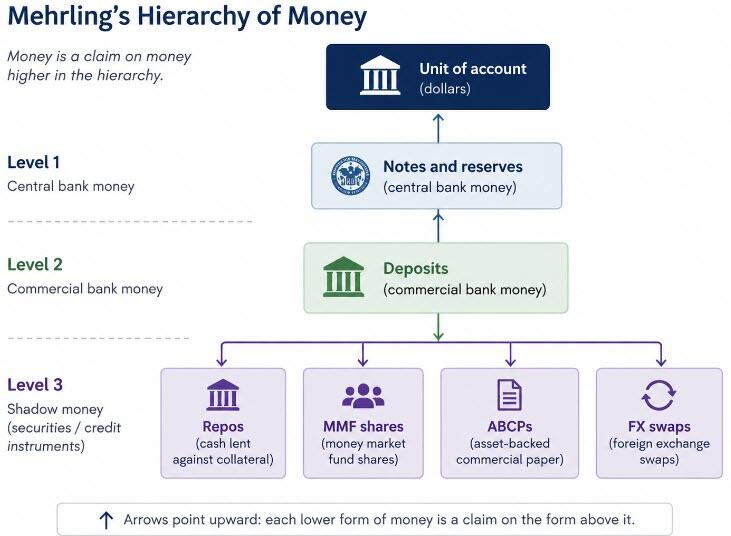
Because of their very short duration and extremely low valuation uncertainty, treasury bills usually enjoy zero discount treatment in the repurchase market and can be reused multiple times through the collateral rehypothecation mechanism without losing value.
White points out that this makes treasury bills functionally closer to the currency itself, serving as a liquidity tool usable for final settlement.
Rehypothecation Mechanism Amplification Effect, Quiet Expansion of Quasi-Money Supply
White particularly emphasizes the key role of the rehypothecation mechanism in this process.
In the repurchase market, dealers can obtain collateral from their own treasury bond holdings or borrow it through reverse repurchase operations and then pledge the latter to other trading counterparts.
According to a 2021 academic study cited by Bloomberg, on average, U.S. government bonds were rehypothecated three to five times from 2015 to 2021; in other periods, this number has been estimated from different sources to have been even higher. In other words, dealers are effectively continuing to amplify the amount of effective collateral available in the market.
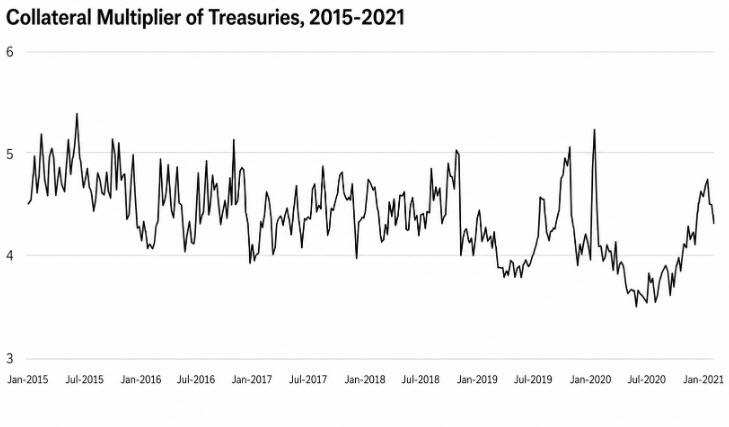
White points out that for long-term government bonds, each round of rehypothecation will gradually erode the actual value of the collateral through discount rates; however, treasury bills can be repeatedly pledged without value loss because the discount rate is zero. This characteristic allows treasury bills to continuously replicate themselves within the financial system, creating a liquidity expansion effect resembling that of quasi-money.
Historically, the rising proportion of treasury bills in total outstanding debt has often preceded structural inflationary trends.
White believes there is a reasonable transmission path behind this: increased liquidity pushes up asset prices, strengthens the wealth effect, while artificially suppressing capital costs, ultimately transmitting to the real economy and raising overall price levels.
The Federal Reserve in a Dilemma, Policy Independence Fundamentally Challenged
White believes that the increase in the scale of treasury bill issuance constitutes a fundamental constraint on the Federal Reserve's policy space.
As more public debt becomes directly linked to short-term interest rates, every rate hike by the Federal Reserve will immediately raise the government's interest expenses, equivalent to automatically tightening fiscal policy. This mechanism objectively creates political pressure, making it more difficult for the Federal Reserve to act decisively in the face of rising inflation.
White directly points out that with the continued rise in the proportion of treasury bills, "the Federal Reserve may no longer be able to optimally set policies to achieve inflation targets in the future."
Meanwhile, the increase in treasury bill supply may also trigger vulnerabilities in the short-term financing market. If the new supply pushes treasury bill yields upward, money market funds may shift funds from the repurchase market to treasury bills, thereby reducing liquidity supply in the repurchase market.
White particularly notes that in the current context where the sum of Federal Reserve reserves and reverse repurchase tool sizes are low relative to GDP, this migration of funds poses a particularly pressing risk for tightening in the short-term financing market.
At the financing structure level, the Treasury itself will also face higher fragility. The issuance of treasury bills means more frequent and larger-scale auctions, where any rise in inflation expectations will immediately reflect in borrowing costs. Even if the Treasury intends to reduce long-term bond issuance, if the term premium rises significantly, long-term financing costs may ultimately increase rather than decrease.
White's conclusion is rather pessimistic: as the proportion of treasury bills expands, policy interest rates will simultaneously bear the dual functions of monetary policy and fiscal stability. Finding a balanced interest rate level that satisfies the inflation target, financial stability, and fiscal sustainability is likely to be a fundamentally unsolvable problem.
免责声明:本文章仅代表作者个人观点,不代表本平台的立场和观点。本文章仅供信息分享,不构成对任何人的任何投资建议。用户与作者之间的任何争议,与本平台无关。如网页中刊载的文章或图片涉及侵权,请提供相关的权利证明和身份证明发送邮件到support@aicoin.com,本平台相关工作人员将会进行核查。