Author| Yuhang Yuan
Editor| Jingyu
There are very few robots that can make you laugh at first sight.
On August 27, Pollen Robotics, a subsidiary of Hugging Face, opened pre-orders for Microduck.
A bipedal robotic duck standing 25 cm tall and weighing less than 800 grams, available in four colors, priced at $399, with shipment before Christmas. It can walk, squat, and get back up on its own after being knocked over. It can even put on a pair of detachable roller skates to skate. Its mouth is articulated, allowing it to bend down to pick up socks or markers from the ground and then stand up again, still holding its "loot" in its beak.
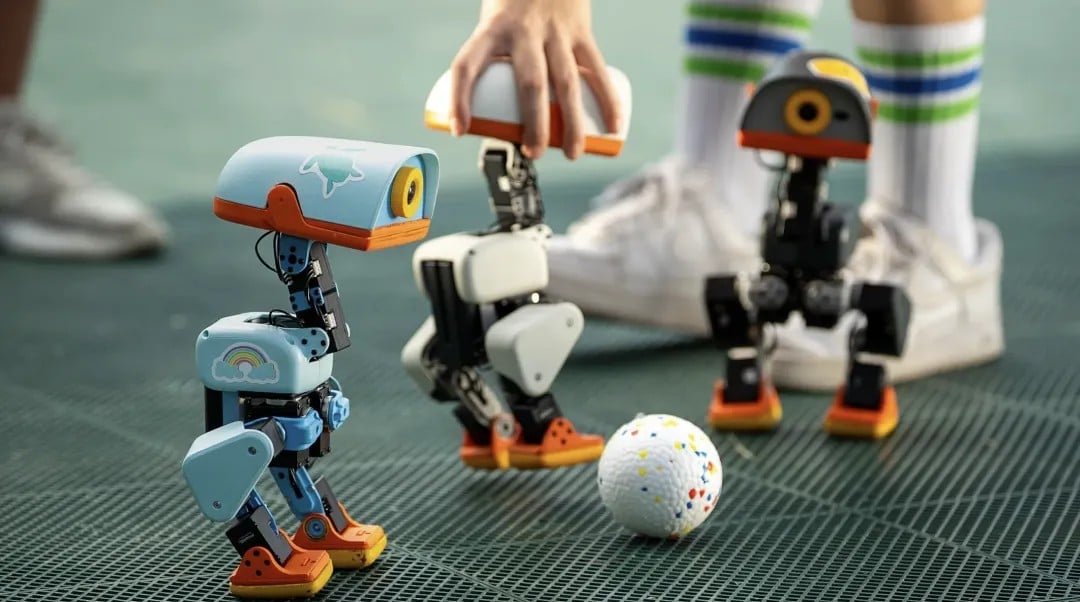
Microduck soccer match|Image source: Hugging Face
It does not have voice interaction and cannot talk, but it has a microphone and speaker, and each Microduck generates its unique "timbre identity" after initial setup.
The official setting is very clear—treat it as a living creature, rather than an assistant.
If you only see "cuteness," then you are likely underestimating what lies behind this duck.
01 An "electronic pet" you can play with right out of the box
The contents of the box are simple—a robotic body, a battery, a USB-C cable, and a game controller. Charge it, pair the controller, and the duck can move.
It comes pre-installed with 7 behavior strategies, each an independently trained action model using reinforcement learning. By pushing the joystick with the controller, Microduck takes little strides forward, wobbling while walking, at a slow but steady pace. It stops when you release the joystick, standing very straight.
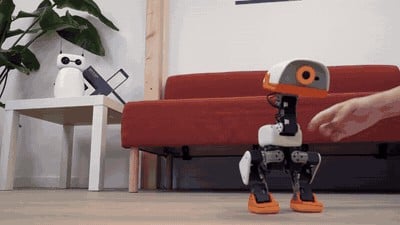
Although it has no wings, the little duck has quite good balance|Image source: Hugging Face
Pressing buttons triggers different actions—squatting, standing, raising its leg to kick a ball. From the GIFs, the most irresistible action to replay is likely "getting up by itself." Push it backward, and it lies on its back for a second, then twists its body, lifts its head, and executes a roll to stand up again—all in one smooth motion.

The little duck's beak can indeed pick up socks, and it can also roller skate|Image source: Hugging Face
The mouth can grasp objects. Lower its head, open its mouth, and grab small items from the ground, then lift its head and take two steps—this action is called "Grab," resembling a real duck catching fish by the water's edge.
The accessory pack includes a pair of detachable roller skate bases, which unlock the "skating mode" when attached. There’s also a small ball to kick, a laser pointer for it to track with its camera, and NFC tags—a different behavior command can be preset on the table, and the duck can walk over and scan it to trigger the corresponding action.
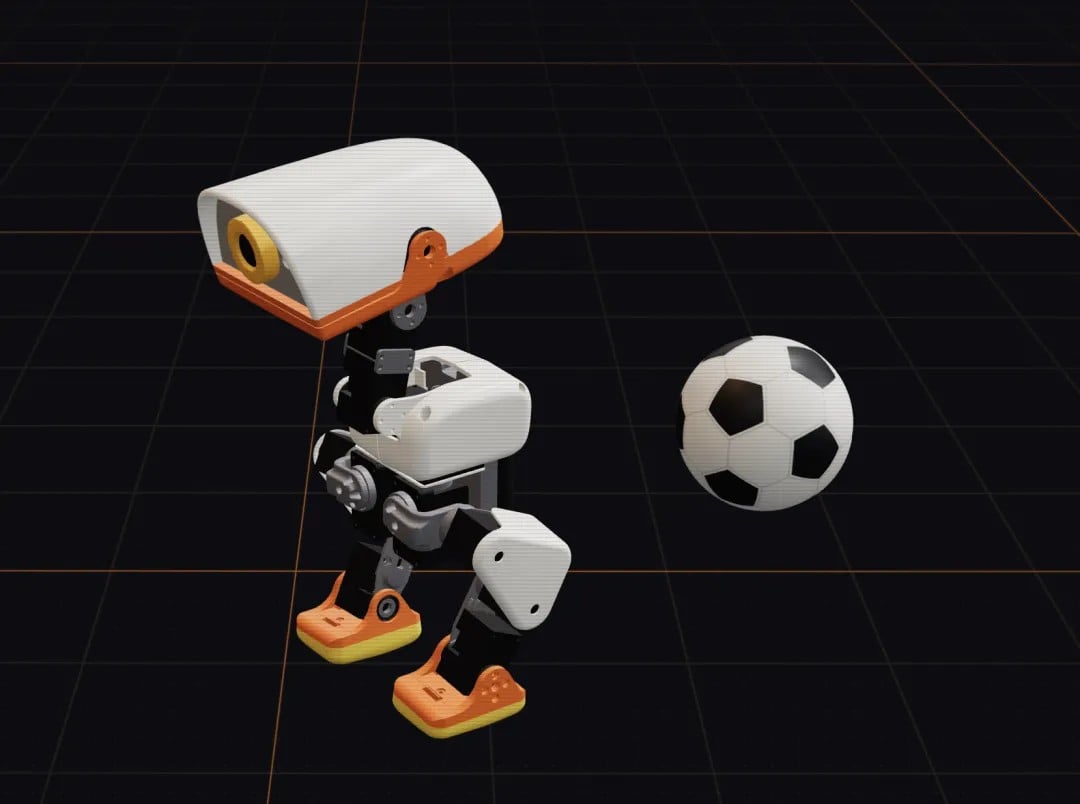
Users can train virtual little ducks to perform various actions in a simulation environment|Image source: Hugging Face
In short, the unboxing experience is designed more like Nintendo than Boston Dynamics. It can be enjoyed without understanding any code, but if you do understand, the playability will increase exponentially—every factory-installed action can be retrained or a brand new behavior can be trained from scratch and then deployed back to the actual device.
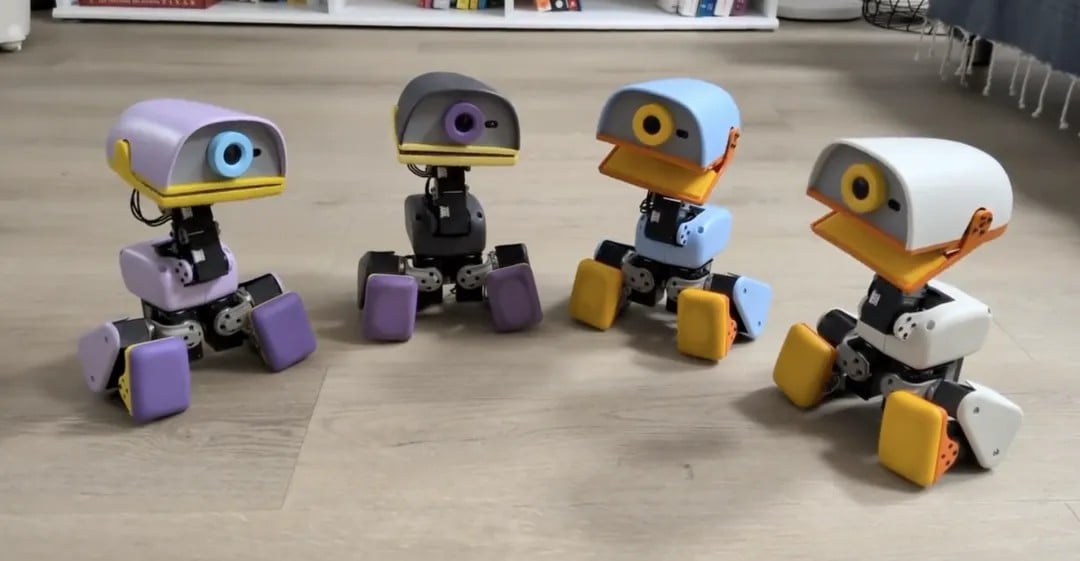
Ducks of different colors sit side by side|Image source: Hugging Face
The four color options also have significance. Hugging Face states that the duck shape was chosen because the robot's proportions and wobbling gait naturally resemble those of a duck. The four colors (milky white, graphite, lavender, sky blue) together "look like a group of different characters, rather than a row of identical machines."
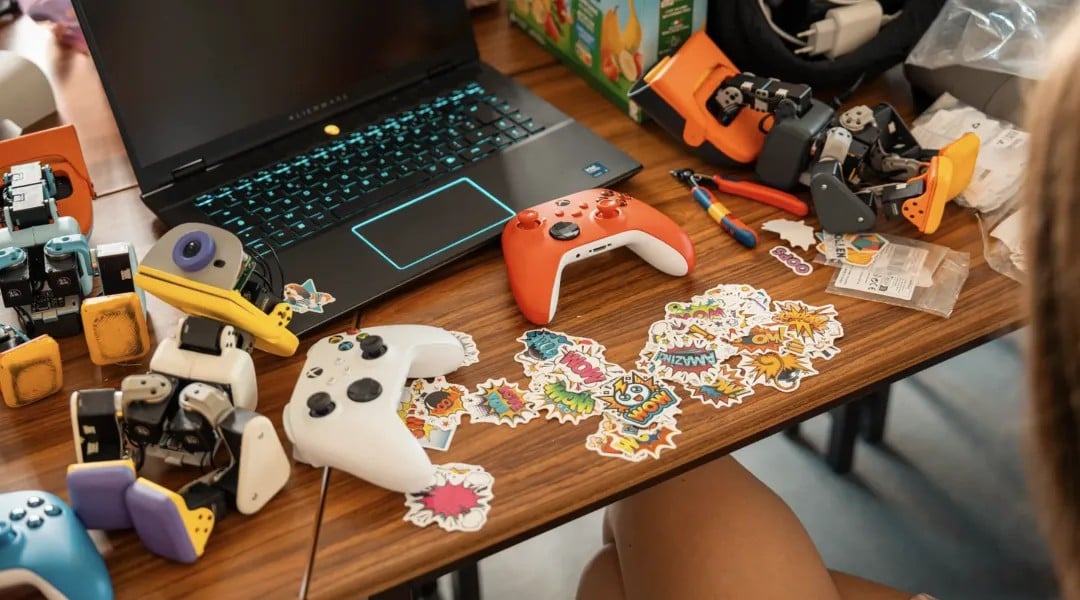
The official stickers allow you to personalize your little duck|Image source: Hugging Face
The official package also includes stickers, allowing personal customization of the duck’s lips and eyes. When there are multiple ducks together, they can team up to kick a ball, creating a chaotic yet joyful scene.
02 A duck raised in the community
Microduck is not a product that came out of nowhere.
Its predecessor was called Open Duck Mini, which was an open-source project initiated by Pollen Robotics' R&D engineer Antoine Pirrone. The inspiration came from a BDX robot in Disney's "Galactic Starcruiser" experience—a small character that walks on two legs and is expressive. Pirrone wanted to recreate it using 3D printing and cheap servos, with material costs around $400, assuming you have a printer and soldering iron.
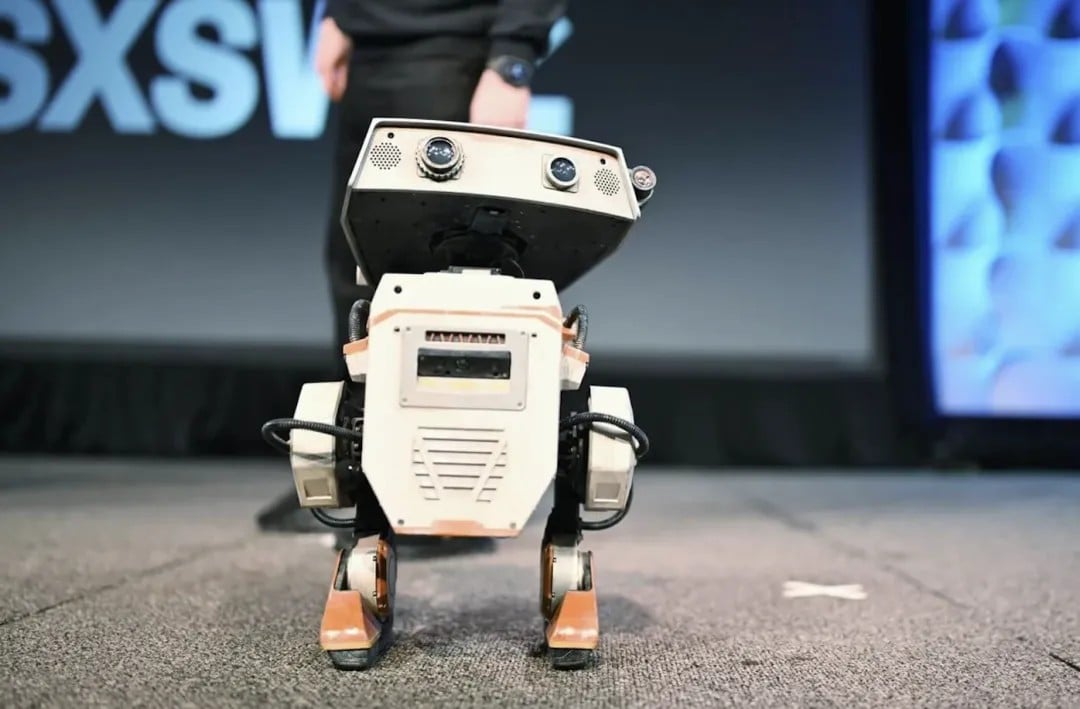
The little duck's predecessor Open Duck Mini|Image source: AIFITLAB
This project gained over 2600 stars on GitHub. In June of this year, two Open Duck Minis were featured on stage at Google I/O, running Google's Gemma 4 model on Raspberry Pi 5 and Jetson Orin Nano for on-device voice inference, not connecting to the cloud. That demonstration made many people realize for the first time that hardware costing a few hundred dollars could run a decent language model locally.
But Microduck's direction is opposite to that demonstration. The peak moment of Open Duck Mini was making inferences—letting the small model "speak" on the device; whereas Microduck's key selling point is control—letting strategy models drive the robot to "act." The 7 pre-installed behaviors are all reinforcement learning strategies trained in the MuJoCo physics simulator and deployed on the actual machine to run at 50 Hz.
In other words, Pirrone's community project has been picked up by Pollen for commercialization, but the core philosophy remains unchanged—providing more people with a tangible platform to get started with reinforcement learning and sim-to-real.
03 "Open source," but only halfway
The software stack of Microduck is fully open source under the Apache 2.0 license, including SDK, MuJoCo simulation environment, and complete reinforcement learning training pipeline. All seven action strategies out of the factory are also publicly available; you can fork them, modify, retrain, and deploy back to the actual machine. The official even encourages users to publish new behaviors they have trained to the community, allowing other ducks to learn as well.
Hugging Face CEO Clem Delangue's tagline on X is very direct—"A $399 open-source robot you can teach new tricks with reinforcement learning."
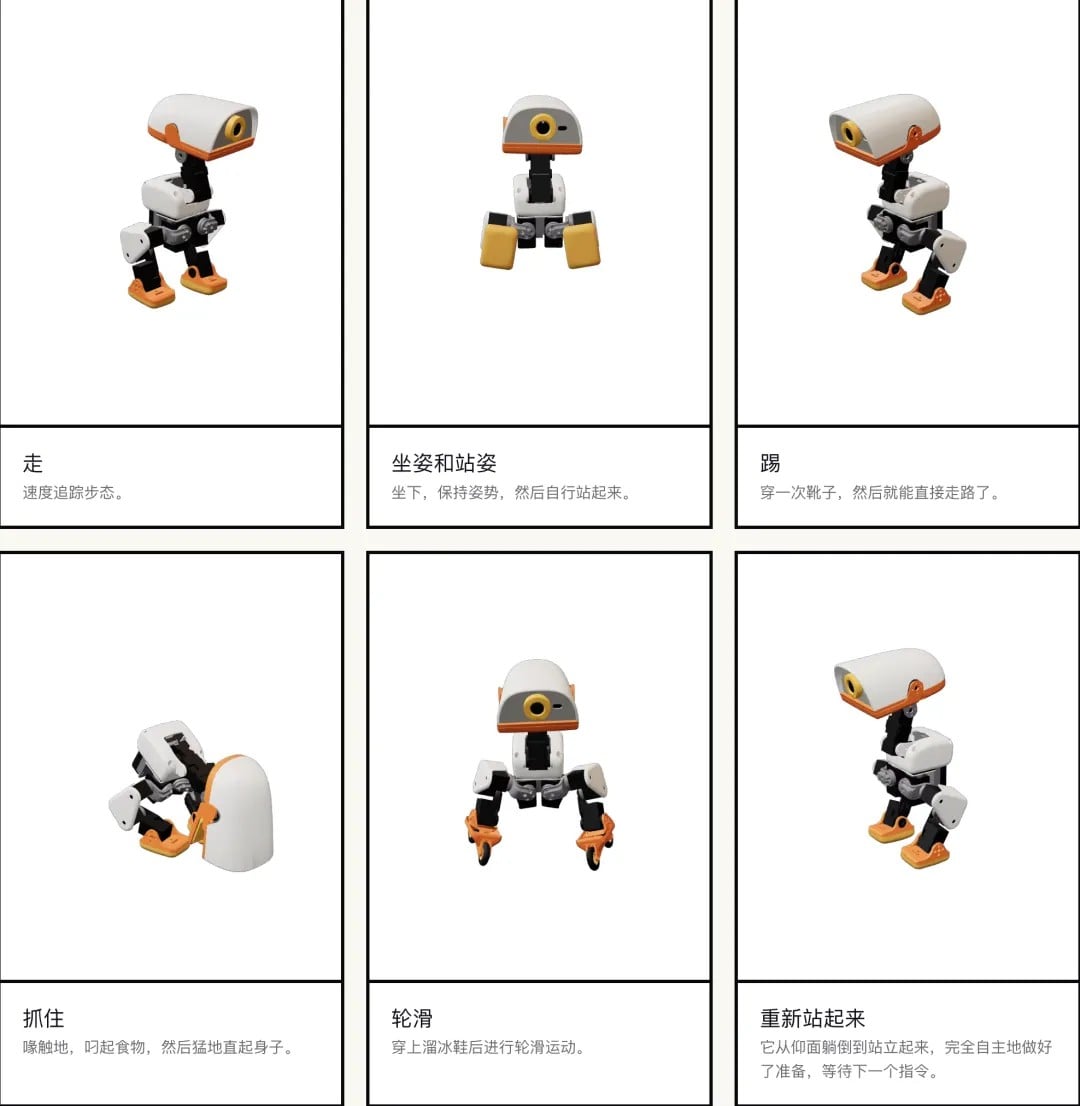
Some actions the little duck can currently perform|Image source: Hugging Face
However, strictly speaking, the term "open source robot" is misleading. Pollen Robotics clearly states that the hardware design and circuit diagrams will not be open-sourced. This means you can see, modify, and retrain all the "brains" that make the duck move, but the blueprints for creating the duck's "body" are locked.
This is a product with an open-source soul running on a closed-source shell.
For the pure open-source community, this might be a disappointment. However, from a business perspective, the logic is very clear—hardware is Pollen's moat, and software openness is aimed at ecological development. Hugging Face's strength lies in turning the developer community into a flywheel. The open sharing of model weights has made Hugging Face Hub the GitHub of the AI field, and now they want to replicate the same logic in robotic behavior strategies.
Training a walking strategy, publishing it to the Hub, and having others download and run it on their own ducks—this represents the mapping of "models are useful because people can build on one another's work" to the physical world.
04 Hugging Face's Embodied AI Chessboard
To understand Microduck, it needs to be placed within the context of Hugging Face's layout in embodied intelligence over the past two years.
In early 2024, Hugging Face hired Remi Cadene from Tesla as Chief Research Scientist to lead a brand-new open-source robot project. A few months later, LeRobot was released—a comprehensive open-source library for end-to-end robotic learning, positioned as "Transformers for the robotics field," integrating dataset hosting, model training, and physical simulation.
In April 2025, Hugging Face acquired Pollen Robotics located in Bordeaux, France, incorporating about 20 employees into its team. Pollen's flagship product, Reachy 2, is a research-grade humanoid robot priced at approximately $70,000, already deployed at top universities like Cornell and Carnegie Mellon. However, $70,000 is destined for a niche market.
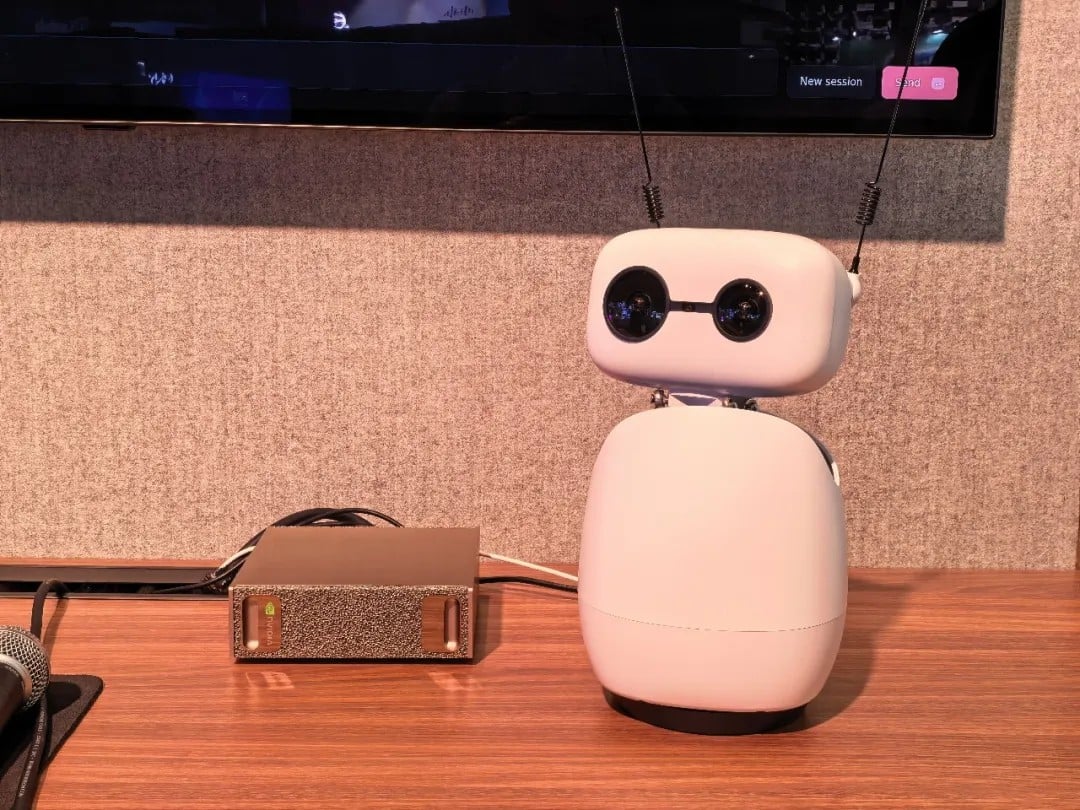
Geek Park chatted with the Reachy Mini robot at this year’s GTC conference in March|Image source: Geek Park
Just three months after the acquisition was completed, in July 2025, Reachy Mini was released. A desktop robot 28 cm tall, starting at $399, focusing on conversational interaction, animated expressions, and visual recognition. At CES this January, Jensen Huang personally demonstrated it with DGX Spark during his keynote, labeling it "your own office R2-D2." Pollen revealed that Reachy Mini has shipped a total of 3000 units.
Looking back at this trajectory now, the logic is very clear—LeRobot builds the platform, Pollen makes the hardware, Reachy Mini targets "interaction," and Microduck focuses on "action." The two product lines complement rather than compete with each other. Reachy Mini has a head, antennas, and can talk, making it suitable as a vessel for conversational AI and visual models; Microduck has legs, can walk, and can grasp objects, making it suitable for reinforcement learning and motion control experiments.
Hugging Face is trying to cover the two core research directions in embodied intelligence on the desktop for under $500.
05 A $13 Billion Duck
All of these arrangements now have a broader context.
On the same day that Microduck opened pre-orders, multiple media outlets reported that Nvidia had essentially reached an agreement to acquire Hugging Face for about $12.9 billion. If completed, this will be one of Nvidia's largest acquisitions in history.
Nvidia's intentions are not hard to guess. The prosperity of open-source models directly drives the demand for GPUs—every model training and inference on the Hub could mean more computational power consumption. But beyond the model ecosystem, Nvidia has equally ambitious plans in embodied intelligence.

At the end of this year's GTC conference, Jensen Huang interacted with the snowman robot|Image source: Geek Park
From Isaac Sim to the GR00T base model, and then to the Cosmos world model, Nvidia is constructing a full-stack robotics toolchain from simulation to deployment. Hugging Face's LeRobot, Pollen's hardware, and the developer community precisely fill in the "low-cost hardware entry" and "community flywheel" pieces of this system.
A $399 duck may be the cheapest yet most effective user acquisition tool on Nvidia's chessboard. It allows students, researchers, and enthusiasts worldwide to run through the entire reinforcement learning process on Microduck, thereby naturally evolving into users of Nvidia's embodied intelligence ecosystem.
However, the acquisition also brings uncertainty. Hugging Face's core values are open-source and neutrality—it hosts models from Meta, Google, Mistral, and others. Once it falls under Nvidia's umbrella, whether this neutrality can be maintained or whether the community will vote with their feet remains to be seen.
Microduck itself will not solve any core problems in robotics; Pollen acknowledges this as well. But it may give more people the chance to touch those complex problems firsthand. As embodied intelligence is still far from large-scale commercialization, enabling more people to "join the game" may be more important than any technological breakthrough.
This duck stands very steadily. As for the chess game behind it, it has just begun.
免责声明:本文章仅代表作者个人观点,不代表本平台的立场和观点。本文章仅供信息分享,不构成对任何人的任何投资建议。用户与作者之间的任何争议,与本平台无关。如网页中刊载的文章或图片涉及侵权,请提供相关的权利证明和身份证明发送邮件到support@aicoin.com,本平台相关工作人员将会进行核查。


