

This article is jointly produced by PANews and BIT US Stocks. BIT US Stocks offers over 10,000 US mainboard stocks and ETFs, supports deposits and withdrawals in stablecoins and traditional US dollar wire transfers, and enjoys full shareholder rights and dividend voting rights.
The cryptocurrency market lost momentum before resistance, with BTC bulls and bears hunting around $77,000
Bitcoin is still fluctuating; although the price stands at a high following a strong rebound in August, the technical structure has begun to weaken. BTC has encountered resistance multiple times between $81,000 and $82,000. After achieving nearly a 25% increase in August, the strongest gain since 2017, the market opened in September showing weakness, with sentiment shifting to "can it hold?" The short-term key is $77,000: Rekt Capital noted early signs of a "evening star" and bearish divergence, and heavy selling pressure at the 50-week average (around $81,200).
Currently, liquidity around BTC is almost symmetrical at $74,500 to $77,500 below and $79,000 to $82,000 above, indicating a possible repeated sweep in the short term. Jasper De Maere, an OTC trader at Wintermute, stated that $75,000 and $72,000 are key supports ahead of the September FOMC meeting; if the weekly close falls below $72,000, the market will struggle to find a clear bottom again.
On the other hand, Michaël van de Poppe also believes that BTC is still in a clear range-bound situation. After hitting resistance on the upside, a sweep back toward $76,000 to $77,000 is not surprising and could even represent a new trading opportunity. Some traders see $75,600 as a critical short-term dividing line: if it holds, there may be a chance to challenge $81,400 to $82,800 again, and breaking $83,000 could even open up a path to $93,000 to $96,000.
Despite facing external headwinds such as oil prices breaching $90, a 10-year US Treasury yield exceeding 4.8%, and a strengthening dollar, BTC remains between $76,000 and $80,000, demonstrating some resilience, but the dollar's rebound remains the biggest external pressure. Historical data shows that Bitcoin's average return in September is -2.96%, often referred to by traders as "Rektember". Going forward, attention needs to be focused on whether Bitcoin can hold $77,000, whether it can break $82,000, and whether ETF fund flows continue to be constructive.
Today's highlights:
Ethena (ENA) unlocked approximately 40.63 million tokens, valued at approximately $6.4 million
Upbit's 24-hour trading volume ranking: XRP, BTC, ETH, BONK, SKR
Bitcoin spot ETF: -$236 million
Ethereum spot ETF: +$10.9528 million, continuing a net inflow for 12 days
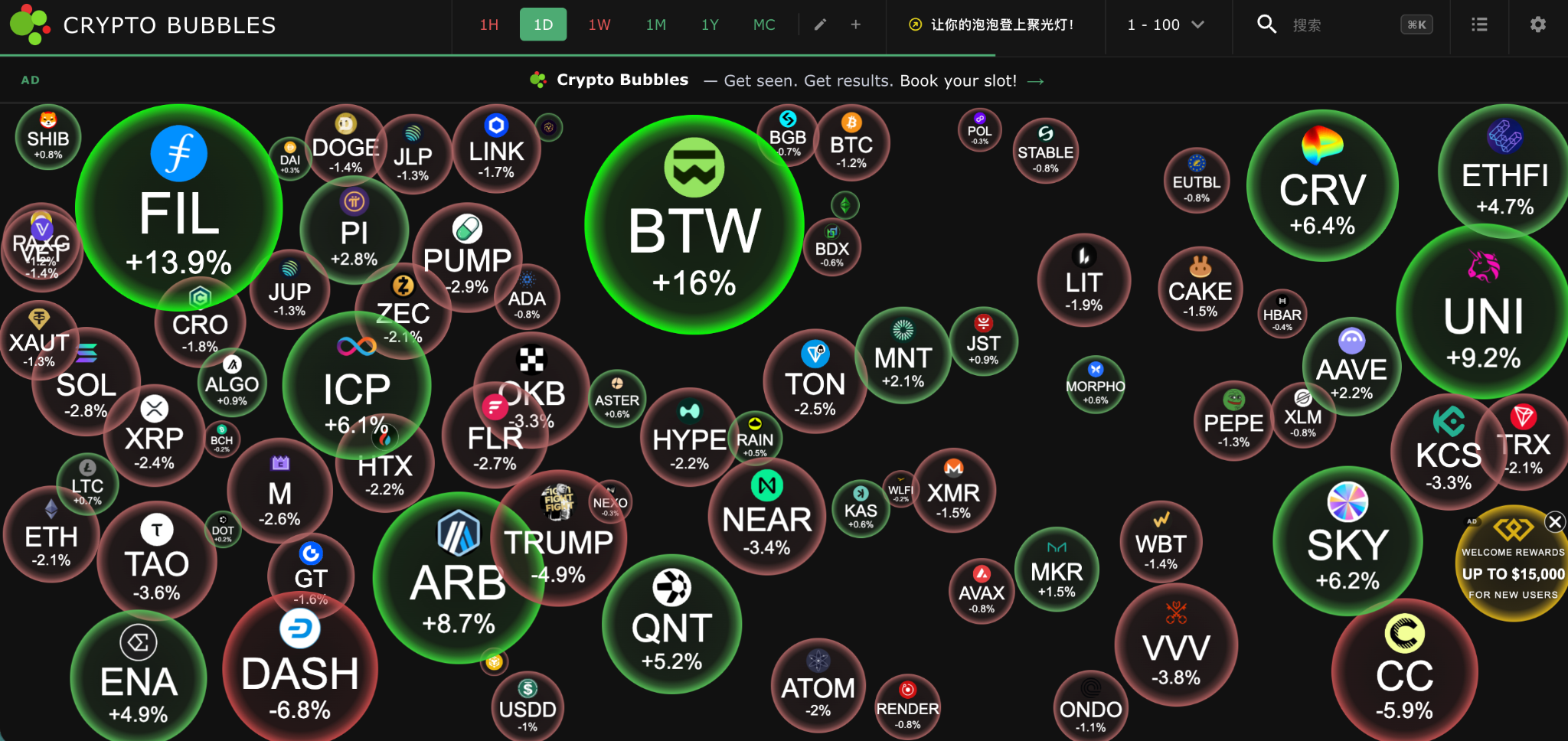
Today, the largest gains among the top 100 cryptocurrencies by market capitalization: BTW up 16%, FIL up 13.9%, UNI up 9.2%, ARB up 8.7%, SKY up 6.2%.
Stock index futures lower at the start, with night trading funds seeking a safety net from AI earnings

Affected by rising oil prices, bond yields, and the dollar, the three major US stock index futures fell across the board: Dow futures down 0.05%, Nasdaq 100 futures down 0.39%, and S&P 500 futures down 0.16%.
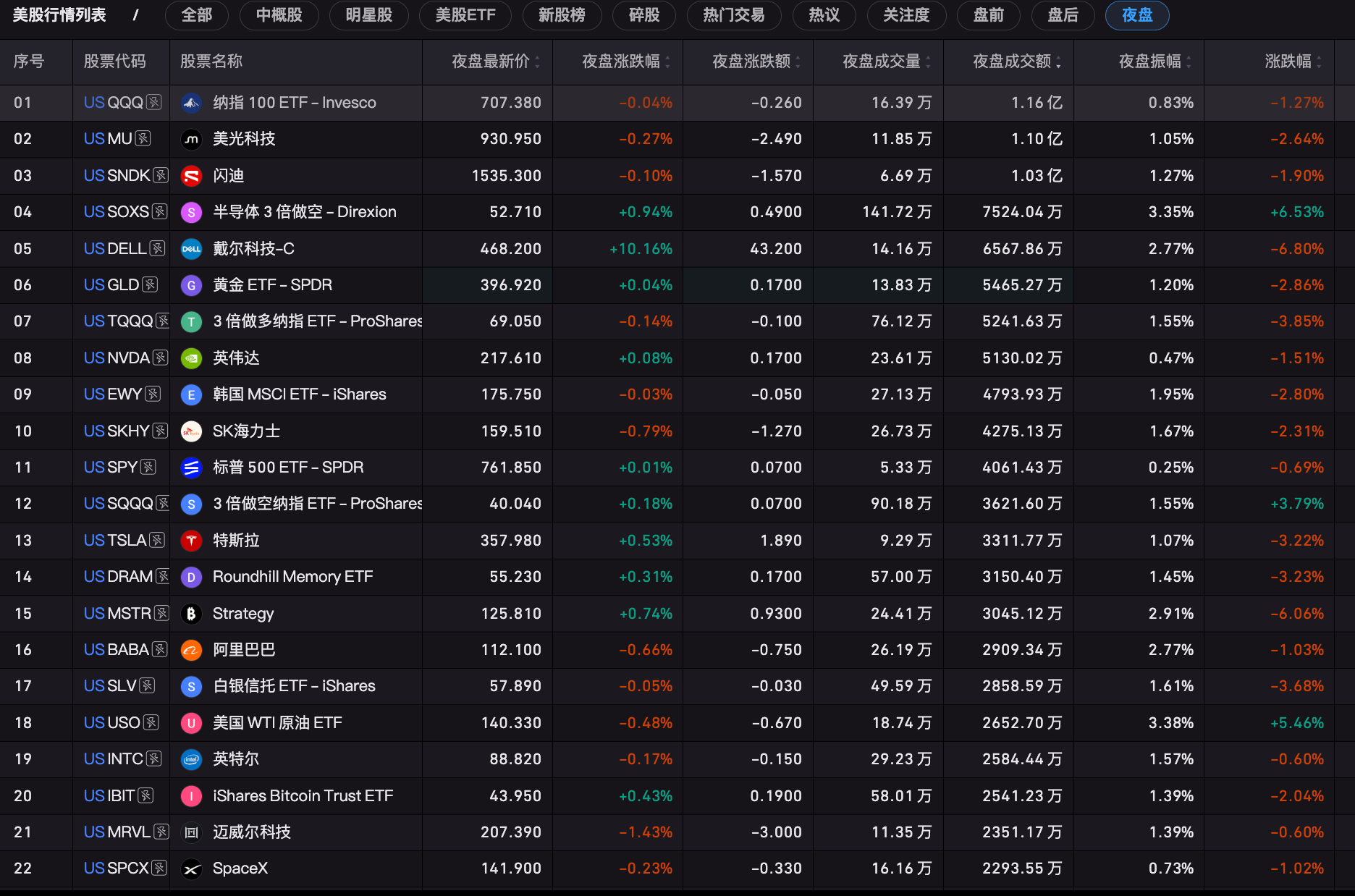
BIT night trading data shows that the AI hardware sector has become differentiated, with funds favoring stocks with high earnings realization, while the market remains cautious about the high valuations in semiconductors. Nvidia slightly rose 0.08% in nightly trading, Micron Technology fell 0.27%, SanDisk fell 0.10%, and Roundhill Memory ETF rose 0.31%; Marvell Technology fell 1.43%.
The standout of the night was Dell, soaring 10.16% as the company significantly raised its full-year revenue guidance to $192 billion, with second-quarter revenue of $47 billion, a year-over-year increase of 58%; AI server orders were $60.9 billion, with backorders of $95 billion.
Optical communication company Credo fell over 10%, with Q1 revenue of $479 million and a year-over-year increase of 114.7%. The adjusted EPS was $1.20, and all exceeded expectations. The company also stated that it expects optical business revenue for FY2027 to exceed $600 million, but the gross margin slightly decreased quarter-on-quarter, combined with the prior excessive rise in the optical communication sector, funds opted to realize profits.
Cloud database company MongoDB fell over 14% in night trading. Although its Q2 revenue increased 30.5% year-over-year and exceeded expectations, the core cloud database Atlas revenue of $566 million, a year-over-year increase of only 28.9%, did not meet "hidden expectations" and triggered profit taking.
Tesla slightly rose 0.53% in night trading as the market focuses on its Cybercab event on September 3.
Oil prices ignite, bond yields rise, AI long-duration assets face reassessment
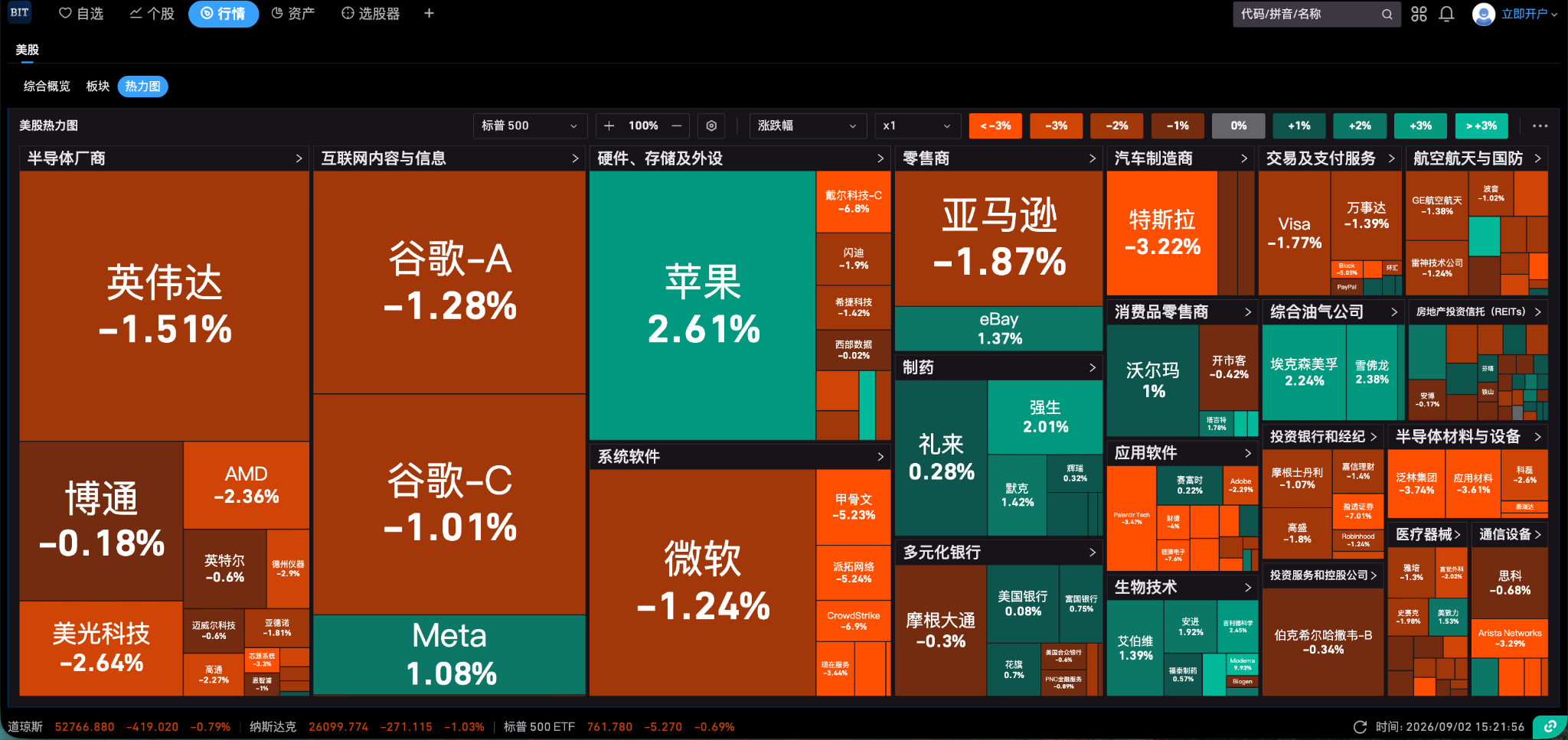
On the first trading day of September, the three major US indexes collectively closed lower, with the VIX rising 9.52% to 16.34, and market sentiment quickly shifted from "buying on dips" to "reducing risk exposure." Scott Rubner, Chief Equity and Derivatives Strategist at Citadel Securities, warned that September marks the onset of a "tactical downswing window" for US stocks and suggested reducing positions on rallies and buying protection at lower levels. He believes that favorable earnings reports have been realized, retail and buyback demand have entered a seasonal weakness, and the large expiration of options poses a risk as the cost of hedging remains low, leading to a deteriorating risk-reward ratio for chasing rallies.
What triggered the sell-off was the escalation of the US-Iran conflict, with market concerns that energy transportation through the Strait of Hormuz could be disrupted. WTI crude oil briefly exceeded $90 during the day, while Brent crude rose above $96. Ole Hansen, Senior Commodity Strategist at Saxo Bank, stated that the market is worried about a long-term disruption of energy flows through the Strait of Hormuz.
The bond market amplified risks, as the yield on the 10-year US Treasury bond rose above 4.81%, while the 30-year US bond yield briefly rose to 5.29%; the yield on Japan's 10-year bond has surpassed 3% for the first time in thirty years. Yields on long-term bonds in Germany, France, and the UK also rose in tandem. Global government bond yields have returned to mid-2008 levels, with the market repricing fiscal deficits, persistent inflation, and energy shocks. Federal Reserve Governor Michael Barr also stated that if inflation does not sufficiently slow down, the Fed should be prepared to raise interest rates.
High interest rates hurt technology stocks the most; the Philadelphia Semiconductor Index fell 2.10%, SOXX fell 2.10%; Nvidia fell 1.51%, AMD fell 2.36%, and Micron fell 2.64%. The software ETF IGV fell 3.46%, with ServiceNow, Snowflake, Palantir, and Adobe all declining. Oracle fell 5.27%, making it one of the most pressured companies among major tech stocks, as the market worries it has massively borrowed for AI infrastructure, with $43 billion in debt for fiscal year 2026, $55.66 billion in capital expenditures, and negative free cash flow of $23.7 billion.
Apple rose against the trend by 2.61%, as John Ternus took over as CEO from Cook, with the market betting on a new product cycle. In a letter to all employees, he stated that next week's iPhone launch will be "extraordinary," providing a rare positive catalyst in large tech stocks.
Energy stocks have become one of the few safe havens, with ExxonMobil rising 2.25%, Chevron rising 2.38%, and ConocoPhillips rising 2.79%; on the contrary, transportation stocks fell due to rising diesel prices pushing up costs, with FedEx down 1.91% and UPS down 0.80%.
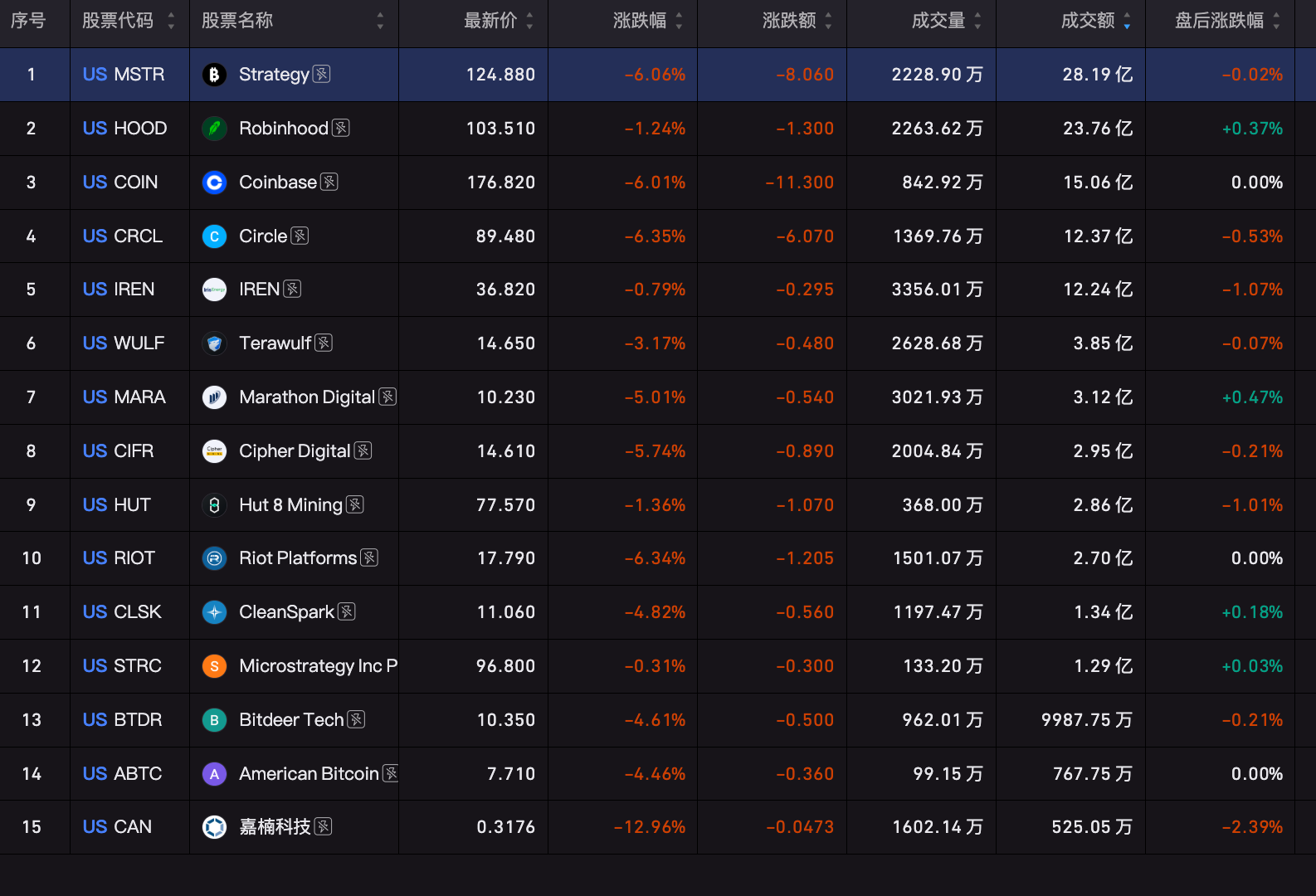
Cryptocurrency-related stocks collectively fell, with data from BIT US Stocks showing Circle down 6.35%, Strategy down 6.06%, Coinbase down 6.01%, and Robinhood down 1.24%.
Mining companies also generally declined, with Riot Platforms down 6.34%, MARA down 5.01%, Cipher Digital down 5.74%, CleanSpark down 4.82%, Bitdeer down 4.61%, American Bitcoin down 4.46%, Terawulf down 3.17%, Hut 8 down 1.36%, IREN down 0.79%, and Canaan Technology plunged 12.96%. CryptoSlate pointed out that Bitcoin's hash rate has not reached a new high for 316 days on a seven-day average, with some miners reallocating power resources towards AI and high-performance computing, making the recovery of mining stocks no longer solely dependent on Bitcoin's price rebound.
APAC faces pressure from global bond yields and oil prices, with Japan and South Korea leading declines
The Asia-Pacific market encountered a collective cooling of risk assets, with the escalation of the US-Iran conflict, soaring oil prices, and a global long bond sell-off putting triple pressure that hit Asian investors hard, first selling technology stocks, then exporting chains, and finally even heavy-weight blue chips could not escape.
The South Korean stock market suffered the heaviest losses, with the KOSPI index closing down 3.99%, hitting its lowest level since August 19 and marking the largest single-day decline in the past two weeks. Samsung Electronics fell 4.02%, SK Hynix fell 4.73%, LG Energy fell 5.31%, Hyundai Motor and Kia fell 5.62% and 5.18% respectively, with foreign capital net selling about 1.9 trillion Korean won in South Korean stocks.
Japan also faced dual pressure from long bonds and the yen, with the Nikkei 225 index closing down 2.9%, and the Topix index down 2.4%. SoftBank Group plummeted 6.42%, with Tokyo Electron decreasing by about 5%, and Nintendo falling 3.1%. Japan's 10-year Treasury yield rose to around 3.01%, the highest since 1996. Meanwhile, a member of the Bank of Japan's policy review committee, Takeda, released hawkish signals, stating that he does not rule out the possibility of significant and consecutive interest rate hikes, adding that the next rate hike may not just be 25 basis points, which once caused the yen to rise to 159.44. Tokyo short-term capital data shows that market bets on an interest rate hike by the Bank of Japan in September have risen to 97%.
Frederick Neumann, Chief Economist at HSBC, believes that the current situation in Asia resembles that of the 1997 financial crisis — high US Treasury yields, volatility in the yen, and an optimistic sentiment regarding technology; but the biggest difference is that Asia has shifted from a capital importer to a capital exporter. The real risk is not the financial fragility of 1997, but rather a "demand fragility" arising from reliance on US AI hardware demand. If high financing costs begin to suppress AI capital expenditures, economies such as South Korea, Japan, and Singapore may face backlash from declining export demands.
The A-share market also opened low and fell, with the Shanghai Composite Index down 0.97%, the Shenzhen Component Index down 1.88%, and the ChiNext Index down 2.39%, with over 3,900 stocks declining in the market. Military industry, gas, and liquid-cooling servers saw activity against the trend, while agriculture, pharmaceuticals, optical modules, and high-position tech stocks experienced significant corrections.
The Hong Kong stock market was similarly weak, with the Hang Seng Index down 0.07% and the Hang Seng Tech Index down 0.74%. Tech stocks generally fell, with Baidu, Kuaishou, NetEase, and Alibaba weakening; auto stocks faced pressure, with NIO down over 5% and Li Auto down nearly 5%; gold and lithium battery stocks also followed commodity drops. Biomedicine was active against the trend, with Zai Lab rising nearly 6%.
Next, attention should be focused on:
September 2 (Wednesday)
22:30 US EIA crude oil inventory, Strategic Petroleum Reserve inventory: Against the backdrop of escalating US-Iran conflicts and increased risks in the Strait of Hormuz, the importance of inventory data is amplified. If commercial inventories decline and SPR replenishment expectations increase, WTI and Brent may continue to receive support; if inventories unexpectedly accumulate, the risk premium for oil prices may retract. The SEMICON Taiwan International Semiconductor Exhibition will be held until September 4: The conference will focus on advanced packaging, HBM, semiconductor equipment and materials. If the industry chain releases signals of capacity expansion or technological breakthroughs, it will benefit advanced packaging, storage, equipment, materials, and the TSMC supply chain.
September 3 (Thursday)
02:00 The Federal Reserve releases the Beige Book: The Beige Book will provide frontline observations on employment, consumption, credit, real estate, and inflation. If the report shows that wages and service inflation remain sticky, it will strengthen the expectation of a September rate hike; if employment and consumption clearly cool down, the market may reassess the Fed's rate decision.
Broadcom's post-market earnings report, along with those of Keysight Technologies, Snowflake, NetApp, FuelCell Energy, C3.ai, ChargePoint: Broadcom is this week's key event in the AI hardware sector, with the market focusing on guidance for AI semiconductor revenues, custom AI accelerator orders, AI network chip demand, and client concentration; Keysight looks at AI server and enterprise hardware demand; Snowflake focuses on data cloud and AI application consumption; NetApp focuses on storage; C3.ai focuses on enterprise AI software; ChargePoint focuses on electric vehicle charging infrastructure.
20:30 Federal Reserve Governor Waller is interviewed: This is an important speech before the FOMC's quiet period. If Waller echoes Waller's hawkish stance, the probability of a rate hike in September may continue to rise; if he emphasizes employment risks, the market may lower rate hike pricing.
Tesla's Cybercab press conference: Tesla will unveil a Cybercab without a steering wheel or pedals in Austin. The market is focused on whether it will officially join the Robotaxi fleet, progress on commercialization licenses, production timelines, and unit economics; if the release exceeds expectations, Tesla, autonomous driving, sensors, in-car computing, and the Robotaxi concept will receive a boost.
The 2026 World Power Battery Conference will be held until September 4: Leading industry players such as Tesla, CATL, and BYD will attend and release development indices for the power battery industry. Significant advancements in all-solid-state batteries, fast charging, battery safety, and energy storage technology will affect the new energy vehicle, battery materials, equipment, and energy storage sectors.
September 4 (Friday)
DocuSign, Lululemon, Zscaler, Ciena, UiPath, Planet Labs, Ambarella, and others will release earnings: Zscaler focuses on cloud security demand, Ciena focuses on optical communication prosperity, DocuSign focuses on corporate software spending, Lululemon focuses on consumer resilience, and Ambarella focuses on edge AI and in-vehicle visual chips.
免责声明:本文章仅代表作者个人观点,不代表本平台的立场和观点。本文章仅供信息分享,不构成对任何人的任何投资建议。用户与作者之间的任何争议,与本平台无关。如网页中刊载的文章或图片涉及侵权,请提供相关的权利证明和身份证明发送邮件到support@aicoin.com,本平台相关工作人员将会进行核查。


