Author: Byron Gilliam
Translation: Shen Tide TechFlow
Shen Tide Introduction: Bitcoin supporters often refer to fractional reserve banking as a Ponzi scheme, arguing that when a run happens, even good banks will fail. However, a new study has analyzed a large number of bank runs and found that most ceased before threatening the bank. This presents a rebuttal that investors who view bank vulnerability as part of the crypto narrative must confront.
“You’ve got it completely wrong, as if I had money locked in a safe.” (George Bailey talking about fractional reserve banks)
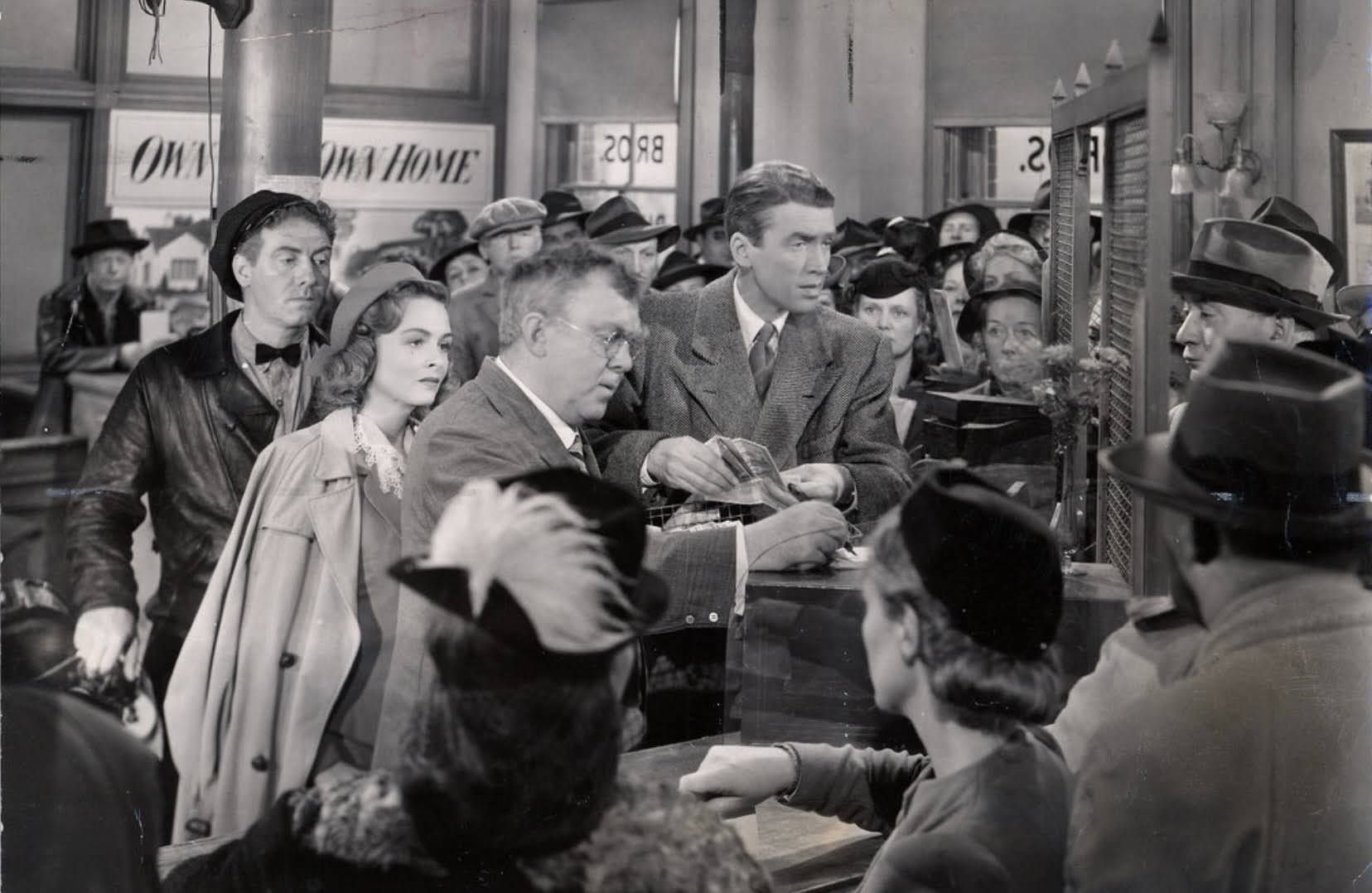
The fundamental promise of banking is that everyone can retrieve their money at any time, as long as they don't all try to withdraw at once.
This is what George Bailey taught us.
“You guys have got it completely wrong, as if I had money locked in a safe.” He told customers at the Bailey Brothers Building & Loan during the run. “The money isn’t here. Your money is in Joe’s house, right next to yours. It’s also with the Kennedy family, Mrs. Macklin, and with hundreds of other families.”
“You lent them the money to build their houses, and then they'll do their best to pay you back,” he explained.
The anxious customers did not immediately feel reassured. George had to produce his own $2,000 to stave off the run. Even so, the bank was not truly saved until the end of the movie: friends and customers donated enough to fill the $8,000 hole in the bank's balance sheet.
Austrian school economist Murray Rothbard would say let Bailey Bros. fail. “Fractional reserve banking is a fraud, a Ponzi scheme, deceit,” he once wrote.
He believed that banks can commit this fraud because bankers like George Bailey distort the way they can release so many loans.
“Because everyone is used to thinking that banks just take our money and lend it out,” Rothbard explained in a speech, “it’s hard to shift that mindset and realize that banks are actually engaged in legalized counterfeiting.”
In other words, if people truly understood how fractional reserve banking operates, with banks “creating money out of thin air”, everyone would want their money back at the same time. Even the best banks would fail.
This pessimistic view of banks seems to have academic support. Economists Douglas Diamond and Philip Dybvig wrote a classic study on the fragility of fractional reserve banks: “Bank Runs, Deposit Insurance, and Liquidity.”
This study formalized Rothbard's intuition: banks that finance long-term loans with demand deposits face the risk of being overwhelmed by runs even if their assets are healthy.
Thus, fears about bank failures can be self-fulfilling: “During a run, depositors withdraw their funds because they expect the bank to fail,” the authors explained. “In fact, sudden withdrawals can force a bank to sell many assets at a loss, ultimately leading to failure.”
“This may not necessarily relate to the bank's fundamental condition,” they added. Instead, “anything that makes [depositors] expect a run will trigger a run.”
“Even ‘healthy’ banks can fail.”
Diamond and Dybvig arrived at this troubling conclusion mainly relying on theoretical models based on mathematics and game theory.
A new study indicates that this model does not reflect reality.
Each bank run event, captured by a large language model from newspaper reports, has been documented on a website detailing why the run started and how it was resolved.
The surprising finding is that most runs fizzled out before threatening the bank. The authors found, “There are more runs that did not lead to bank failures than those that did.”
This contradicts the expectations of the Diamond-Dybvig self-fulfilling model.
Even among banks with very weak fundamentals, only 59% failed after experiencing a run.
I would guess Rothbard would expect this number to be 100%.
Meanwhile, banks with the strongest fundamentals “rarely failed,” even when faced with runs.
The authors’ conclusion? “This pattern raises doubts about a strong view: that liquidity issues alone can trigger severe financial distress.”
I think this is their polite way of saying that Diamond, Dybvig, Rothbard, gold believers, and Bitcoin believers are all wrong about fractional reserve banking.
Cases Piled High
Diamond and Dybvig were right about one thing at least: “The bank runs in our model are caused by shifts in expectations,” they noted, “and expectations can depend on nearly anything.”
I randomly flipped through the bank run database and found some excellent examples.
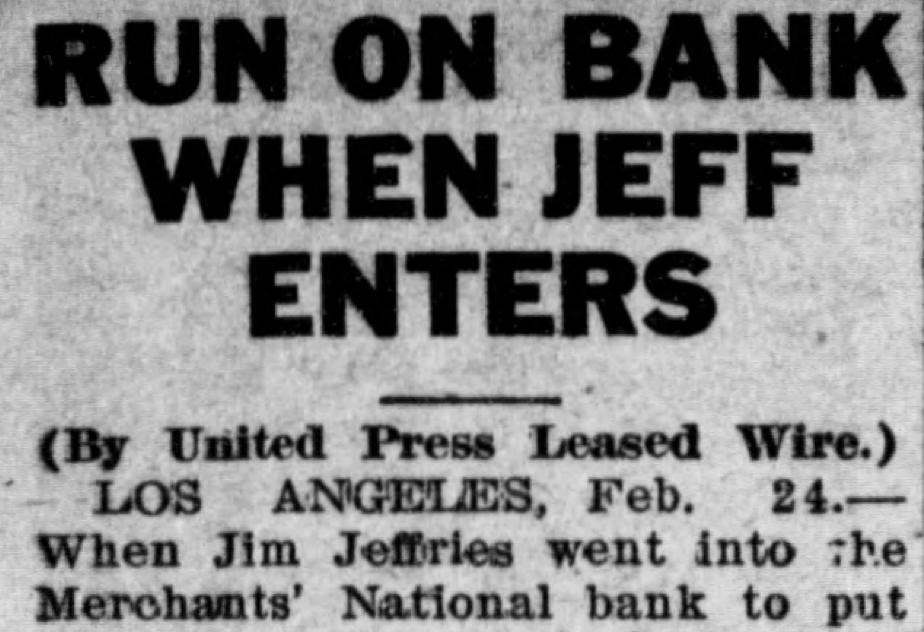
In 1910, a run occurred at the Merchants National Bank in Los Angeles because boxer Jim Jeffries visited the bank, attracting a crowd of boxing fans. The newspaper reported, “Dozens of depositors believed something was wrong and started to withdraw their deposits. It wasn’t until the fighter left that the frightened customers settled down.”
It turned out Jeffries was just opening an account and depositing part of his championship earnings.
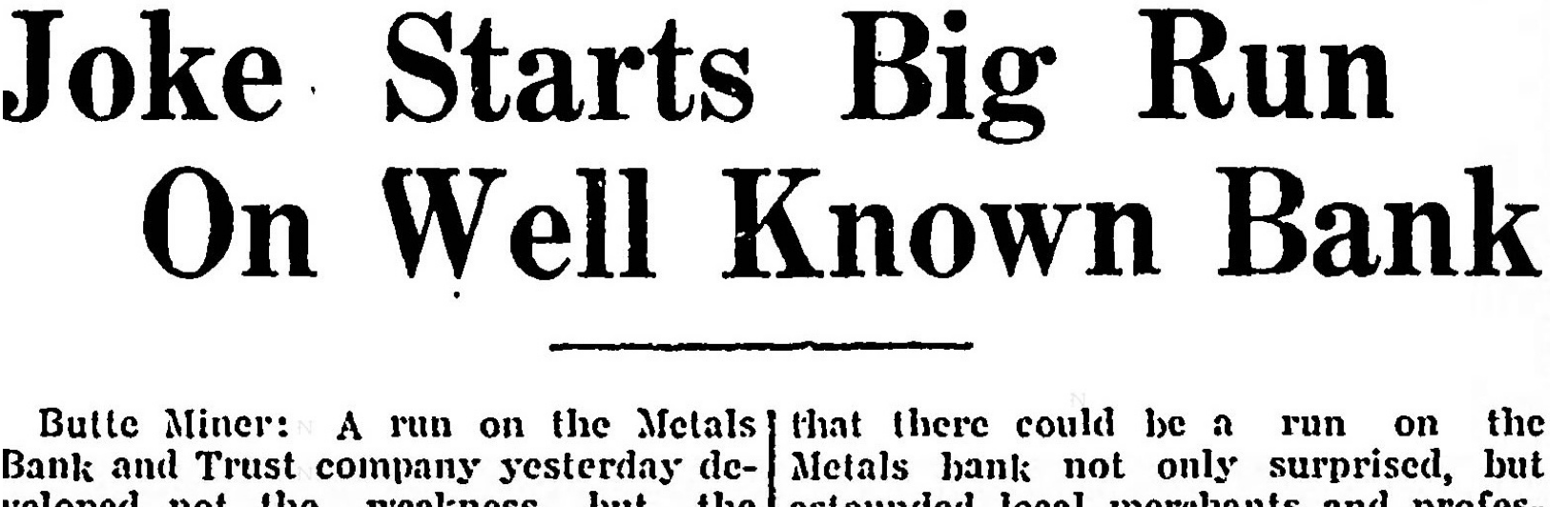
In 1924, a run occurred at the Metals Bank & Trust Company in Butte, Montana, due to someone hearing a joke bet that the bank wouldn’t open the next day. The newspaper reported that the bank continued to operate for four hours past normal closing time to accommodate withdrawals, “until it got dark and unsafe to continue paying depositors.”
The joke was that the bank would indeed close the next day because of Lincoln's birthday.
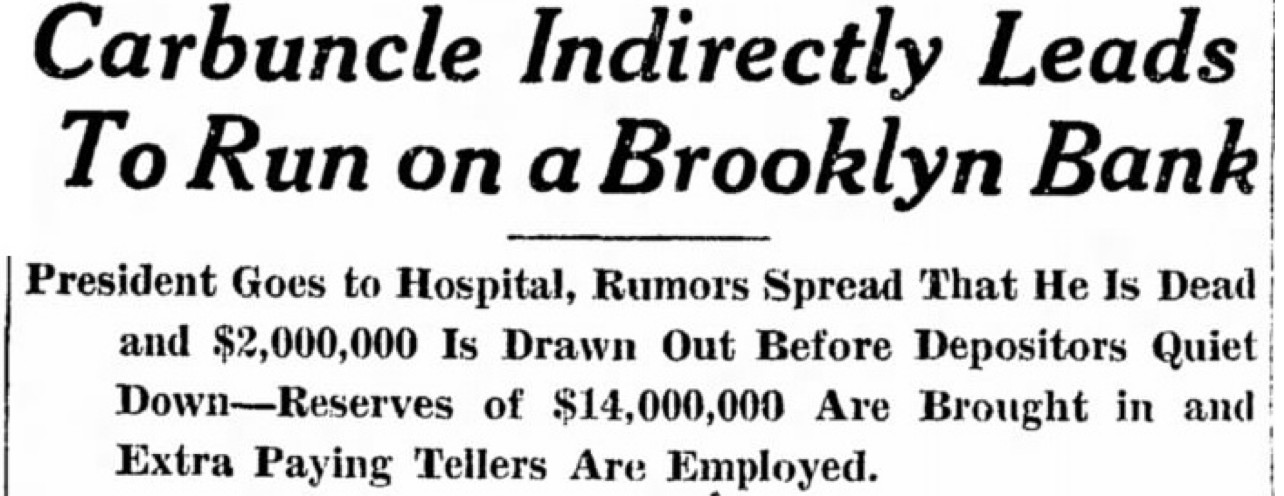
In 1929, a run happened at the Bay Ridge Savings Bank in Brooklyn, New York, prompted by rumors that the president had died. Fortunately, the newspaper reported that the bank “had learned of this false rumor in advance,” allowing time to prepare $14 million in cash to handle withdrawals.
The truth was the president was in Connecticut having a boil removed from his neck. (He survived the surgery.)
Once again, this is just a random sampling from the database.
But the peaceful resolutions of these runs seem to contradict the strongest interpretation of the Diamond-Dybvig theory: it turns out that bank runs are rarely self-fulfilling.
However, sometimes they do occur.
In 1930, a run broke out at the Independence State Bank in Chicago, triggered by a fight outside the two doors of the bank. The newspaper reported, “A police patrol car responded to a restaurant’s call, stopping in front of the bank, sparking rumors that the bank was being run on.” Somehow, over $1.6 million was withdrawn from the bank’s $5.6 million in deposits, which surely depleted the bank’s liquid assets, prompting state officials to feel the need to close it.
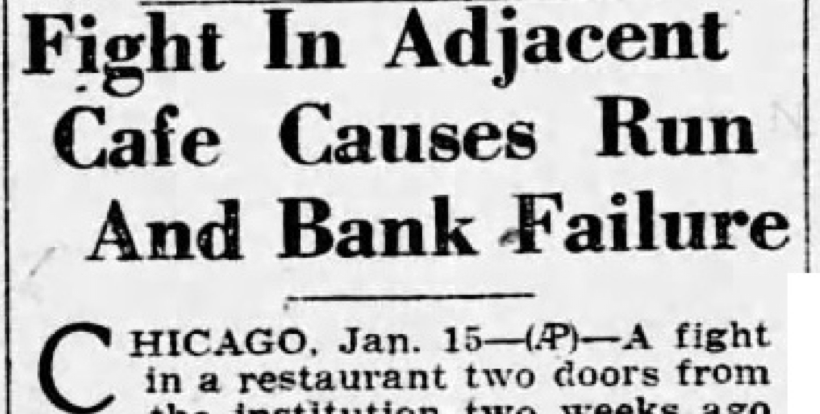
The Bank Runs website did not indicate whether the Independence Bank had a fundamentally stable balance sheet. But the authors' research suggests that if it were indeed stable, the bank would almost certainly have survived.
In many cases, weathering a run only required publicly displaying cash.
For instance, a run in 1907 was halted by “dramatically displaying large amounts of cash and currency at the counter for depositors to see.”
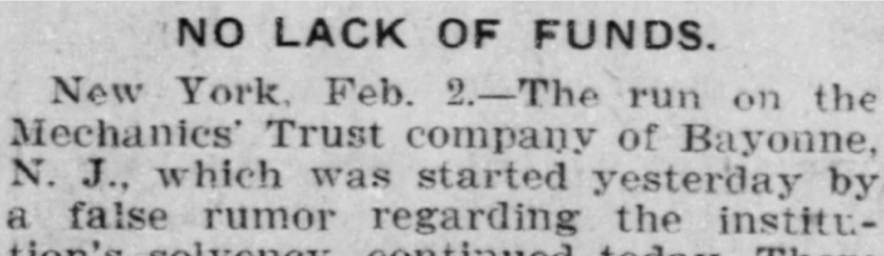
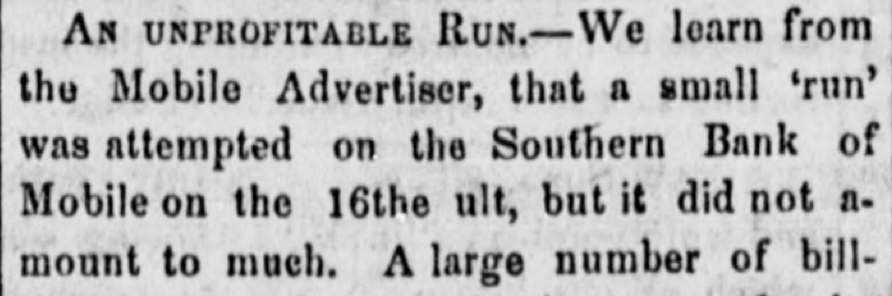
In 1857, a “profitless run” at a bank in Alabama was stopped because depositors saw a high pile of “a golden marakoff and a silver ladin” on the cashier's desk. (Marakoff and ladin were famous Russian fortresses.)
In 1924, a manager of a bank in Brooklyn halted a run by stacking bills in denominations up to $1,000 in front of the bank window, “carelessly stacked into a big pile”, for everyone to see.
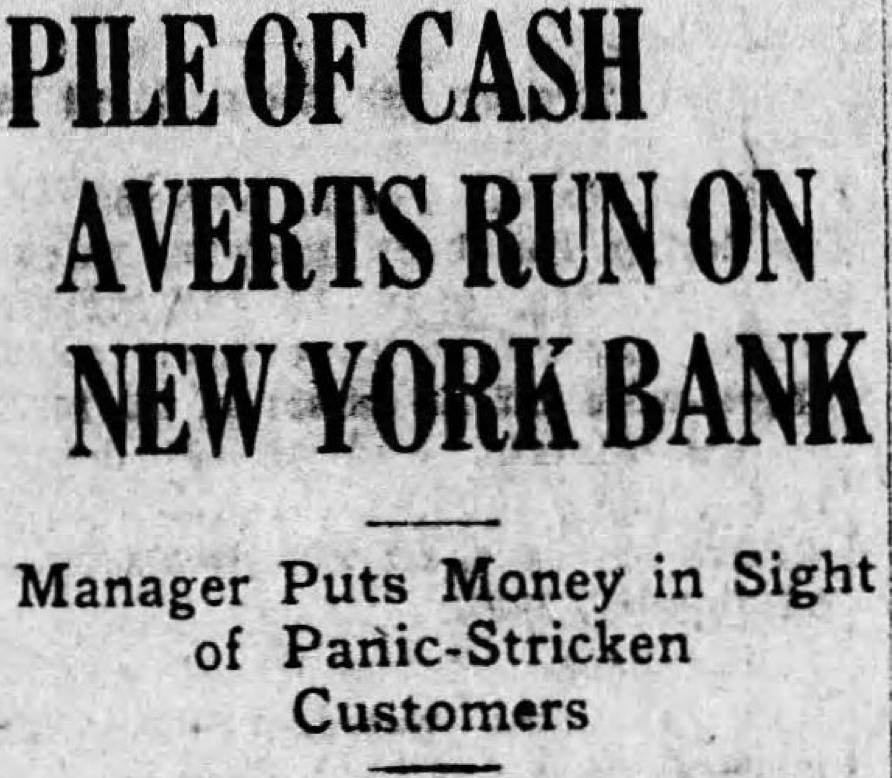
Do bank customers understand that no matter how high the cash piles are, if everyone wants to withdraw money at the same time, it won’t be enough to pay everyone?
I guess they understand.
(Byron Gilliam)
免责声明:本文章仅代表作者个人观点,不代表本平台的立场和观点。本文章仅供信息分享,不构成对任何人的任何投资建议。用户与作者之间的任何争议,与本平台无关。如网页中刊载的文章或图片涉及侵权,请提供相关的权利证明和身份证明发送邮件到support@aicoin.com,本平台相关工作人员将会进行核查。


