OriginalAlex Xu AlexAlex's Research and Investment Memo
In my personal experience of the crypto cycles (2016-2026), each round of cycles will have its own meme position.
However, in the past few rounds of vigorous bull markets, the presence of memes has varied significantly; my personal feeling is:
2016-2018 Bull Market: Relatively thin presence; I can hardly recall any meme assets from that round except for Doge (it may also be that time was too far ago).
2020-2022 Bull Market: Presence has increased somewhat, but still not at the center of the stage (the original Doge, the rising Shiba performed remarkably, in 4-5 months before the crash on May 19, 2021, meme concepts thrived).
2023-2025 Bull Market: The true center position, heat and presence time greatly extended, with a rich variety of variants emerging (from the earliest Bitcoin inscription type meme to political memes, cult memes, social media memes, presidential-level memes, and then AI agent memes).
The question worth pondering and answering is: what determines the presence and cognitive share of memes in each round of crypto bull market cycles?
This question will affect how we choose investment narratives in the entire crypto bull market, specifically: should we continue to over-allocate to memes in terms of energy and funds in this round of the bull market?
From the examples of meme types above, it can be seen that my definition of memes is quite generalized. For instance, inscription assets and AI launch pad projects based on agents are all included in the category of memes.
Because in my definition, crypto assets can roughly be divided into business/production type assets and meme type assets:
When what everyone focuses on and trades is primarily its business side, such as the pmf of a protocol's product, AUM, revenue capacity, and token buyback and destruction, that asset approaches the business/production type asset. These types of assets can be driven by various narratives in the short term, but ultimately the question to answer is: what is my profit-generating ability/token return ability? This is similar to most listed companies;
When what people trade is primarily the consensus side of the asset, which is the scope of propagation and understanding of the asset, as well as the strength of recognition from investors and potential investors, this type of asset approaches meme assets. From this angle, consensus is the "fundamentals" of meme assets.
In this seemingly binary classification scheme, there are also some gray areas, such as the numerous AI agent projects based on Virtual and ai16z emerging in 2025 (can you still remember the web3 virtual idol Luna singing and dancing live? And the web3 research AI chatbot aixbt?).
Most of these projects are born with a business-type positioning, but early on they are driven more by narrative consensus. Ultimately, by the time they phase out, they are still far from real pmf and meaningful revenue scale, so in my definition, they are closer to memes than business-type projects.
Another type of marker is meme launch pads, such as pumps and pons; they belong to meme infrastructure but essentially are business-type projects. However, the participation heat of memes is their core business metric, determining their valuation level.
Returning to the key question raised earlier, what determines the positioning and weight of memes in each cycle? Under what circumstances will memes become the main storyline of the market?
I believe the core factor is mainly: the supply and quality of business/production-type assets during the cycle.
When the narrative of business-type assets in the cycle explodes + business development is smooth, it will become the main flow of speculative funds in the crypto field.When business-type projects decline, there is a lack of quality product innovation, and business data is generally weak, crypto funds will choose to flow into meme asset categories unrelated to traditional fundamentals.
Because the fomo sentiment and the desire for wealth gain always resurrect with the cycle; the funds and emotions brought by the bull market must have a destination.
This is also why memes have had such different presences in several past cycles:
2016-2018 Bull Market: The explosion year of smart contracts/public chains, the cycle with the most explosive narrative and imagination, the narrative and future business imagination space of public chains were large enough that even traditional VCs went crazy for it, swallowing almost all speculative funds;
2020-2022 Bull Market: The year of blockchain applications, narrative still of high quality, DeFi, NFT, and GameFi took turns making appearances, the concept of web3 became popular worldwide, and there were observable leaps in business data (TVL, transaction volume, fees, active address counts, and crazy APRs). The amount of funds attracted to the industry further increased, but under the influence of celebrities like Musk and Vitalik (whose address was hit by coin dropping), memes began to take on excess funds;
2023-2025 Bull Market: The most sluggish round of blockchain business-type narrative and business, most product innovations from the previous round were debunked, and there were no strictly new products; conversely, while the speed of funds flowing into the industry is far less than in the previous two rounds, the existing funds are still considerable, with most flowing into memes.
So, what are the background conditions determining the positioning of memes in this seemingly gradually unfolding bull market cycle?
Currently, it seems that many conditions are similar to the previous cycle, namely:
1. Quality business-type narratives (business models that make sense) are still scarce; most of the few (RWA, prediction markets) are controlled by non-token issuing companies or public companies, and there are not many good secondary token carriers (mainly Ondo, but the value of tokens has not yet been captured);
2. Fomo and the desire for sudden wealth are unextinguished; all casinos throughout the ages have players visiting.
So, unless a batch of quality business-type projects emerges again at some stage, memes are still likely to be the main storyline of this bull market (if not the only one).
But does this mean investors should over-allocate to memes this round? Not necessarily.
This round has two new points that will increase the difficulty of speculation and survival for memes:
The supply side of memes is very abundant: after the last cycle, the meme issuance assembly line and harvesting process have become highly industrialized, and the supply side is more sufficient, even close to infinite.
The demand side mentality is shortsighted and weak: after repeated harvests of various narratives in the last round, the foundational investors with sufficient belief in memes have significantly decreased.(Do you remember last round when Murad advocated the meme supercycle?) The consensus of memes is essentially a form of collective funding, and changes in mentality can lead to weakened solidarity, causing the market cap limit and median lifespan of memes to decline.
More importantly, the shortsighted mentality on the demand side and the caution in solidarity would, in turn, cause the supply side (the devs) to close nets faster, creating a self-reinforcing process; this is also the most concerning situation for meme launch pad projects.
In fact, even at the start of the last round of this meme supercycle (January 2024), over-allocating to memes led to the meme sector returns still being in the middle range of the crypto sector, remaining negative, and clearly lagging behind BTC:
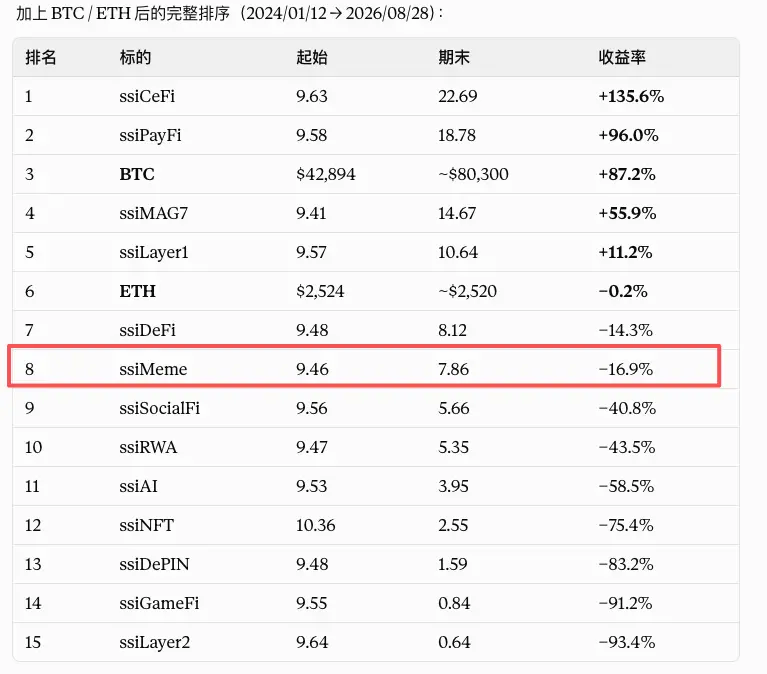
Note: Based on the Sosovalue crypto track index; the index statistical logic is the top ten assets in that track (monthly updates) and market cap weighting (refreshed at five-minute intervals).
It is worth noting that this index measures only the top market cap memes, which have a large gap from the actual operations of early on-chain meme dog users; the death rate and volatility (including upward volatility) of early on-chain memes are much higher than that of top memes. Although there are no reliable statistics, I believe that it is probably a curve with a worse periodic return.
Having discussed the challenges of speculation in memes this round, let’s talk about the marginal positive points compared to the last round:
The main one is Robinhood, a new player, and its net inflow of users and funds on-chain.
Of course, currently, how many of Robinhood's on-chain users are traditional brokerage app investors is still likely to be a low percentage, but if Robinhood's memes continue to be hot, users who have been beaten down in semiconductor stocks may consider trying their luck here.
Additionally, Robinhood still has some cards to play, such as launching powerful memes and meme launch pads on its main site, which has the ability to fuel on-chain heat.
However, if these cards are played too early, it may lead to a lack of subsequent imagination; thus, keeping them hidden in the short term would give greater deterrence to bears.
Now let’s look at what new narratives exist in the meme market.
As mentioned earlier, memes are a generalized asset class; just in the last round, in a span of just over two years, they went through inscriptions, political memes, cult/retro internet culture, social media, trending figures (Trump), and then iterated multiple times to AI agents.
Among the current categories of memes, the bull market can be easily understood as a Chinese meme, while a relatively new one is coin-share themed memes on Robinhood, also known as stock memes. The key points of these memes include:
1. Coupling with listed company stocks: If there’s Nvidia (NVDA), there’s AI (Artificial Inu), which can be freely created.
2. Pairing with on-chain RWA coin-share based on Uniswap's AMM liquidity pools.
3. Based on the above mechanism, the creators of stock memes have various custom methods for the attribution and processing of fees generated from trading, such as being used for repurchasing and destroying stock memes, or distributing to holders of stock memes.
Based on the above mechanisms, a recent narrative that has emerged in the market is: “Coin-share memes are cornering Wall Street.”
In specific procedural terms: enthusiastic meme traders buy stock memes on-chain because the on-chain liquidity of stock memes mainly comes from pairing with coin-shares; thus, when users buy stock memes using stablecoins or ETH, they need to first route through buying the paired coin-share, creating one-sided upward pressure on coin-shares. If there are difficulties in minting coin-shares on-chain due to weekends or other reasons, and the total on-chain supply is small, unable to stabilize the on-chain price relative to the normal prices in the stock market, it may lead to short-term surge in on-chain coin-share prices by several times.
Recently, the situation with Boner (stock meme) - HIMS (coin-share) on Robinhood reflects this dynamic.
Considering that HIMS itself has a significant short position in the stock market, the narrative of “on-chain financial counterattack against Wall Street” or even “cornering Wall Street” thus takes shape.
So how is the quality of this kind of meme narrative?
Generally speaking, it’s weak.
A good meme narrative requires a solid storytelling logic and appeal, strong virality, and a good ability to resist refutation.
Firstly, the short-term surge of HIMS coin-share comes from the disruption of the on-chain minting mechanism on Robinhood, thus this narrative is logically weak and easily refutable (the minting/destroying depth of coins on Ondo is better, and the HIMS provided by it did not experience significant fluctuations that day).
Secondly, “cornering Wall Street” is an old refrain without much novelty, filled with traces of artificial orchestration, and lacking the original sports target – the first appearance of 2021’s GameStop – where community-driven fermentation brought appeal and organic self-propagation.
Additionally, the narrative templates for stock memes are also rapidly replicating, with projects like SAYLORMOON emerging quickly.
At the end of the article, I’d like to talk about what kind of investors are suitable for memes.
Whether it's investment or speculation, the core of the former is to assess the long-term intrinsic value of assets, while the core of the latter is to predict short-term capital voting; despite the differences in methods and focus, there is a commonality between them: People who are skilled and focused on this field often win money from those who are not focused or proficient.
Based on my observations of excellent meme players around me, they often possess several or all of the following advantages:
1. Energetic, active-minded, passionate about trading itself.
2. Imaginative, highly sensitive to narratives.
3. Steady and sustained presence on the frontlines/on-chain; very sensitive to market temperature and directional shifts.
4. A relatively closed, high-cognition practical small circle with shared targets and frequent dense communication.
5. They have formed a relatively systematic speculative framework and have the ability to quickly patch and even iterate overall.
*Another important plus:
If you are a KOL with sufficient downstream subscribers, you have the ability to diffuse narratives, accelerate consensus building, and attract solidarity for some smaller, earlier memes, helping small projects cross the crucial stage from death to life. If you also have a network connecting to other KOLs, you can unite to amplify this ability.
In the realm of value investment, however, some of the above advantages become ineffective or even counterproductive, as their behavior patterns include:
1. Low trading frequency and fewer trades.
2. Unwilling to pay for assets’ imaginative narratives and story premiums.
3. Keep away from Mr. Market, not closely following fluctuations and market quotes, actively isolating from public emotions.
This is why value investing and market speculation are very difficult to coexist in the same person, as the core attributes required are clearly mutually exclusive.
It’s hard to imagine a person actively buying into the grand vision and story of asset A and then becoming cautious and conservative about asset B, only believing in thoroughly evidenced logic.
But in any case, whether for speculation or investment, it is essential to base actions on sufficient self-awareness, avoiding investment paths incompatible with one’s attributes and nature, while maximizing strengths and avoiding weaknesses, is also a form of investment “not making unnecessary difficulties.”
This is just one opinion, for reference only.
I wish everyone a successful hunt in this bull market cycle.
免责声明:本文章仅代表作者个人观点,不代表本平台的立场和观点。本文章仅供信息分享,不构成对任何人的任何投资建议。用户与作者之间的任何争议,与本平台无关。如网页中刊载的文章或图片涉及侵权,请提供相关的权利证明和身份证明发送邮件到support@aicoin.com,本平台相关工作人员将会进行核查。


