
Author: Jae, PANews
For a long time, the governance tokens of numerous crypto projects have been criticized by the market as "air tokens" that lack effective value capture mechanisms and are detached from the fundamentals. Now, as on-chain protocols gradually reveal their genuine profitability, crypto assets are beginning to undergo a structural reform in token economics.
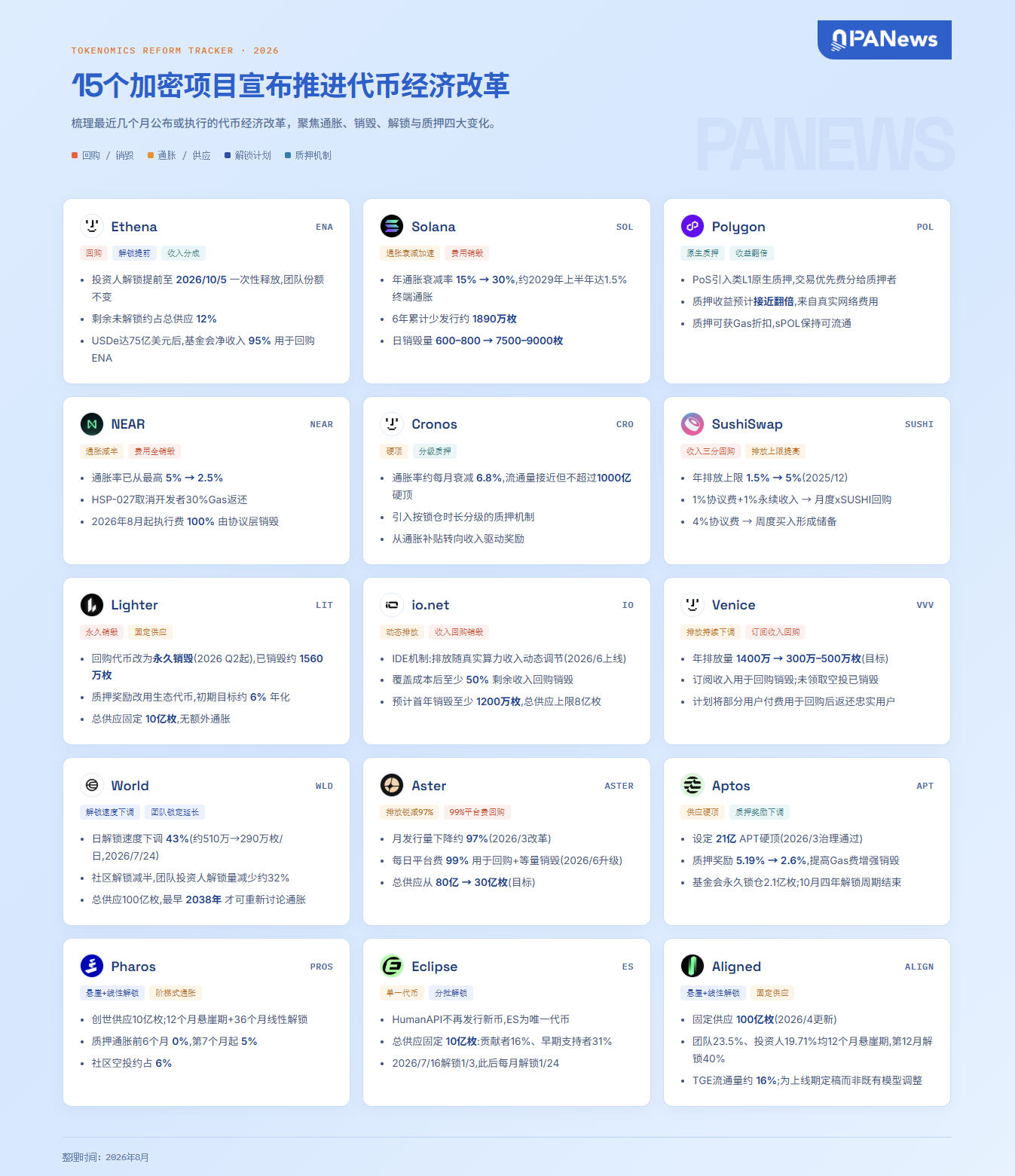
According to PANews statistics, 15 mainstream crypto projects like Ethena, Solana, and Polygon are rewriting their token economic models. From reducing inflation, repurchase and destruction, to adjusting unlock rhythms and upgrading staking mechanisms, project teams are starting to redesign the supply and demand logic of tokens and the mechanisms for capturing value.
Meanwhile, another set of figures reflects this trend more intuitively: According to Allium Labs, as of the end of August, the token repurchase amount by crypto projects has approached $640 million this year, far exceeding the $545 million during the same period last year, with only $366,000 for the entire year of 2024.
This means that the reform in token economics is shifting from "how to issue more tokens" to "how to reduce supply, create real demand, and establish a more direct connection between protocol revenue and token value."
The reforms of 15 projects converge into four main lines
According to PANews statistics, in recent months, 15 well-known projects covering public chains, DeFi, AI, and DePIN tracks have launched adjustment plans for token economics through community proposals and governance votes. Their reform initiatives mainly extend towards four paths: reducing inflation, repurchasing and destroying tokens, optimizing unlocks, and empowering staking, reflecting the strategic differentiation of different types of projects in value capture mechanisms.
Public Chain Level: Press Down Inflation, Set Hard Caps
Public chains represented by Solana, NEAR, and Aptos focus on controlling supply and ending inflation subsidies.
Solana, through the SIMD-550 governance proposal, has doubled the annual inflation decay rate to 30%, accelerating towards a terminal inflation rate of 1.5%, and is expected to reduce the issuance of nearly 18.9 million SOL in the next six years;
NEAR has halved its inflation cap to 2.5% and canceled the Gas subsidies returned to developers, achieving the rigid cancellation of full execution fees at the protocol level;
Aptos has set a hard cap on supply to alleviate market negative expectations of "continuous large dilution."
This signifies that underlying infrastructure is transitioning from expansion reliant on increased issuance and subsidies to balancing supply and demand through genuine on-chain demand.
Application Layer: Cash Flow Reinvestment
Vertical applications represented by Lighter, Aster, io.net, Venice, and SushiSwap aim to integrate protocol revenue into the token supply and demand curve.
Lighter and Aster convert most platform transaction fees into secondary market buybacks and destruction to alleviate the inflation problem of tokens;
io.net and Venice have pioneered off-chain revenue reinvestment: io.net has launched a dynamic release mechanism linked to actual computing power revenue, repurchasing and destroying over 50% of the surplus after deducting operational costs; Venice has invested part of its AI inference subscription fees into buybacks, exploring how to transform off-chain cash flow into token value;
SushiSwap has restructured its fee distribution matrix, splitting part of the protocol fees and perpetual contract income into secondary market repurchases and operational treasury reserves, balancing short-term buy support and long-term capital.
Their adjustment approach is to liberate tokens from being governance certificates to becoming value carriers that can share in business growth.
Unlocking Side: Chip Disassembly + Smoothing Curve
In response to the structural selling pressure from early chips, projects have adopted unique unlocking restructuring strategies.
Ethena chose "short pain over long pain": It decided to release the remaining investor shares in one go on October 5 this year, while keeping the team’s shares unchanged; meanwhile, it set a plan to initiate a 95% net income buyback upon reaching a USDe target scale of $7.5 billion, aiming to eliminate the long-term monthly unlock's downward expectations in one go;
Related Reading: Buying Back Chips and Starting Repurchases: How Should Ethena Play Its “Value Return” Card?
World opted to trade time for space: It reduced the daily token release speed by 43%, postponing the inflation issue until 2038, mitigating market shocks with slower release rates;
New projects like Aligned and Pharos have avoided risks at the source: They established a cliff lock period of up to 12 months during the TGE initial phase and phased step unlocks, compressing staking inflation to zero during the cold start period to avoid sell-offs during insufficient liquidity.
Staking Side: From Inflation Subsidy Issuance to Real Revenue Iteration
Polygon and Cronos will reconstruct their staking systems, aiming to switch the source of staking yield from inflation issuance to real business income.
Polygon will introduce a native staking mechanism in its PoS architecture, allocating part of the priority fees from network transactions to stakers, with staking rewards supported by the network's actual throughput instead of inflation subsidies, while also combining sPOL to release liquidity.
Cronos will introduce a tiered staking weight that is forcibly linked to the lock-in period, switching the source of incentives to ecological business revenue, guiding long-term capital retention and suppressing floating tokens in the secondary market.
"Dual Oligopoly" Becomes Buyback Main Force, but Buyback Does Not Equal Price Increase
It is worth noting that more than half of the 15 projects involved token buybacks or destruction, which are becoming widely adopted adjustment measures.
This year's dramatic increase in buybacks in the crypto field also indicates that mainstream decentralized protocols are systematically borrowing capital allocation logic from traditional stock markets, enhancing the economic value of tokens per unit through profit buybacks and supply cancellations. Projects with ample cash flow attempt to provide buy support for their protocol tokens through protocol revenue buybacks.
From the market structure perspective, the two major protocols, Hyperliquid and pump.fun, account for nearly 90% of the buyback volume of crypto projects.
Hyperliquid is particularly aggressive: About 99% of its protocol fees are used to repurchase and permanently destroy HYPE through the Assistance Fund. As of now, the cumulative buyback amount of the Assistance Fund is about $1.1 to $1.3 billion, accounting for 4.7% of the total token supply, and the price of HYPE has frequently set new highs, breaking above $80; pump.fun uses 50% of its revenue for buybacks, having cumulatively destroyed about $445 million, accounting for 16.35% of the total token supply, with the current market price of PUMP basically remaining flat since the buyback was initiated.
Bitwise CIO Matt Hougan stated that the whole crypto market is undergoing an "income revolution." He emphasized that the major obstacle for traditional mainstream capital to allocate crypto assets on a large scale has long been that tokens cannot generate measurable cash flow returns, and when protocols like Hyperliquid and Uniswap establish mechanisms linking network prosperity with token deflation, token holders will be able to substantively share in the growth dividends of the protocols.
From the market performance perspective, the buyback mechanisms have indeed produced noticeable positive cases, but buybacks themselves are not a sufficient condition for determining token prices.
As of now, protocols executing buybacks like Chainlink, Jupiter, and Layerzero have seen their token prices decline by about 50%, 70%, and 45%, respectively, compared to when buybacks started. Hyperliquid's uniqueness lies in the fact that while it repurchases tokens, the protocol also maintains growth, forming a positive flywheel, rather than simply "using money to prop up the market."
Allium Labs research director Elton Shehdula pointed out that while buyback activities can reduce circulation and create buy support, they cannot replace the organic growth of protocol revenues, nor can they guarantee the long-term appreciation of tokens.
In contrast, even if Chainlink and Jupiter execute buybacks, if business growth slows or the competitive landscape deteriorates, token prices will still continue to decline.
The Reform of Token Economics is Transitioning from "Designing a Set of Rules" to "Designing a Business"
This round of reform is essentially an attempt by crypto projects to reposition the role of tokens within their business models. In the past, tokens were tools for fundraising, growth incentives, and governance certificates; today, an increasing number of projects are trying to make them value-bearing tools for protocol income.
However, the problems are equally significant: If a project cannot generate stable cash flow, the effect of buybacks could remain merely at the level of expectations. Deflation does not equal value growth; if users, transaction volumes, and revenue continue to decline, even if token supply is reduced, token prices may still weaken.
In the future, the criteria for judging token economic models may shift from "how much to issue, how much to unlock, how much APY" to indicators like "how much income, how much distribution, how much buyback, how much net issuance, and whether it is sustainable."
The phenomenon of Hyperliquid and pump.fun contributing nearly 90% of buybacks actually also reminds the market that the so-called "value capture transformation" is still highly concentrated, with the vast majority of projects yet to establish a link between revenue and token value.
Ultimately, every reform of a token economic model must face the same question: Does the increase in token price come from reduced supply or a larger cake?
免责声明:本文章仅代表作者个人观点,不代表本平台的立场和观点。本文章仅供信息分享,不构成对任何人的任何投资建议。用户与作者之间的任何争议,与本平台无关。如网页中刊载的文章或图片涉及侵权,请提供相关的权利证明和身份证明发送邮件到support@aicoin.com,本平台相关工作人员将会进行核查。


